Star Cluster · Deep guide
Messier 75
Also called: M75 · NGC 6864
One of the most tightly packed globular clusters, on the far side of the galaxy's centre.
What is it?
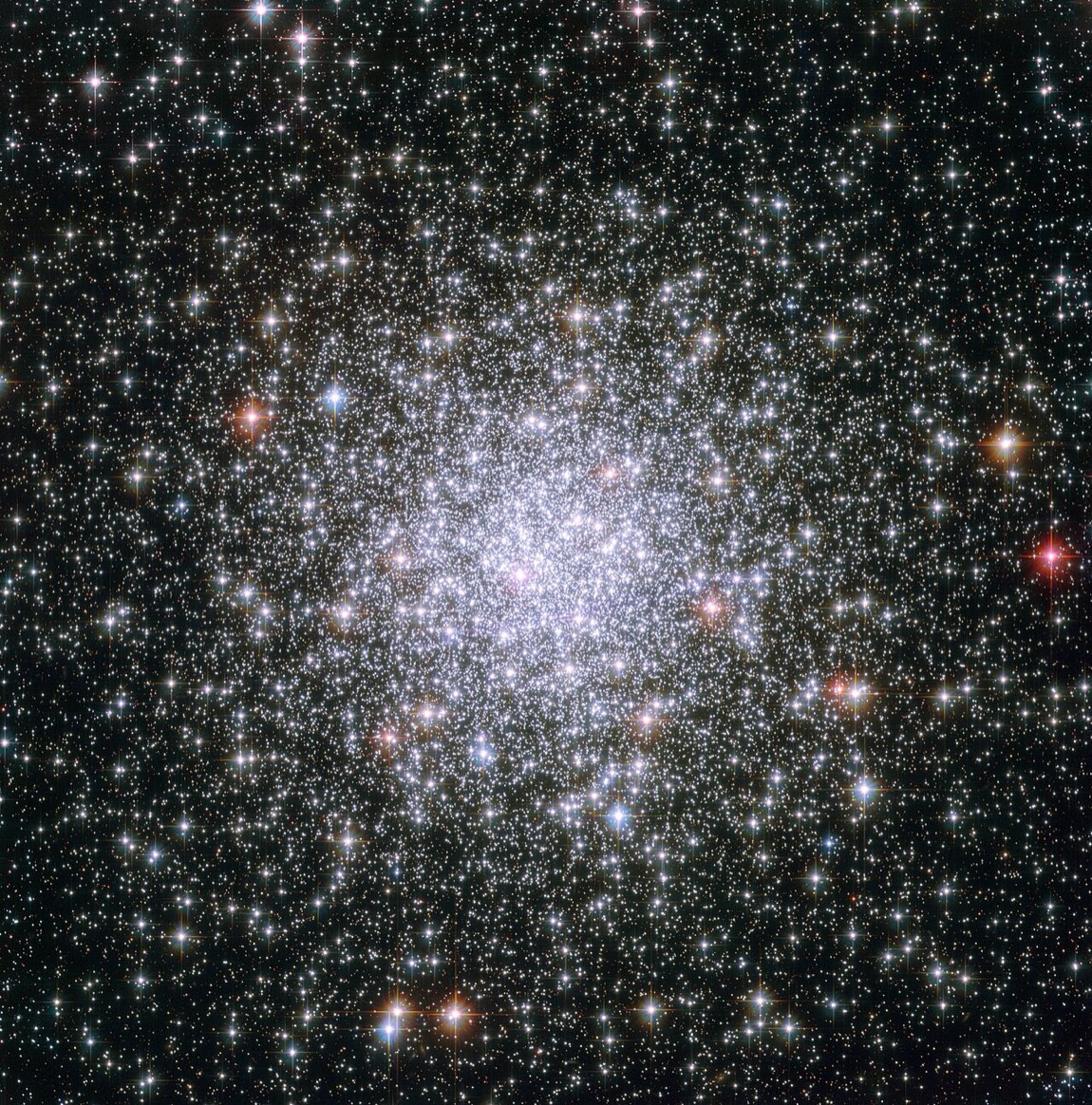
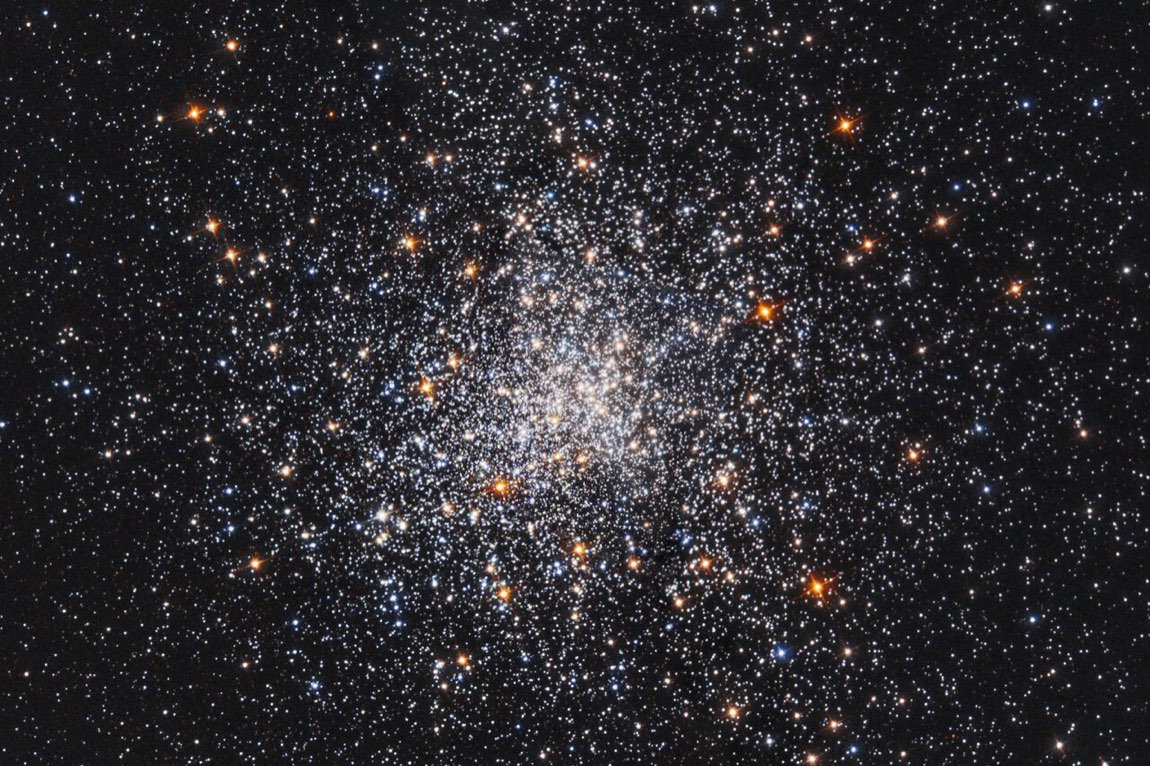
Messier 75 is a globular cluster in Sagittarius, discovered by Pierre Méchain in 1780. It lies about 67,500 light-years away, beyond the centre of the Milky Way. It is a Class I cluster, the most centrally concentrated category, so its stars are crowded densely toward its core. Its brightness equals about 180,000 Suns. Astronomers think M75 may have come from the Gaia Sausage, a dwarf galaxy that merged with the Milky Way long ago.
The deep dive
Researched for the Atlas from Wikipedia — Messier 75 (1,601 characters read) · updated Nov 15, 2026
01 Discovered by Méchain, cataloged by Messier
Messier 75 owes its place in history to a collaboration between two French astronomers. Pierre Méchain spotted it first in 1780, and Charles Messier added it to his famous catalog of comet-like objects that same year. Messier's catalog was never meant to be a celebration of deep-sky wonders — it was a practical nuisance list, a guide to fuzzy smudges that might fool comet hunters into false excitement. M75 made the cut because, through the telescopes of the era, it looked deceptively like a comet without a tail. That serendipitous mistake preserved the discovery for posterity. Today the cluster also carries the designation NGC 6864 from the New General Catalogue, giving it two identities that appear across the scientific literature depending on whether you are reading historical or modern papers.
02 One of the most concentrated clusters known
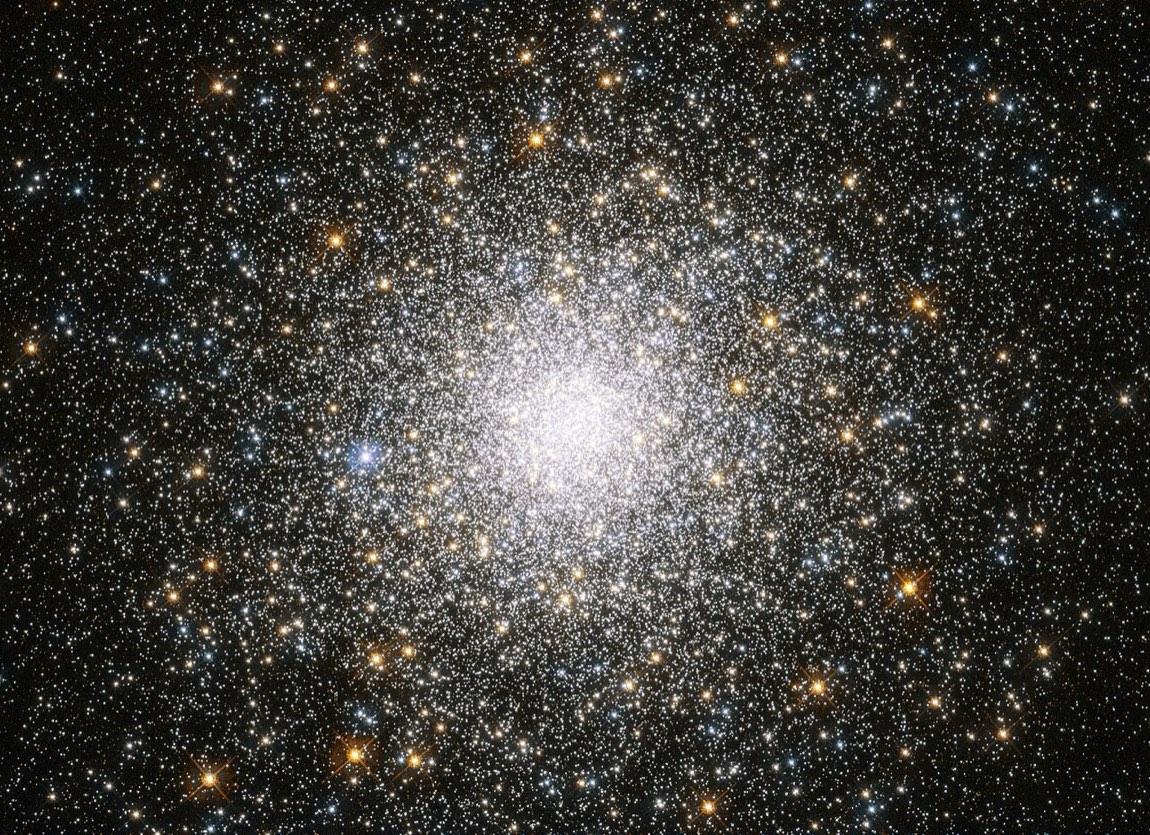
Not all globular clusters are created equal in terms of how tightly their stars are packed together. Astronomers use the Shapley–Sawyer Concentration Classification to rank them, running from loosely scattered Class XII objects all the way to the densest Class I. Messier 75 sits at that extreme end — Class I — making it one of the most densely concentrated globular clusters known anywhere in the sky. The numbers back this up dramatically: the core radius is only about 1.6 light-years across, roughly 400 times the distance from the Sun to its nearest stellar neighbor, yet within that tiny volume the mass density reaches 7.9×10⁴ solar masses per cubic parsec. To put that in everyday terms, a cubic parsec is a cube roughly 3.26 light-years on a side, and M75's core packs the equivalent of 79,000 suns into every such cube.
03 A structure that has not yet collapsed at its core Deeper
Many of the densest globular clusters have undergone a runaway process called core collapse, where gravitational interactions among stars drain energy from the center, causing it to shrink to an almost point-like singularity of stellar crowding. M75 appears not to have reached that endpoint yet. Its core radius of about 1.6 light-years is small but still measurably extended, and its half-light radius — the distance within which half the cluster's total light is emitted — is 9.1 light-years, or 2.80 parsecs. The fact that such a Class I cluster still maintains a recognizable, non-collapsed core makes it a scientifically valuable object for understanding exactly when and how the collapse process triggers. It sits in an intriguing middle ground: extraordinarily dense, yet not quite over the edge.
04 RR Lyrae stars and a metallicity mystery Deeper
Among M75's stellar population, astronomers have identified 38 RR Lyrae variable stars — ancient, pulsating stars that expand and contract with clockwork regularity, making them some of the most reliable distance-measuring tools in astronomy. Beyond their role as cosmic rulers, the ensemble of RR Lyrae in a cluster carries a chemical fingerprint. Globular clusters are traditionally divided into two groups, called Oosterhoff I and Oosterhoff II, based on the pulsation periods of their RR Lyrae stars, which correlate with the stars' metal content. M75 falls into neither camp cleanly; it is classified as Oosterhoff-intermediate. This ambiguous status is relatively rare and scientifically interesting, suggesting a metallicity that sits between the two classical populations — a possible clue to the unusual origins of the cluster itself.
05 Blue stragglers: stars that refused to age
Globular clusters are old, and their stars are supposed to age together like members of a single generation. Blue stragglers break that rule — they appear younger, hotter, and bluer than they should be, seemingly defying the age of their neighbors. Astronomers have identified 62 candidate blue stragglers in the field of M75, and a striking 60 percent of them are concentrated in the core region. This clustering toward the center is consistent with one leading explanation for their existence: they form when two stars collide or when one star strips mass from a close binary companion, effectively getting a new lease on stellar life. The dense core of M75 — that Class I packing — provides exactly the kind of crowded environment where such stellar encounters are most likely to happen.
06 A slow, tilted spin through deep space Deeper
Globular clusters are not static balls of stars — they rotate, though often barely perceptibly. M75 has been measured to show a slow rotation around an internal axis. That axis is inclined along a position angle of −15°±30°, a value with a substantial uncertainty range that reflects how difficult it is to disentangle genuine rotation from the random motions of individual stars along the line of sight. The measurement tells us the cluster is not perfectly face-on or perfectly edge-on to us, but tilted at that oblique angle. Detecting rotation in a system 67,500 light-years away requires painstaking spectroscopic analysis of stellar velocities, and the wide error bar honestly captures the limits of current observations rather than hiding ignorance behind false precision.
 ⤢
07 A relic of a devoured dwarf galaxy
M75 is not a native of the Milky Way in any simple sense. It is classified as part of the Gaia Sausage, the hypothesized remnant of an ancient dwarf galaxy that collided and merged with our galaxy long ago. The name comes from the sausage-shaped distribution that the merger's stars and clusters trace out in velocity space, a pattern revealed by data from the European Space Agency's Gaia satellite. M75 is therefore a captured immigrant — a cluster that formed in a separate galaxy and was absorbed when that galaxy was torn apart by the Milky Way's gravity. Its membership in this structure links it to one of the most significant merger events in our galaxy's history, connecting a small fuzzy patch in Sagittarius to a cosmological story of galactic cannibalism.
08 An extreme orbit through the galactic halo
M75 moves around the Milky Way on a path that is anything but circular. Its orbital eccentricity is 0.87 — where 0 would be a perfect circle and 1.0 would be a straight-line plunge — meaning it follows a dramatically elongated ellipse. At its farthest point from the galactic center, the apocenter, it reaches about 57,000 light-years away. The full trip around the galaxy takes 0.4 billion years to complete. For comparison, our Sun takes roughly 0.225 billion years to complete one orbit, and it travels a far more sedate, nearly circular path. M75's wild ellipse is itself a clue to its violent past: objects captured from disrupted dwarf galaxies frequently inherit chaotic, highly eccentric orbits rather than the settled, circular ones of clusters born inside the Milky Way.
09 On the far side of the galactic center from us
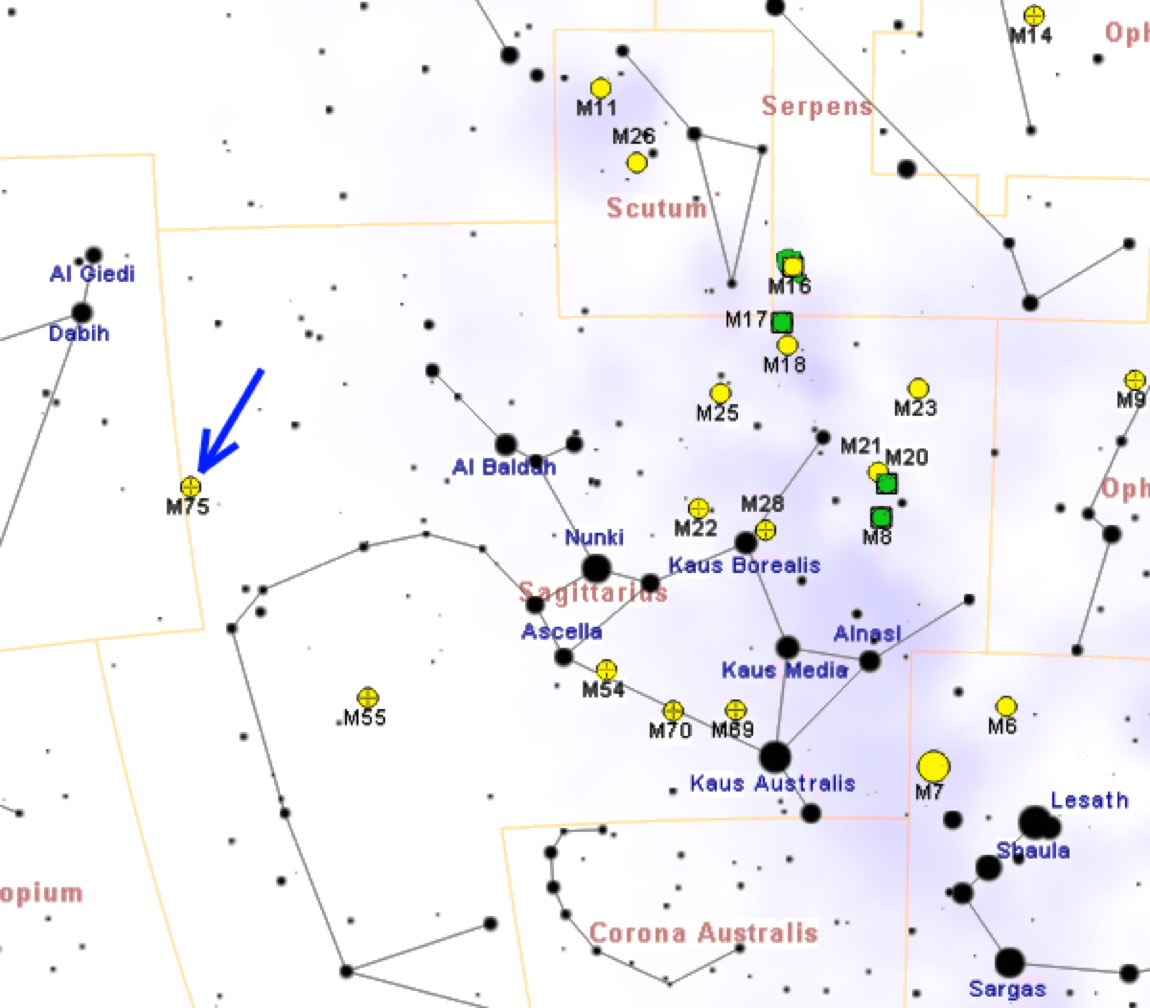
M75 sits about 67,500 light-years from Earth and lies 14,700 light-years beyond the Galactic Center, placing it on the opposite side of the galaxy from our Solar System. This geometry matters for observation: everything we see of M75 is filtered through an enormous column of the Milky Way's gas, dust, and stars. It resides in the southern constellation Sagittarius, the same direction as the galactic core, so observers must look straight through the crowded central regions of our galaxy to find it. Its total radius — derived from its apparent size on the sky combined with its known distance — works out to 67 light-years, making it a physically substantial cluster despite appearing small and faint from Earth at an apparent magnitude of about −8.5 in absolute terms.
10 Luminosity that dwarfs the Sun by thousands
Despite its modest appearance in an amateur telescope, M75 is a powerhouse. Its absolute magnitude is about −8.5, which corresponds to a total luminosity of roughly 180,000 times that of the Sun. To picture this, if you could replace the Sun with M75 at the same distance, it would outshine the Sun by a factor equivalent to nearly every star you could see in the night sky combined, and then some. This extraordinary brightness comes not from any single spectacular star but from the combined light of hundreds of thousands of old, evolved stars — many of them red giants that have swelled and brightened as they age. The cluster's Class I concentration means those stars are packed densely enough that the core, in particular, would be a dazzling, almost shadowless environment to any hypothetical observer positioned inside it.
11 How to find M75 in the night sky
M75 lives in the constellation Sagittarius, well placed for observers in the southern hemisphere and visible from mid-northern latitudes during summer evenings. With an apparent magnitude that makes it accessible through binoculars under good conditions, it appears as a faint, unresolved smudge — looking almost exactly as it did to Méchain and Messier through their eighteenth-century instruments. Because of its extreme concentration, small telescopes struggle to resolve individual stars at its edges the way they can with looser clusters like M13. Larger amateur instruments begin to reveal a bright, compact core surrounded by a hazier halo. Its position near the galactic center means that the Milky Way's summer glow provides a spectacular backdrop, but also that light pollution and atmospheric haze along that low horizon can challenge northern-hemisphere observers significantly.
 ⤢