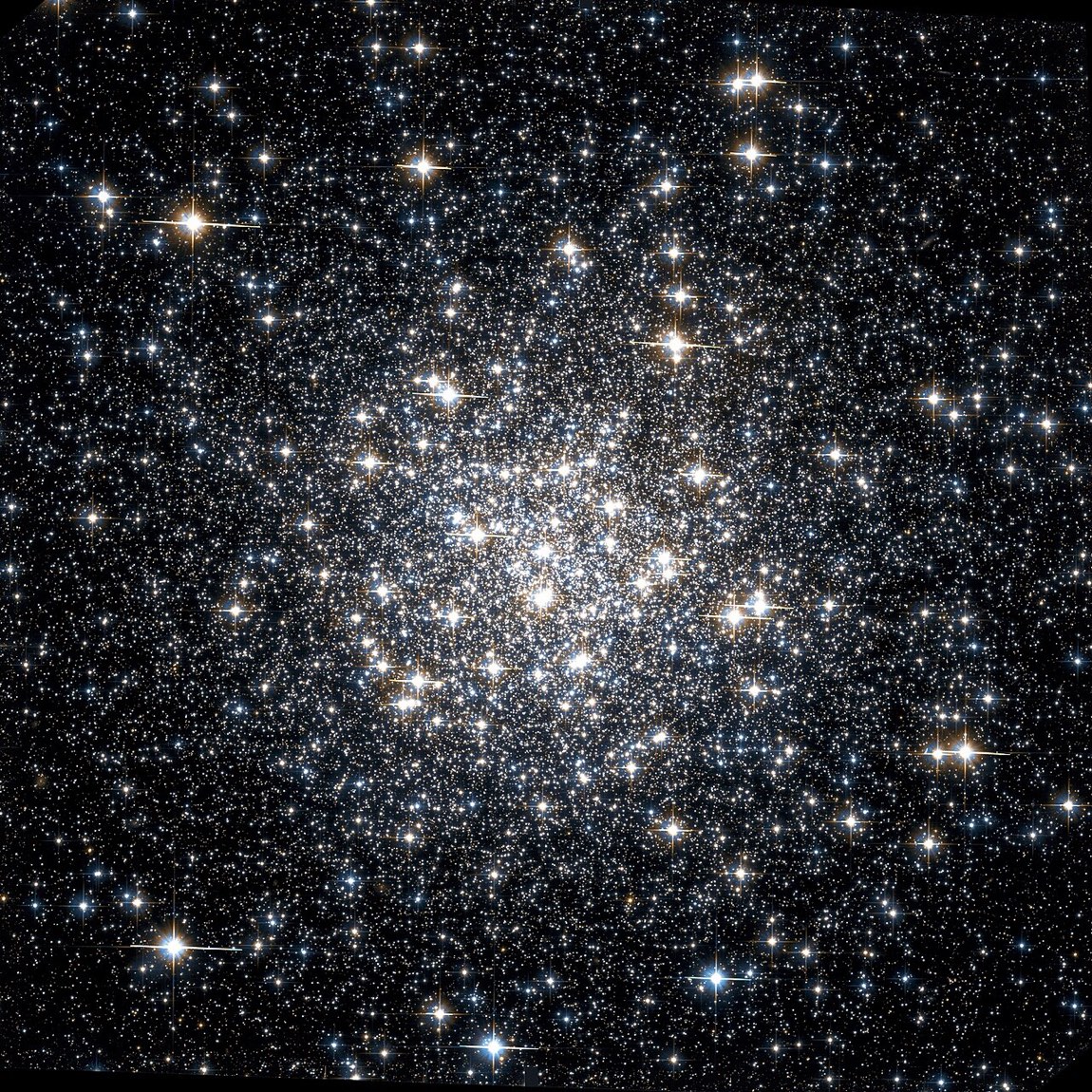
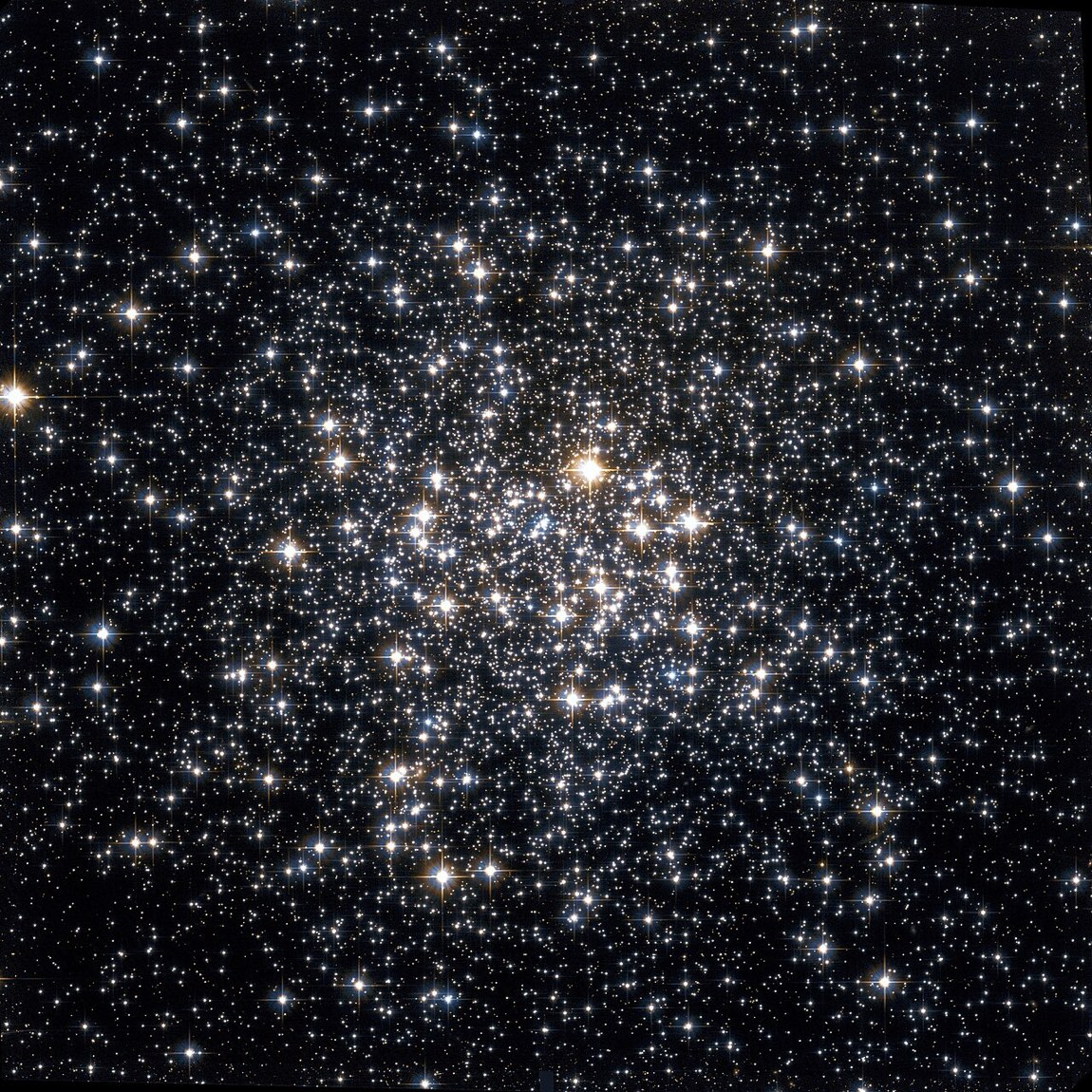
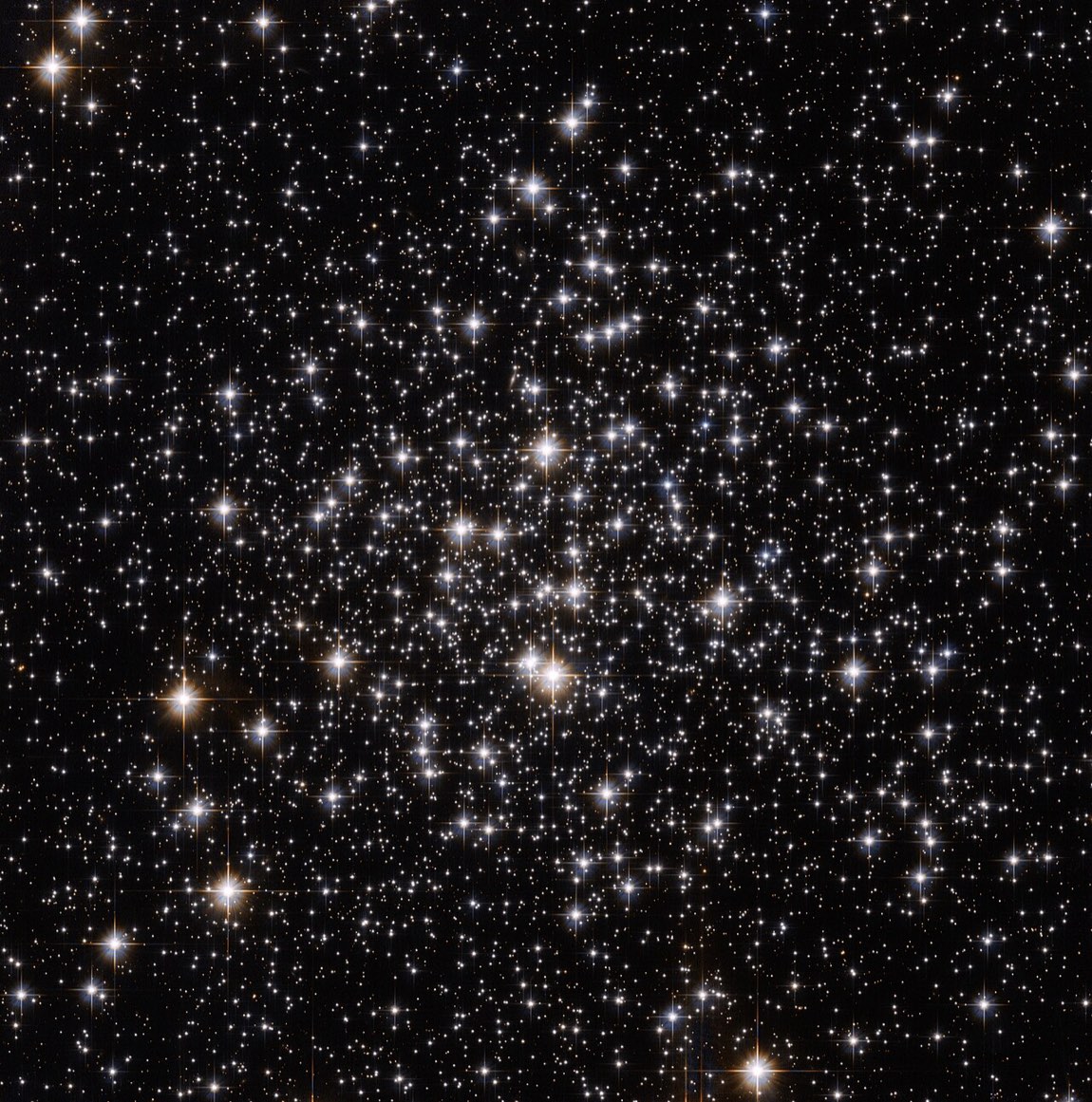
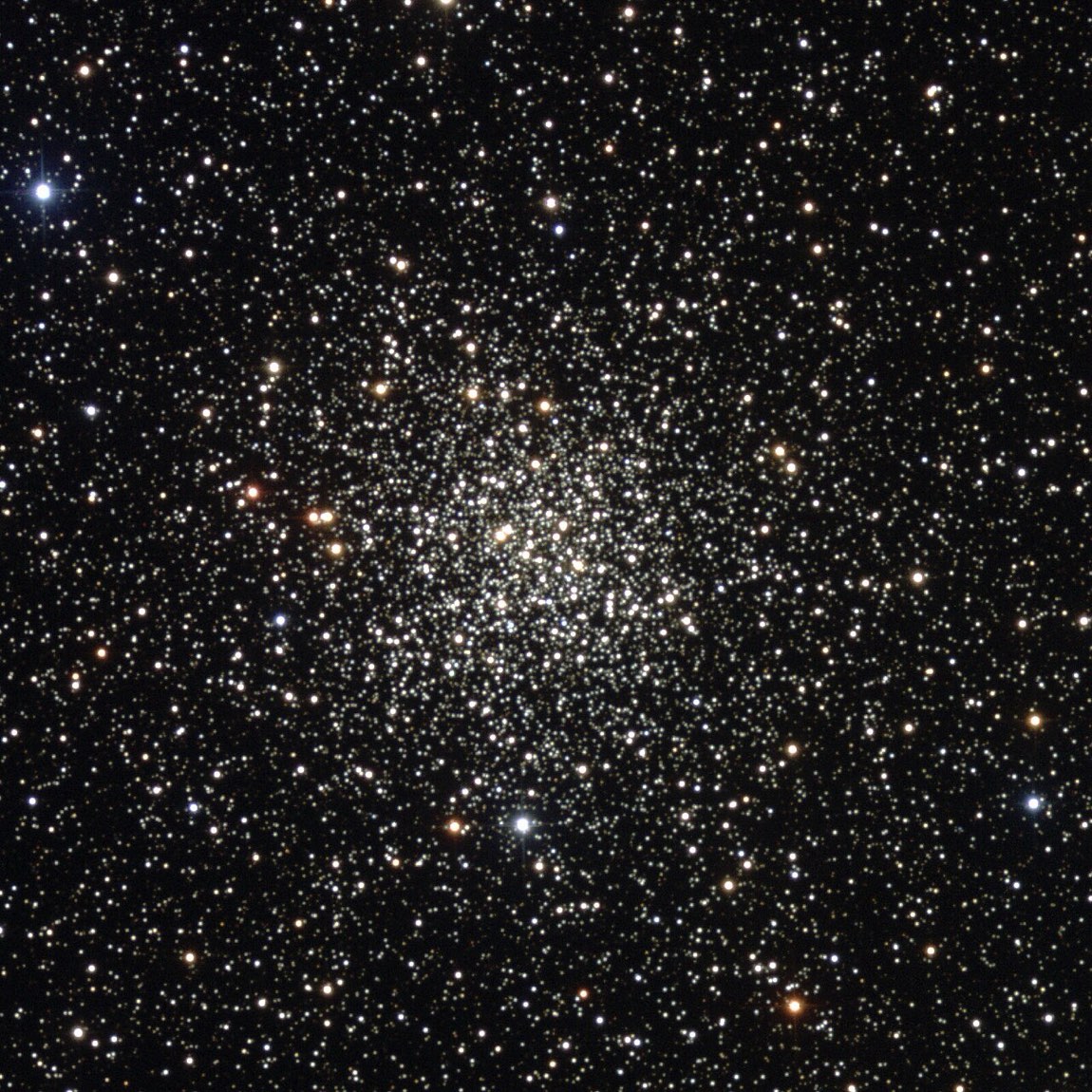
 Photograph · ESA/Hubble and NASA · CC BY 3.0
Star Cluster · Deep guide
Messier 71
Also called: M71 · NGC 6838 · Angelfish Cluster
A loose cluster in Sagitta that astronomers argued about for decades: open or globular?
What is it?
Messier 71 is a star cluster in the small constellation Sagitta, discovered by Philippe Loys de Chéseaux in 1745. For many decades, until the 1970s, it was classed as a dense open cluster because it lacks a tightly packed centre and its stars are richer in metals than typical globulars. Modern measurements found a short horizontal branch, a feature typical of globular clusters, so it is now considered a globular. At 9–10 billion years old it is relatively young for its type, which helps explain its unusual look.
The deep dive
Researched for the Atlas from Wikipedia — Messier 71 (1,569 characters read) · updated Nov 15, 2026
01 Why astronomers argued about what M71 is
For several decades — right up until the 1970s — professional astronomers classified Messier 71 as a densely packed open cluster, not a globular cluster. The debate was not a minor quibble: open clusters and globular clusters are fundamentally different objects, with different ages, origins, and stellar populations. Three pieces of evidence drove the misclassification. First, M71 lacks the tight, luminous central compression that most globular clusters display. Second, its stars are relatively metal-rich — meaning they contain more elements heavier than hydrogen and helium than ancient globulars typically do. Third, it lacks the RR Lyrae variable stars that serve as a nearly universal fingerprint of old globular clusters. Each of those clues pointed in the same direction, and leading researchers in star cluster science followed them — to the wrong answer. It took modern photometric analysis of the cluster's Hertzsprung–Russell diagram to finally settle the question and move M71 firmly into the globular cluster column.
02 The H–R diagram clue that changed everything Deeper
The decisive evidence that reclassified M71 came from detecting a short horizontal branch in its Hertzsprung–Russell diagram — the standard plot of stellar temperature against luminosity. A horizontal branch is a strip of stars that have exhausted hydrogen in their cores and are now fusing helium; its presence and shape are powerful diagnostics of a cluster's age and composition. In most classic old globular clusters, the horizontal branch stretches far to the blue (hot) end of the diagram, and stars evolving through that region become RR Lyrae variables — pulsating stars that astronomers use as distance markers. In M71, the horizontal branch is conspicuously short and sits toward the redder, cooler end of the diagram. That geometry means no stars are spending significant time in the temperature range where RR Lyrae pulsation occurs, which neatly explains their total absence. The shortness of the branch is itself a consequence of M71's relatively young age for a globular cluster: 9 to 10 billion years, compared with the 12 to 13 billion years typical of the oldest globulars.
03 A globular cluster that bends the rules
Even after its reclassification, M71 remains an oddity among globular clusters. Most globulars are ancient relics from the early universe, populated almost entirely by old, metal-poor Population II stars — the first stellar generations, formed when the cosmos had not yet forged many heavy elements. M71's stars are comparatively metal-rich, suggesting they formed from gas that had already been enriched by earlier generations of stars. This makes M71 more chemically similar to younger stellar populations, blurring the line that astronomers usually draw between globular and open clusters. Its loose, diffuse appearance reinforces that impression; the article compares it directly to M68 in the constellation Hydra as another example of a very loosely concentrated globular cluster. M71 is therefore not a typical representative of its class — it sits at the boundary between categories, which is precisely why it fooled experts for so long and why it continues to attract research attention.
 ⤢
04 Mass, luminosity, and what they tell us Deeper
Messier 71 has a measured mass of about 53,000 solar masses and a luminosity of around 19,000 solar luminosities. Those two numbers together are revealing. For comparison, our own Sun has a mass of one solar mass and a luminosity of one solar luminosity by definition, so 53,000 solar masses packed into a sphere just 27 light-years across represents a substantial concentration of stellar material — roughly equivalent to stacking 53,000 stars like the Sun into a volume that, in everyday terms, would take light about 27 years to cross at 300,000 kilometers per second. The mass-to-light ratio implied by these figures is relatively high, meaning M71 is not especially luminous for its mass. This is consistent with its stellar population being older and including many dim, evolved stars rather than hot, brilliant young ones. These numbers help astronomers model how M71 formed, how it has lost mass through stellar evolution and gravitational interactions over its 9-to-10-billion-year lifetime, and how it compares to other loosely concentrated globular clusters.
05 Size and distance: putting M71 in perspective
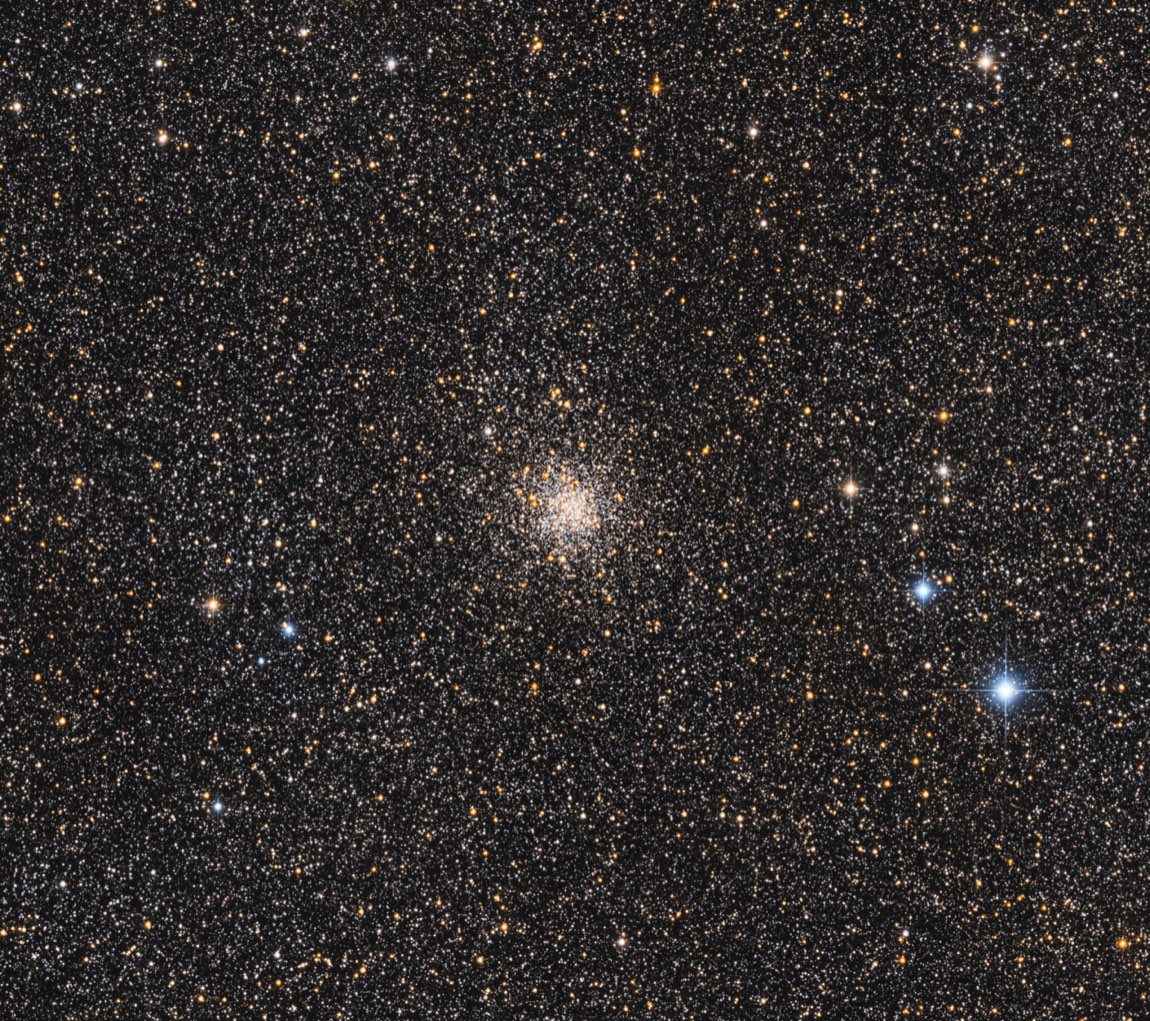
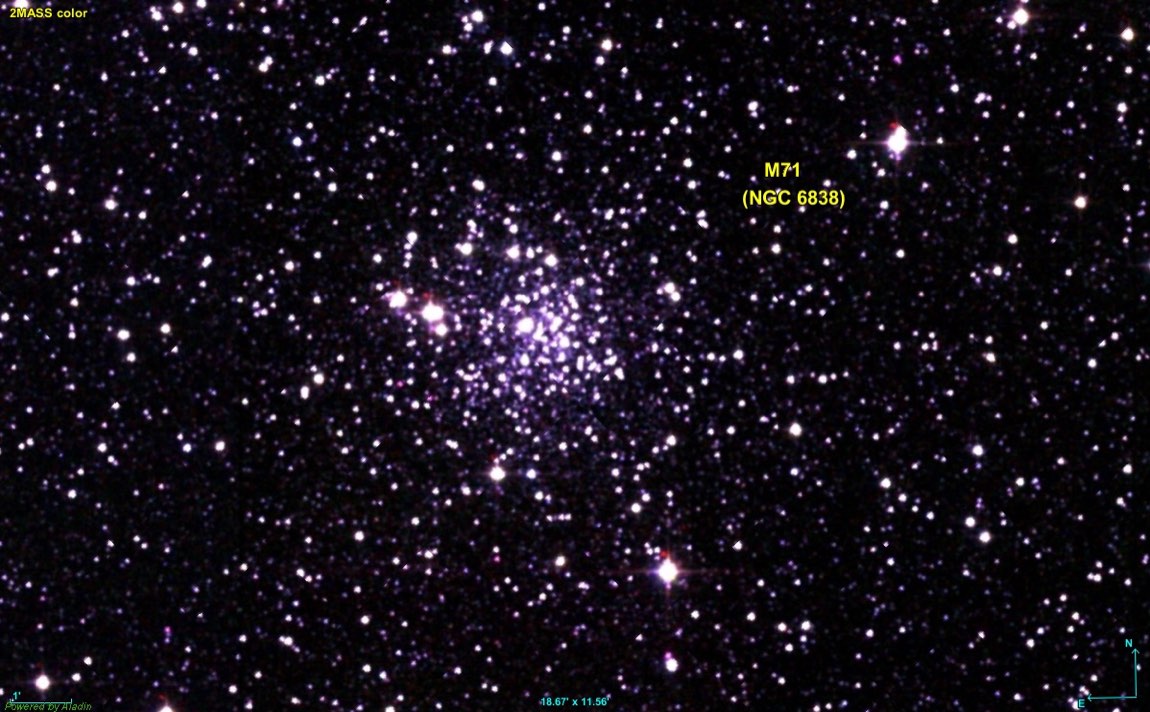
Messier 71 sits about 13,000 light-years from Earth — far enough that its light takes thirteen thousand years to reach us, yet close enough to be one of the more accessible globular clusters for study. It spans 27 light-years, or 8 parsecs, from edge to edge. To put that physical size in perspective, the nearest star to the Sun, Proxima Centauri, is about 4.2 light-years away; M71's full diameter is therefore roughly six times that distance. Despite being 13,000 light-years away, M71 carries an apparent magnitude bright enough for Messier to have catalogued it as a noteworthy fuzzy object in the eighteenth century. Its location in the small northern constellation Sagitta — the Arrow — places it in a relatively compact, easy-to-identify star pattern, which helps amateur astronomers star-hop to it from nearby brighter stars.
06 Discovery: three astronomers, one cluster
The discovery history of M71 involves at least three independent observers across roughly three decades. Philippe Loys de Chéseaux, the Swiss astronomer, found it first in 1745. Around 1775, Koehler at Dresden independently noted the same fuzzy patch of sky. Charles Messier then added it to his famous catalog of comet-like objects in 1780, giving it the number 71 that astronomers still use today. Messier's catalog, originally compiled as a practical nuisance list to prevent confusion during comet searches, became one of the most enduring reference lists in observational astronomy — which is why a loosely concentrated globular cluster in a minor constellation carries the prestigious Messier designation that guarantees it a place in every amateur astronomer's target list. The cluster is additionally catalogued as NGC 6838, and somewhat uncertainly as NGC 6839, with the article noting that the NGC 6839 identification is very uncertain.
 ⤢
07 Z Sagittae: a variable star inside the cluster Deeper
Among M71's tens of thousands of stars, one stands out with its own name: Z Sagittae, classified as an irregular variable star and confirmed as a member of the cluster. Variable stars are stars whose brightness changes over time, and the type matters enormously. Regular pulsating variables like RR Lyrae stars change brightness in a predictable rhythm tied to their physical properties, making them useful as distance indicators. Irregular variables like Z Sagittae do not follow a predictable pattern, which makes them scientifically interesting in a different way — their behavior can reflect instabilities in the star's outer layers, mass-transfer events if the star has a companion, or other poorly understood processes. The fact that M71 hosts an irregular variable but not the RR Lyrae variables typical of older globulars is fully consistent with the cluster's unusual status: its relatively young age and metal-rich stars produce a stellar population that simply does not generate the classic variable star fingerprint expected of an ancient globular.
08 How to find and observe the Angelfish Cluster
Messier 71's popular name, the Angelfish Cluster, gives observers a visual impression to look for. It lives in Sagitta, one of the smallest constellations in the sky but a recognizable arrow-shaped asterism nestled between the more prominent star patterns of Aquila and Vulpecula. Because M71 lacks the dense central core that makes clusters like M13 or M22 immediately striking, observers using small telescopes often describe it as looser and more diffuse than a typical globular — an impression that, as we now know, reflects genuine physical reality. Its classification as a very loosely concentrated globular means stars are spread more evenly across its 27-light-year diameter rather than packed tightly toward the center. This loose appearance once fooled professionals into calling it an open cluster, but through a medium-aperture telescope under dark skies, the cluster's hazy, granular glow is a rewarding target that carries a genuinely unusual scientific story behind it.
09 Open questions and ongoing debates Deeper
Despite the reclassification settled in the 1970s, Messier 71 continues to sit at an uncomfortable boundary in stellar astronomy. Its metal-rich stars, loose concentration, relatively young age of 9 to 10 billion years, and absent RR Lyrae variables all make it an atypical globular cluster. Researchers still debate exactly how such a cluster formed and what its present chemical composition tells us about conditions in the early Milky Way. The article also flags a cataloguing uncertainty: M71 is listed as possibly identical to NGC 6839, but that identification is explicitly described as very uncertain — a reminder that even basic bookkeeping in astronomy can remain unresolved. The question of whether M71 represents the low-age, high-metallicity extreme of a continuous globular cluster population, or whether it is fundamentally a different kind of object that happened to survive to the present, is one that photometric and spectroscopic surveys continue to address.
 ⤢