 Photograph · en:NASA , en:STScI , en:WikiSky · Public domain
Star Cluster · Deep guide
Messier 107
Also called: M107 · NGC 6171 · Crucifix Cluster
A loose globular in Ophiuchus, the last of its kind added to the Messier list.
What is it?
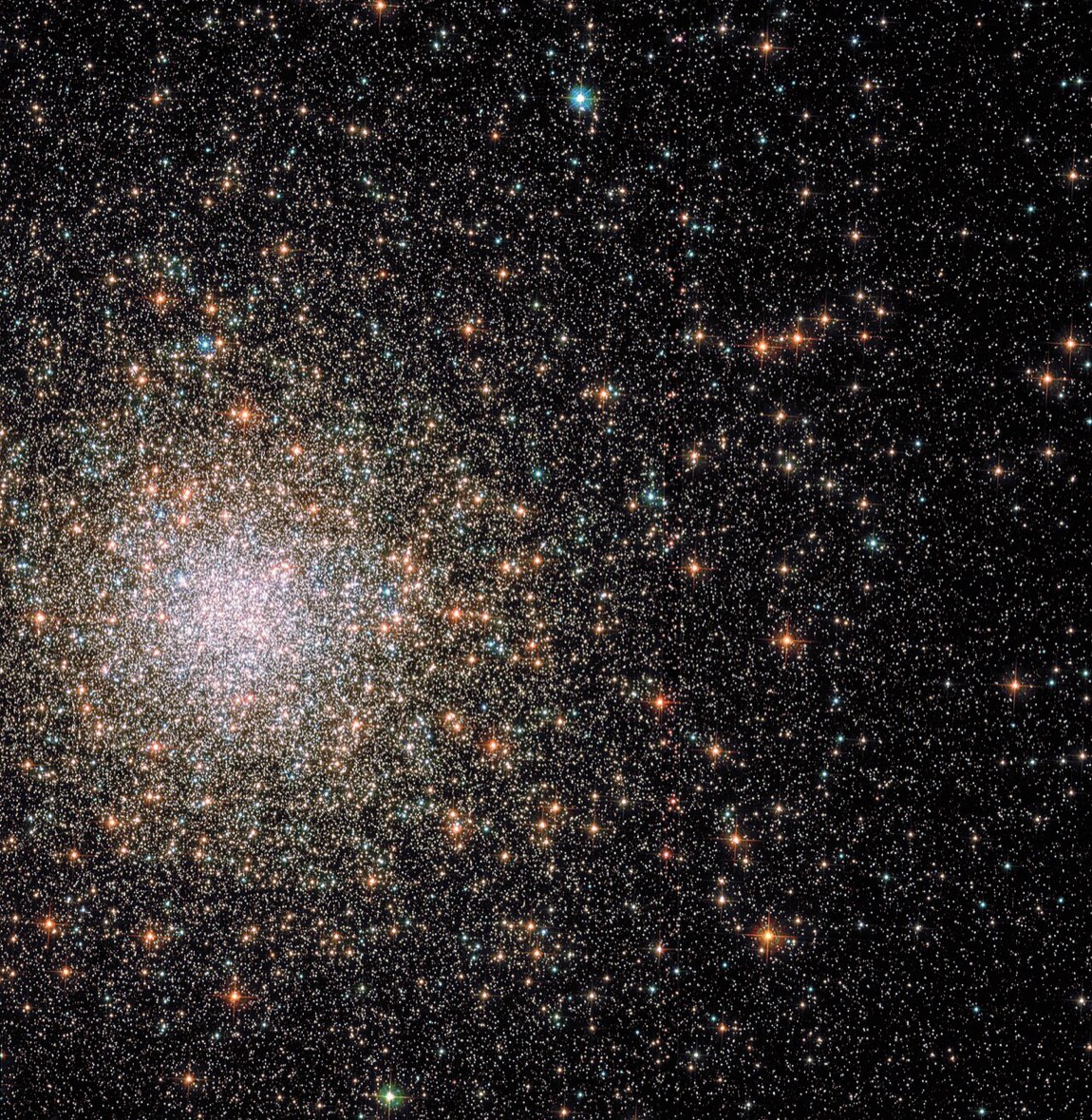
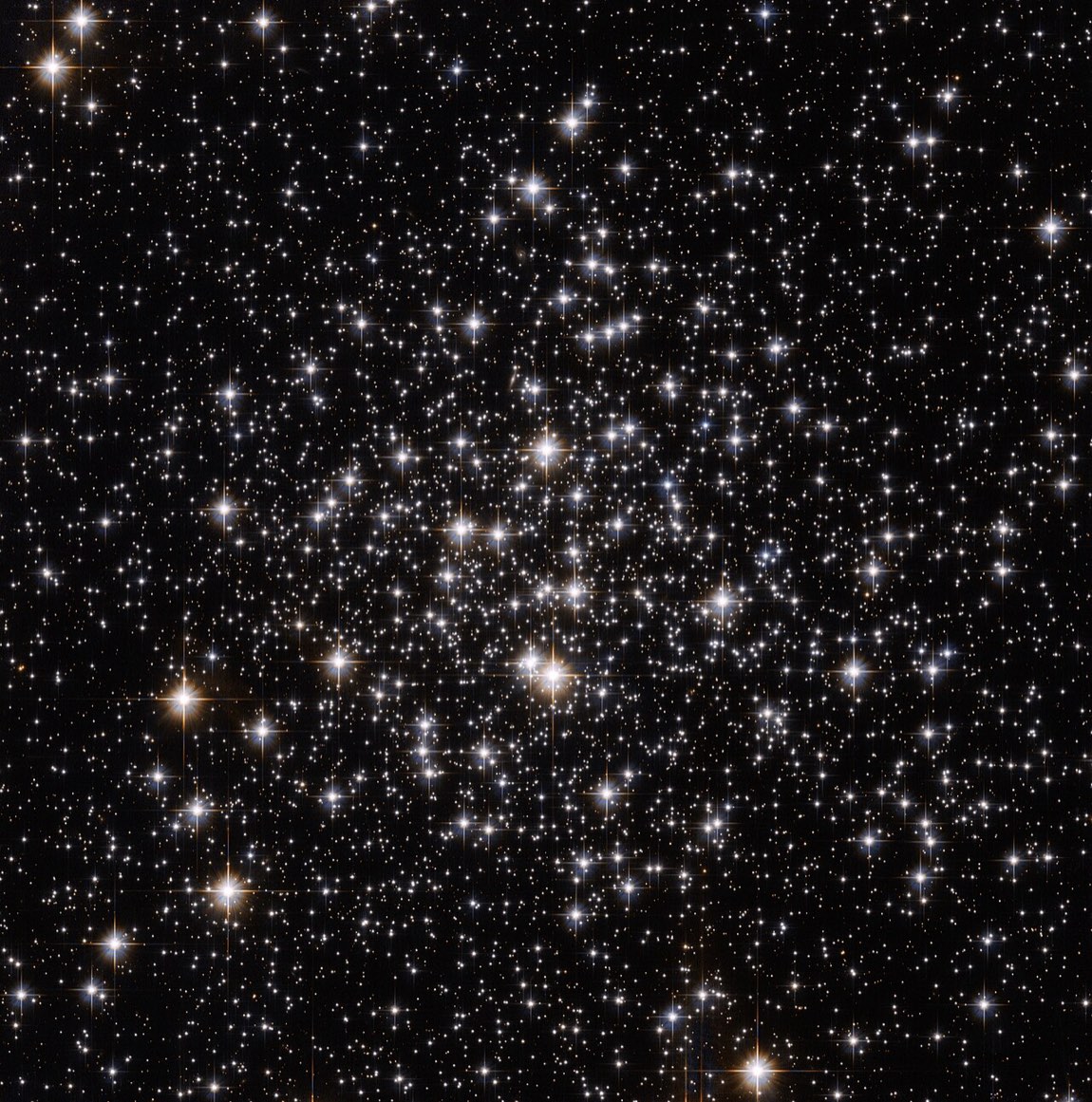
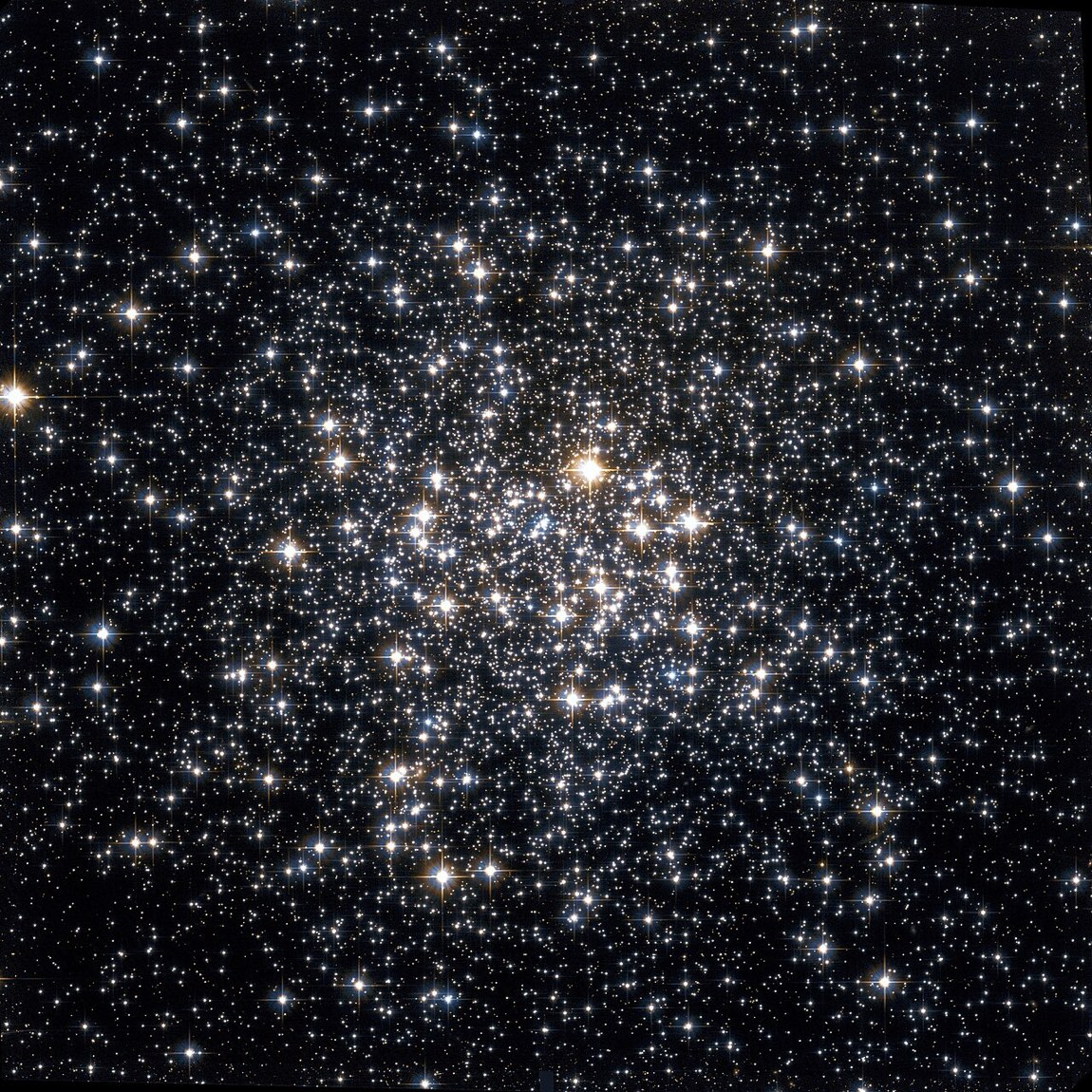
Messier 107 is a loosely packed globular cluster in Ophiuchus, about 2.5° south of the star Zeta Ophiuchi. Pierre Méchain found it in April 1782 and William Herschel found it again in 1793, but it was only added to the modern Messier catalogue in 1947 by Helen Sawyer Hogg. It is the last globular cluster on the list. M107 lies about 20,900 light-years away and its orbit dips in and out of the galaxy's central bar. It contains 22 known RR Lyrae variable stars.
The deep dive
Researched for the Atlas from Wikipedia — Messier 107 (1,303 characters read) · updated Nov 15, 2026
01 A Cluster on the Edge of the Galactic Bar
M107 occupies an unusually dynamic position in the Milky Way. It sits about 20,900 light-years from Earth and roughly 9,800 light-years from the Galactic Center — close enough to the galactic plane that its orbit dips into one of the galaxy's most active structural features. At its closest approach to the center, its perigalactic distance of about 9,200 light-years carries it into and out of the galactic bar, the elongated, dense region of stars that cuts through the heart of the Milky Way. At its farthest, it swings out to around 12,400 light-years from the center, briefly grazing the quieter territory of the galactic halo. This means M107 experiences dramatically different gravitational environments across a single orbit — from the chaotic bar region to the sparse outer reaches — making it a compelling object for studying how globular clusters survive and evolve under changing tidal stresses.
02 Why M107 Is Called the Crucifix Cluster
M107 carries the informal name the Crucifix Cluster, though the Wikipedia article does not detail the precise visual reasoning behind it. The cluster is also catalogued as NGC 6171, reflecting its independent entry in John Herschel's 1864 General Catalogue. Herschel described it in careful observational language as a "globular cluster of stars, large, very rich, very much compressed, round, well resolved, clearly consisting of stars" — language that captures the layered richness visible even through nineteenth-century instruments. The dual identity of M107 and NGC 6171 is a common feature of deep-sky objects that were observed and catalogued multiple times before astronomical record-keeping was unified, and both designations remain in active use today in professional literature.
03 Three Discoverers and a 165-Year Wait
The story of M107's official recognition stretches across nearly two centuries. Pierre Méchain first spotted it in April 1782, and William Herschel independently observed it in 1793, yet neither observation was enough to earn it a place in Messier's famous catalogue during Messier's lifetime. The cluster finally received its M-designation in 1947, when astronomer Helen Sawyer Hogg added it and three other Méchain objects to the modern version of the catalogue. Méchain had contributed several candidate objects that Messier himself had verified and included, but these four were overlooked in earlier compilations. M107 therefore holds the distinction of being the last object in the Messier Catalogue by number — a position that reflects bureaucratic history as much as astronomical significance. Hogg's work corrected a 165-year gap in the official record.
04 How to Find M107 in the Night Sky
Locating M107 requires only a modest familiarity with Ophiuchus, the large constellation that straddles the celestial equator. The cluster lies 2.5 degrees south and slightly west of the naked-eye star Zeta Ophiuchi, making Zeta a reliable jumping-off point for star-hoppers. Because M107 sits very close to the galactic equator, the surrounding star field is rich and can make the cluster blend into the background for inexperienced observers. John Herschel's nineteenth-century description — large, very rich, very much compressed, round, and well resolved — still serves as a useful preview of what to expect at the eyepiece. Its classification as a very loose globular cluster means its outer stars are more spread out than in a tightly packed cluster, which can make resolution of individual stars somewhat easier under dark skies.
05 Variable Stars Hidden in the Cluster Deeper
M107 contains at least 22 known RR Lyrae variable stars, a type of pulsating star that expands and contracts on timescales of less than a day. RR Lyrae stars are enormously useful to astronomers because their intrinsic brightness is well understood, allowing them to serve as standard candles — objects of known luminosity that can be used to measure distances with precision. Finding 22 of them in a single globular cluster provides a statistical sample large enough to refine the distance estimate to M107 itself. The cluster also hosts a probable SX Phoenicis variable, a related but distinct class of pulsating star typically found in older, metal-poor stellar populations. The presence of this probable SX Phoenicis variable is noted with appropriate uncertainty in the literature, underscoring that variable-star classification in dense cluster environments can be observationally challenging.
06 What Makes a Globular Cluster "Very Loose" Deeper
M107's formal description as a very loose globular cluster refers to its concentration class — a measurement of how steeply a cluster's star density increases toward its center. Globular clusters are graded from loosely packed to highly concentrated, and M107 falls toward the sparse end of that spectrum. This matters because concentration class influences how a cluster ages: loosely packed clusters are more susceptible to tidal stripping, the process by which the host galaxy's gravitational pull gradually peels stars away from the cluster's outer regions. Given that M107's orbit brings it into the gravitational environment of the galactic bar at perigalactic distances of around 9,200 light-years, it is exposed to tidal forces capable of reshaping its outer structure over billions of years. Its loose character may partly reflect that ongoing stripping across its long orbital history.
07 M107's Place in the Messier Catalogue
The Messier Catalogue was originally compiled by Charles Messier in the eighteenth century as a practical tool — a list of fuzzy objects that could be mistaken for comets and should be ignored during comet searches. Over time it became one of the most famous inventories in amateur astronomy. M107's addition in 1947 by Helen Sawyer Hogg makes it one of a small group of objects appended to the catalogue after Messier's death, based on records left by his collaborator Méchain. As the last numbered object in the catalogue, M107 sometimes attracts the attention of observers completing the full Messier marathon — the challenge of observing all Messier objects in a single night. Its position in Ophiuchus and its proximity to the galactic plane make it accessible during the spring and early summer marathon season for observers in the northern hemisphere.
08 The Galactic Halo Connection Deeper
Although M107 spends part of its orbit plunging toward the galactic bar, it also swings outward far enough to sample the galactic halo — the vast, diffuse spherical region surrounding the Milky Way's disk. The article states explicitly that its orbit is partly as far out as the galactic halo, with its apogalactic distance reaching between roughly 12,400 light-years from the Galactic Center. The halo is dominated by old, metal-poor stars and ancient globular clusters, and M107's periodic visits to this region place it in the broader population of halo objects even though its proximity to the galactic plane might suggest otherwise. This dual character — part disk-grazer, part halo wanderer — makes M107 an interesting case study in the orbital diversity of globular clusters, which were among the first structures to form in the early Milky Way.
09 Helen Sawyer Hogg and the Missing Méchain Objects
Helen Sawyer Hogg was a Canadian astronomer who made variable stars in globular clusters her specialty, and her 1947 revision of the Messier Catalogue was a significant act of historical scholarship as much as scientific curation. Méchain had observed and recorded several objects that Messier either verified or intended to include, but four of them — M107 among them — had fallen through the cracks of successive catalogue editions. Hogg identified these overlooked entries and formally incorporated them, completing the catalogue in a form close to what most observers use today. The fact that it took 165 years from Méchain's 1782 observation to official inclusion illustrates how astronomical catalogues are living documents, subject to revision as historians and scientists comb through old records. Hogg's correction gave M107 its permanent identity as a Messier object.