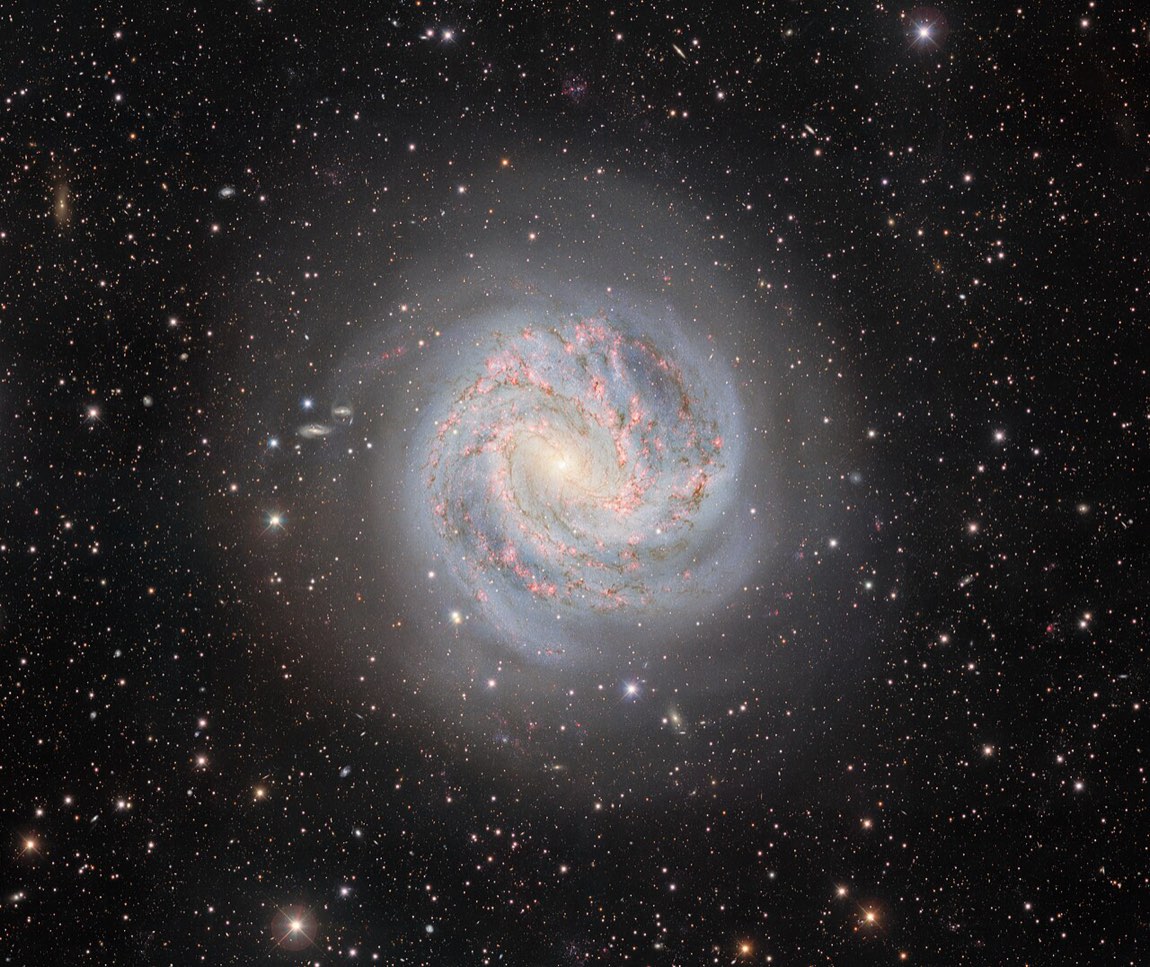
 Photograph · CTIO/NOIRLab/DOE/NSF/AURA Image processing: T.A. Rector (University of Alaska An · CC BY 4.0
Galaxy · Deep guide
Messier 83 (Southern Pinwheel Galaxy)
Also called: M83 · NGC 5236 · Southern Pinwheel Galaxy
A bright barred spiral in the southern sky, big enough to spot in binoculars.
What is it?
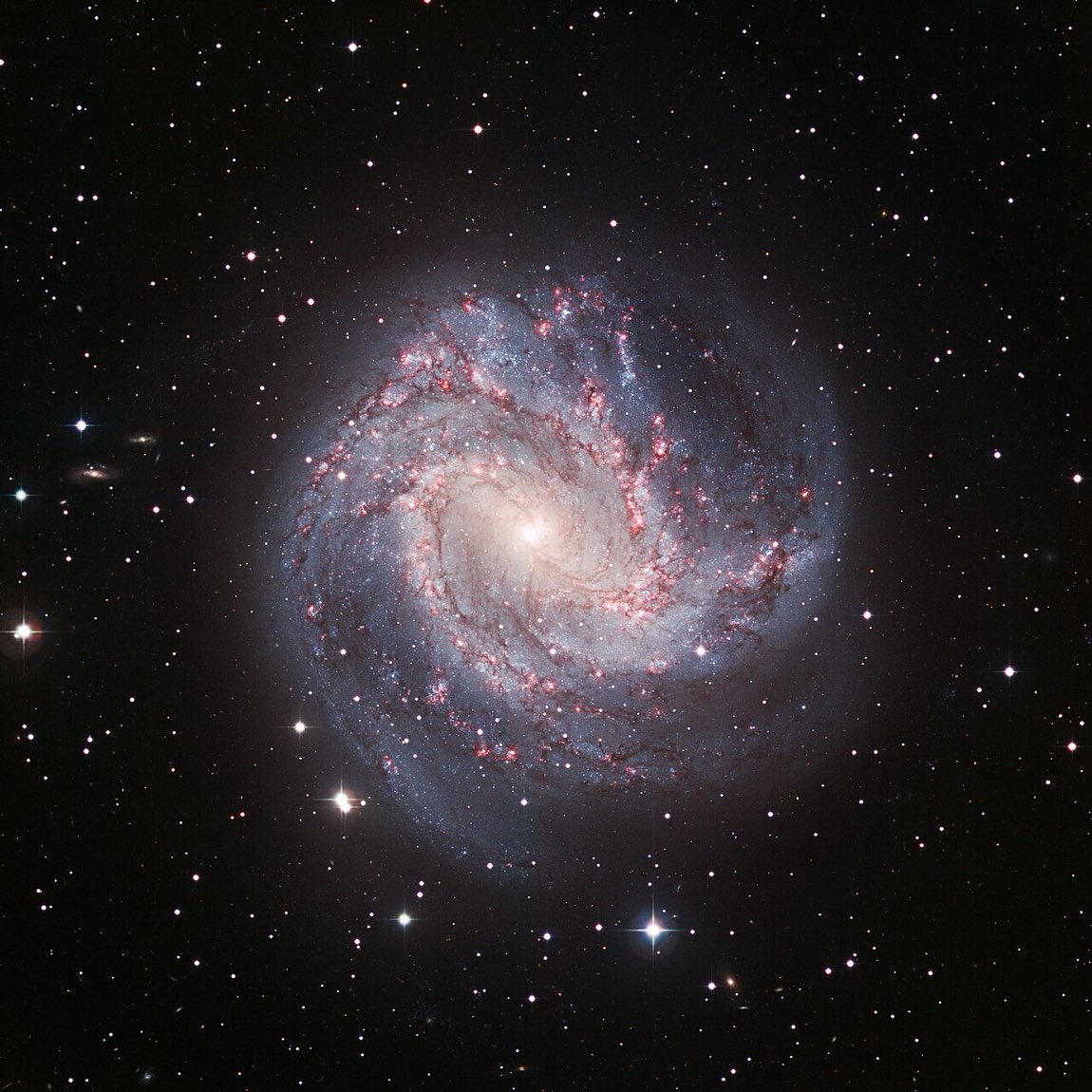
Messier 83, the Southern Pinwheel Galaxy, is a barred spiral about 15 million light-years away on the border of Hydra and Centaurus. Nicolas-Louis de Lacaille discovered it in 1752 from the Cape of Good Hope, and Messier added it in 1781. It is one of the closest and brightest barred spirals in the sky and is visible in binoculars. Its loosely wound arms are busy forming stars, especially along their leading edges. A likely encounter with the dwarf galaxy NGC 5253 may have set off bursts of star formation in both.
The deep dive
Researched for the Atlas from Wikipedia — Messier 83 (3,455 characters read) · updated Nov 15, 2026
01 A Galaxy Discovered at the Cape of Good Hope
M83 entered the historical record on 17 February 1752, when French astronomer Nicolas-Louis de Lacaille spotted it while observing from the Cape of Good Hope in South Africa — making it one of the first deep-sky objects discovered from the Southern Hemisphere. It is striking that Lacaille caught it at all, since systematic cataloguing of nebulous objects was still in its infancy. Nearly three decades later, in March 1781, Charles Messier added it to his famous catalogue of objects that could be mistaken for comets, giving it the number 83. That catalogue, now a foundational reference for amateur and professional astronomers alike, immortalised the galaxy under the name it most commonly carries today. The galaxy's popular nickname, the Southern Pinwheel, derives from its visual resemblance to M101 (the Pinwheel Galaxy), though M83 sits far deeper in southern skies, straddling the constellation borders of Hydra and Centaurus.
02 What Kind of Spiral Galaxy Is M83, Exactly? Deeper
M83 carries the morphological classification SAB(s)c in the De Vaucouleurs system, and each letter and symbol in that compact code tells a specific story. The 'SAB' label means it is a weakly barred spiral — not a full classical bar like the Milky Way's, but not a pure unbarred spiral either. The '(s)' indicates a pure spiral structure with no surrounding ring of stars or gas, so the arms wind directly outward from the central region. Finally, the 'c' suffix tells astronomers that those spiral arms are loosely wound, giving M83 an open, airy appearance compared to tightly coiled spirals. Taken together, M83 is classified as a massive, grand design spiral galaxy — meaning its arms are prominent, coherent, and well-defined across the full disk rather than being patchy or fragmented. Its isophotal diameter spans approximately 36.24 kiloparsecs, equivalent to about 118,000 light-years, making it broadly comparable in size to our own Milky Way.
03 Star Birth Along the Leading Edge of the Arms
One of M83's most telling physical features is where it makes its new stars. The star formation rate is measurably higher along the leading edges of the spiral arms — exactly as density wave theory predicts. In that model, a galaxy's spiral pattern acts like a slow-moving compression wave, and gas clouds pile up at the front edge of each arm, triggering gravitational collapse and star birth. M83 is a textbook demonstration of this process in action. Even more surprising was a discovery announced by NASA's Galaxy Evolution Explorer project on 16 April 2008: large numbers of new stars were being born in the outer reaches of the galaxy, as far as 20 kiloparsecs from the galactic centre. This was unexpected because astronomers had long assumed those outer regions lacked the raw materials — gas and dust — required for star formation. The discovery forced a reassessment of where star formation can occur within disk galaxies.
04 A Neighbour Galaxy That Stirred Things Up
M83 does not exist in isolation. The peculiar dwarf galaxy NGC 5253 lies nearby, and the two galaxies are thought to have interacted gravitationally within the last billion years. That encounter likely triggered intense starburst activity in the central regions of both galaxies — episodes where star formation rates spike dramatically above normal levels. Galaxy interactions of this kind are well-documented drivers of star bursts, and M83 and NGC 5253 appear to be a relatively nearby example of the phenomenon. The interaction is described as historical rather than ongoing, but its effects on the structure and star-formation history of M83's inner disk may still be visible today. This kind of close galactic encounter is one reason M83 is so scientifically valuable: at roughly 15 million light-years away, it is close enough that individual star-forming regions and their aftermath can be studied in considerable detail.
05 Six Supernovae and What They Revealed Deeper
M83 holds a remarkable record: six supernovae have been observed within it, more than in almost any comparable galaxy. The first, SN 1923A, was detected by Carl Otto Lampland on 5 May 1923 at magnitude 14. Others followed in 1945, 1950, and 1957, all of unknown type. The fifth event, SN 1968L, was classified as Type II-P and reached magnitude 11.9. The sixth, SN 1983N, turned out to be historically transformative. Discovered by Robert Evans from Australia on 3 July 1983, it was observed with the Very Large Array just three days later and became the first Type I supernova ever detected in radio emission. It peaked at an apparent visual magnitude of 11.54 on 17 July. Its spectrum was considered peculiar at the time, but roughly a year after the explosion, approximately 0.3 solar masses of iron were found in the ejecta — the first unambiguous detection of such a large iron mass from any supernova. SN 1983N ultimately became the modern prototype of the hydrogen-deficient Type Ib supernova subclass, with the progenitor inferred to have been a Wolf–Rayet star.
06 Clues to a Supermassive Black Hole at the Core
Until very recently, it was unclear whether M83 harboured a supermassive black hole at its centre — a feature now considered standard in large galaxies. In April 2025, researchers published the first observational clues pointing to the possible existence of such an object in M83's nucleus. The article notes these as first clues rather than a confirmed detection, reflecting the genuine scientific uncertainty still surrounding the finding. This is a significant development because M83 is one of the closest and most intensively studied barred spiral galaxies in the sky, and understanding whether its nucleus hosts a massive compact object has implications for how galaxies in its class form and evolve. The search for supermassive black holes in nearby galaxies continues to refine models of galactic structure, and M83 is now squarely part of that ongoing story.
07 M83's Place in Its Local Galaxy Group Deeper
M83 sits at the gravitational heart of one of two distinct subgroups within the larger Centaurus A/M83 Group — a collection of galaxies that together represent one of the nearest galaxy groups to the Local Group. The other subgroup is centred on the giant elliptical galaxy Centaurus A. Astronomers debate whether these two subgroups should be treated as a single group or two separate ones. What is observationally clear is that the galaxies around M83 and those around Centaurus A are physically close to each other, and crucially, neither subgroup appears to be moving relative to the other — suggesting the system as a whole is gravitationally bound. In a separate analysis by A.M. Garcia, M83 is identified as the dominant member of a group catalogued as LGG 355, which includes at least four member galaxies: NGC 5264, IC 4316, and ESO 444-78. This local environment of smaller companions and a neighbouring giant elliptical makes M83's cosmic neighbourhood unusually rich for study.
08 Bright Enough to See With Binoculars
Despite lying 15 million light-years from Earth — a distance so vast that the light now reaching us left before the earliest members of our genus existed — M83 is bright enough to be spotted with ordinary binoculars. It is considered one of the closest and brightest barred spiral galaxies anywhere in the sky. This accessibility has made it a popular target for amateur astronomers in the Southern Hemisphere and low-latitude northern sites, though its position near the borders of Hydra and Centaurus keeps it perpetually low or below the horizon for observers in higher northern latitudes. Through a telescope, its loosely wound, open spiral arms and the glow of its star-forming regions become progressively more apparent. The combination of proximity, brightness, and structural clarity is precisely why M83 has also attracted so much professional scientific attention: it offers a relatively unobstructed window into the physics of a grand design spiral galaxy.
09 Why M83 Hosts So Many Recorded Supernovae Deeper
The fact that six supernovae have been observed in M83 is not purely a matter of luck. M83's elevated star formation rate — particularly along the leading edges of its spiral arms — means it is continuously producing large numbers of massive stars, and massive stars are the ones that end their short lives in supernova explosions. A galaxy actively forming stars at a high rate is statistically more likely to generate core-collapse supernovae (Type II) on a frequent basis. M83's proximity also matters: at 15 million light-years, supernovae that might be too faint to detect in more distant galaxies are still bright enough to record here, with SN 1983N and SN 1968L both reaching an apparent magnitude of 11.9 — easily within the range of modest telescopes. The historical record stretching back to 1923A reflects nearly a century of consistent monitoring, underscoring how M83 has served as a natural laboratory for supernova science across generations of astronomers.
10 The Naming of a Southern Pinwheel
M83's popular name, the Southern Pinwheel Galaxy, is straightforwardly descriptive: its loosely wound spiral arms, seen nearly face-on from Earth, produce a pinwheel silhouette that visually echoes M101, the Pinwheel Galaxy in Ursa Major. The 'Southern' qualifier reflects geography rather than any intrinsic property — M83 sits in a part of the sky that is best observed from the Southern Hemisphere or the tropics, while M101 is a northern-sky object accessible to most Northern Hemisphere observers. M83 also carries the designation NGC 5236 from the New General Catalogue, in addition to its Messier number. The pairing of these two names — one from Lacaille's 1752 discovery and one from Messier's 1781 catalogue — reflects the galaxy's long observational history. It is rare for a deep-sky object to have been independently significant enough to earn prominent places in both an 18th-century discovery record and the most famous comet-avoidance catalogue in astronomy.
 ⤢