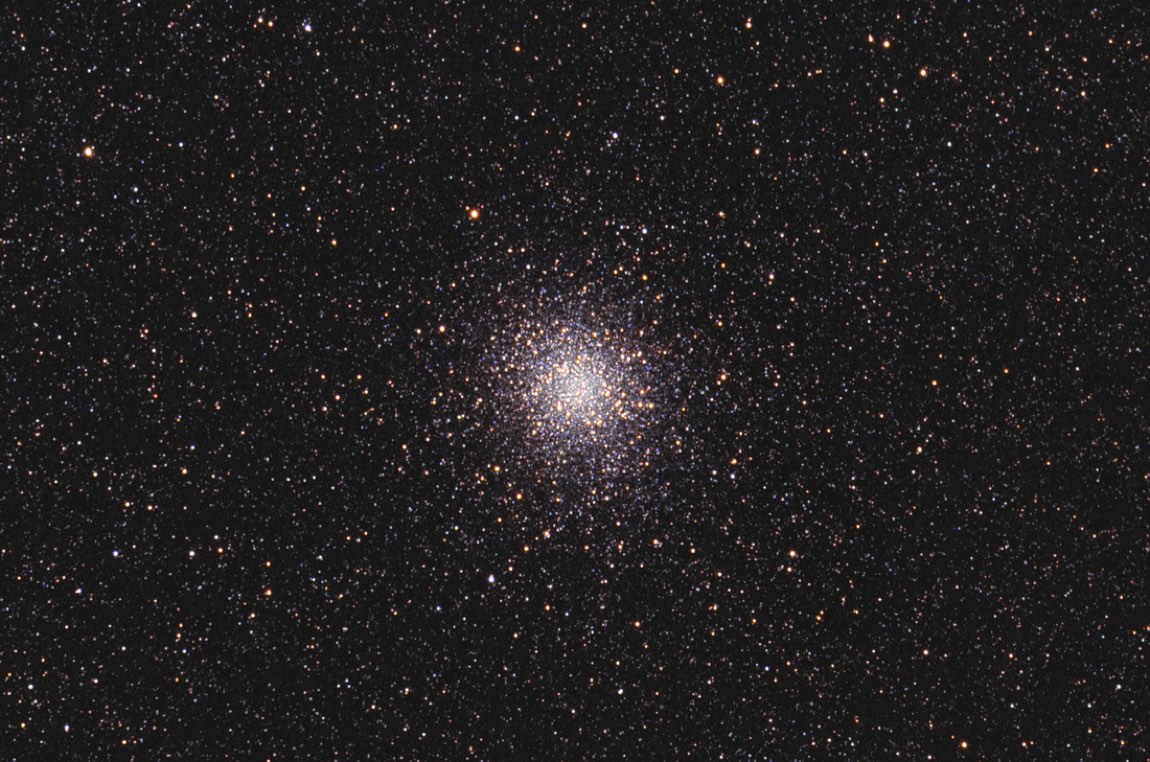
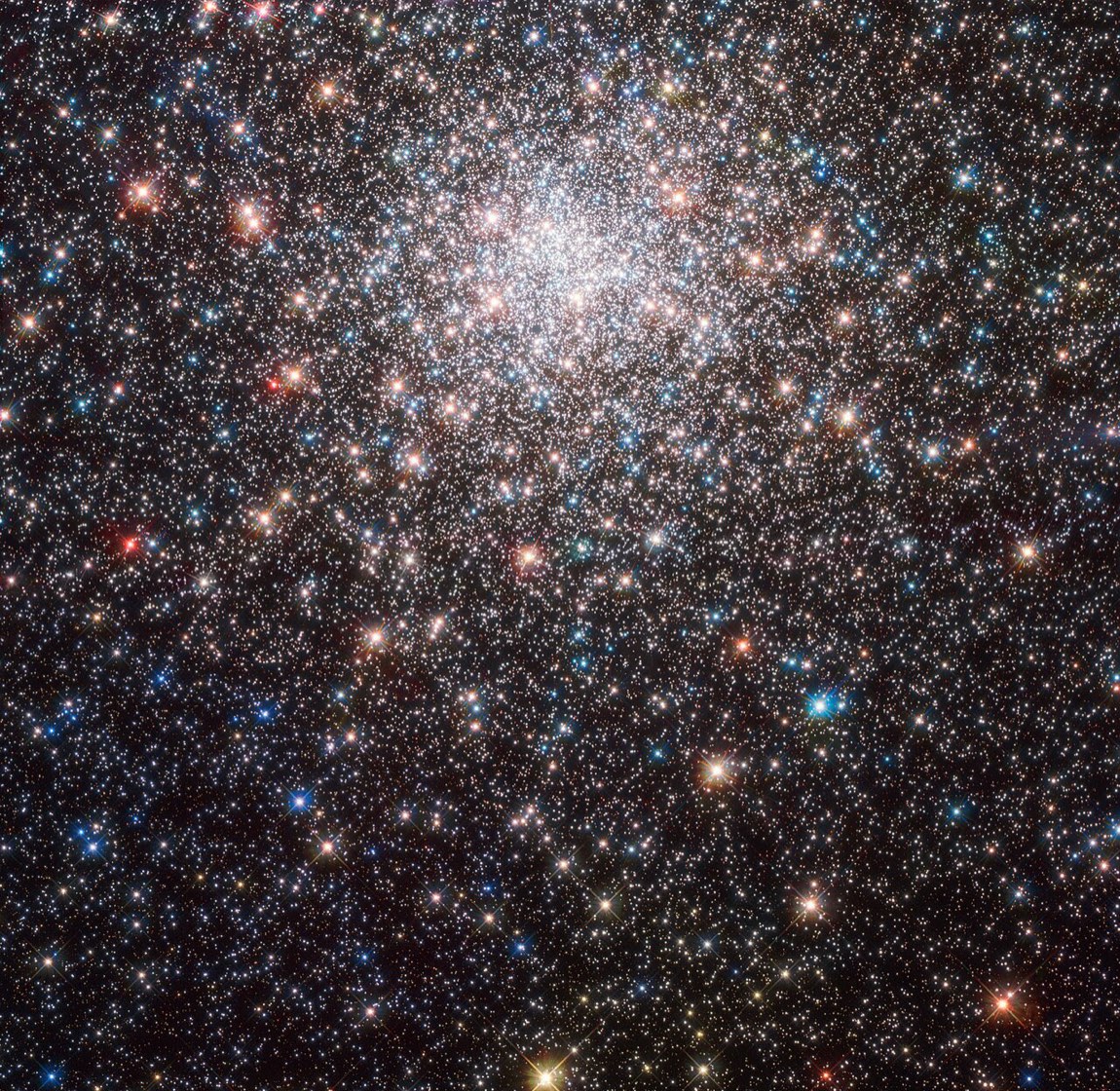
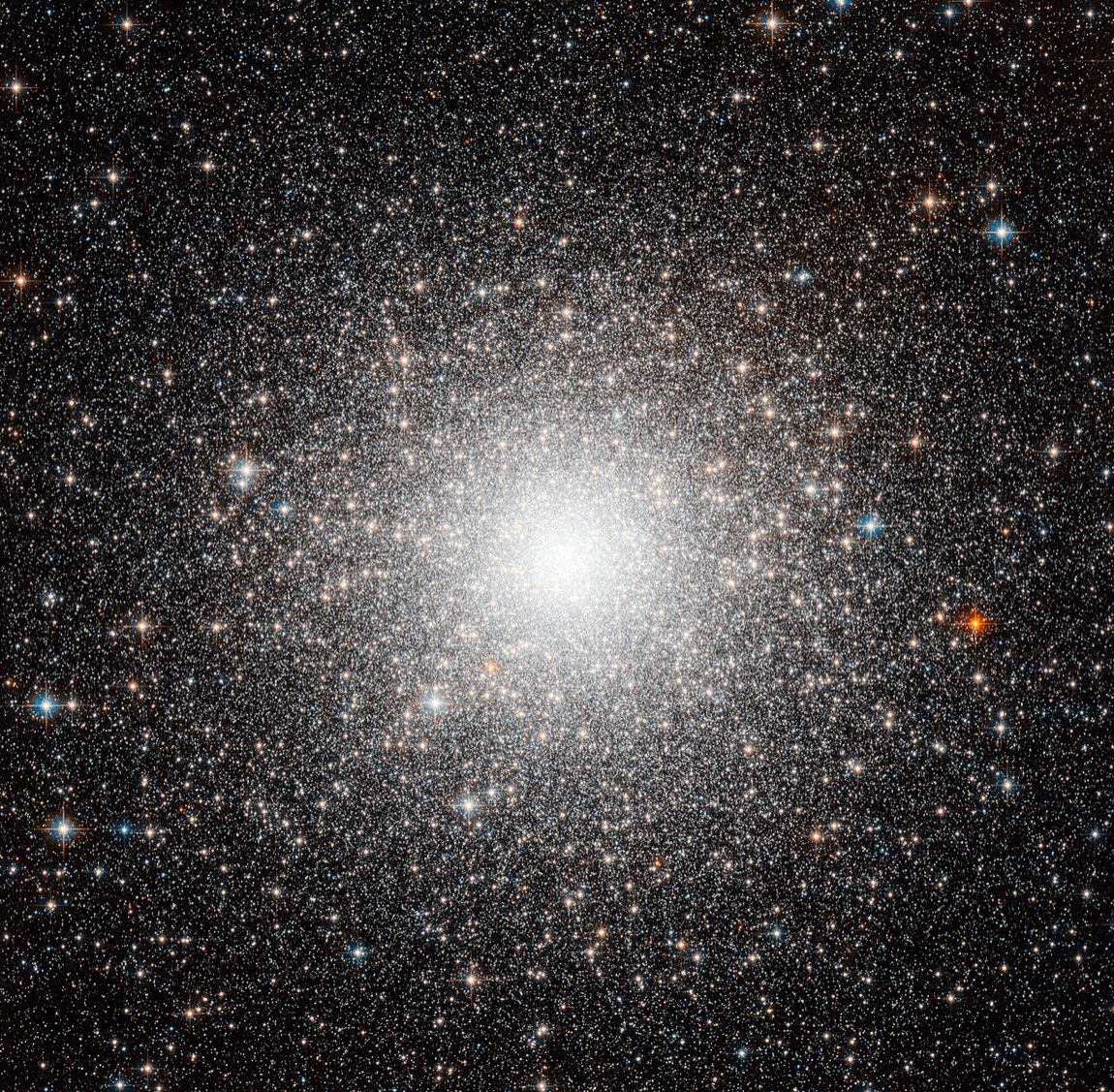
 Photograph · ESA/Hubble & NASA · CC BY 3.0
Star Cluster · Deep guide
Messier 54
Also called: M54 · NGC 6715
A globular cluster that belongs to another galaxy, the Sagittarius Dwarf.
What is it?
Messier 54 is a globular cluster in Sagittarius, discovered by Charles Messier in 1778 near the star Zeta Sagittarii. It was long thought to be part of the Milky Way, but in 1994 astronomers found it most likely belongs to the Sagittarius Dwarf Elliptical Galaxy, a small galaxy being absorbed by ours. Modern estimates put it about 80,000 light-years away, too far for amateur telescopes to resolve its stars. In 2009 a team reported evidence of an intermediate-mass black hole at its core.
The deep dive
Researched for the Atlas from Wikipedia — Messier 54 (1,451 characters read) · updated Nov 15, 2026
01 How Charles Messier Catalogued M54
Charles Messier discovered M54 in 1778 and promptly added it to his famous catalog of objects that could be mistaken for comets. That catalog was a practical tool, not a scientific one — Messier was a comet hunter, and fuzzy smudges in the sky were his occupational hazard. By logging objects like M54, he could quickly rule them out when scanning for new comets. What he could not have known is that this particular fuzzy smudge was not a nearby oddity belonging to our own Milky Way, but a globular cluster sitting at the heart of an entirely different galaxy. For more than two centuries after its discovery, M54 was simply filed away as one of many Milky Way globulars, its true extragalactic nature hiding in plain sight. The misclassification is understandable — the distinction between a distant Milky Way cluster and a cluster belonging to a dwarf satellite galaxy is impossible to make by visual inspection alone, requiring the kind of precise distance measurements that only became available in the late twentieth century.
02 The 1994 Discovery That Changed Everything
For over two hundred years, M54 was assumed to be a Milky Way globular cluster at a distance of roughly 50,000 light-years from Earth. That understanding was overturned in 1994, when astronomers determined that M54 most likely belongs to the Sagittarius Dwarf Elliptical Galaxy, known as SagDEG. That single reassignment made M54 the first globular cluster formerly thought to be part of our own galaxy to be reclassified as extragalactic — a historic first, even though the cluster had been catalogued since 1778. Modern distance estimates now place M54 considerably farther away than the old figure: approximately 79,750 light-years from Earth, which is well beyond the central regions of our own galaxy. The revision illustrates how profoundly our picture of the local universe can shift when better measurement tools arrive. What looks like a neighbour can turn out to be a resident of a whole different galactic system, one that happens to be falling into the Milky Way and is slowly being torn apart by gravitational tides.
03 M54's Strange Address: A Galaxy's Core Deeper
M54 does not merely belong to the Sagittarius Dwarf Elliptical Galaxy — it sits at that galaxy's center. This positional coincidence has sparked a genuine scientific debate about what M54 actually is. Some researchers argue that because it occupies SagDEG's center, it may literally be the core of that dwarf galaxy, the dense nuclear remnant left at its heart. Others take a different view: they propose that M54 is a genuine globular cluster that formed elsewhere within SagDEG and then sank to the center over time. The mechanism they invoke is dynamical friction, a process in which a massive object moving through a sea of lighter bodies experiences a drag force as it gravitationally tugs those bodies along behind it. This drag gradually bleeds energy from the cluster's orbit, causing it to spiral inward until it settles at the galaxy's gravitational center. Both interpretations remain on the table, and resolving the question requires disentangling the cluster's stellar population from the broader stellar population of SagDEG itself — a technically challenging task.
04 Luminosity, Density, and Physical Scale
Despite being located in another galaxy, M54 is a genuinely impressive object by any measure. It shines with the luminosity of roughly 850,000 times that of the Sun, and it carries an absolute magnitude of −10.0, making it intrinsically one of the brighter globular clusters known. It is also one of the denser globulars, rated class III on a concentration scale that runs from class I, the densest, down to class XII, the most loosely packed. A class III rating places M54 firmly toward the compact end of the spectrum, meaning its stars are crowded tightly together near its center. That density matters for understanding its dynamics: closely packed stars interact more frequently, exchanging energy in ways that affect the long-term evolution of the cluster. It also matters for the question of whether a black hole lurks at its core, since dense stellar environments are considered favorable sites for the formation and retention of massive black holes.
05 Evidence for an Intermediate-Mass Black Hole Deeper
In July 2009, a team of astronomers announced that they had found evidence of an intermediate-mass black hole residing in the core of M54. This category of black hole — more massive than the stellar-mass black holes formed when individual stars collapse, but far less massive than the supermassive black holes anchoring large galaxies — has been one of the most elusive objects in astrophysics. Their existence has been theoretically predicted, but confirmed examples are rare and contested. Finding evidence for one inside M54 is particularly significant because of where M54 sits: at the center of SagDEG. If the cluster is indeed the nucleus of that dwarf galaxy, then its central black hole would be the equivalent of a galactic nuclear black hole, offering a low-mass analogue to the supermassive black holes found in larger systems. The discovery connects M54 to broader questions about how black holes form and grow across the full range of galaxy sizes, from dwarf systems like SagDEG up to giants like the Milky Way.
06 Why You Cannot Resolve Its Stars
One of M54's most frustrating observational qualities is that even larger amateur telescopes cannot resolve it into individual stars. This stands in contrast to nearer globular clusters, where a sufficiently powerful backyard telescope can pick out individual stellar points across the cluster's halo. The reason M54 resists resolution is straightforward: it is enormously far away. At roughly 79,750 light-years, its stars are packed so tightly together in angular terms that they blur into a single unresolved glow even at high magnification. The cluster appears as a compact, slightly fuzzy point or a small nebulous patch — consistent enough in appearance with a comet that Messier thought it worth cataloguing as a hazard to comet hunters. Professional telescopes with the light-gathering power and resolution to study M54's stellar content do exist, and they have been essential for measuring the cluster's distance, luminosity, and the dynamics that hint at a black hole in its center.
07 Finding M54 in the Night Sky
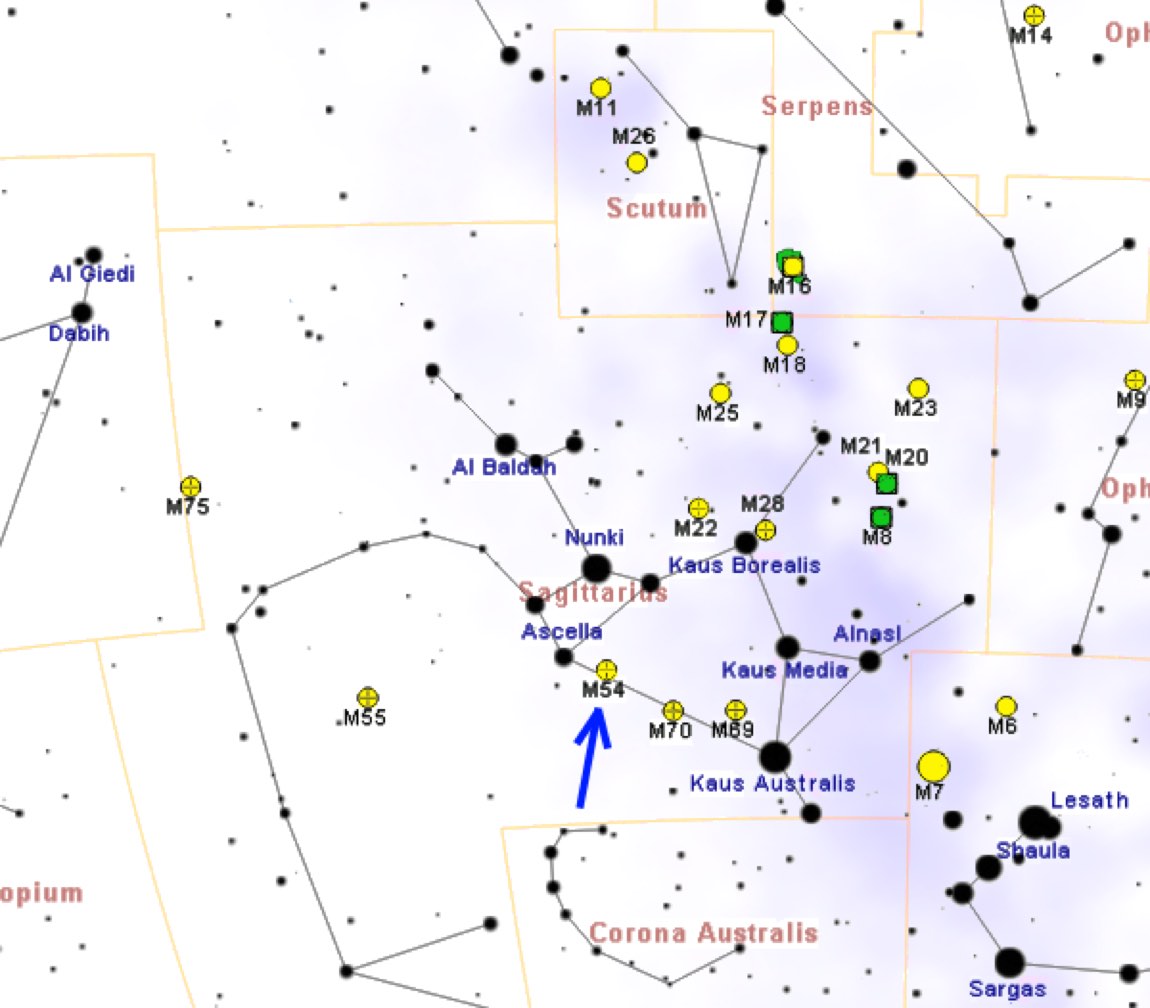
Although M54 belongs to another galaxy and cannot be resolved into stars by amateur instruments, it is still described as easily found in the sky. The key landmark is ζ Sagittarii, one of the named stars in the constellation Sagittarius. M54 sits close to this star on the sky, giving observers a convenient anchor point for locating it. Sagittarius itself is a rich constellation for deep-sky observers, lying in the direction of the Milky Way's core and packed with other Messier objects. Under dark skies, M54 appears as a small, concentrated glow — compact enough that its dense class III structure is at least suggested by its tight, bright appearance relative to more loosely concentrated clusters. Its apparent magnitude means it is within reach of binoculars and small telescopes under good conditions, even if what those instruments show is an unresolved spot of light rather than a resolved swarm of individual suns.
08 The Sagittarius Dwarf Galaxy Connection Deeper
The Sagittarius Dwarf Elliptical Galaxy, SagDEG, is itself one of the more dramatic objects in the local universe. It is a satellite galaxy of the Milky Way, and it is not surviving that relationship intact — gravitational tides from the Milky Way are pulling it apart, stretching its stars into long streams that wrap around our galaxy. M54's membership in SagDEG means the cluster is embedded in a galaxy undergoing active disruption. The fact that M54 sits at SagDEG's center makes it a potential anchor point for understanding the dwarf galaxy's structure and mass distribution. By studying the kinematics of M54 and the stars surrounding it, astronomers can probe conditions at the very heart of a galaxy that is being consumed. M54 thus serves double duty: it is both an object of study in its own right and a probe of its host galaxy's innermost region, one of the rare cases where a globular cluster provides a window into galactic-scale dynamics.
09 A Cluster Mistaken for a Galaxy Piece for 216 Years
The gap between M54's discovery in 1778 and its extragalactic reclassification in 1994 spans 216 years — longer than the United States has existed as a nation. During all that time, astronomers had no reason to suspect it was anything other than a Milky Way globular. The old distance estimate of about 50,000 light-years was consistent with other known clusters, and without precise parallax measurements or reliable standard candles capable of reaching such distances, there was no practical way to test the assumption. The 1994 reassignment depended on recognizing SagDEG as a distinct galaxy in the first place and then connecting M54 to it through distance measurements. This story is a useful reminder that catalog membership does not equal complete understanding. Objects can sit in well-studied lists for generations before a new technique or a new framework reveals that something fundamental about their classification was wrong. M54 holds the distinction of being the first such Milky Way globular to be reassigned to extragalactic status.
10 Open Questions Surrounding M54 Today Deeper
Several significant questions about M54 remain unresolved. The most fundamental is its true nature: is it the actual nucleus of SagDEG, representing the dense core of an ancient dwarf galaxy now being shredded by the Milky Way, or is it a globular cluster that happened to migrate to the center of SagDEG through orbital decay driven by dynamical friction? The two scenarios have different implications for SagDEG's history and mass profile. A second open question concerns the intermediate-mass black hole reported in 2009. The evidence was described as suggestive rather than conclusive, and intermediate-mass black holes in general remain one of astronomy's contested frontiers. Confirming or refuting such an object in M54 would require continued high-resolution spectroscopic study of the cluster's core stellar dynamics. Finally, as SagDEG continues to be disrupted by the Milky Way, the long-term fate of M54 itself is not fully determined — whether it will eventually be fully absorbed into our galaxy's halo or retain some coherent structure is an ongoing area of investigation.
 ⤢