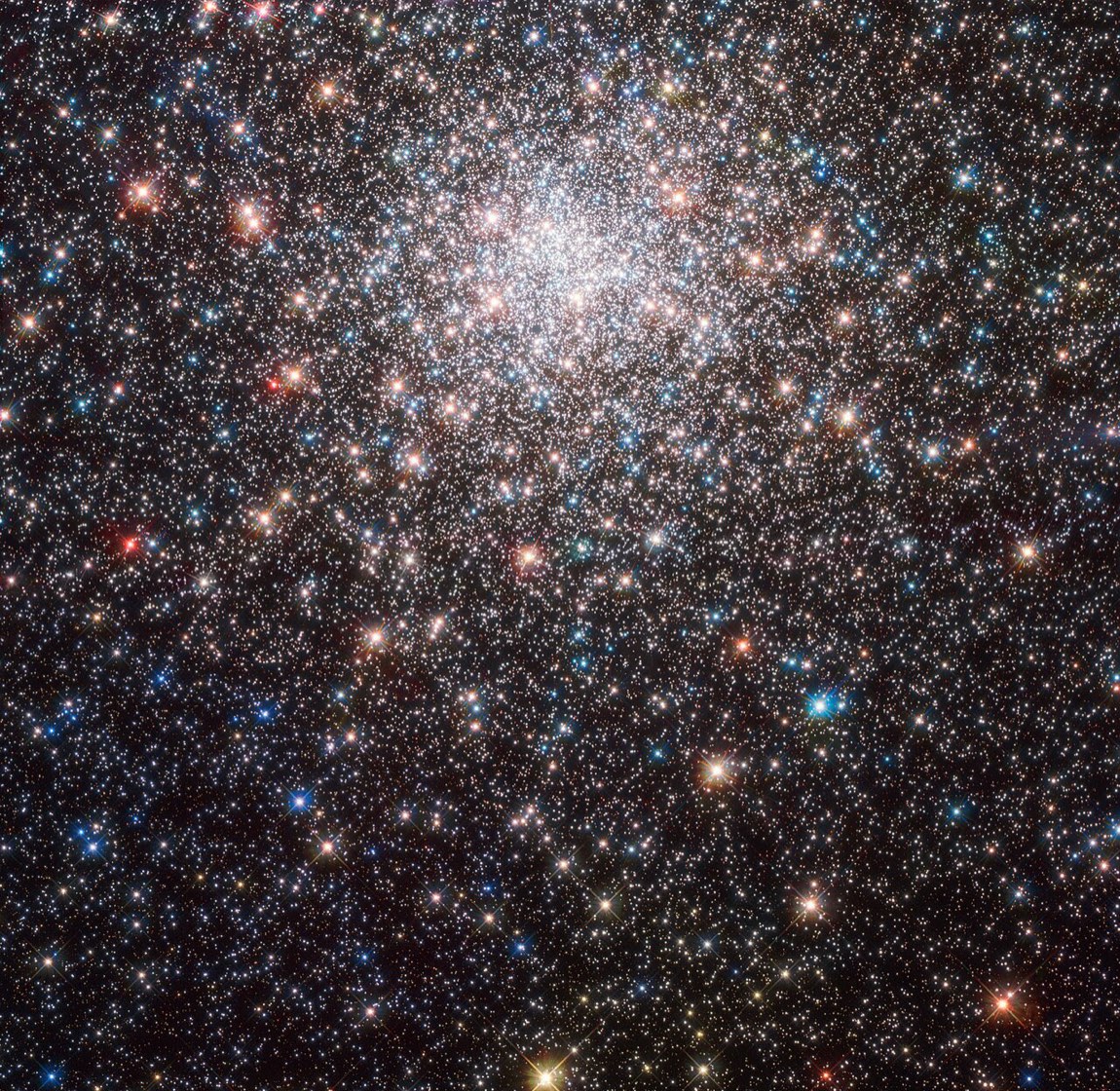
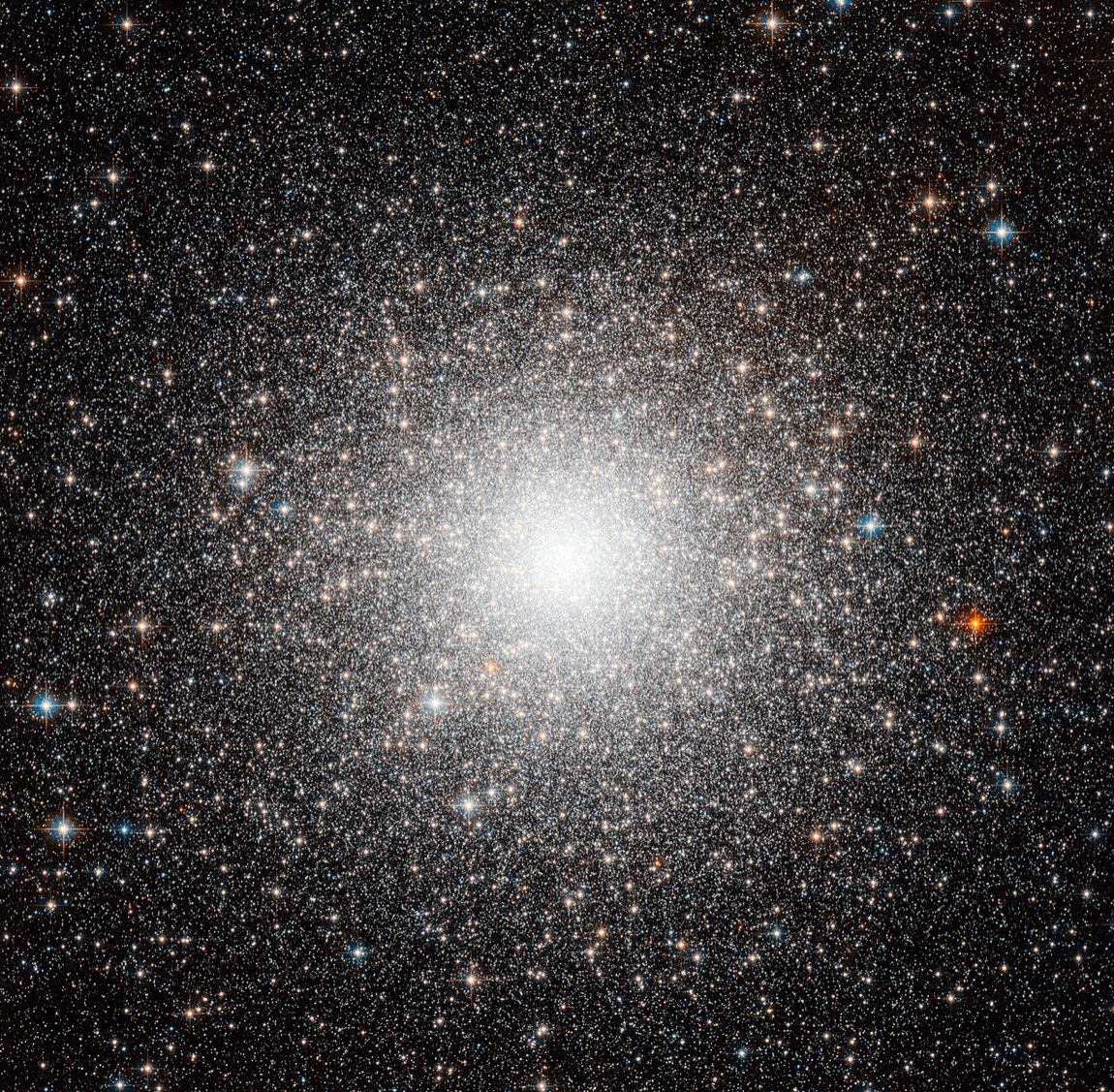
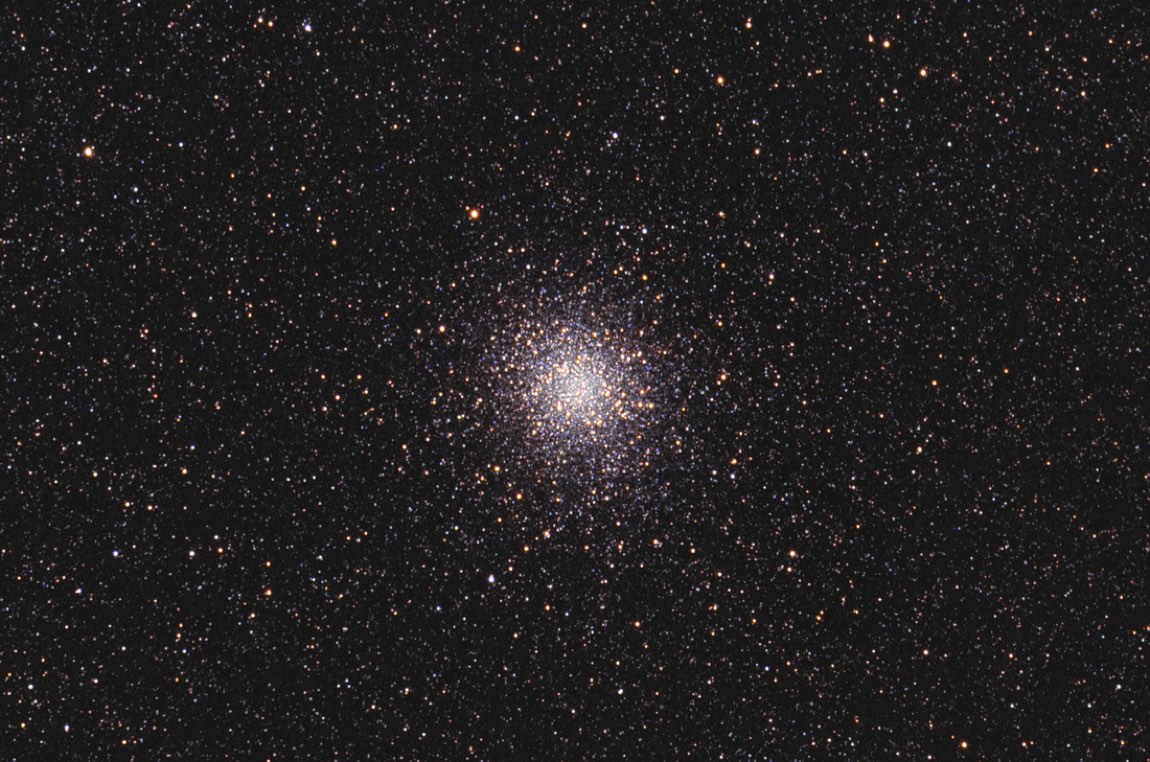
 Photograph · Hewholooks · CC BY-SA 3.0
Star Cluster · Deep guide
Messier 22 (Great Sagittarius Cluster)
Also called: M22 · NGC 6656 · Great Sagittarius Cluster · Crackerjack Cluster
One of the brightest and nearest globular clusters, glittering above the Teapot of Sagittarius.
What is it?
Messier 22 is a globular cluster in Sagittarius and one of the brightest in the night sky. Abraham Ihle found it in 1665, making it one of the first globulars ever discovered. It lies about 10,600 light-years away, one of the closer globulars to Earth, and spans about 99 light-years. Because it sits in front of the crowded galactic bulge, astronomers use it to watch for microlensing, when the gravity of a cluster object briefly magnifies the light of a more distant star.
The deep dive
Researched for the Atlas from Wikipedia — Messier 22 (3,063 characters read) · updated Nov 15, 2026
01 A Cluster Discovered Before the Telescope Era
M22 holds a distinguished place in astronomical history as one of the first globular clusters ever discovered. Abraham Ihle spotted it in 1665, making it among the earliest of its kind recorded by human observers. Nearly a century later, in 1764, Charles Messier catalogued it among his famous list of comet-like objects that could confuse sky-watchers hunting for genuine comets. Scientific study came much later: Harlow Shapley undertook the first careful analysis in 1930, counting roughly 70,000 stars and identifying its dense core. Halton Arp and William G. Melbourne extended that work in 1959. Then, in 1977, James E. Hesser and colleagues noticed something unusual — M22's red giant branch showed an unusually large color spread, similar to the complex stellar population seen in Omega Centauri — and that observation ignited decades of intense scrutiny that continues today.
02 Why M22 Looks Fainter Than It Should
M22 is one of the closest globular clusters to Earth, sitting roughly 10,600 light-years away, and by rights should dazzle any observer. Yet its apparent magnitude is only 5.5, hovering right at the edge of naked-eye visibility under dark skies. The culprit is interstellar dust. M22 lies in front of part of the galactic bulge — the crowded central region of the Milky Way — and that line of sight passes through dust clouds that absorb and scatter its light, a process astronomers call extinction. Without that dimming, M22 would shine considerably brighter. Even so, it earns the title of brightest globular cluster visible from mid-northern latitudes, including Japan, Korea, Europe, and most of North America. Its southerly declination of nearly 24 degrees south of the celestial equator keeps it low in the sky for northern observers, which further reduces its visual impact compared with clusters like M13 and M5.
03 The Physical Scale of a Giant Star City
Stretched across 32 arcminutes of sky — roughly equal to the full Moon's diameter — M22 is an impressively large object for a globular cluster. At its estimated distance of about 10,600 light-years, that angular size translates to a true diameter of 99 plus or minus 9 light-years. To put that in perspective, the nearest star to our Sun, Proxima Centauri, is only about 4.2 light-years away, so M22 spans a distance roughly 24 times that gap from one edge to the other. Its shape is elliptical rather than perfectly spherical, and its interior is not uniform — Harlow Shapley's pioneering 1930 study already identified a dense, concentrated core. Within this enormous volume, 32 variable stars have been recorded, stars whose brightness changes measurably over time and which serve as useful tools for measuring distances and understanding stellar evolution.
04 A Rare Planetary Nebula Hidden Inside Deeper
Among the many thousands of stars packed into M22, astronomers have identified something exceedingly rare: a planetary nebula embedded within the cluster itself. M22 is one of only four globular clusters in the entire Milky Way known to harbor such an object. A planetary nebula forms when a massive star — often a red giant — expels its outer layers in an expanding, glowing shell of gas. The object in M22, designated GJJC1, is estimated to be only about 6,000 years old, making it a very recent arrival on astronomical timescales. Its central star is a blue star. The nebula's existence was first flagged in 1986 by Fred Gillett and his associates, who noticed it as a pointlike infrared light source using the IRAS satellite. Its true nature as a planetary nebula was confirmed by Gillett and colleagues in 1989. The rarity of such objects inside globular clusters makes GJJC1 a scientifically valuable laboratory for studying late stellar evolution in dense, old stellar environments.
05 Two Black Holes and What They Reveal Deeper
In 2012, researchers made a striking discovery inside M22: two black holes, each estimated to weigh between 10 and 20 solar masses. They were first detected using the Very Large Array radio telescope in New Mexico and subsequently confirmed by the Chandra X-ray telescope. Black holes of this mass class are called stellar-mass black holes, formed when massive stars exhaust their fuel and collapse. Their presence inside M22 carries significant theoretical implications. For decades, models of globular cluster dynamics predicted that gravitational interactions would efficiently eject black holes outward and eventually out of the cluster entirely. Finding two still resident inside M22 suggests those ejection processes are not nearly as effective as previously thought. Extrapolating from two detected objects, researchers estimate that M22 may actually contain somewhere between 5 and 100 black holes in total. Beyond that, the ongoing gravitational interactions between stars and black holes are thought to explain another puzzle: why M22 has an unusually large core compared to many other globular clusters.
06 M22 as a Gravitational Lens Deeper
M22's position in front of the galactic bulge gives it a scientific role that goes beyond its own stellar population. Because it sits as a foreground object against the dense background of bulge stars, it creates opportunities for microlensing events — moments when a star or compact object within M22 passes in front of a background star, temporarily bending and amplifying that star's light due to gravity. This effect, predicted by Einstein's general relativity, requires precise alignment of foreground object, lens, and background source, and the rich stellar field of the galactic bulge behind M22 provides an ample supply of potential background targets. Microlensing surveys using M22 can help astronomers search for compact dark objects — including black holes, neutron stars, or even rogue planets — that would otherwise be completely invisible. This makes the cluster not just an object of study in itself but also a natural gravitational instrument for probing the contents of the galactic bulge beyond it.
07 Metal-Poor Stars and What That Tells Us Deeper
M22 is described in the astronomical literature as a metal-poor cluster, meaning its stars contain relatively low abundances of elements heavier than hydrogen and helium. In astronomy, all elements heavier than helium are collectively called metals, and their abundance in a star reflects the chemical enrichment history of the gas from which that star was born. Metal-poor globular clusters like M22 are generally very old, having formed early in the universe's history when fewer generations of stars had yet forged and dispersed heavy elements through supernovae. The large color spread of M22's red giant branch — the feature that caught James Hesser's attention in 1977 and drew comparisons to the complex cluster Omega Centauri — suggests that the cluster may not have had a single, simple formation event. Such color spreads can indicate multiple stellar populations or variations in chemical composition among member stars, hinting at a more complex early history than a simple, single-burst origin story would predict.
08 How to Find and Observe M22
For observers in the northern hemisphere, M22 is best sought on summer nights when Sagittarius climbs as high as it will get above the southern horizon. A useful starting point is Lambda Sagittarii, also known as Kaus Borealis, the northernmost star of the famous Teapot asterism that marks Sagittarius. M22 lies to the northeast of that star. With an apparent magnitude of 5.5, it sits right at the threshold of naked-eye visibility under truly dark skies, though most observers will first pick it up with binoculars as a soft, slightly resolved glow. An 8-inch telescope will begin to resolve hundreds of individual member stars, since the brightest stars in the cluster shine at 11th magnitude. Despite being the brightest globular visible from mid-northern latitudes including most of North America, Japan, Korea, and Europe, its low altitude from those locations means it never looks quite as striking as it would from more southerly viewing sites, where it climbs higher and its light passes through less turbulent atmosphere.
09 The Cluster's Place Near the Galaxy's Heart
M22 resides in the constellation Sagittarius, in the direction of the galactic bulge — the dense, roughly spherical concentration of old stars that swells around the Milky Way's center. This location is not coincidental; globular clusters in our galaxy tend to concentrate around the galactic center, orbiting it in a roughly spherical halo. M22's position near the bulge means that when we look at it, we are gazing in the general direction of the galaxy's core, through increasingly crowded stellar fields and dust lanes. That proximity to the bulge is what enables M22's scientific use as a gravitational microlensing tool. It also means the cluster sits in a region of the sky densely packed with Milky Way stars, creating a spectacular star-field backdrop that enhances the visual drama of observing it through a telescope on a clear summer night.
10 Variable Stars as Clocks and Rulers Deeper
Among M22's population of approximately 70,000 stars, astronomers have identified 32 variable stars — stars that change their brightness in a measurable, often periodic way. Variable stars in globular clusters are scientifically prized for several reasons. Certain classes of variables, particularly RR Lyrae stars, pulsate with a well-understood relationship between their period and their true luminosity, making them reliable distance indicators known as standard candles. Because globular clusters are compact and all their member stars lie at essentially the same distance from Earth, measuring the period of a variable star inside M22 can help refine the distance estimate to the whole cluster. Variable stars also serve as probes of stellar physics, revealing information about the internal structure, composition, and evolutionary stage of stars in ways that steady, non-varying stars cannot. The 32 known variables in M22 represent a resource that researchers can return to as instrumentation and analysis techniques improve over time.
11 The Unusual Core and What Stirs It Deeper
One of M22's distinguishing structural features is its unusually large core — the central, densely packed region of the cluster where stellar crowding is highest. Harlow Shapley first noted the dense core during his 1930 study, but subsequent research has raised the question of why it is as extended as it is. The 2012 discovery of two stellar-mass black holes, each between 10 and 20 solar masses, provided a compelling explanation. When black holes of significant mass remain embedded within a globular cluster, they interact gravitationally with the surrounding stars. These interactions transfer energy from the black holes' orbits into the stellar population, effectively inflating or stirring the core and preventing it from collapsing inward as tightly as clusters without such black holes tend to do. If M22 harbors anywhere from 5 to 100 black holes as the current estimates suggest, those objects would collectively exert a substantial ongoing influence on the cluster's internal dynamics — making M22's core structure a living record of its hidden black hole population.
 ⤢