 Photograph · Chuck Ayoub · CC0
Star Cluster · Deep guide
Messier 35 (Shoe-Buckle Cluster)
Also called: M35 · NGC 2168 · Shoe-Buckle Cluster
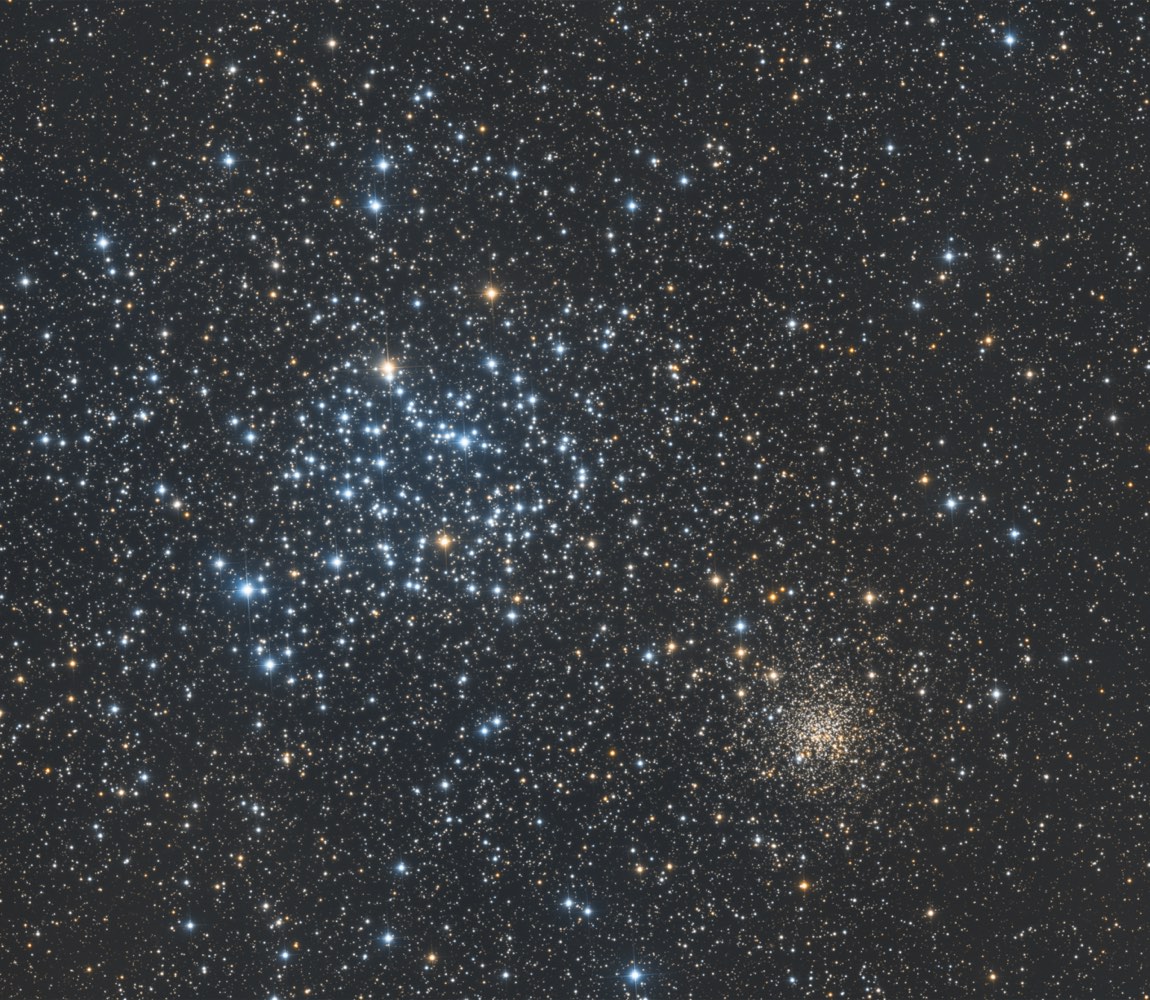
A bright open cluster at the feet of Gemini, with a more distant cluster peeking from behind.
What is it?
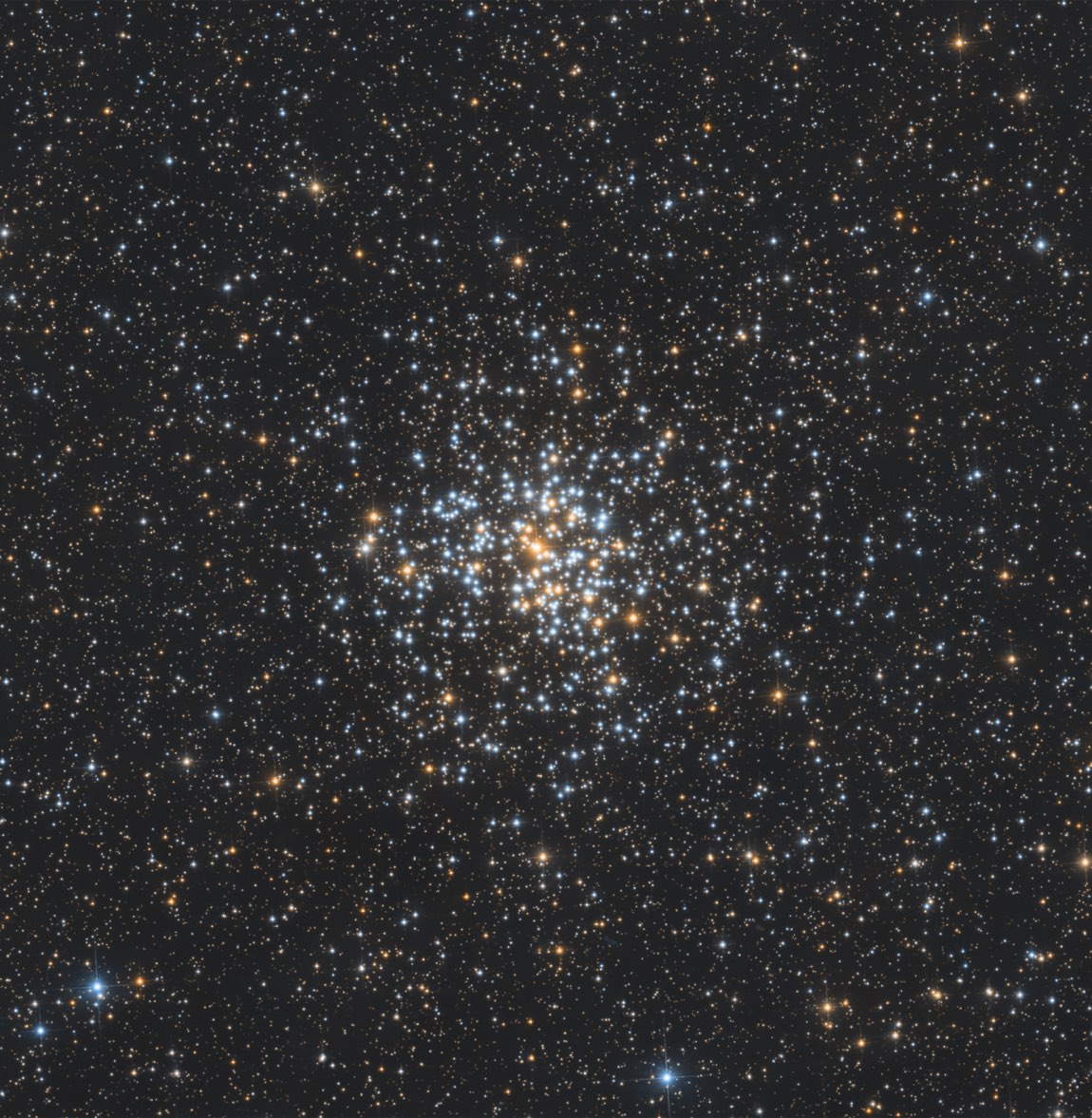
Messier 35 is an open cluster in western Gemini, spread over an area almost as large as the full Moon. Philippe Loys de Chéseaux found it around 1745, and John Bevis independently found it before 1750. It lies about 2,970 light-years away and is roughly 100 million years old, with a mass of about 1,600 Suns. Just southwest of it, a telescope shows the compact cluster NGC 2158, which is much farther away.
The deep dive
Researched for the Atlas from Wikipedia — Messier 35 (1,729 characters read) · updated Nov 15, 2026
01 Two Discoverers, One Cluster
Messier 35 carries the fingerprints of two independent minds working in the same era. Philippe Loys de Chéseaux, a Swiss astronomer, spotted the cluster around 1745, but English astronomer John Bevis independently found it before 1750 — neither apparently aware of the other's work. The cluster eventually entered history under Charles Messier's famous catalog, as was typical for objects of this period: Messier himself is remembered for the list rather than the discoveries it absorbed. This double-discovery story is a reminder of how lively and competitive observational astronomy was in the mid-eighteenth century, when telescopes were becoming good enough to reveal faint patches of sky as resolvable swarms of stars, but communication between observers across Europe was slow enough that duplication was common. The cluster also carries the designation NGC 2168, assigned later when John Louis Emil Dreyer compiled his New General Catalogue, giving the object a second identity it still answers to today.
02 A Neighbor Cluster Hiding in Plain Sight
Directly southwest of Messier 35, so close in the sky that a telescope eyepiece can frame both at once, sits the compact open cluster NGC 2158. The juxtaposition is one of the more striking visual coincidences in amateur astronomy — a loose, sparkling swarm sitting beside a tighter, hazier knot. The article does not give NGC 2158's distance, so we cannot say whether the two clusters are physically related or simply a line-of-sight coincidence, but their apparent proximity makes wide-field views of this region of Gemini particularly rewarding. Messier 35 itself lies in the western part of Gemini at roughly the same declination the Sun occupies at the June solstice, which is a handy celestial landmark: it marks a boundary in the sky that has carried calendrical meaning for millennia, even though the cluster itself sits 2,970 light-years (912 parsecs) away — far beyond anything our solar system can claim as a neighbor.
03 How Wide Is the Shoe-Buckle Cluster?
One of the first things that strikes observers about Messier 35 is sheer scale. Spread across a patch of sky almost as large as the full moon, the cluster is generously sized for a backyard telescope. That apparent size reflects both its true physical extent and its relative closeness at 2,970 light-years. For the mass study by Bouy et al. in 2015, researchers defined the cluster's central region using a box 27.5 arcminutes by 27.5 arcminutes — a substantial surveying footprint on the celestial sphere. Within that region they found a mass of around 1,600 solar masses. The angular breadth of the cluster also means that membership determination is a real scientific challenge: distinguishing genuine cluster stars from background and foreground field stars requires careful analysis of proper motions, parallax measurements, and spectral signatures rather than simply drawing a circle on a chart and counting everything inside.
04 Weighing a Star Cluster Without a Scale Deeper
Calculating the mass of a star cluster from Earth requires clever indirect methods, and Messier 35 has been the subject of two notable attempts using different approaches. Leonard and Merritt in 1989 applied a statistical technique built around the proper motion velocities of cluster stars — essentially using the spread of sideways motion across the sky as a proxy for the gravitational well holding the cluster together. Their result for the mass enclosed within the central 3.75 parsecs (12.2 light-years) fell between 1,600 and 3,200 solar masses, a range they considered consistent with what a realistic stellar population should contribute within that radius. Twenty-six years later, Bouy et al. in 2015 approached the problem with richer kinematic and spectral data and arrived at a mass of around 1,600 solar masses within the central 27.5-by-27.5-arcminute area. The two results bracket each other, with the lower bound of the older estimate matching the newer figure — a satisfying, if imprecise, convergence across a quarter century of improving data.
05 Membership: Who Really Belongs? Deeper
Deciding which stars genuinely belong to Messier 35 and which merely share the same patch of sky is one of the more nuanced problems in open cluster research. Using kinematic data — parallax measurements and proper motion — alongside spectral information published before 2015, researchers identified 305 stars that can be shown with very high confidence to be true members. But the picture becomes fuzzier when probability thresholds are relaxed: averaging over stars with a 50 percent membership probability inflates the count to as many as 4,349. That ten-fold difference illustrates how richly populated the background star field is in this direction of Gemini. The concept of membership itself carries a subtlety: a star counts as a member if it is gravitationally bound to the cluster, but also if it was recently freed from that gravitational tie — meaning it was formed in the same event and has not yet drifted far enough to be unrecognizable as kin.
06 Binary Stars Hidden Among the Members Deeper
Among 418 probable members examined by Leiner et al. in 2015, 64 — roughly one in six — betrayed themselves as binary star systems through variable radial velocities. A star that appears to speed toward and away from us in a periodic rhythm is almost certainly being tugged by an unseen companion as the two orbit their common center of mass. Finding binaries this way, through spectroscopy rather than direct imaging, is called the radial velocity method, and it is particularly sensitive to close pairs that orbit quickly. A binary fraction of roughly 15 percent among studied members is scientifically meaningful: binary stars influence a cluster's dynamical evolution, transferring kinetic energy in gravitational encounters and affecting how the cluster disperses over time. Whether this binary fraction is typical, elevated, or depleted relative to other open clusters of similar age is a question the article does not fully resolve, leaving room for further comparative study.
07 Chemically Peculiar Stars in the Cluster Deeper
Four probable members of Messier 35 are classified as chemically peculiar stars — objects whose surface abundances of certain elements are dramatically enhanced or depleted relative to normal stars of the same temperature. Chemical peculiarity in open cluster stars is of particular interest to astronomers because clusters provide a controlled environment: all members should have formed from the same original gas cloud at roughly the same time, so any chemical oddities must arise from processes operating within individual stars after formation, such as gravitational settling or radiative levitation of elements through the stellar atmosphere. Beyond these four, one star designated HD 41995 sits within the angular field of the cluster and shows emission lines in its spectrum. Emission-line stars are notable because they indicate gas surrounding or falling onto the star, often associated with rapid rotation or outflow — but the article is careful to note only that HD 41995 lies within the telescopic angular field, stopping short of confirming it as a true cluster member.
08 Variable Stars: At Least Three Suspects
In 2005, Hu et al. conducted a search for variable stars across the field of Messier 35 and turned up 13. Variability — brightness that changes over time — can arise from many causes: pulsation, eclipses by a companion, starspot activity, or outbursts. Of the 13 variables found, at least three are suspected to be genuine cluster members rather than background objects whose light happens to pass through the same region of sky. The phrasing "at least three are suspect as cluster members" is deliberately cautious, because confirming membership requires the same kinematic and spectral work applied to the broader cluster population, and that confirmation had not been fully established by the time the article was written. Variable stars within clusters are particularly valuable scientifically because knowing a star's distance and age — both set by cluster membership — helps calibrate models of stellar pulsation and evolution that otherwise have more free parameters.
09 The Cluster's Chemical Fingerprint Deeper
The metallicity of Messier 35 is measured at [Fe/H] = −0.21 ± 0.10. This notation compares the iron abundance of cluster stars to that of the Sun on a logarithmic scale: a value of zero would mean solar metallicity, while −1 would mean ten times less iron than the Sun. At −0.21, Messier 35 stars are modestly iron-poor — roughly 60 percent of the Sun's iron content, though the uncertainty of ±0.10 gives a real spread of possibilities. The slight metal deficiency is not dramatic; it places M35 among the many open clusters that formed from gas already somewhat enriched by previous stellar generations but not as enriched as the material that formed our own solar system. Metallicity matters because it influences stellar evolution timescales, the likelihood of planet formation, and the colors of the cluster's stars. The ±0.10 uncertainty also reminds readers that measuring iron abundances in dozens of stars and averaging them is an intrinsically statistical enterprise, prone to both measurement error and real star-to-star scatter.
10 Observing Messier 35 for Yourself
Messier 35 sits in the western part of Gemini at the declination the Sun occupies at the June solstice, which makes it a winter and early spring showpiece for observers in the northern hemisphere, well-placed in evening skies when Gemini rides high. Its apparent diameter approaches the full moon's width, so it rewards a wide-field eyepiece or even steadily held binoculars more than high magnification. At its distance of 2,970 light-years the cluster resolves beautifully into individual stars under modest aperture, filling the field with a loose spray of points. The nearby compact cluster NGC 2158 adds a visual bonus directly to the southwest, its condensed haze offering a striking contrast to M35's open texture. Identifying both in a single low-power view is a classic pairing that experienced observers recommend. The cluster's apparent magnitude is bright enough to locate under suburban skies, though dark skies reveal the full star count and the contrast with the background Milky Way field behind it.
11 Open Questions Still Surrounding M35 Deeper
Even a relatively well-studied cluster like Messier 35 carries unresolved scientific questions. The mass estimates from 1989 and 2015 span a wide range — 1,600 to 3,200 solar masses in the central region alone — and the true total mass of the cluster, including its outer halo, remains uncertain. The nature of HD 41995, the emission-line star in the cluster's angular field, has not been settled: is it a genuine member with unusual physics, or simply a background star? The variable stars identified by Hu et al. in 2005 are only tentatively linked to the cluster, leaving their nature ambiguous. The binary fraction of roughly 15 percent among studied members may not represent the full cluster population, since the radial velocity method is biased toward short-period pairs. And the chemically peculiar members invite further study: understanding how peculiarity develops in a cluster environment, where stellar ages and initial compositions are controlled, could sharpen models of atomic diffusion inside stellar atmospheres. The 2015 data cutoff means more recent surveys using missions like Gaia have likely refined membership lists, distances, and mass estimates in ways the article does not capture.