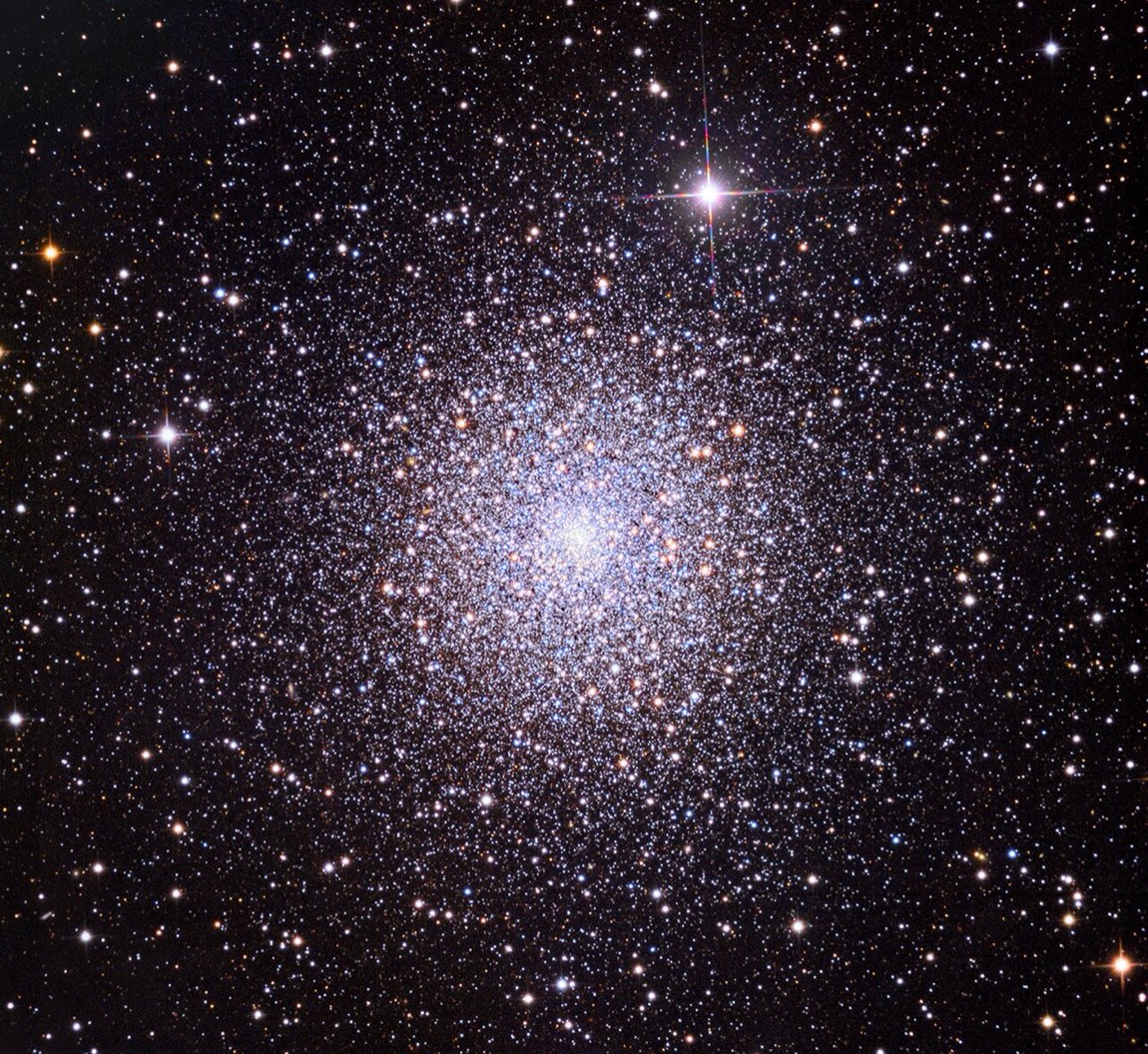
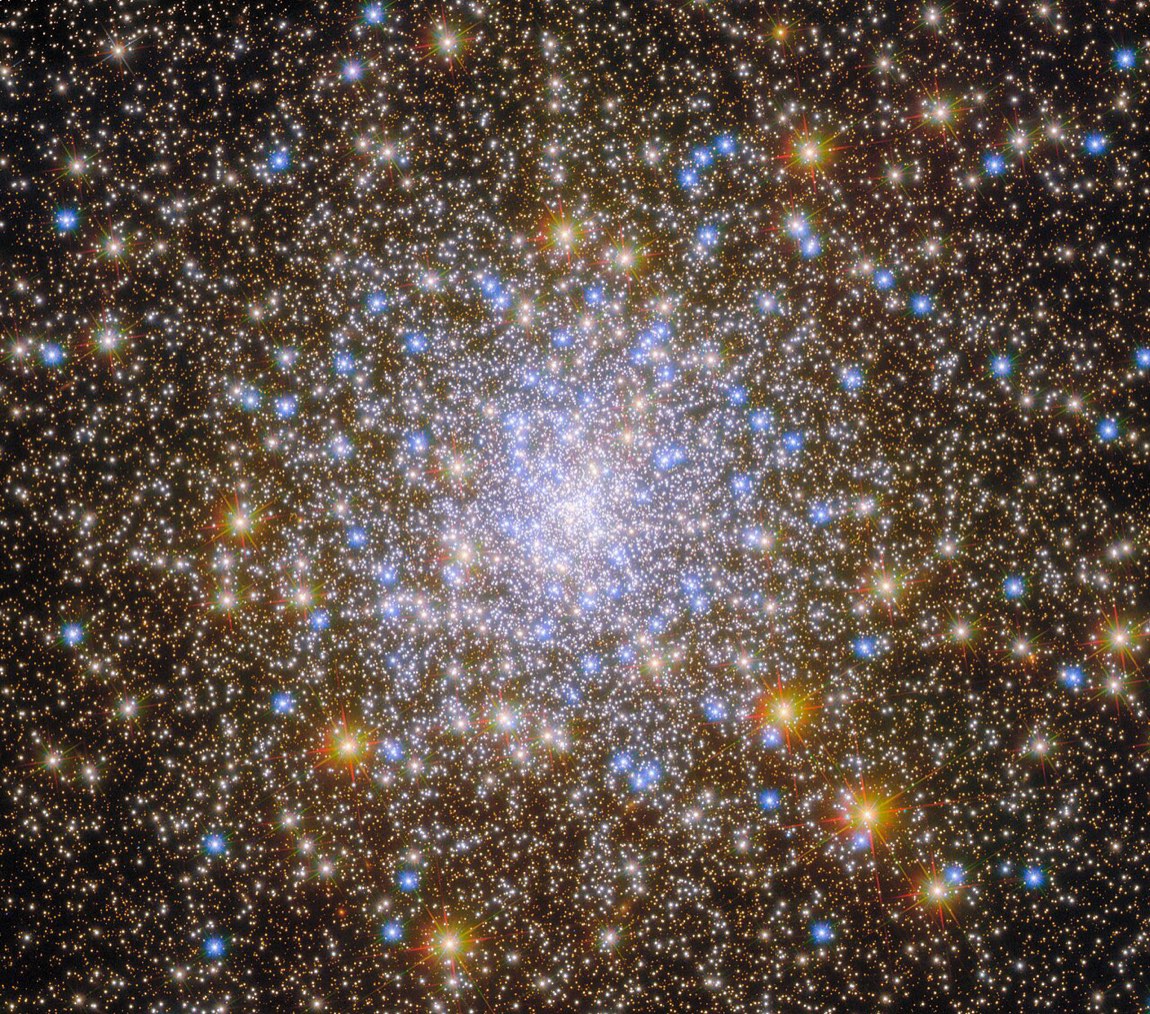
 Photograph · ESA/Hubble & NASA, M. Libralato, G. Piotto, A. Sarajedini · CC BY 4.0
Star Cluster · Deep guide
Messier 30 (Jellyfish Cluster)
Also called: M30 · NGC 7099 · Jellyfish Cluster
An ancient globular cluster in Capricornus, almost 13 billion years old.
What is it?
Messier 30 is a globular cluster in southeastern Capricornus, discovered by Charles Messier in 1764. Binoculars show it as a hazy, slightly oval patch, while larger telescopes reveal individual stars and a very compressed core. It lies about 27,100 light-years away, is about 93 light-years across and holds roughly 160,000 times the mass of the Sun. At an estimated 12.9 billion years, its stars formed when the universe was young.
The deep dive
Researched for the Atlas from Wikipedia — Messier 30 (2,232 characters read) · updated Nov 15, 2026
01 How Charles Messier First Saw It
On the night of August 3, 1764, the French astronomer Charles Messier turned his telescope toward the southern constellation Capricornus and recorded what he called a circular nebula without a star. He had no way of resolving the individual points of light packed into the cluster — his instruments simply blurred them together into a glowing smudge. More than a century later, compilers of the New General Catalogue in the 1880s gave it a warmer review, describing it as a "remarkable globular, bright, large, slightly oval." That oval shape is real and detectable even today: a pair of 10×50 binoculars will show a hazy patch about 4 arcminutes wide that is slightly stretched along the east–west axis. What Messier logged as a featureless blob has since revealed itself to be one of the more structurally interesting globular clusters in the galaxy, with a collapsed core and an unusual origin story.
02 A Cluster That Came from Somewhere Else
Most globular clusters in the Milky Way orbit the galactic center in roughly the same direction as the rest of the galaxy's rotating disk. M30 does not. It follows a retrograde orbit — moving against the general flow — through the inner galactic halo. That backward motion is a strong fingerprint of foreign origin. Astronomers interpret it as evidence that M30 was not born inside the Milky Way at all, but was instead acquired from a satellite galaxy that was later absorbed and torn apart by our own. In a sense, M30 is a refugee: its stars formed in a different galactic environment, possibly billions of years before the merger, and were only later folded into the Milky Way's collection. At its current estimated age of roughly 12.9 billion years, M30 formed when the universe itself was less than a billion years old, making this retrograde orbit a rare preserved clue about an ancient galactic collision.
03 Core Collapse: A Gravitational Catastrophe Deeper
M30 has passed through one of the most dramatic events a globular cluster can experience: core collapse. Over billions of years, gravitational interactions among stars cause heavier stars to sink toward the center while lighter ones drift outward — a process called mass segregation. Eventually this runaway concentration reaches a tipping point, and the core contracts to an extraordinary density. M30's core now packs roughly a million solar masses into every cubic parsec of space — a cubic parsec being a cube about 3.26 light-years on each side, roughly the distance from the Sun to Alpha Centauri. That density makes the core one of the highest-density regions anywhere in the Milky Way. The cluster's overall diameter spans about 93 light-years, but when observed with a large telescope the core appears as a compressed knot just about one arcminute wide with still further star density packed within it. The contrast between that dense nucleus and the outer halo is one of the defining visual signatures of a post-core-collapse globular.
04 Blue Stragglers: Stars That Cheat Time
Inside M30's crowded core, stars pass so close to one another so frequently that strange things happen. One remarkable product of these stellar traffic jams is a class of object called a blue straggler. Normal stellar evolution dictates that old, massive stars should have long since exhausted their fuel and died — yet blue stragglers appear young, hot, and blue in clusters that are nearly as old as the universe. The leading explanation is mass transfer: when two aging stars orbit each other closely, one can siphon hydrogen from its companion, essentially refueling itself and resetting parts of its evolutionary clock. The dense environment of M30's collapsed core creates the crowding necessary for these interactions to happen at a high rate. Blue stragglers are therefore not genuinely young stars — they are old stars that have been rejuvenated by their neighbors, and M30's post-collapse core is an especially productive factory for producing them.
05 Binary Stars Born from Near Collisions Deeper
Beyond blue stragglers, the intense stellar density in M30's core drives another unusual outcome: the creation of binary star systems through dynamical encounters. In less crowded environments, most binaries form together from the same cloud of gas during a cluster's birth. In a core-collapsed cluster like M30, however, stars pass close enough to each other that gravitational interactions can capture two previously unrelated stars into a mutual orbit, or harden existing binary systems by drawing them closer together. These dynamically formed binaries are significant because they act as a kind of gravitational heat source for the cluster. When a binary interacts with a passing single star, energy can be transferred outward, slightly counteracting the inward collapse of the core. Studying the binary population in M30 therefore gives astronomers a window not just into exotic stellar physics but into the long-term dynamical fate of the cluster itself.
06 A Color Gradient Pointing to the Center Deeper
One of the more visually striking consequences of M30's core collapse is a color gradient that runs across the cluster's face. Mass segregation — the gravitational tendency for heavier stars to sink inward — has caused the central region to accumulate a greater proportion of high-mass stars relative to the outer halo. Because more massive stars burn hotter and emit more blue light, the core of M30 appears bluer than its outskirts. This gradient is not simply an optical illusion or an artifact of the cluster's overall age; it is a direct, observable record of the mass-sorting process that has been operating for billions of years. Detecting such gradients requires careful photometric measurements across different radii of the cluster, and M30 serves as one of the cleaner examples of this phenomenon among post-core-collapse globulars, making it a useful calibration point for models of cluster evolution.
07 M30's Address in the Galaxy
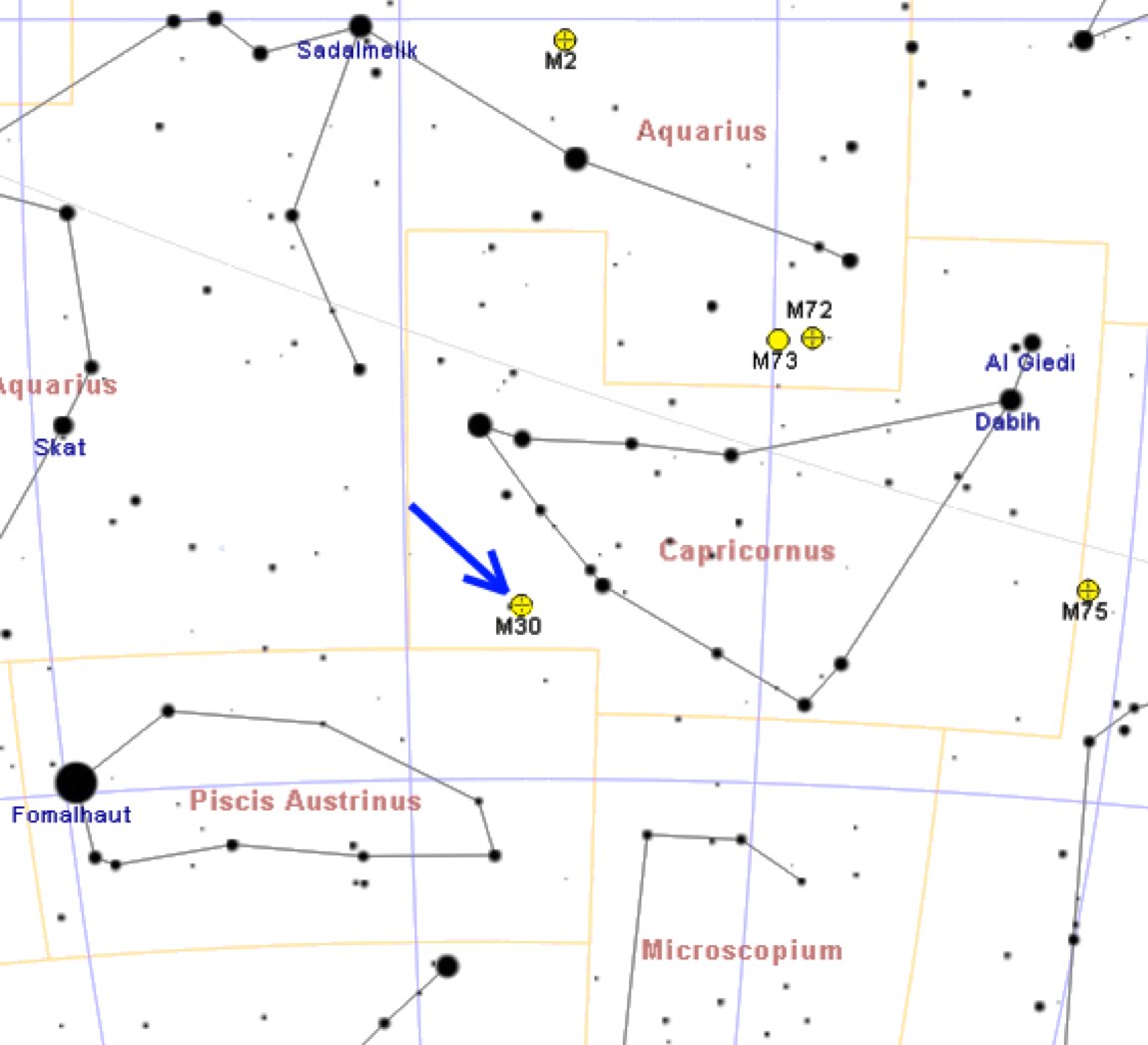
M30 sits about 27,100 light-years from Earth, with a margin of error of roughly 2.5 percent — meaning the true distance could plausibly be anywhere from about 26,400 to 27,800 light-years. For comparison, the Sun itself is estimated to lie about 26,000 light-years, or 8.0 kiloparsecs, from the galactic center. M30 is currently 22,200 light-years, or 6.8 kiloparsecs, from the galactic center, placing it closer to the Milky Way's core than our own solar system is. The cluster sits in the southern constellation Capricornus, at roughly the same declination the Sun occupies at the December solstice. Because of its position relative to Earth's orbit around the Sun, M30 reaches its best viewing window — when it is on the opposite side of the sky from the Sun — in the first half of August each year.
08 How to Find and Observe M30
M30 is an accessible target for amateur astronomers willing to point their equipment toward the southern reaches of Capricornus during summer evenings in the Northern Hemisphere. A pair of 10×50 binoculars is sufficient to show it as a soft, slightly elongated glow about 4 arcminutes wide, stretched gently along the east–west direction. Stepping up to a larger telescope — even a modest backyard instrument — begins to resolve individual stars at the cluster's edges and reveals the full angular size, which extends up to 12 arcminutes across. The compressed core, about one arcminute wide, becomes visible as a noticeably brighter and tighter knot at the cluster's heart. The first half of August offers the longest window for observation when the cluster is in opposition to the Sun, maximizing the hours it spends above the horizon in a dark sky. Southern Hemisphere observers enjoy a higher altitude view that makes the detail even easier to tease out.
09 What 160,000 Solar Masses Looks Like
M30 contains a total mass of approximately 160,000 times the mass of the Sun. That number is large enough to be hard to grasp, but here is one way to frame it: if you replaced every person alive on Earth today with a copy of the Sun, you would need to repeat that exercise about twenty times before reaching M30's total mass. All of that material — hundreds of thousands of stars at various stages of their lives — is packed into a sphere about 93 light-years across, with the overwhelming majority of the mass concentrated in and near the collapsed core. The cluster's age of roughly 12.9 billion years means that the most massive stars, which burn through their fuel fastest, have long since exploded as supernovae. What remains today are the survivors: lower-mass stars, red giants, white dwarfs, neutron stars, and those peculiar rejuvenated blue stragglers born from the chaos of the dense interior.
10 Open Questions About M30's Past and Future Deeper
Several threads about M30 remain genuinely unsettled. The retrograde orbit strongly implies an extragalactic origin, but astronomers have not definitively identified which satellite galaxy once hosted M30 before the Milky Way absorbed it. Matching disrupted satellite remnants to their former globular clusters is an active area of research. Within the cluster, questions persist about the ultimate fate of a post-core-collapse system: will M30 eventually re-expand its core through binary-star heating, achieving a new equilibrium, or will it continue contracting? Whether a central intermediate-mass black hole — something between a stellar black hole and a supermassive one — lurks at the center of M30's dense core is also unresolved; such objects have been proposed for some collapsed clusters but are notoriously difficult to confirm observationally. Each of these open questions makes M30 more than a beautiful object in a backyard telescope — it is a live laboratory for some of the deepest problems in stellar dynamics.
 ⤢