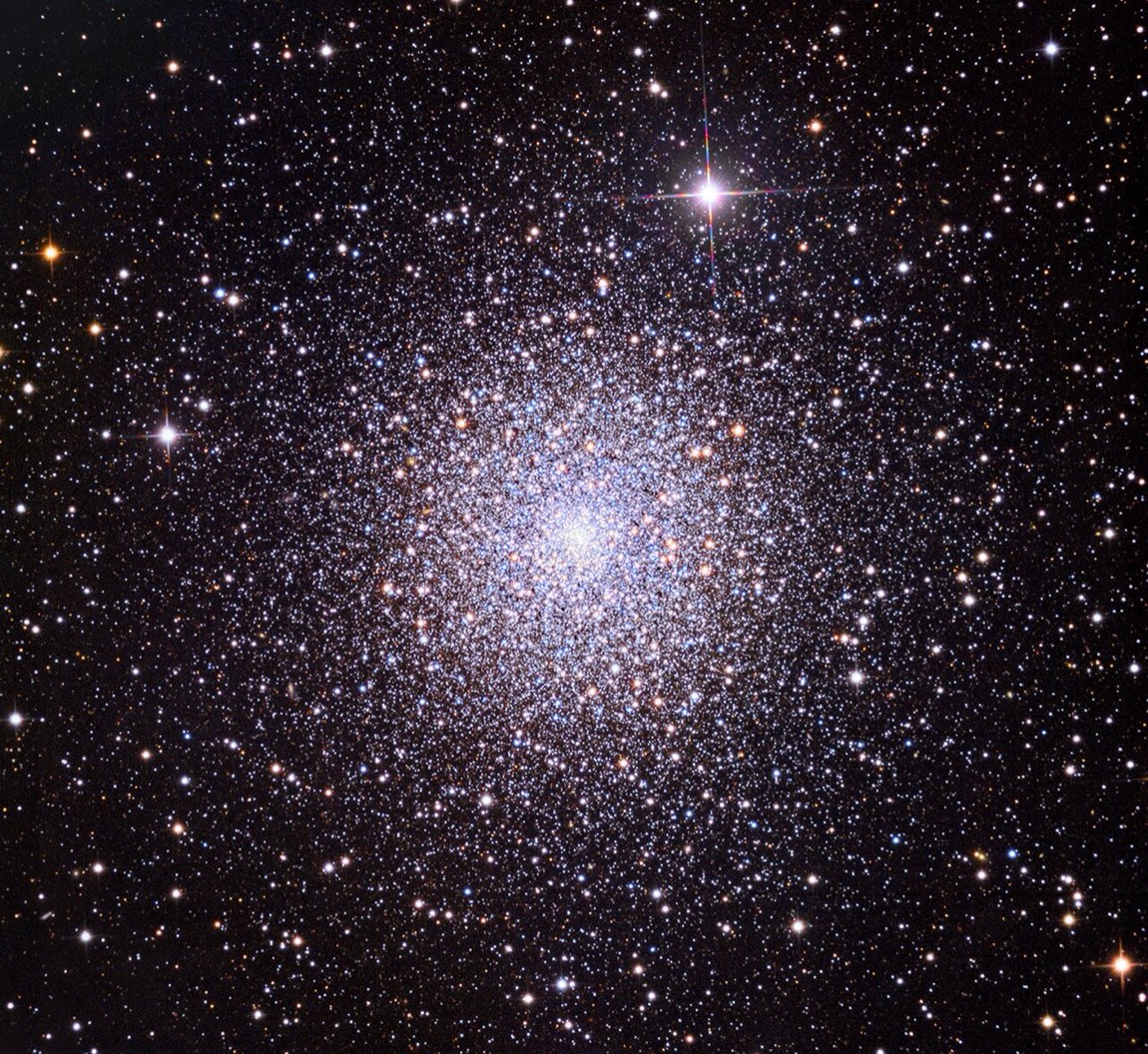
 Photograph · Ngc1535 · CC BY-SA 4.0
Star Cluster · Deep guide
Messier 15
Also called: M15 · NGC 7078 · Great Pegasus Cluster
One of the densest globular clusters known, with a collapsed core and a nebula hidden inside.
What is it?
Messier 15 is a globular cluster in Pegasus, found by Jean-Dominique Maraldi in 1746. About 35,700 light-years away, it holds over 100,000 stars and is one of the most tightly packed globulars in the Milky Way. Its core has undergone 'core collapse', crowding huge numbers of stars around what may be a central black hole. M15 also contains Pease 1, the first planetary nebula ever discovered inside a globular cluster, found in 1928. At magnitude 6.2 it is an easy binocular target.
The deep dive
Researched for the Atlas from Wikipedia — Messier 15 (1,947 characters read) · updated Nov 15, 2026
01 Discovered by accident, catalogued for posterity
Messier 15 was first spotted by Jean-Dominique Maraldi in 1746, most likely while he was sweeping the sky in search of something else entirely. Charles Messier, whose life's obsession was hunting comets, added the cluster to his famous catalogue in 1764 precisely because objects like this one could fool a comet-hunter — a soft, fuzzy smudge that refused to move against the stars. That catalogue entry gave the cluster its lasting identity as M15. It also carries the designation NGC 7078 from the later New General Catalogue, and has earned the informal name the Great Pegasus Cluster, a nod to the constellation it inhabits. The irony is rich: a list built to dismiss nuisances became one of astronomy's most celebrated inventories, and M15 endures as one of its finest entries.
02 An ancient city of a hundred thousand suns
With an estimated age of 12.5 ± 1.3 billion years, Messier 15 is one of the oldest known globular clusters — born not long after the universe itself, which is roughly 13.8 billion years old. It contains over 100,000 stars packed into a sphere 175 light-years across, centered 35,700 light-years from Earth. Despite that enormous distance, the cluster blazes with a total luminosity 360,000 times that of the Sun, giving it an absolute magnitude of −9.2. If you placed M15 where the Pleiades sit — a few hundred light-years away — it would cast shadows at night. The sheer stellar population means that in M15's core, stars are separated by distances thousands of times smaller than typical stellar neighborhoods in our own part of the Milky Way.
03 Core collapse: when gravity wins Deeper
Messier 15 is one of the most densely packed globular clusters known in the Milky Way, and its core tells a dramatic story. Through a process called core collapse, the innermost stars have fallen inward over billions of years, transferring energy outward and causing the center to contract into an extraordinarily dense cusp. This is not a sudden event but a slow gravitational ratchet that plays out over cosmic timescales. The result is a central density cusp — a sharp spike in star counts toward the cluster's heart — surrounding what may be a central black hole. Whether that black hole is real, and what its mass might be, remains an open and contested question. Core collapse makes M15 a natural laboratory for studying the endpoint of gravitational dynamics in a dense stellar system.
04 Pease 1: a cosmic first hidden inside the cluster
Among M15's many distinctions, one stands out for its uniqueness in astronomical history. In 1928, astronomers identified Pease 1, the first planetary nebula ever discovered inside a globular cluster. A planetary nebula is the glowing shell of gas expelled by a dying star at the end of its life — a stellar ghost, essentially. Finding one embedded within a globular cluster was a landmark moment, confirming that individual stars within these ancient swarms do age and die on their own schedules. What makes Pease 1 even more remarkable in retrospect is how rare such objects have proven to be: since 1928, only three additional planetary nebulae have been found inside globular clusters anywhere. The rarity likely reflects how unusual it is for a globular-cluster star to follow precisely the right evolutionary path to produce one.
05 Variable stars, pulsars, and a double neutron star Deeper
Messier 15 is an extraordinary menagerie of exotic stellar objects. The cluster hosts 112 variable stars — stars whose brightness changes measurably over time — making it one of the richest known repositories of stellar variability. Even more striking are its eight pulsars, the rapidly spinning neutron stars left behind after massive stars explode as supernovae. Pulsars are among the most precise natural clocks in the universe, and having eight in a single cluster offers a rare opportunity to study their formation and evolution in a shared environment. One of those systems, designated M15-C, is a double neutron star — two neutron stars locked in mutual orbit. Such binary systems are prized by physicists because their orbital decay provides direct evidence for gravitational wave emission, echoing the physics that earned the 2017 Nobel Prize in connection with similar systems.
06 X-ray eyes reveal hidden energetic sources Deeper
The cluster's violent interior life became clearer once astronomers turned X-ray telescopes toward it. Two distinct bright X-ray sources have been detected within M15: Messier 15 X-1, also catalogued as 4U 2129+12, and Messier 15 X-2. The detection came from two generations of orbiting observatories — the pioneering Uhuru satellite, which opened the field of X-ray astronomy, and the far more sensitive Chandra X-ray Observatory, which could resolve finer spatial detail. Messier 15 X-1 carries the additional distinction of being the first astronomical X-ray source detected in the constellation Pegasus. X-ray sources in globular clusters typically involve compact objects — neutron stars or black holes — pulling gas from a companion star, heating it to tens of millions of degrees in the process. M15's dense core, where close encounters between stars are common, is exactly the environment where such systems are expected to form.
07 How to find and observe M15 yourself
Messier 15 sits in the constellation Pegasus and offers a convenient star-hop to reach it: the cluster lies about 4 degrees west-northwest of Epsilon Pegasi, the brightest star in Pegasus. At magnitude 6.2, M15 hovers right at the edge of naked-eye visibility under dark, transparent skies, though most observers will need at least binoculars to pick it out. Through binoculars it appears as a soft, unresolved glow — exactly what fooled Messier into cataloguing it in the first place. A small telescope begins to sharpen the edges, but a reflector or refractor with at least 6 inches (150 mm) of aperture is needed before individual stars start to emerge from the haze. The brightest individual members glow at magnitude +12.6. The cluster spans 18 arc minutes on the sky, equal to three-tenths of a degree — just over half the apparent width of a full Moon.
08 Why so many exotic objects cluster here Deeper
The extraordinary concentration of pulsars, X-ray binaries, variable stars, and a potential central black hole in M15 is not coincidental — it flows directly from the cluster's exceptional stellar density. When stars are packed tightly enough, gravitational encounters between them become frequent on astronomical timescales. These encounters can strip stars from wide binary systems, harden close binaries, or create entirely new compact-object pairings that would never form in the sparse field of the Milky Way disk. M15's core collapse has pushed stellar densities to extremes, essentially running a continuous experiment in gravitational dynamics. The cluster has also had 12.5 billion years for these interactions to accumulate. Astronomers therefore treat M15 as a benchmark object — one of the best available windows onto how dense stellar systems evolve under their own gravity over cosmic time.
09 The uncertain case for a central black hole Deeper
One of the most tantalizing open questions in M15 research concerns what lies at its very center. The steep central density cusp — the sharp rise in stellar concentration toward the core — is consistent with two very different explanations. It could indicate the gravitational influence of an intermediate-mass black hole, far more massive than a stellar-remnant black hole but smaller than the supermassive varieties found in galactic centers. Alternatively, the cusp might be produced entirely by a dense concentration of stellar remnants such as neutron stars and stellar-mass black holes, with no single dominant object required. The article is careful to describe the central object as something that "may be" a black hole, reflecting genuine scientific uncertainty. Distinguishing between these scenarios requires precise measurements of stellar velocities near the core, and the debate has not been settled definitively.
10 What M15's age tells us about the early universe
An age of 12.5 ± 1.3 billion years places Messier 15 among the relics of the universe's earliest epoch of star formation. At the lower end of that uncertainty range the cluster could be as young as about 11.2 billion years; at the upper end, as old as 13.8 billion years — which would make it essentially as old as the universe itself. Globular clusters like M15 formed when the universe was still young, gas-rich, and assembling its first large structures. Their stars therefore carry the chemical fingerprints of that early era: low abundances of heavy elements, because those elements had not yet been forged and scattered by generations of supernovae. Studying M15 is in some sense studying a preserved sample of the conditions under which the Milky Way's stellar halo first came together, billions of years before our own Sun existed.
 ⤢