Star Cluster · Deep guide
Messier 2
Also called: M2 · NGC 7089
A ball of some 150,000 ancient stars hiding near the edge of naked-eye visibility in Aquarius.
What is it?
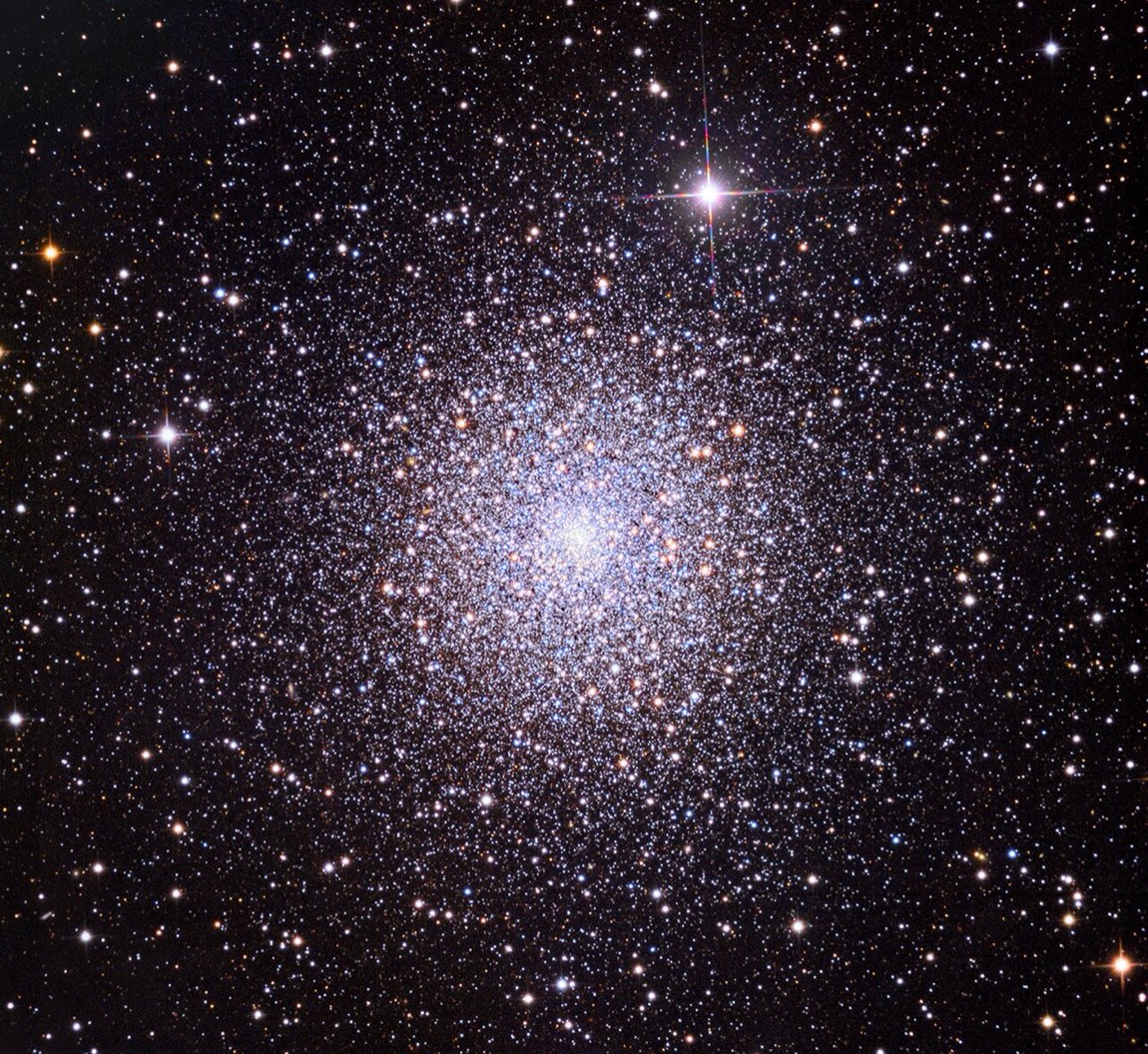
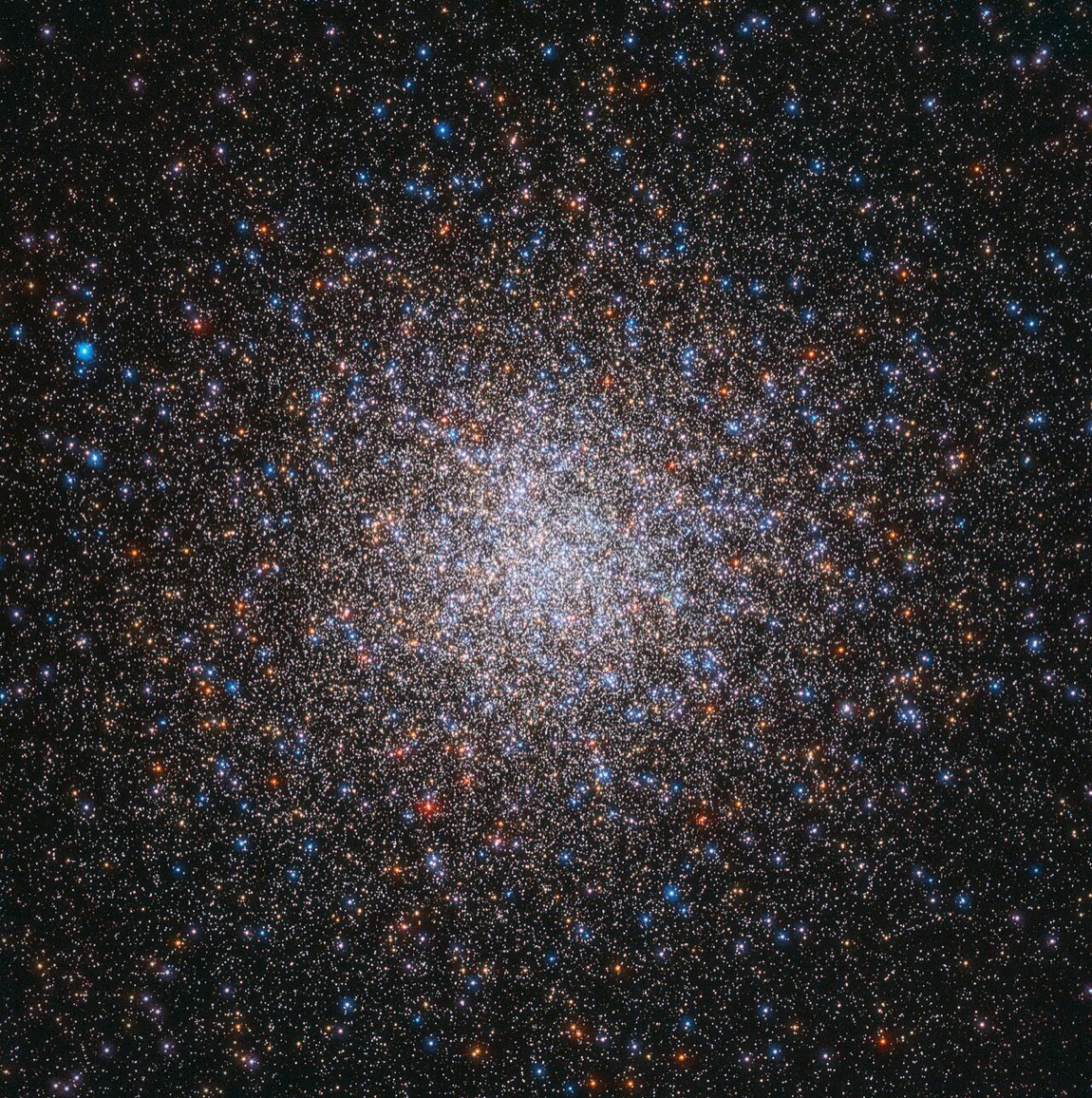
Messier 2 is a globular cluster in Aquarius, a tightly packed sphere of very old stars orbiting the Milky Way. Jean-Dominique Maraldi found it in 1746 while observing a comet, and William Herschel was the first to see its individual stars in 1783. It holds roughly 150,000 stars across about 175 light-years, making it one of the larger globular clusters known. Its stars are around 12.5 billion years old, and astronomers link it to the Gaia Sausage, the remains of a smaller galaxy that merged with ours long ago.
The deep dive
Researched for the Atlas from Wikipedia — Messier 2 (3,280 characters read) · updated Nov 15, 2026
01 Discovered during a comet hunt
M2 owes its discovery to a happy accident. In 1746, French astronomer Jean-Dominique Maraldi was sweeping the sky alongside Jacques Cassini in search of a comet when he stumbled upon this faint, fuzzy patch in Aquarius. He logged it, but the cluster sat in relative obscurity until Charles Messier independently rediscovered it in 1760. Messier, whose whole mission was cataloguing objects that might fool comet hunters, looked at M2 and concluded it was simply a nebula — a cloud of gas with no stars at all. It took another two decades and a far more powerful telescope for anyone to prove him wrong. In 1783, William Herschel turned his large reflector on the cluster and became the first person to resolve it into individual stars, finally revealing the true nature of the object Maraldi had noticed by chance nearly forty years earlier.
02 A shape that sets it apart
Most people picture globular clusters as perfectly round, symmetrical balls of stars, and many are close to that ideal. M2 is notably different: the article describes it as rich, compact, and significantly elliptical. That elongated shape is a physical signature, hinting at the cluster's internal dynamics, its history of gravitational interaction, and possibly the tidal forces it has experienced while orbiting the Milky Way. At 175 light-years in diameter, it is genuinely large even by globular cluster standards — one of the larger examples known. Packing roughly 150,000 stars into that volume produces an extraordinary stellar density toward the core that is essentially impossible to appreciate from 37,500 light-years away, where the whole structure barely registers as a smudge without optical aid.
03 Stars that pulse and giants that glow Deeper
Among M2's roughly 150,000 stars, astronomers have identified 21 known variable stars — stars whose brightness changes over time. The cluster's brightest members are red and yellow giant stars, evolved suns that have exhausted the hydrogen in their cores and swelled to enormous sizes. The overall spectral type of the cluster is listed as F4, meaning that when you blend the light of all its stars together, the mixture resembles a star somewhat hotter and whiter than our Sun. The brightest individual star in the cluster shines at only apparent magnitude 12, which is far too faint for the naked eye but reachable with a modest telescope. That single data point underscores how distant M2 really is: even its stellar giants, which in a closer cluster might appear impressive, are reduced to faint points requiring dedicated equipment to detect.
04 A relic of a devoured galaxy Deeper
M2 is not simply a homegrown product of the Milky Way. It is identified as part of the Gaia Sausage, the hypothesized remains of a dwarf galaxy that merged with our own galaxy in the distant past. The name comes from the sausage-like shape that the merger debris traces in velocity space, a signature uncovered using data from the European Space Agency's Gaia spacecraft. The implication is striking: M2 may have formed inside a completely separate galaxy before being captured and absorbed. If so, the cluster is a surviving fragment of a cosmic collision that happened billions of years ago, now orbiting the Milky Way as a kind of gravitational trophy. This origin story connects M2 to some of the most dramatic events in our galaxy's early history.
05 A stellar stream stretching 45 degrees of sky Deeper
Gaia data revealed something remarkable trailing M2: an extended tidal stellar stream approximately 45 degrees long and 300 light-years wide. To put that angular length in perspective, 45 degrees is roughly the span from the horizon to nearly halfway up the sky — an enormous swath of the celestial sphere. This stream is composed of stars that have been gravitationally stripped from the cluster over time, pulled away by tidal forces as M2 orbits the Milky Way. The stream's existence confirms that the cluster is slowly being eroded. Interestingly, researchers suggest the stream may have been perturbed by the presence of the Large Magellanic Cloud, the satellite galaxy currently on a close approach to the Milky Way. This makes M2's tidal stream a probe of large-scale gravitational influences acting across the galaxy.
 ⤢
06 Home in the galactic halo's southern cap
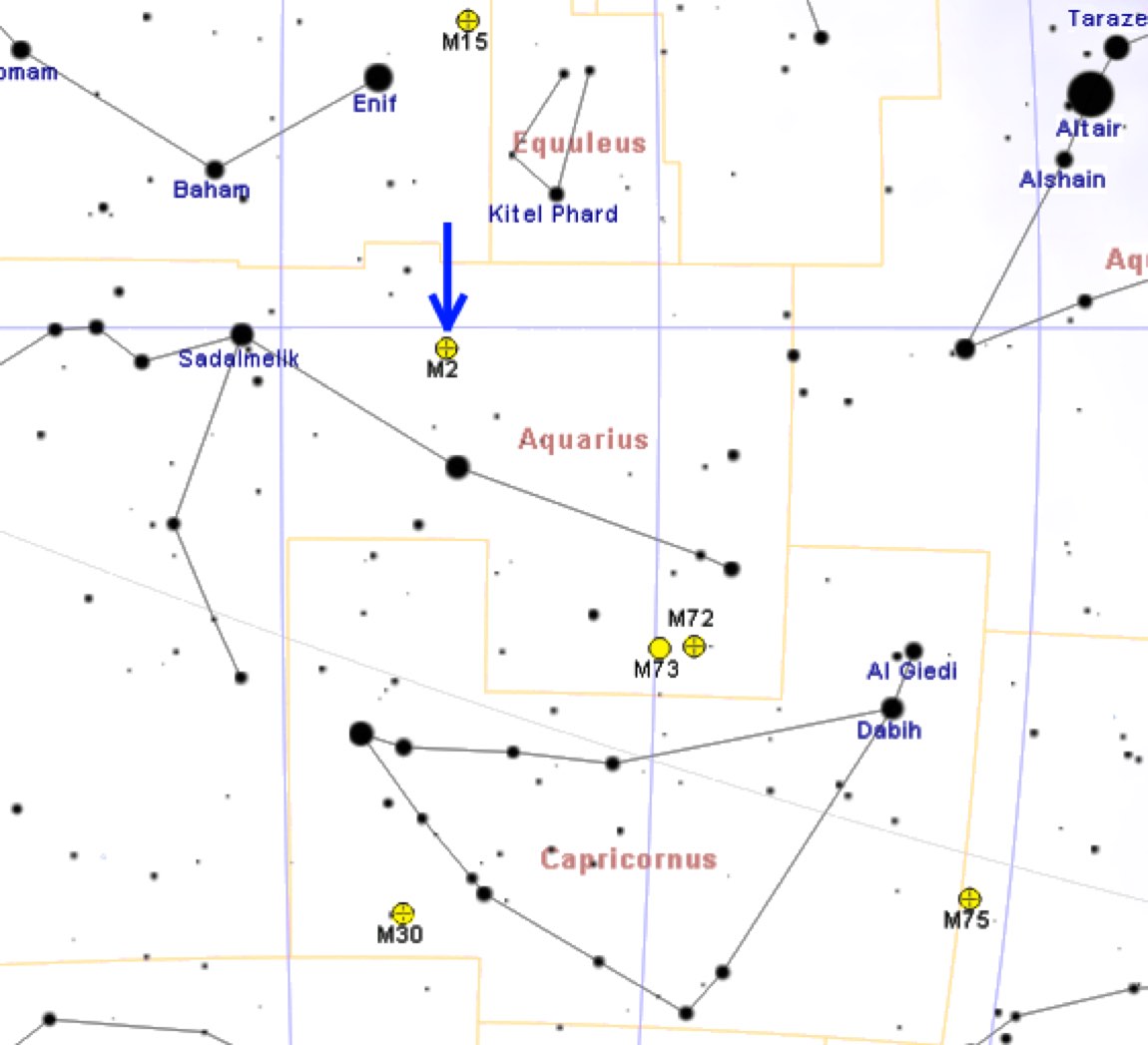
M2 resides in the galactic halo, the vast diffuse region that surrounds the flat disk of the Milky Way. More specifically, it sits in the southern galactic cap, placing it essentially beneath the Milky Way's south pole. Globular clusters are characteristic inhabitants of this halo region, and M2's position there is consistent with clusters that formed early in the galaxy's history or were acquired through mergers. From Earth, the cluster appears in the constellation Aquarius, sitting five degrees north of the star Beta Aquarii — a convenient signpost for observers. Its location 37,500 light-years away means it lies well outside the Sun's neighborhood but is still gravitationally bound to the galaxy, tracing a long orbit through the halo.
07 The Oosterhoff puzzle: old but not old enough Deeper
The Oosterhoff classification system, developed by Dutch astronomer Pieter Oosterhoff, sorts globular clusters into two types based on metallicity, age, and the average pulsation period of RR Lyrae variable stars. Type II clusters are typically metal-poor, ancient, and have RR Lyrae stars pulsing with an average period around 0.64 days. M2 checks the metallicity box with a value of −1.65 and matches the pulsation period criterion, which also places it in the Oosterhoff Gap — an observed separation between Type I and Type II clusters on a metallicity-versus-period diagram. The puzzle is its age. Standard Type II clusters are expected to exceed 13 billion years old, but M2 clocks in at only 12.5 billion years, well below that threshold. This anomaly has been addressed in research by Marín-Franch, though the debate is not fully settled: a more recent study by Botev and colleagues proposed a new lower age limit for M2 of 13.2 billion years, which would resolve the discrepancy entirely if confirmed.
08 How to find and observe M2
M2 sits five degrees north of Beta Aquarii in the constellation Aquarius, making Beta Aquarii a reliable starting point for any star-hop. Under exceptionally dark skies and with excellent seeing conditions, the cluster is just barely visible to the unaided eye, though most observers will need optical assistance. Even a small pair of binoculars will immediately show that M2 is not a point-like star — it has an unmistakable fuzzy, non-stellar appearance. A small telescope sharpens the view but still shows it as an unresolved glow. Larger amateur telescopes begin to pick out individual stars at the cluster's edges, with the brightest members reaching only apparent magnitude 12. That means none of M2's stars are individually bright enough to see without a telescope, so resolution into stars is a reward reserved for those with serious equipment and steady air.
09 What the spectral type F4 tells us Deeper
Astronomers assign M2 an overall spectral type of F4, a figure derived by summing the light of all its stars into a single composite spectrum. Spectral type F sits between the hotter A-type stars and the cooler, Sun-like G-type stars, so F4 implies the blended starlight of M2 is slightly hotter and whiter than our Sun's output. This composite type is shaped overwhelmingly by the cluster's most luminous members — the red and yellow giants — along with the population of older, evolved stars that dominate a cluster 12.5 billion years old. Younger star clusters, which still contain hot blue massive stars, would produce a much bluer spectral signature. M2's F4 type is therefore a fingerprint of age: the hot massive stars that once lived here burned out billions of years ago, leaving behind a population whose blended light peaks in the yellow-white part of the spectrum.
10 An ancient cluster with an unsettled birthday
M2's age of 12.5 billion years makes it one of the older globular clusters associated with the Milky Way, formed when the universe was still young and galaxies were assembling from primordial gas. The universe itself is about 13.8 billion years old, so M2 came into being only about 1.3 billion years after the Big Bang — an almost incomprehensibly early chapter of cosmic history. Yet even this venerable age remains under debate. While 12.5 billion years is the figure most commonly cited in the literature and used to classify M2, the study by Botev and colleagues proposed a revised lower limit of 13.2 billion years for M2's age. If that higher figure holds up under further scrutiny, it would actually resolve M2's awkward position relative to the Oosterhoff Type II classification and make the cluster a more typical member of that group.
 ⤢