 Diagram · ISRO official site · CC BY-SA 4.0
Spacecraft · Deep guide
Chandrayaan-3
The first landing in the Moon's south polar region, and India's triumph.
What is it?
On August 23, 2023, India's Chandrayaan-3 set its Vikram lander down at 69° south — the closest to the lunar south pole anyone had landed — making India the fourth nation to land on the Moon and the first to reach its most coveted region. The Pragyan rover confirmed sulfur in the polar soil, and the mission's frugal budget (about $75 million) rewrote assumptions about the cost of lunar exploration.
The deep dive
Researched for the Atlas from Wikipedia — Chandrayaan-3 (29,293 characters read) · updated Sep 20, 2026
01 Why the Lunar South Pole Was the Target
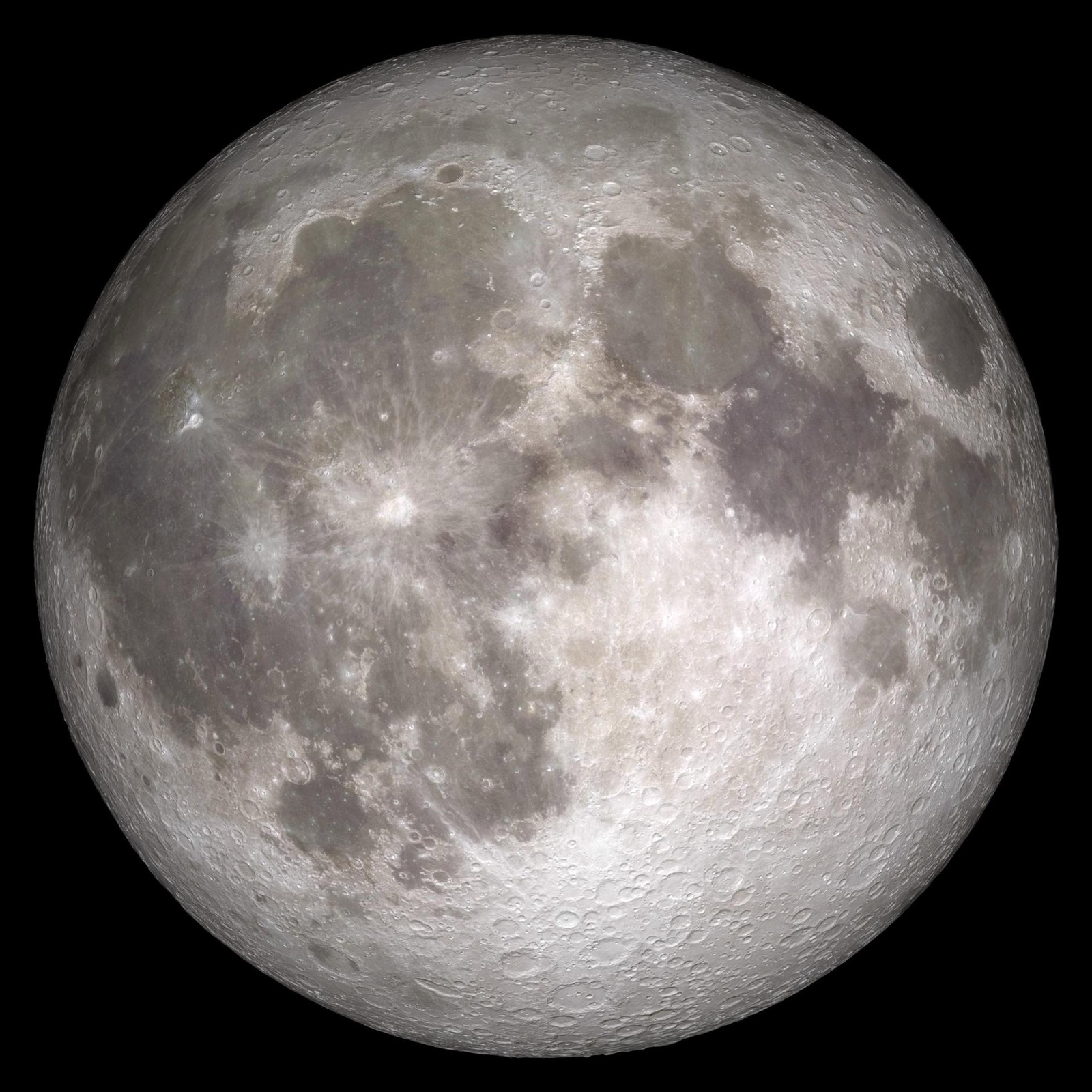
The lunar south pole is one of the most scientifically compelling destinations in the inner Solar System, and Chandrayaan-3's choice to land there was deliberate. Studies show large amounts of ice locked in this region, sheltered by the permanently shadowed floors of craters and the long cast shadows of mountains. Because temperatures never rise high enough to vaporize it, that ice can preserve solid-state compounds that would melt away in warmer locations elsewhere on the Moon. Those compounds potentially carry a chemical record of conditions during the early Solar System, offering clues about lunar, Earth, and Solar System history that no other location can provide. The terrain, however, is treacherous. The same mountains and craters that protect the ice also create wildly unpredictable lighting, steep slopes, and boulder-strewn surfaces that make precision landing exceptionally difficult. Chandrayaan-2 demonstrated that danger in 2019 when it crashed during its descent attempt. Landing at 69° S made Chandrayaan-3 the first mission in history to achieve a soft landing in this high-latitude polar region.
02 How Chandrayaan-2's Crash Reshaped the Design Deeper
Every engineering choice on Chandrayaan-3 was shadowed by the failure of its predecessor. ISRO's investigation identified attitude instability during the camera coasting phase as one of the main contributors to Chandrayaan-2's crash. The fix was to allow the lander to actively control attitude and thrust during all phases of descent, eliminating the passive coasting window entirely. The attitude correction rate was more than doubled, rising from 10°/s on Chandrayaan-2 to 25°/s on Vikram. The number of main landing thrusters was reduced from five to four, removing the centrally mounted engine that could only produce fixed thrust and replacing it with four variable-thrust engines with slew rate changing capabilities. A laser Doppler velocimeter was added so the lander could measure its velocity simultaneously in three directions. The landing legs were strengthened, instrument polling frequency was raised, and multiple additional contingency systems were incorporated. The target landing zone itself was tightened to a far more precise 16 km² area, selected using high-resolution imagery from Chandrayaan-2's orbiter, which had survived intact in lunar orbit.
03 The Eleven-and-a-Half Minutes That Mattered Most
The landing sequence on 23 August 2023 was the most consequential eleven and a half minutes in Indian space history. As Vikram reached the low point of its elliptical orbit, its four engines fired as a braking manoeuvre at 30 kilometres above the Moon's surface. After 11.5 minutes of powered deceleration, the lander was 7.2 km above the surface, where it paused for about 10 seconds. Eight smaller thrusters then took over to stabilize the craft, and Vikram rotated from a horizontal to a vertical orientation — essentially standing itself upright while still falling. Two of the four main engines slowed the descent further to roughly 150 metres above the ground. There, Vikram hovered for about 30 seconds while its cameras scanned for an optimal touchdown spot, a capability absent from its predecessor. Once a safe patch was identified, the lander continued downward and touched down at 12:33 UTC. The landing made ISRO the fourth national space agency to soft-land on the Moon, after the Soviet space programme, NASA, and China's CNSA.
04 The Rover's Chemistry Lab on Wheels
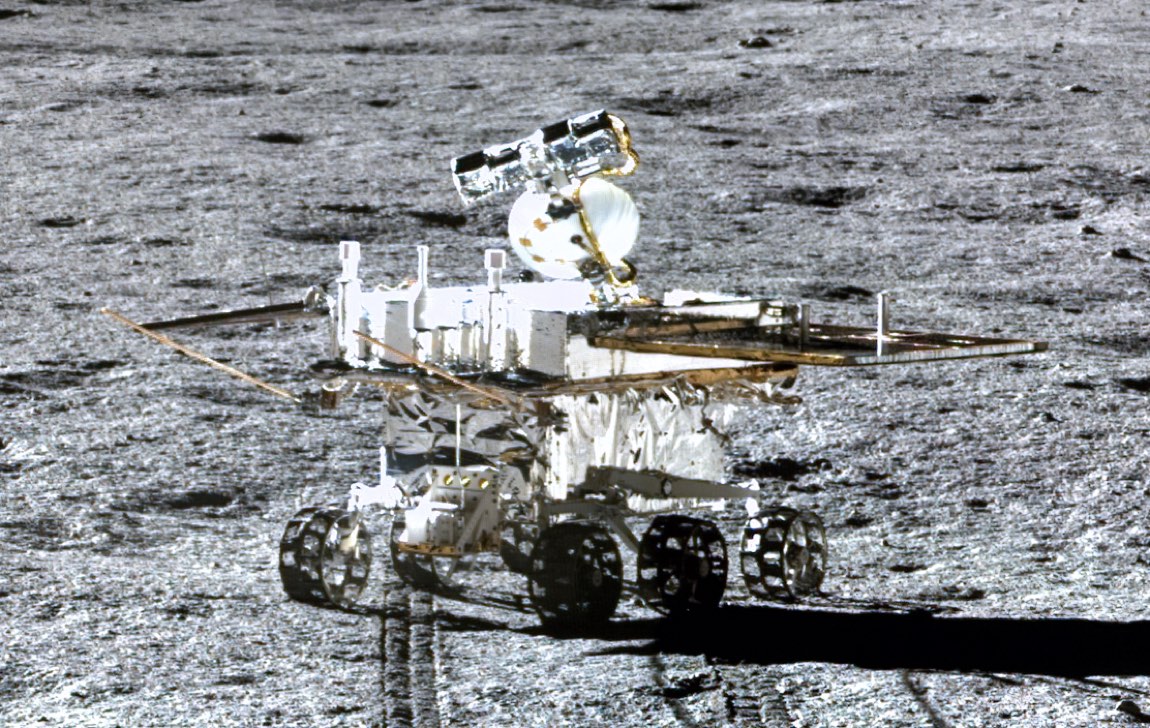
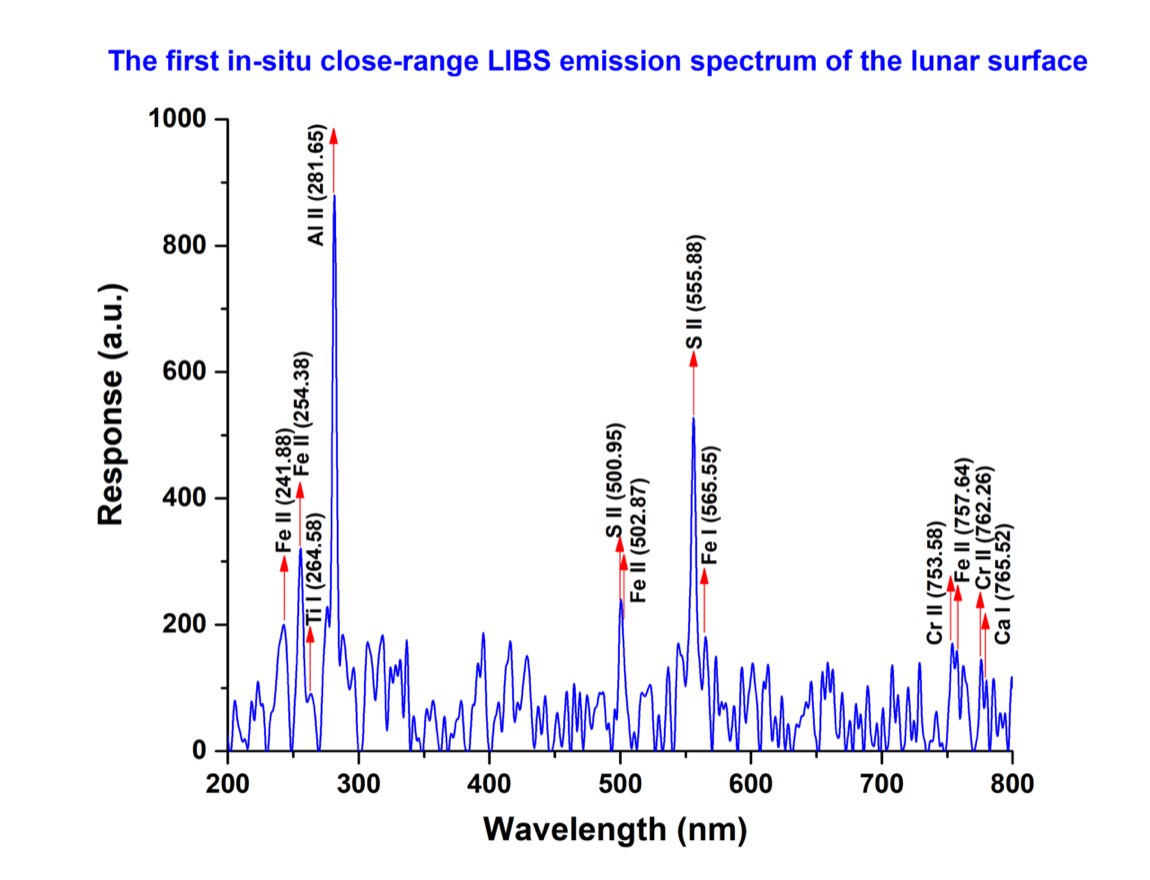
Pragyan is a six-wheeled rover with a mass of just 26 kilograms — roughly the weight of a medium-sized dog — and dimensions of 917 by 750 by 397 millimetres. Despite its modest size, it carried two powerful analytical instruments. The laser-induced breakdown spectroscopy, or LIBS, instrument fires laser pulses at soil and rocks, vaporizing tiny amounts of material and reading the light signature of the resulting plasma to identify elements including magnesium, aluminium, silicon, potassium, calcium, titanium, and iron. The alpha particle X-ray spectrometer, or APXS, bombards surface material with alpha particles and reads the resulting X-ray emissions to build a detailed chemical and mineralogical profile. Together these instruments gave scientists their first direct, in-situ chemical measurements of the lunar south polar surface. The rover also displaced about 50 centimetres from Vikram's landing point, and the engine exhaust from the lander's later hop experiment blew away close to 3 centimetres of regolith, exposing fresher subsurface material for analysis.
05 Sulfur, Plasma, and a Probable Moonquake Deeper
Within the first week of surface operations, Chandrayaan-3 generated three distinct scientific firsts. On 29 August, ISRO reported that the LIBS instrument had unambiguously confirmed the presence of sulfur in the lunar surface near the south pole through the first-ever in-situ measurements at that location. Sulfur had been identified in Apollo samples from equatorial regions, but NASA project scientist Noah Petro called Pragyan's south-polar detection a "tremendous accomplishment." The rover also detected aluminium, calcium, iron, chromium, titanium, manganese, silicon, and oxygen, while a search for hydrogen was ongoing. On 31 August, the RAMBHA-LP Langmuir probe on Vikram released the first in-situ plasma measurements taken at the lunar poles, reporting early-lunar-day densities between 5 and 30 million electrons per cubic metre, later rising to between 380 and 600 electrons per cubic centimetre — significantly higher than orbital radio occultation estimates from Chandrayaan-2. Electron kinetic temperatures ranged from 3,000 to 8,000 Kelvin. That same day, the ILSA seismometer recorded what is suspected to be a moonquake on 26 August, though its cause remains under investigation.
06 Heat, Soil Layers, and a Surprising Temperature Deeper
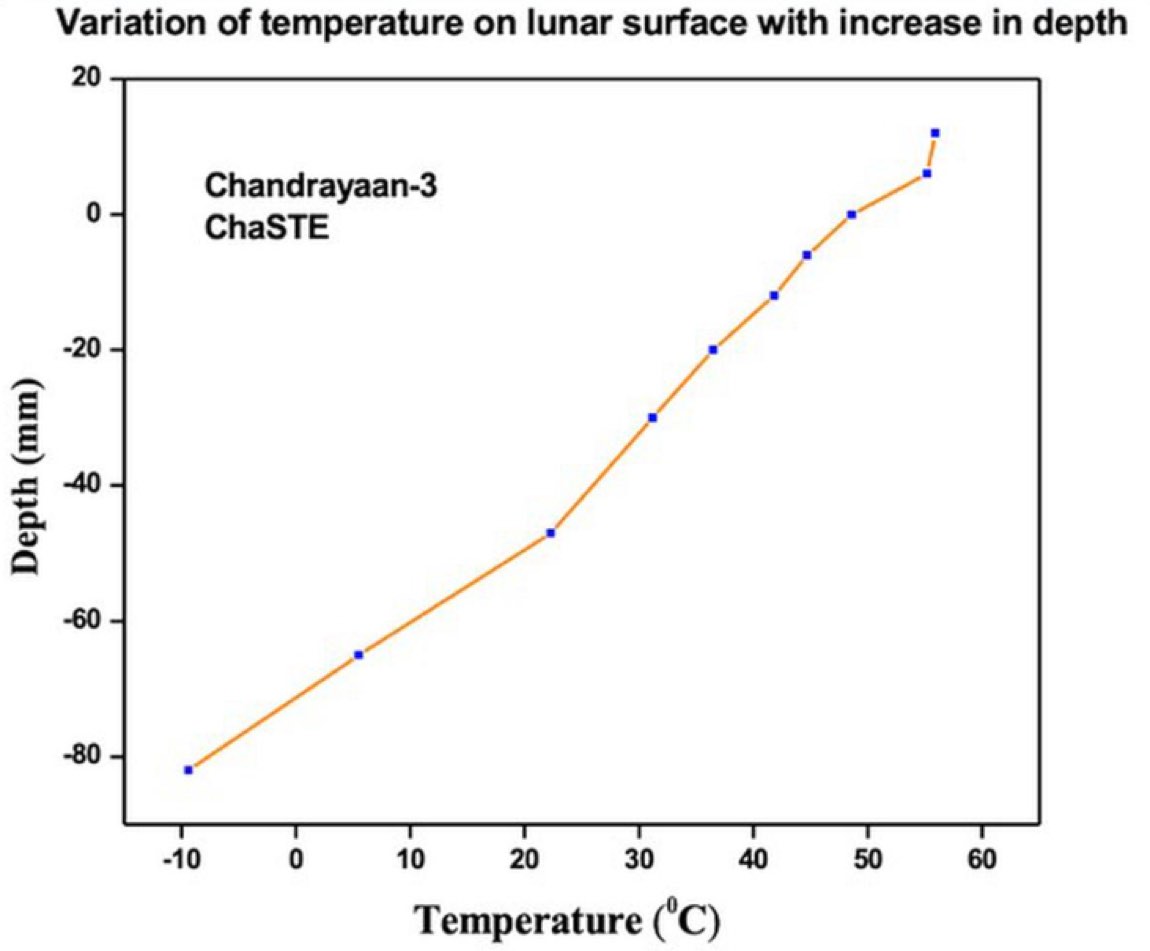
The ChaSTE probe penetrated the top 10 centimetres of the lunar surface, taking in-situ temperature measurements roughly every second over approximately 10 Earth days, from 24 August to 2 September 2023, covering local times from about 8 AM to 4 PM on the Moon. These were the first thermophysical measurements ever made within the top 10 centimetres of the lunar surface at a high-latitude south polar location. The peak surface temperature at the landing site was measured at 355 K, plus or minus 0.5 K — noticeably higher than the roughly 330 K predicted by earlier remote observations. Research published in March 2025 attributed this to ChaSTE being deployed on a Sun-facing slope of approximately 6°. An independent flat-surface sensor about a metre away recorded roughly 332 K, consistent with orbital data. After Vikram's hop experiment, ChaSTE was redeployed at a slightly displaced location and revealed a two-layer subsurface structure within the top 6.5 centimetres: the upper 3 centimetres conduct heat more efficiently, while the lower layer has reduced thermal conductivity, with soil density doubling and cohesion increasing fivefold — from 300 to 1,600 pascals — with depth.
07 A Tiny Mirror That Could Last Decades
One of Vikram's most durable contributions to science is a device that requires no power and has no moving parts. The Laser Retroreflector Array, supplied by NASA's Goddard Space Flight Center, consists of eight corner-cube retroreflectors mounted on a hemispherical support framework and weighs just 20 grams. On 12 December 2023, for the first time on the lunar surface, NASA's Lunar Reconnaissance Orbiter beamed a laser at it and received the reflection back, demonstrating that the array could serve as a permanent, precisely located reference point near the south pole. Any orbiting spacecraft equipped with a laser ranging instrument can now use it to triangulate positions from different directions and altitudes. Because it is entirely passive — no battery, no electronics, no mechanism to fail — it is designed to remain functional for several decades, long after every other component of the mission has ceased operating. This makes it a kind of enduring bookmark on the Moon, useful to missions that have not yet been built.
08 When the Propulsion Module Became an Earth Observer Deeper
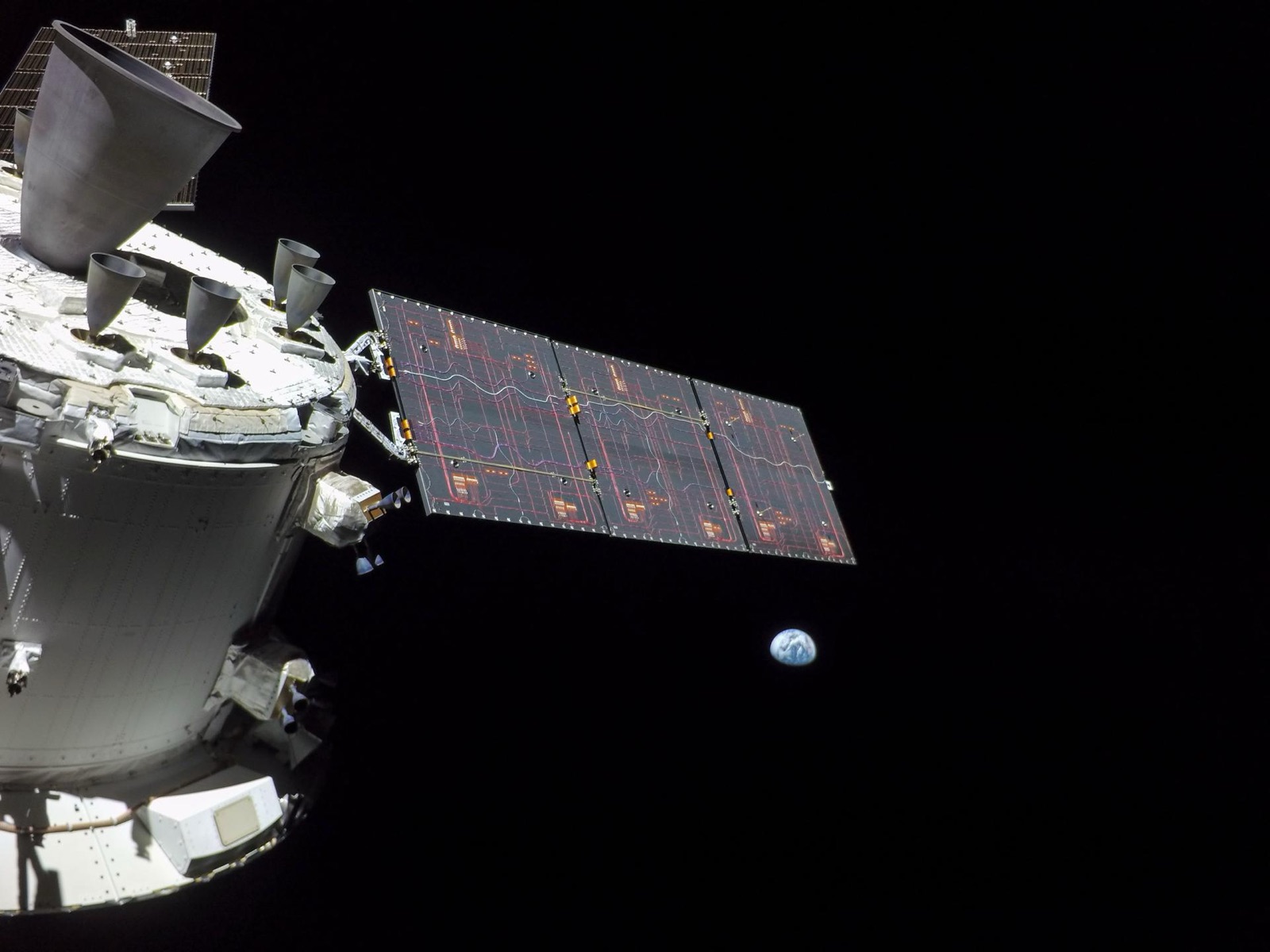
After delivering Vikram to lunar orbit, the propulsion module was originally planned to operate its SHAPE instrument — which studies spectral and polarimetric properties of Earth in the near-infrared wavelength range of 1 to 1.7 micrometres — for three months from lunar orbit. But with more than 100 kg of fuel remaining after just one month, ISRO's flight dynamics team decided to attempt something more ambitious. On 9 October 2023, a manoeuvre raised the apogee from 150 km to 5,112 km, stretching the orbital period from 2.1 hours to 7.2 hours. A trans-Earth injection on 13 October targeted an orbit of roughly 380,000 by 180,000 km. After four lunar flybys, the module exited the lunar sphere of influence on 10 November and crossed its first Earth perigee on 22 November 2023 at an altitude of about 154,000 km. It now orbits Earth with a predicted minimum perigee altitude of 115,000 km and an orbital period of nearly 13 days at a 27-degree inclination. SHAPE continued operating, including observations during the 28 October 2023 solar eclipse. Data from this orbit informs planning for future sample return and gravity-assisted flyby missions.
09 The Hop Experiment and What It Revealed Below
On 3 September 2023, Vikram did something no Indian spacecraft had ever done: it re-ignited its engines while on the lunar surface and briefly became airborne again. The lander rose 40 centimetres off the ground, translated 50 centimetres laterally, and came to rest on a nearby slope of roughly 2.6°, rotating by small angles in each axis relative to its original orientation. ISRO described it as a "hop experiment," and it made Vikram only the second lander ever to successfully perform such a manoeuvre on the Moon, after NASA's Surveyor 6 in 1976. The test proved technologies relevant to future sample return missions. The engine exhaust during the hop eroded about 3 centimetres of loose regolith from the surface, exposing the more compact layer beneath. Engineers described the stratigraphy as cake-like — a cohesive, porous upper layer acting as a thermal blanket, underlain by denser, less conductive material. ChaSTE's follow-up measurements at the new location captured a surface temperature dip during lunar twilight, which at the Shiv Shakti point lasted over 57 minutes and involved a temperature drop of 60°C compared to daytime readings.
10 Primitive Mantle Samples at Shiv Shakti Deeper
One of the most geologically significant findings from the mission emerged from APXS measurements at the landing site, officially named Statio Shiv Shakti. Scientists from the Physical Research Laboratory used the rover's alpha particle X-ray spectrometer to measure concentrations of volatile elements in what appears to be primitive lunar mantle material. The composition found at the site is unlike the typical lunar surface material represented in existing sample collections, making it a potentially valuable location for accessing mantle rocks that are otherwise absent from Earth's lunar meteorite and Apollo collections. A 2026 study further compared APXS data with the geochemistry of the Allan Hills meteorite ALHA 81005, discovered in Antarctica and the first suspected lunar meteorite, finding close geochemical similarities with the Shiv Shakti plains. Although it could not be conclusively established that the meteorite originated from the south polar region, the study generated new hypotheses about how the formation of the vast South Pole-Aitken Basin may have altered the geochemical composition of the surface at the landing site.
11 Nuclear Heat and Future Rover Longevity Deeper
One of the quieter stories of the mission concerns what was deliberately left off the spacecraft. The propulsion module was equipped with two radioisotope heating units designed and developed by the Bhabha Atomic Research Centre. These devices generate heat from the natural decay of radioactive material, keeping spacecraft electronics warm without requiring battery power. ISRO considered installing them on Vikram and Pragyan as well, which would have potentially extended both the lander and rover beyond a single 14-Earth-day lunar day. The plan was abandoned because the added mass of the RHUs would have exceeded the allowable limits for the lander and rover. Without them, neither was designed to survive the nighttime temperatures of minus 120°C. The mission was therefore explicitly scoped to a single lunar daylight period, which proved to be the case: neither Vikram nor Pragyan responded to wake-up signals on 22 September or subsequently by 28 September 2023. Project director P. Veeramuthuvel confirmed that ISRO is now collaborating with the Indian Department of Atomic Energy to develop RHU and radioisotope thermoelectric generator payloads for future Chandrayaan and deep-space exploration missions.
12 The Spacecraft's Awards and Global Recognition
The scientific and engineering achievement of Chandrayaan-3 earned the mission a string of major international honours. The Exploration Museum awarded ISRO the Leif Erikson Lunar Prize in 2023. Aviation Week presented its Laureates Award to ISRO for the mission the same year. In April 2024, the Space Foundation awarded the Chandrayaan-3 team the John L. 'Jack' Swigert Jr. Award for Space Exploration at the annual Space Symposium in Colorado. The International Astronautical Federation presented its World Space Award at the 75th International Astronautical Congress in Milan in October 2024, citing the mission as an example of the "synergy of scientific curiosity and cost-effective engineering." In May 2026, the American Institute of Aeronautics and Astronautics presented the Goddard Astronautics Award at the AIAA ASCEND 2026 conference in Washington, D.C., specifically honouring the mission as the first spacecraft to successfully land close to the lunar south pole and for confirming the presence of essential chemical elements there. India's Prime Minister declared 23 August a national holiday — National Space Day — and named the touchdown point Statio Shiv Shakti.
13 Tracking Across Three Continents
Chandrayaan-3 did not travel to the Moon relying solely on Indian infrastructure. ISRO's own Telemetry, Tracking and Command Network, ISTRAC, based in Bengaluru, served as mission control and carried out the critical lunar orbit insertion on 5 August 2023. But supporting data came from ESA's European Space Tracking network, known as ESTRACK, and from NASA's Deep Space Network, operated by the Jet Propulsion Laboratory. The multinational cooperation extended beyond this single mission. Under a new cross-support arrangement, ESA agreed to provide tracking support for upcoming ISRO missions including India's first human spaceflight programme, Gaganyaan, and the Aditya-L1 solar research mission. In return, future ESA missions will receive equivalent support from ISRO's tracking stations. The Laser Retroreflector Array experiment on 12 December 2023 further illustrated multinational collaboration: the reflector was supplied by NASA's Goddard Space Flight Center, housed on an Indian lander, and interrogated by NASA's Lunar Reconnaissance Orbiter, demonstrating how different space agencies' assets can work together on a single scientific measurement long after a primary mission has concluded.
 ⤢
⤢