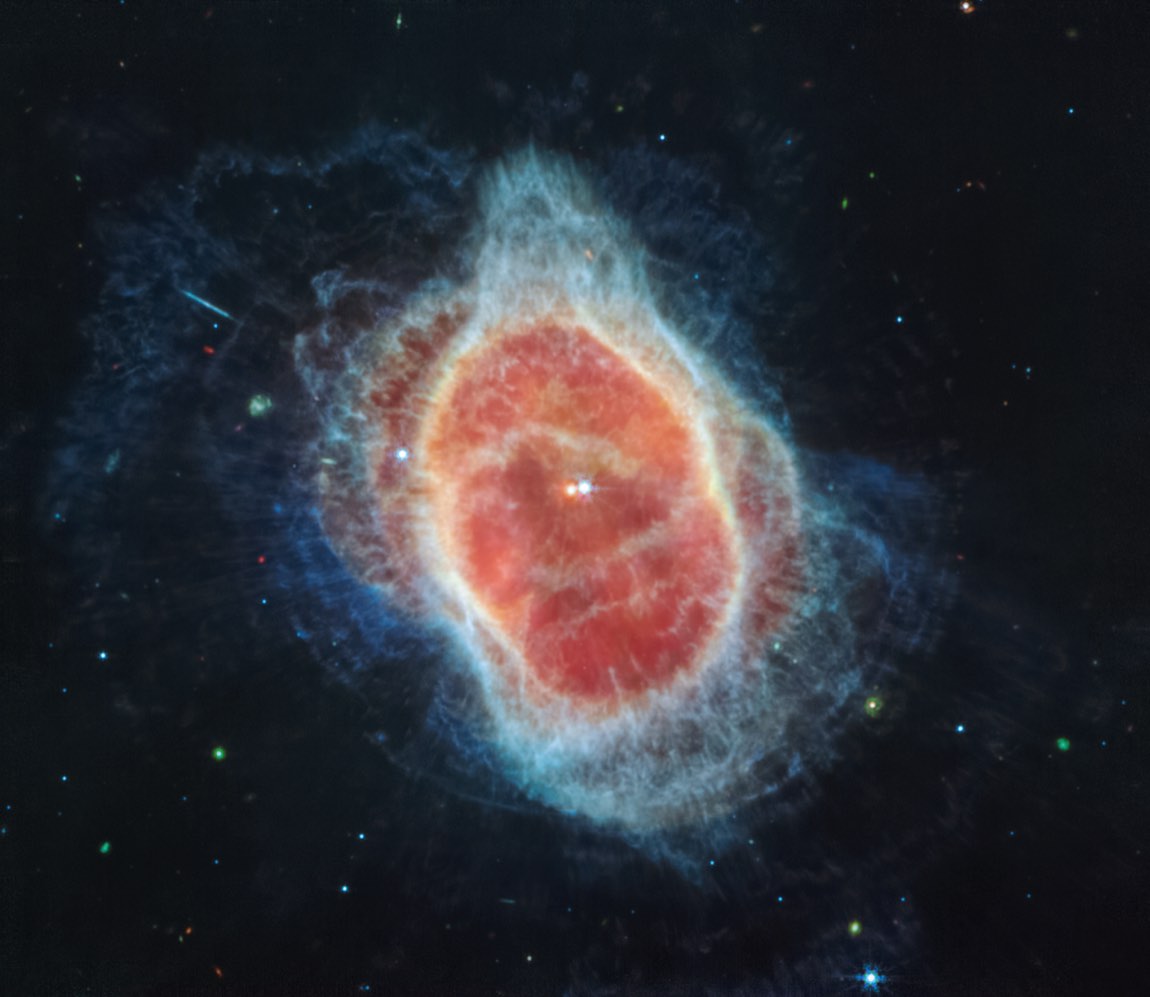
 Photograph · NASA, ESA, CSA, STScI, O. De Marco (Macquarie University), J. DePasquale (STScI) · CC BY 4.0
Nebula · Deep guide
Southern Ring Nebula (NGC 3132)
Also called: Caldwell 74 · NGC 3132 · Eight-Burst Nebula · Southern Ring Nebula
The dying-star shell chosen for the James Webb Space Telescope's first image release.
What is it?
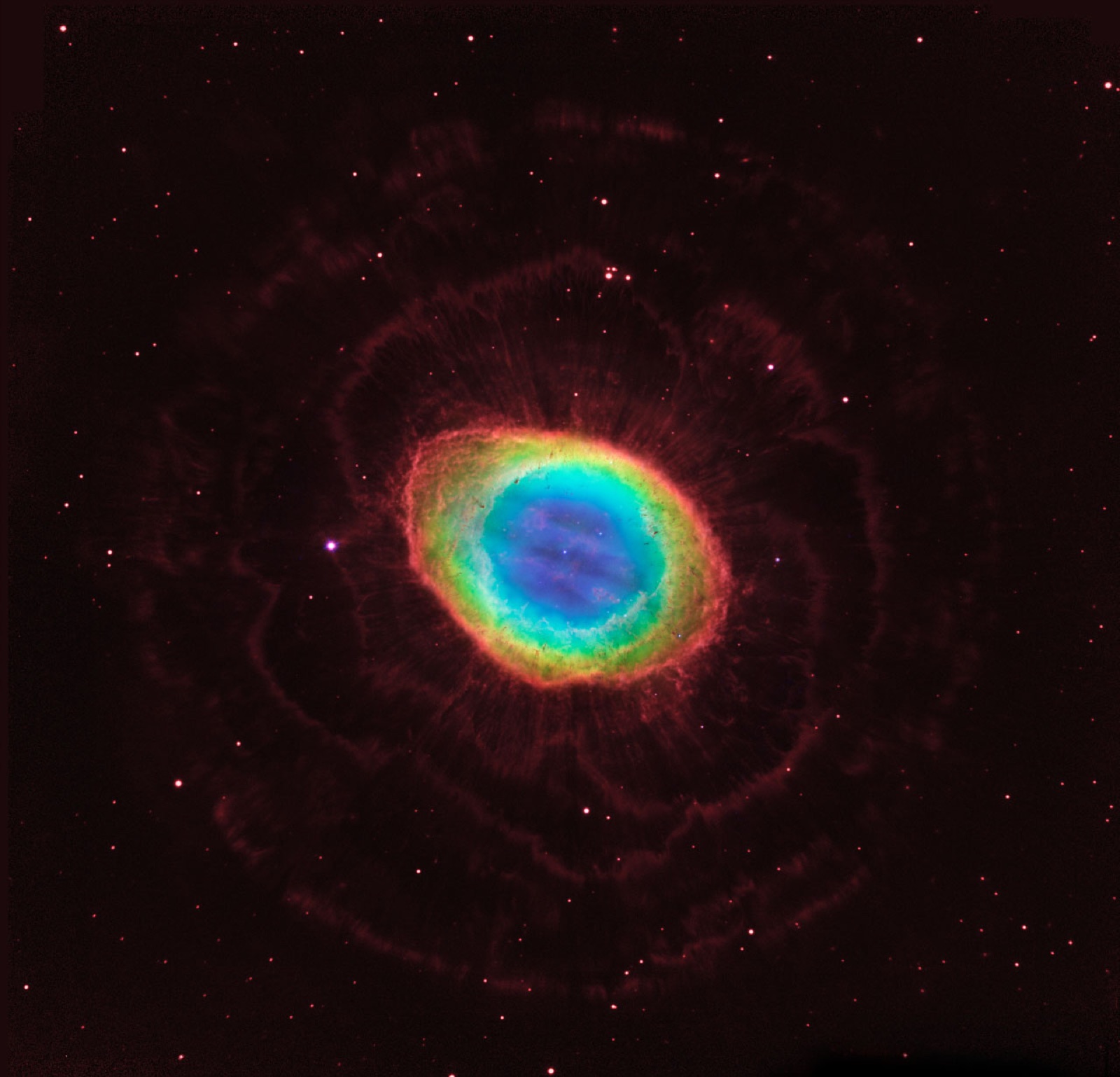
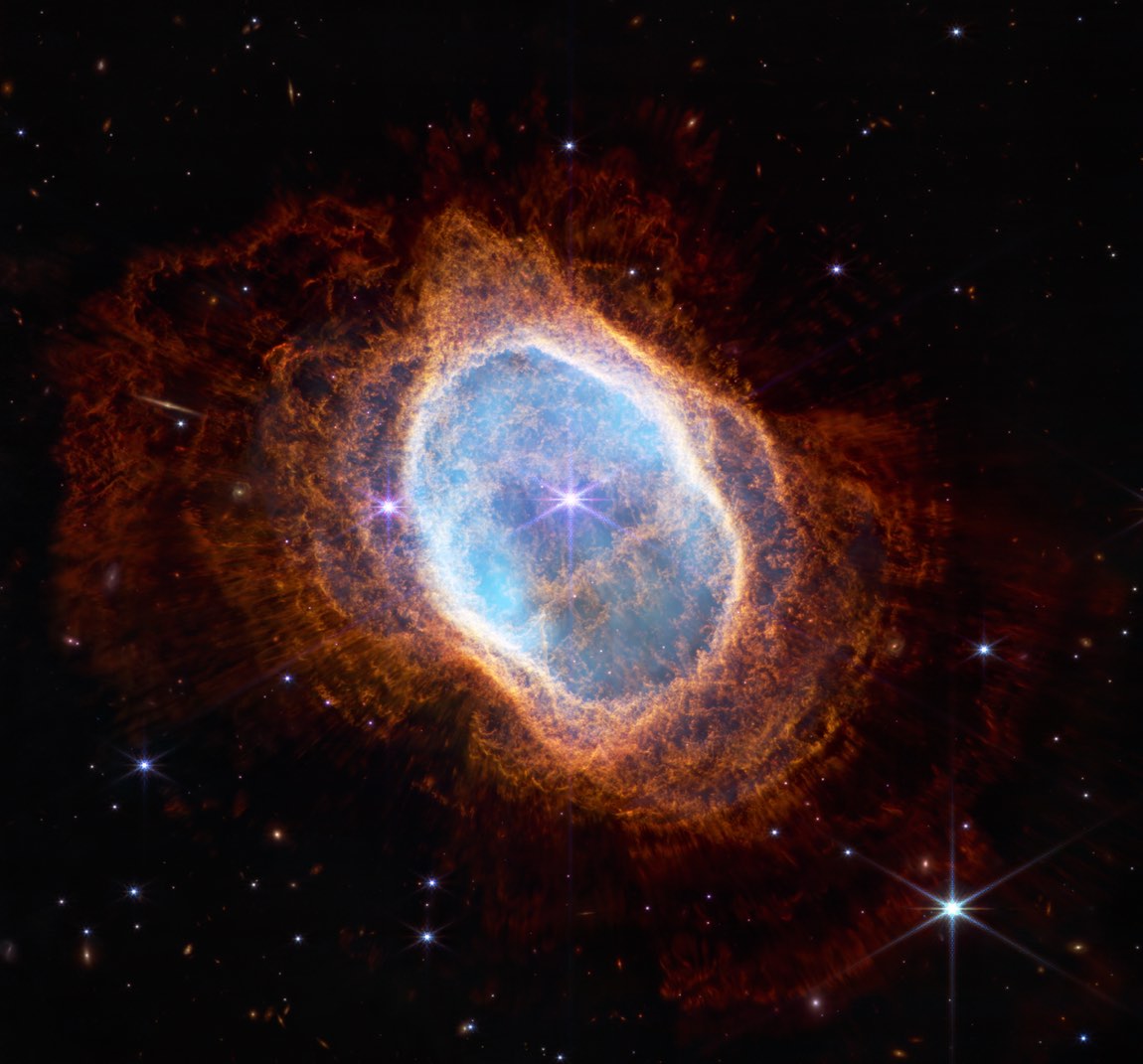
NGC 3132, the Southern Ring or Eight-Burst Nebula, is a bright planetary nebula in Vela. It looks strongly oval from Earth, but 3D modelling shows it is really a bipolar nebula tilted about 20° from our line of sight, with several ring-like shells around a hollow centre. Two stars sit close together in its middle, a brighter one of 10th magnitude and the fainter star that produced the nebula. On 12 July 2022 it was one of five targets in the James Webb Space Telescope's first released science images.
The deep dive
Researched for the Atlas from Wikipedia — NGC 3132 (1,724 characters read) · updated Nov 15, 2026
01 A nebula hiding in plain sight
NGC 3132 goes by several names — the Eight-Burst Nebula, the Southern Ring Nebula, and Caldwell 74 — each reflecting a different observer's impression of its layered, looping shell of glowing gas. The name "Eight-Burst" comes from its appearance through smaller telescopes, where overlapping rings can resemble the figure eight. Despite belonging to the southern sky and sitting in the constellation Vela, it is not entirely inaccessible to northern observers; on exceptionally clear nights it can be spotted as far north as the state of Virginia, though it never climbs high enough there for comfortable viewing. The nebula is classified as a planetary nebula, a term that has nothing to do with planets — it refers to the rounded, planet-like disk these objects showed early telescope users. What we are actually seeing is the expelled outer atmosphere of a dying star, now lit from within by intense ultraviolet radiation.
02 Its true shape: not a ring but a bubble Deeper
From Earth, NGC 3132 presents a strongly elliptical silhouette, suggesting a flattened ring. But three-dimensional modeling has revealed the real structure: it is a bipolar nebula — two lobes of gas blown outward along a single axis, like an hourglass or a pair of soap bubbles joined at the waist. The major axis of this bipolar structure is inclined only about twenty degrees away from our line of sight, which is nearly face-on. That small tilt is precisely why we see an apparent ring rather than the elongated, dumbbell shape we would observe if the axis were tilted closer to ninety degrees. At the heart of the nebula sits a central low-density cavity, and surrounding that cavity are multiple distinct ring-like structures layered concentrically, adding to the visual complexity that earned it its eight-burst nickname.
03 Two stars where you expect one
Look carefully at the center of NGC 3132 and you will find not one star but two, separated by just 1.7 arcseconds on the sky — close enough that they appear almost merged in ordinary images. The brighter of the pair shines at 10th magnitude and is catalogued as HD 87892, a perfectly ordinary A-type main-sequence star of spectral class A2V, similar in character to Sirius though far less famous. The fainter companion, glowing dimly at 16th magnitude, is the actual engine driving the entire nebula: a white dwarf whose surface temperature reaches a scorching 140,000 K. That is roughly 25 times hotter than our own Sun's surface. The two are separated by at least 1,277 au — for scale, that is more than 42 times the distance between the Sun and Neptune, yet they are gravitationally bound into a single system.
04 The white dwarf that built all this
The faint white dwarf at the center of NGC 3132 is what remains after the nebula's progenitor star exhausted its nuclear fuel and shed its outer layers. That original star carried a mass of about 2.7 times that of the Sun — substantial enough to end its life dramatically, puffing up into a giant and then expelling its atmosphere into surrounding space over thousands of years. What remained after all that mass loss is the white dwarf we see today: an Earth-sized cinder of carbon and oxygen, so hot that it floods the surrounding gas with ultraviolet photons. Those photons ionize the gas, causing it to fluoresce brightly and produce the vivid emission colors captured in images. Without the white dwarf's relentless ultraviolet output, the nebula would be invisible.
05 A four-star family, not just a pair Deeper
The white dwarf and the A-type star HD 87892 are not necessarily the whole story. Based on the architecture of the system, astronomers consider NGC 3132 to likely be a quadruple star system — four stars in a gravitationally linked family. The A-type companion orbits at a distance that places it roughly at the edge of a dust cloud surrounding the central white dwarf, suggesting the companion's gravity may have influenced how material was distributed during the nebula-forming mass-loss event. Multiple-star systems are increasingly recognized as important shapers of planetary nebula morphology; a single star shedding mass symmetrically tends to produce a spherical shell, whereas companions can tilt, pinch, and sculpt that outflow into the bipolar and multi-ringed structures we observe in NGC 3132. The quadruple interpretation, if confirmed, would make this one of the more architecturally complex systems known to host a planetary nebula.
 ⤢
06 How far, and how we know
NGC 3132 lies approximately 613 parsecs from Earth, a figure that also translates to about 2,000 light-years. A light-year is roughly 9.46 trillion kilometers, so 2,000 of them is a genuinely vast distance — the light we see left the nebula around the time the Roman Empire was at its height. Distances to planetary nebulae are notoriously difficult to pin down because there is no single reliable standard candle method that works for all of them. Estimates often come from combining the nebula's angular size with assumptions about its physical size, or from measuring the properties of the central star. The 613-parsec figure represents the current best estimate, but as with most planetary nebulae, some uncertainty remains. The good news is that the distance does not greatly affect many of the nebula's scientifically interesting properties, which can be derived from the light itself regardless of exactly how far away the source sits.
07 Webb's first-light moment for NGC 3132
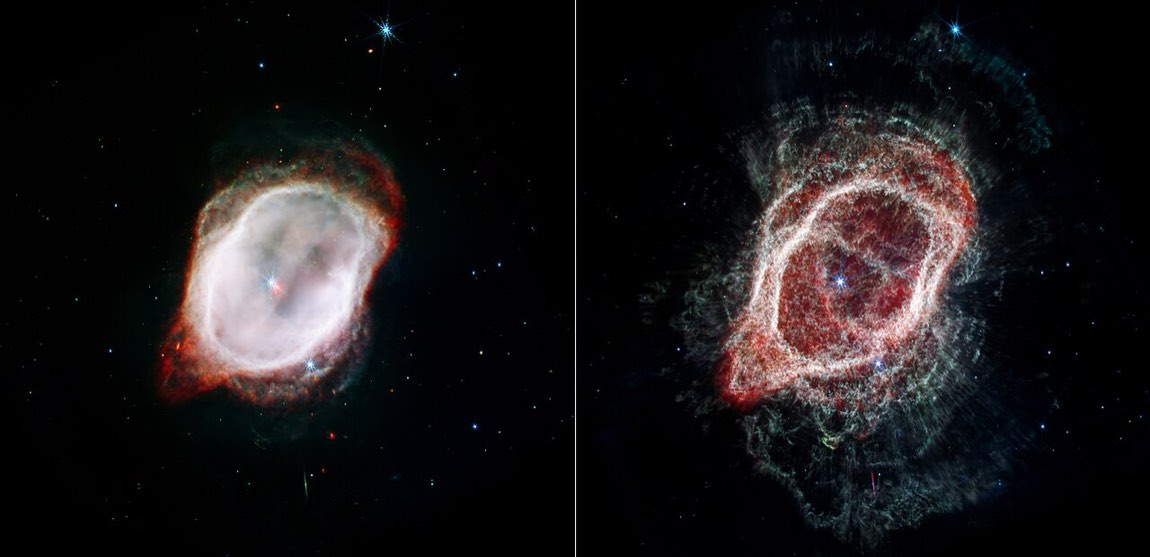
On July 12, 2022, the James Webb Space Telescope unveiled its first official science images to the world, and NGC 3132 was one of only five cosmic objects chosen for that historic release. The selection underscored how scientifically valuable and visually compelling the nebula is. Webb's infrared sensitivity allowed it to peer through dust that obscures shorter-wavelength views, and its extraordinary resolution captured detail in the ring structures and the central stellar pair that earlier observatories could not resolve cleanly. The event was a global media moment, with the Southern Ring Nebula images reaching millions of people who had never heard of NGC 3132 before. For planetary nebula researchers, the Webb data represented a significant new dataset, offering fresh constraints on the geometry, dust distribution, and stellar properties of a system that had already been studied for decades but still held open questions.
08 Why its brightness makes it special Deeper
NGC 3132 is described in the astronomical literature as a bright and extensively studied planetary nebula — a designation that matters more than it might seem. Planetary nebulae span an enormous range of surface brightnesses, and many are so faint that detailed spectroscopy is impractical even with large telescopes. NGC 3132's relative brightness, combined with its southerly but not extreme declination, has made it a preferred target for researchers wanting to study nebular chemistry, kinematics, and ionization structure. The 10th-magnitude A-type star HD 87892 also makes the system useful as a reference point, since its spectral type and luminosity are well characterized and can help constrain the geometry of the system. Extensive study means that NGC 3132 serves as something of a benchmark object: results derived here are sometimes used to calibrate techniques applied to fainter, more distant planetary nebulae elsewhere in the galaxy.
09 Observing NGC 3132 from Earth
With an apparent magnitude of 8.2, NGC 3132 is bright enough to be detected with binoculars under dark skies, though it will appear as little more than a fuzzy star at that magnification. A small telescope of 100 mm or more begins to show its disk-like shape, and a moderate aperture instrument under steady seeing can reveal the elliptical outline and hint at internal structure. The best views come from southern latitudes, where Vela climbs well above the horizon; from Australia, South Africa, or South America, the nebula transits at a comfortable elevation. Northern Hemisphere observers can glimpse it from subtropical latitudes, and determined observers as far north as Virginia can catch it low in the southern sky. Using a narrowband oxygen-III filter dramatically improves contrast by suppressing sky background while passing the nebula's dominant emission, making structural details pop even in moderately light-polluted skies.
10 Open questions the nebula still poses Deeper
Even after decades of study and the new James Webb Space Telescope data, NGC 3132 still presents researchers with genuine puzzles. The quadruple-star interpretation of the central system is considered likely but not definitively confirmed — establishing the orbits of four gravitationally interacting stars in a system this old and complex requires long baseline observations and careful modeling. The precise mechanism by which the multiple ring structures formed is not fully settled; different rings may trace different episodes of mass loss from the progenitor star, but disentangling the timing and physics of each episode is an ongoing task. The inclination of the bipolar axis — just twenty degrees from our line of sight — was itself derived from three-dimensional modeling, and refining that model depends on having accurate distance estimates that still carry some uncertainty. Each of these threads represents active research territory, where new data, including the infrared detail Webb provides, continues to sharpen the picture without yet closing every debate.
 ⤢