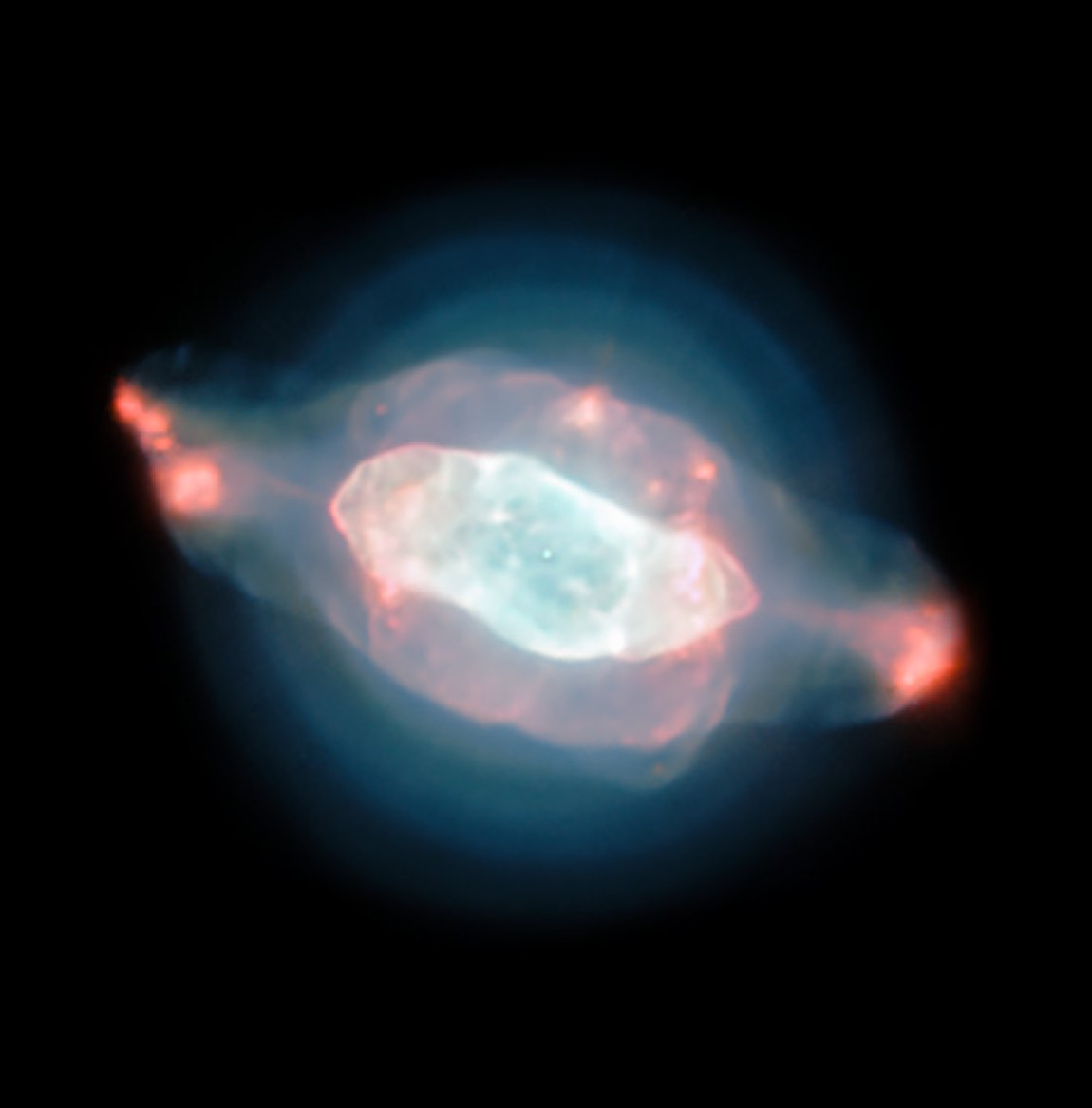
 Photograph · ESO/J. Walsh · CC BY 4.0
Nebula · Deep guide
The Saturn Nebula
Also called: Caldwell 55 · C55 · NGC 7009
A planetary nebula whose 'handles' make it look like Saturn seen with its rings edge-on.
What is it?
The Saturn Nebula is a planetary nebula in Aquarius, the expanding shell of a low-mass star that has shed its outer layers. Lord Rosse named it in the 1840s because its shape, with faint extensions called ansae on either side, resembles Saturn with its rings nearly edge-on. Its structure is complex, with a halo, multiple shells, jet-like streams and small knots. The central star is now a bright white dwarf of magnitude 11.5. William Herschel discovered it on 7 September 1782, one of his earliest finds.
The deep dive
Researched for the Atlas from Wikipedia — Saturn Nebula (2,392 characters read) · updated Nov 15, 2026
01 How the Saturn Nebula Got Its Name
The Saturn Nebula did not always carry its evocative name. When William Herschel first spotted it on September 7, 1782, from the garden of his home in Datchet, England, it was simply another fuzzy smudge catalogued during his ambitious sky survey — one of his earliest discoveries. The name we use today came decades later, in the 1840s, courtesy of Lord Rosse. By that time telescopes had improved dramatically, and observers could finally resolve the nebula's distinctive extensions on either side of its bright central disk. Those wing-like projections gave it an unmistakable resemblance to the planet Saturn viewed with its rings tilted nearly edge-on. Lord Rosse made the connection and the name stuck. Adding to its pedigree, the astronomer William Henry Smyth noted that the Saturn Nebula was counted among Struve's nine so-called "Rare Celestial Objects" — a short, prestigious list of the most remarkable sights the sky had to offer at the time.
02 Herschel's Discovery Night in 1782
The evening of September 7, 1782 was a productive one for William Herschel. Working with a telescope of his own design — Herschel was as much instrument-maker as astronomer — he swept the constellation Aquarius from his garden in Datchet and recorded what would become NGC 7009. The discovery came early in his systematic sky survey, a project that would ultimately reshape humanity's understanding of the deep sky. At the time, Herschel could not have known what the object truly was; planetary nebulae as a class were poorly understood, and their telescopic appearance as small, faintly colored disks led early observers to confuse them with distant planets. The irony is sharp: a nebula that would later be named after a planet was itself mistaken for something planet-like by the very generation that found it. Herschel's patient, methodical survey style — night after night, garden after garden — made discoveries like this one almost inevitable.
03 The Glowing Green Light and Why It Exists
Point a small amateur telescope at the Saturn Nebula and you will notice something immediately striking: the object glows with a distinctive greenish-yellowish hue. That color is not incidental — it is a direct signature of the nebula's chemistry and the ferocious energy pouring out of its central star. The central star is an extremely hot bluish dwarf with a surface temperature of 55,000 K, far hotter than our own Sun. At that temperature, the star floods its surroundings with intense ultraviolet radiation. When that radiation strikes oxygen atoms in the surrounding gas and strips away two of their electrons — producing what chemists call doubly ionized oxygen — those ions re-emit the absorbed energy as visible light at the specific wavelengths that our eyes register as green. Astronomers describe this process as fluorescence. The characteristic green tint of many planetary nebulae, including this one, is essentially a neon sign written in ionized oxygen, powered by a dying star's last fierce output of energy.
04 A Star's Vital Statistics at Its Core Deeper
The white dwarf sitting at the heart of the Saturn Nebula is a remarkable object in its own right. Its apparent visual magnitude is 11.5, meaning a modest backyard telescope can in principle detect it, though separating the star's light from the surrounding nebula requires care. Its absolute magnitude is +1.5, and from that figure astronomers derive a luminosity of roughly 20 solar luminosities — not especially powerful by stellar standards, but concentrated into an object probably no larger than Earth. The surface temperature of 55,000 K places it firmly among the hottest white dwarfs known. This combination of compact size, high temperature, and vigorous ultraviolet output is precisely what makes the star such an efficient ionizing engine for the gas around it. The entire glowing structure we admire in photographs is essentially a monument to this star's past life: the expelled outer layers of what was once a low-mass star, now lit up by the exposed, scorching remnant core that remains.
05 Ansae, Jets, and a Layered Architecture Deeper
What sets the Saturn Nebula apart from simpler planetary nebulae is the sheer complexity of its three-dimensional structure. Astronomers have identified multiple distinct sub-systems packed into one object: a large outer halo, multiple nested shells, jet-like streams, small-scale filaments and knots, and most famously the ansae — a Latin word meaning "handles" — the elongated extensions on either side that give the nebula its Saturn-like profile. Crucially, the ansae are not simply being pushed straight outward from the central star. Studies show they are expanding non-radially, meaning their motion is angled rather than purely radial, which complicates simple models of how such structures form. Although the Saturn Nebula's ansae are the most prominent examples of this feature among planetary nebulae, they are not unique to it: similar structures appear in NGC 3242, NGC 6543, and NGC 2371-2, suggesting that ansae formation may be a relatively common episode in the late lives of certain stars rather than a freakish accident.
06 The Stubborn Uncertainty of Its Distance Deeper
One of the most basic facts you might want to know about an astronomical object — how far away is it? — turns out to be frustratingly difficult to pin down for the Saturn Nebula. Two well-known estimates bracket a significant range. In 1963, O'Dell placed the nebula at approximately 3,900 light-years (1.2 kiloparsecs) from Earth. Four decades later, Sabbadin and colleagues published a revised figure of 5,200 light-years (1.6 kiloparsecs) in 2004. The gap between those two values is itself more than 1,300 light-years — farther than many nearby stellar neighbors. Using O'Dell's closer distance, the overall diameter of the nebula works out to roughly 0.5 light-years, which is a useful physical scale to hold in mind. The difficulty in measuring distances to planetary nebulae is a long-standing problem in astronomy; without a reliable geometric parallax, researchers must rely on indirect methods that each carry their own assumptions and uncertainties.
07 Size on the Sky and Finding It Tonight
The Saturn Nebula sits 1 degree west of the star Nu Aquarii in the constellation Aquarius, a useful pointer for star-hoppers. On the sky, the object has two distinct visible zones. The bright central portion spans 25 arcseconds by 17 arcseconds — small enough that moderate magnification is needed to show any detail. The larger outer shell extends to 41 arcseconds by 35 arcseconds, making the whole structure slightly oval rather than perfectly circular. With an overall visual magnitude of 8, the nebula is technically within reach of binoculars under dark skies, though it will appear as little more than a faint star-like point without a telescope. The object appears on many "best of" observing lists, a distinction that reflects both its brightness and its visual drama: even a small telescope reveals the characteristic greenish color, and larger apertures begin to tease out the ansae that inspired its name.
08 Racing Toward Us at 28 Miles Per Second
The Saturn Nebula is not sitting still. Astronomers measure its radial velocity — the component of its motion directly toward or away from us — at 28 miles per second, and the direction is toward Earth. To put that in perspective, 28 miles per second is roughly 150 times faster than a commercial airliner cruises, though at the nebula's distance of thousands of light-years, even that pace amounts to an almost imperceptible drift across the sky over a human lifetime. Radial velocity measurements like this one are made by studying the Doppler shift of the nebula's spectral lines: gas moving toward us compresses the light waves it emits, nudging spectral features toward the blue end of the spectrum. The measurement tells astronomers not just about the nebula's bulk motion through the galaxy but also, when applied to individual sub-structures within the nebula, about the internal dynamics of its expanding shells and jets.
09 From Low-Mass Star to Glowing Shell
The Saturn Nebula's biography begins long before anything resembling a nebula existed. The object originated as a low-mass star — a star not dramatically different in initial mass from our own Sun. Over billions of years, that star burned through its nuclear fuel, eventually swelling into a red giant and then shedding its outer layers into the surrounding space in a relatively gentle process compared to the explosive death of massive stars. Those expelled layers spread outward, forming the multiple shells, filaments, and halo that we now see illuminated around the remaining core. What is left of the original star is the white dwarf at the nebula's center. The whole structure — halo, shells, ansae, jets — represents the accumulation of material the star lost during its final evolutionary stages, frozen in a moment of cosmic transition and backlit by the dying star's intense ultraviolet glow.
10 NGC 7009's Place Among Planetary Nebulae Deeper
The Saturn Nebula carries three designations that place it in different historical cataloguing traditions. NGC 7009 is its entry in the New General Catalogue, the workhorse reference of deep-sky observers compiled in the nineteenth century. Caldwell 55 is a more modern label from Sir Patrick Moore's Caldwell Catalogue, a list of 109 objects deliberately chosen to complement the famous Messier list. Despite its visual appeal and scientific richness, the Saturn Nebula never made it onto Messier's original catalog. Among planetary nebulae it is considered a complex example, one that researchers use as a kind of benchmark for studying the full range of structures these objects can produce — not a simple bubble, but a layered, asymmetric, kinematically active system. Its combination of brightness, accessibility from both hemispheres, and structural detail has made it a frequent target for both professional imaging campaigns and amateur visual observers.
11 Open Questions That Remain Unanswered Deeper
Even a well-studied object like the Saturn Nebula leaves astronomers with unresolved puzzles. The non-radial expansion of the ansae is one: standard models of stellar wind interaction predict outflow directed away from the central star, so the angled motion of the handles demands a more complicated explanation, perhaps involving asymmetric mass loss, magnetic fields, or a binary companion to the central star. The uncertain distance — with estimates differing by over 1,300 light-years between O'Dell's 1963 value and Sabbadin's 2004 figure — means that physical dimensions like the true diameter and luminosity of the nebula remain imprecisely known. The formation of the small-scale filaments and knots seen throughout the structure is also not fully understood; similar features appear in other planetary nebulae and are thought to arise from hydrodynamic instabilities where fast and slow gas flows collide, but the details are still being worked out. The Saturn Nebula continues to serve as a productive laboratory for these questions.