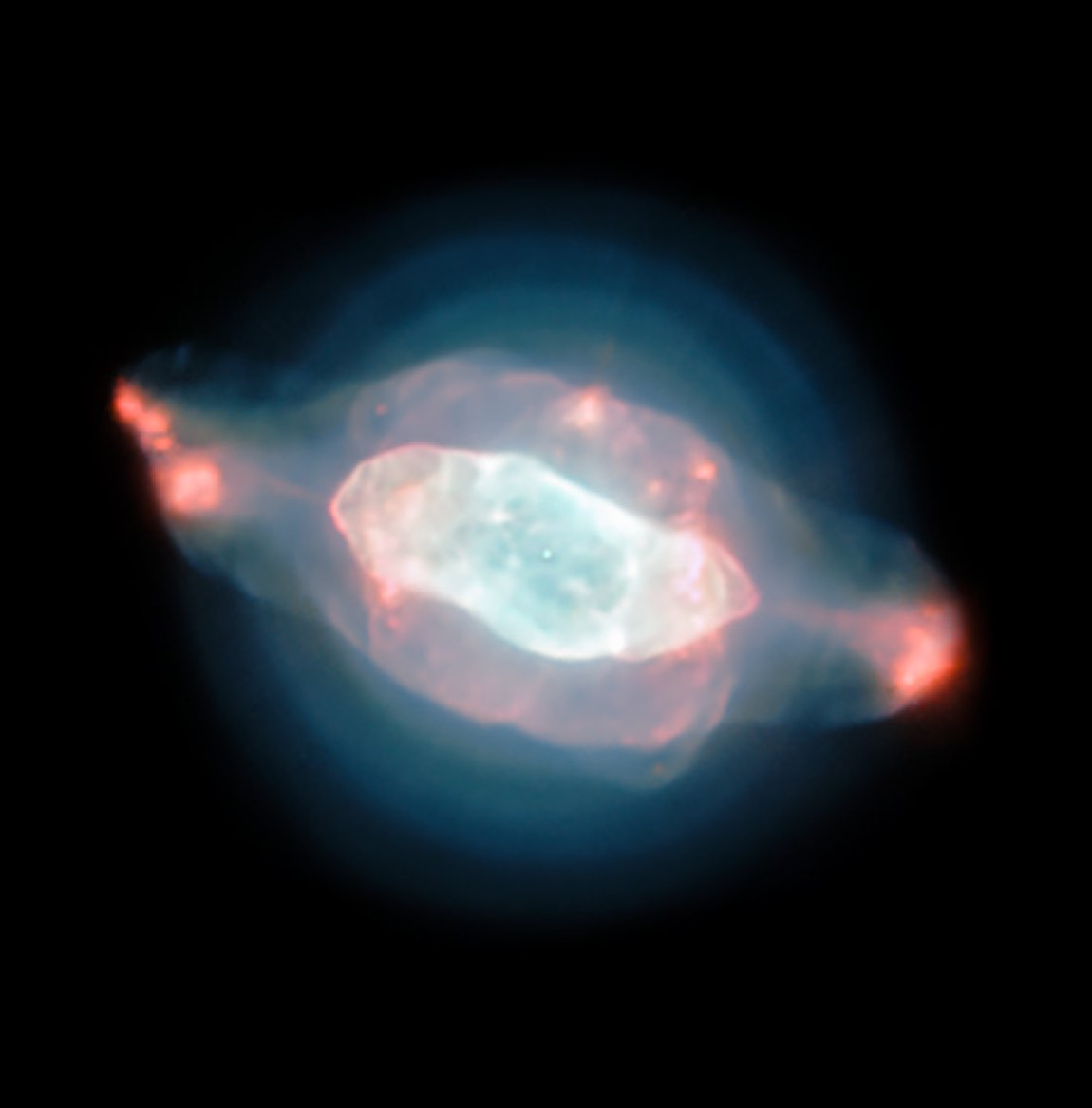
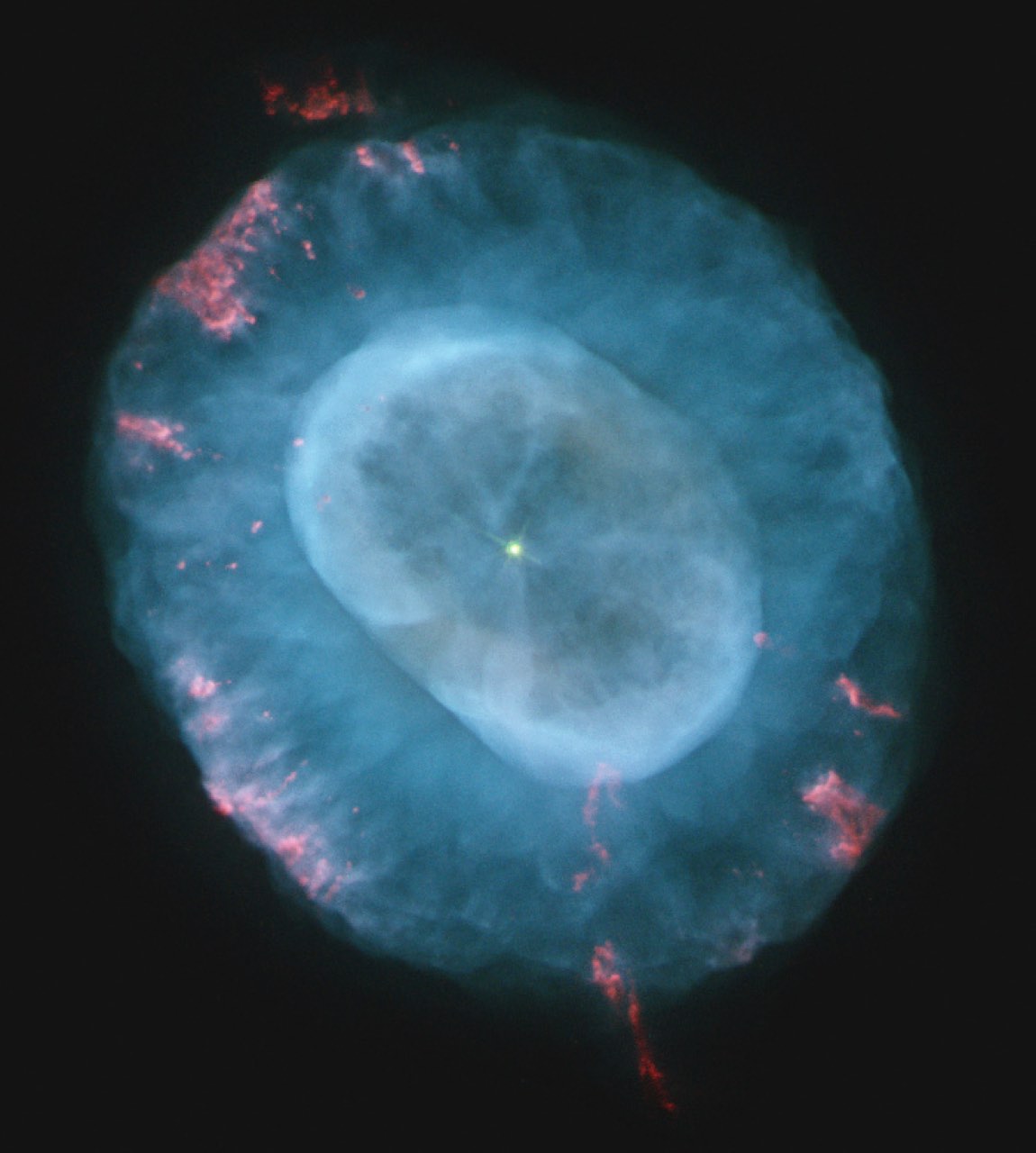
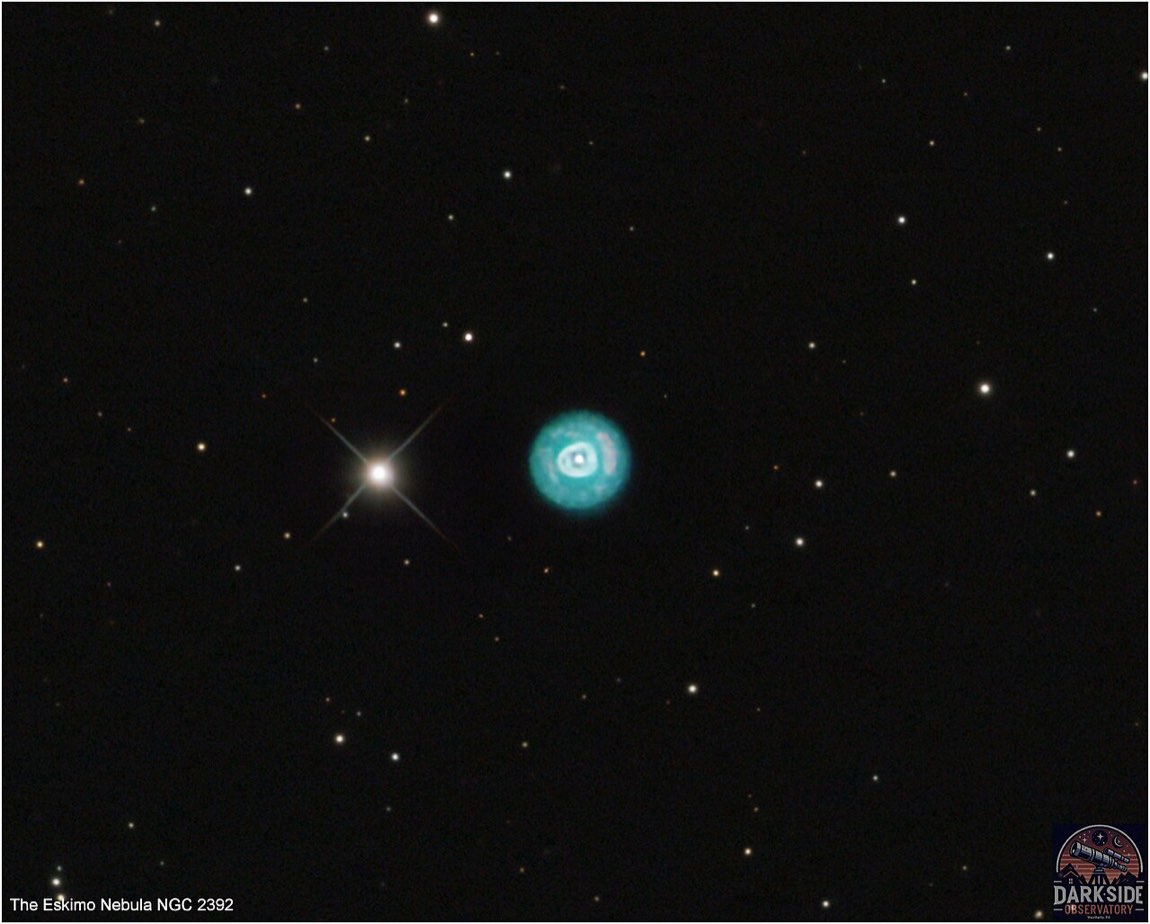
 Photograph · Thedarksideobservatory · CC BY-SA 4.0
Nebula · Deep guide
The Eskimo Nebula
Also called: Caldwell 39 · C39 · NGC 2392 · Clown Face Nebula · Lion Nebula
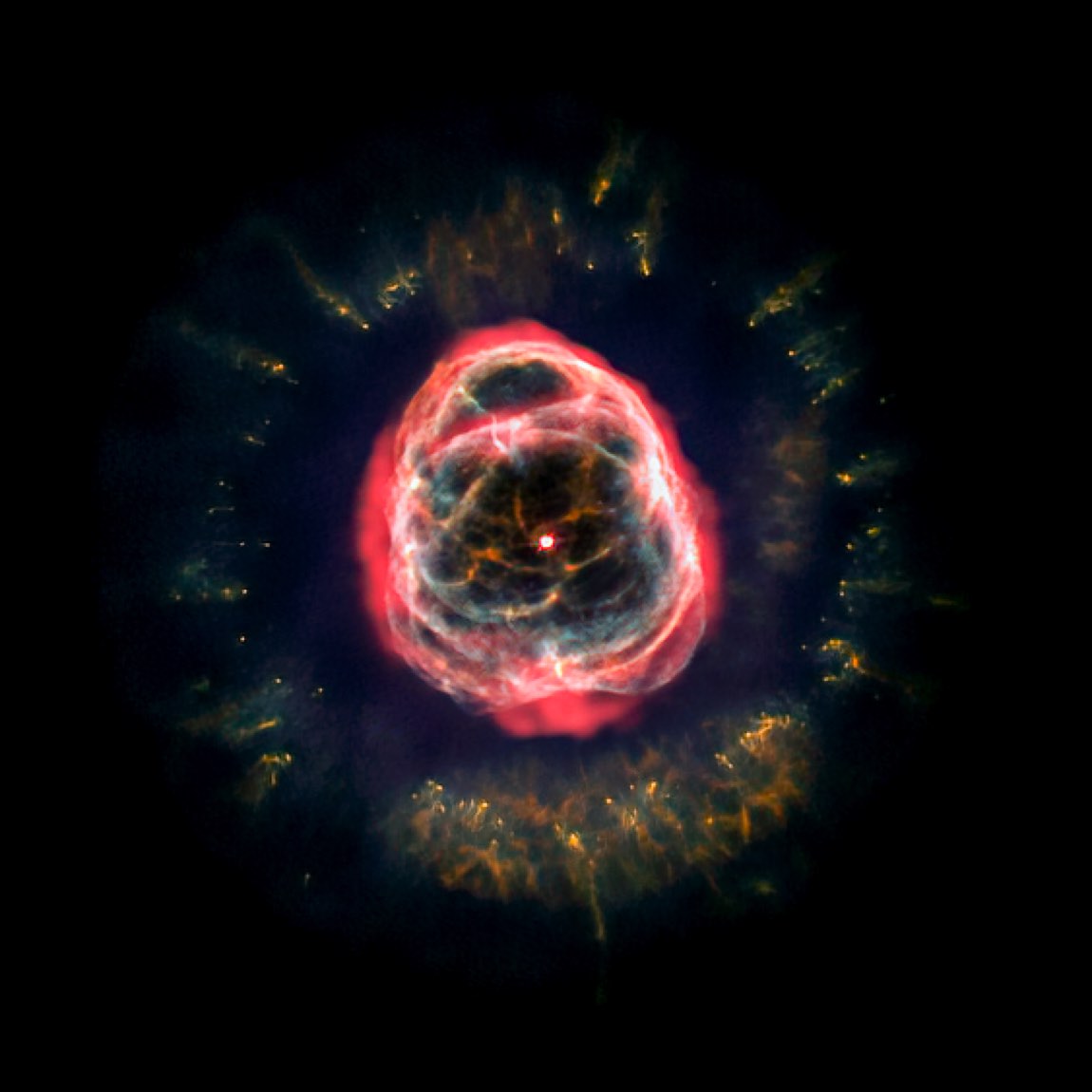
A dying star's face peering out from a fur-lined parka hood of glowing gas.
What is it?
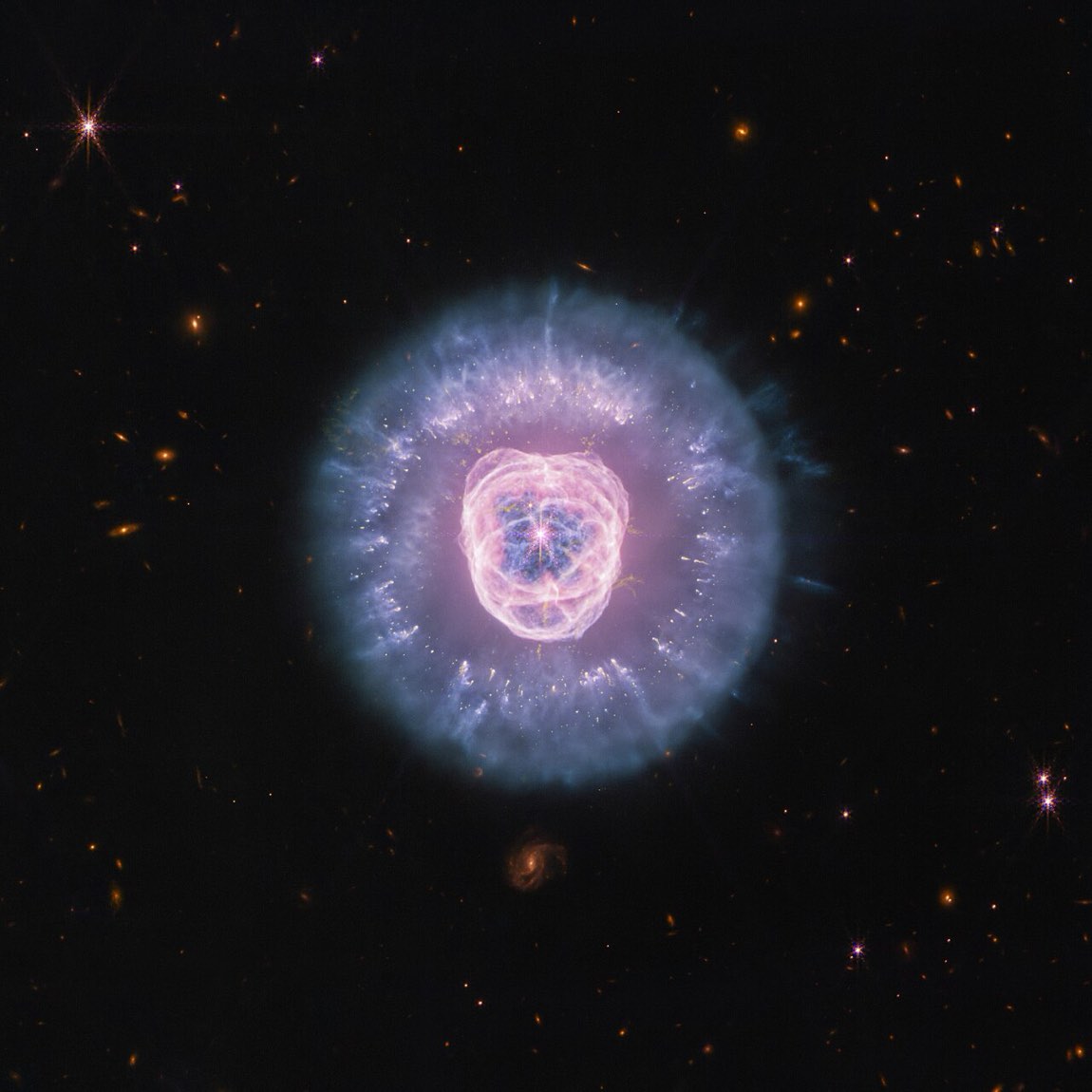
The Eskimo Nebula is a planetary nebula in Gemini, made of the outer layers thrown off by a Sun-like star near the end of its life. In a telescope it resembles a face inside a parka hood, which also earned it the names Clown Face and Lion Nebula. It has a double-shell, two-lobed structure: a strong wind from the hot central star shapes the inner filaments, while the outer disc holds unusual light-year-long streamers. It lies about 6,500 light-years away and can be seen in a small telescope. William Herschel discovered it on 17 January 1787.
The deep dive
Researched for the Atlas from Wikipedia — Eskimo Nebula (1,925 characters read) · updated Nov 15, 2026
01 William Herschel's Night of Discovery
On January 17, 1787, William Herschel was observing from Slough, England, when he trained his telescope on a curious smudge in Gemini and recorded it as a star of ninth magnitude surrounded by equally dispersed nebulosity. He called it "a very remarkable phenomenon" — high praise from an astronomer who catalogued thousands of objects. Herschel was German-born but worked in Britain, and this discovery became one of his most celebrated. The object entered his catalogue as WH IV-45 and was later assigned NGC 2392. Because of its significance, the Astronomical League included it in their Herschel 400 observing program, a curated list of 400 objects Herschel catalogued that amateur astronomers work through as an observational challenge. Herschel had no way of knowing he was looking at the expelled outer layers of a dying star, since the physics of planetary nebulae would not be understood for generations — but his instinct that he had found something genuinely unusual proved entirely correct.
02 A Nebula Caught by the Moon's Shadow
On January 9, 1982, an unusually rare celestial coincidence unfolded: NGC 2392 was occulted by the Moon during a total lunar eclipse — the January 1982 lunar eclipse. During a total lunar eclipse the Moon turns deep red, making it relatively dim, which allowed the event to be observed by several watchers in England who watched the nebula wink out behind the darkened lunar disk. The geographic footprint of visibility stretched across Greenland, the Arctic, the extreme northeast of North America, the northern half of Europe, and North and Northeast Asia. Such an event requires precise alignment between the Moon's orbit and the nebula's position in Gemini — a coincidence that will not repeat soon. The next time an occultation of NGC 2392 occurs during a total lunar eclipse will be during the January 2066 lunar eclipse, visible over the northern half of Asia and the Northwest Pacific, giving future observers more than four decades to plan for it.
03 Two Shells, Two Winds, One Dying Star Deeper
NGC 2392 is classified as a bipolar, double-shell planetary nebula, and that layered structure tells a coherent story of a dying star shedding its atmosphere in stages. The inner region is dominated by visible filaments driven outward by a powerful wind of particles streaming from the central stellar remnant. These are not gentle breezes — they are energetic enough to sculpt glowing threads of gas into the tight, organized patterns visible in detailed images. Beyond this inner zone lies an outer disk populated by unusual filaments that stretch for roughly a light-year — a distance comparable to about 63,000 times the Earth-Sun separation. These long filaments give the nebula its distinctive appearance: the inner bright region resembles a face, while the outer disk creates the impression of a surrounding hood or parka. The bipolar symmetry suggests the outflows are not perfectly spherical but are shaped and focused by forces that astronomers continue to study, possibly including the rotation of the progenitor star or magnetic fields in the ejected gas.
04 The Unusual Star at the Center Deeper
At the heart of NGC 2392 sits a stellar remnant designated HD 59088, classified as an O-type star with the precise spectral type O(H)6f. O-type stars are the hottest and most luminous class in standard stellar classification, and finding one at the center of a planetary nebula places HD 59088 among the hottest stellar remnants known. The notation O(H) in its spectral type indicates hydrogen is detectable in its spectrum, while the "f" suffix denotes emission lines characteristic of a stellar wind — meaning even this remnant is still actively pushing material outward. This intense radiation from HD 59088 is what ionizes the surrounding gas and makes the entire nebula glow. Without that extreme ultraviolet output, the expelled shells would be invisible. The star itself is the core that survived after the outer layers of a Sun-like progenitor were ejected, compressed over cosmic time into a dense, extraordinarily hot object that now illuminates its own discarded atmosphere.
05 How to Spot It With a Small Telescope
One of NGC 2392's most practical virtues is accessibility. At an apparent magnitude bright enough to be detected with a small telescope, it sits in the northern constellation Gemini, one of the most recognizable winter star patterns in the sky. At roughly 6,500 light-years away it is relatively nearby as planetary nebulae go, which helps maintain enough angular size and surface brightness to reward modest instruments. The appearance through a small telescope — a slightly fuzzy, star-like point with a brighter central condensation — echoes almost exactly what William Herschel described in 1787: a star-like object with nebulosity equally dispersed around it. Larger amateur telescopes begin to reveal the layered structure, and under good seeing the contrast between the bright inner region and the fainter outer envelope becomes apparent. The nebula's membership in the Herschel 400 list gives amateur astronomers a formal motivation to seek it out, making it one of the more frequently observed planetary nebulae by backyard observers across the northern hemisphere.
 ⤢
06 What Those Light-Year Filaments Actually Are Deeper
The outer disk of NGC 2392 contains filaments described specifically as "light-year-long" — a scale that makes them genuinely extraordinary structures. A single light-year is about 9.46 trillion kilometers, so these threads of gas extend across distances that dwarf anything in our solar system. The article notes they are described as "unusual," which signals that they remain an active area of study rather than a fully explained feature. In planetary nebulae generally, such extended filamentary structures can arise from instabilities at the boundary between fast and slow winds, where faster-moving material from later ejections plows into slower material shed earlier, creating compressed, elongated knots and streamers. Whether that is the precise mechanism at work in NGC 2392 is part of what makes the nebula scientifically interesting beyond its visual appeal. The bipolar, double-shell classification itself implies two distinct mass-loss episodes or two distinct wind velocities acting on the ejected material, and understanding how those interactions produce light-year-scale filaments remains an open question in nebular physics.
07 The Progenitor: A Star Like Our Sun
The gas making up NGC 2392 was not always a glowing cloud in Gemini — it was once the outer layers of a Sun-like star. When a star with a mass roughly comparable to our Sun exhausts its nuclear fuel, it expands into a red giant and then, rather than exploding as a supernova, it sheds its outer envelope in a comparatively gentle process, leaving behind a hot dense core. That core becomes the central star, while the expelled gas forms the planetary nebula. For NGC 2392, the description of the progenitor as Sun-like is significant because it means this nebula offers an approximate preview of the far future fate of our own solar system. In billions of years, the Sun will go through the same process, puffing out its outer layers and creating its own nebula, while Earth and the inner planets — long since scorched by the red giant phase — would lie within or near whatever nebular structure forms. NGC 2392 makes that abstract future concrete and visible.
08 Multiple Names, One Contested Identity
NGC 2392 has accumulated an unusually long list of names over its observational history: the Eskimo Nebula, the Clown Face Nebula, the Lion Nebula, and Caldwell 39, in addition to its NGC designation and William Herschel's original catalogue number WH IV-45. The Caldwell 39 designation comes from the Caldwell catalogue, an independent list of 109 notable deep-sky objects not in the Messier catalogue, compiled to give amateur observers additional targets. The various visual nicknames — Eskimo, Clown Face, Lion — all attempt to capture the same basic appearance: a bright central region resembling a face surrounded by a broader, fuzzier outer structure resembling a hood or mane. However, in August 2020 the naming landscape changed significantly. On August 11, 2020, the IAU Working Group on Star Names, NASA's IPAC Extragalactic Database, and the SIMBAD Astronomical Database all discontinued use of the "Eskimo Nebula" nickname, judging it offensive, and strongly recommended using the NGC 2392 designation in all further publications. The name debate adds a layer of recent cultural and institutional history to an object first noted more than two centuries ago.
09 The 2020 Renaming and What It Signals
The August 11, 2020 decision by multiple major astronomical institutions to drop the "Eskimo Nebula" nickname was not an isolated act — it was part of a broader reckoning within the astronomical community about the casual use of names that carry colonial or derogatory connotations. The IAU Working Group on Star Names, the NASA/IPAC Extragalactic Database, and the SIMBAD Astronomical Database acted in coordination, giving the recommendation significant institutional weight. By directing the community toward the neutral NGC 2392 designation, the bodies were also implicitly endorsing the systematic catalog system as the most durable and unambiguous way to name astronomical objects. The move prompted discussion about how visual nicknames for celestial objects are coined — typically by observers reaching for a convenient cultural reference — and how those choices, harmless-seeming at the time, can carry different weight across communities and generations. NGC 2392 remains the same fascinating double-shell nebula it always was, but how professional and amateur astronomers refer to it has formally shifted, with the NGC designation now carrying the institutional endorsement that the visual nicknames once enjoyed.
 ⤢