 Photograph · ESO · CC BY 4.0
Nebula · Deep guide
Running Chicken Nebula (IC 2944)
Also called: Caldwell 100 · IC 2944 · Lambda Centauri Nebula · RCW 62
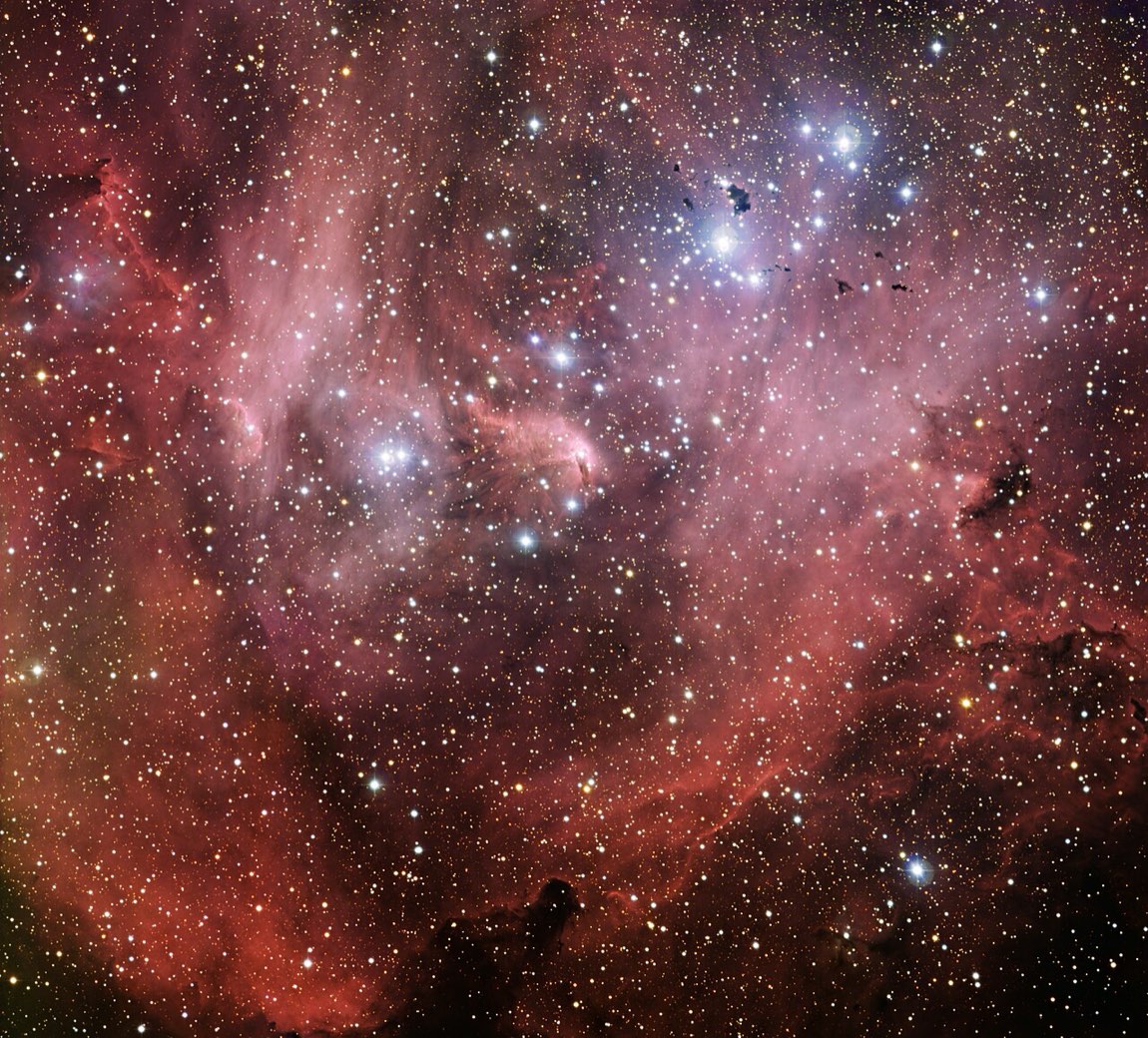
A star cluster and glowing gas cloud in Centaurus, dotted with dark Bok globules.
What is it?
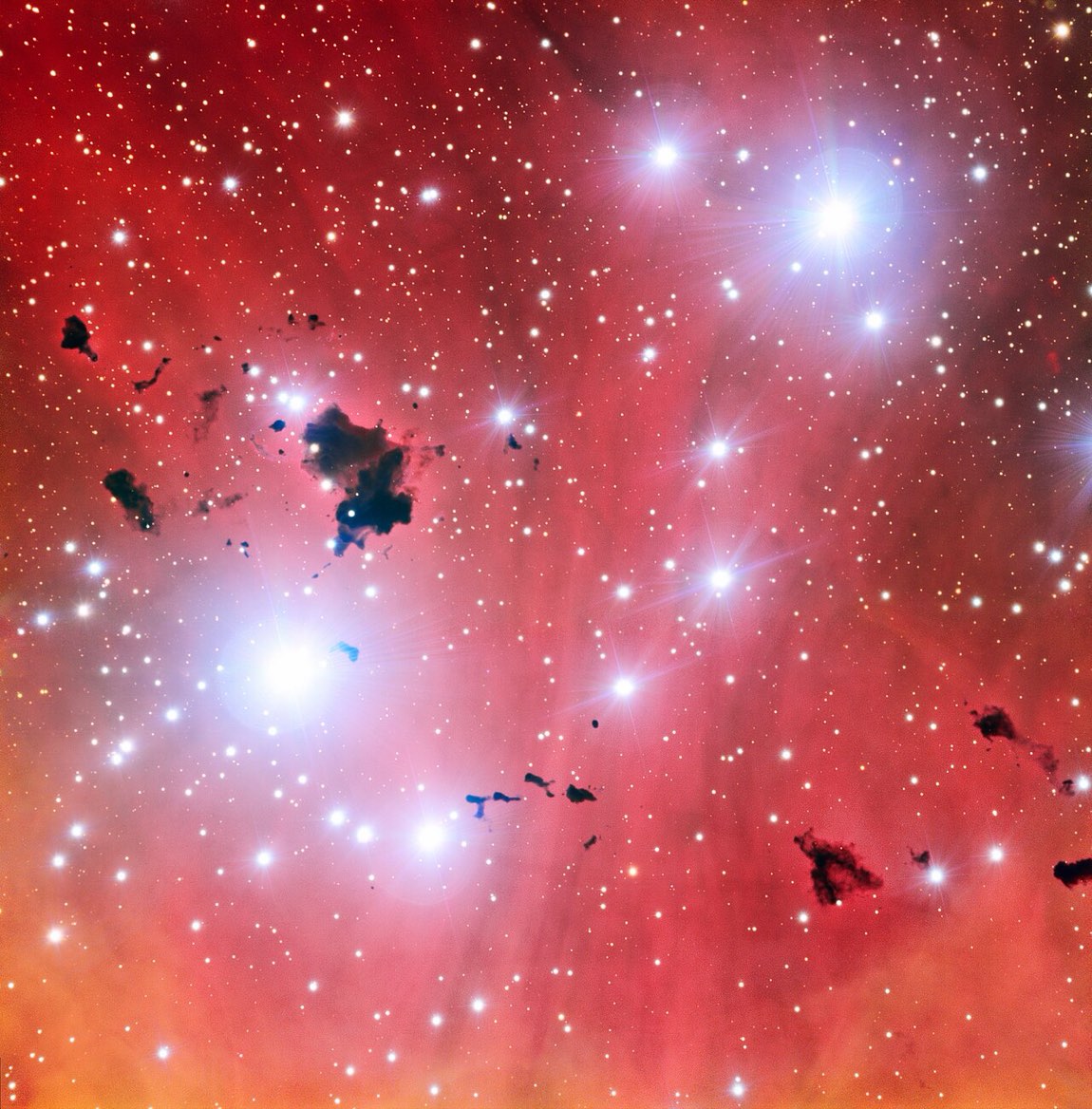
IC 2944 is an open cluster wrapped in an emission nebula near the star Lambda Centauri, nicknamed the Running Chicken Nebula after the shape some see in it. In 1950 A. David Thackeray discovered a set of dark, dense clumps silhouetted against the glowing gas, now called Thackeray's Globules. Such Bok globules are often places where stars form, yet no star formation has been found inside these ones. The wider glow also includes IC 2948 and IC 2872.
The deep dive
Researched for the Atlas from Wikipedia — IC 2944 (1,227 characters read) · updated Nov 15, 2026
01 A Neighborhood of Three Nebulae
What looks like a single glowing cloud in photographs of this region is actually a layered neighborhood of distinct objects. IC 2944 itself is the open star cluster and its immediately surrounding nebulosity, stretching in the direction of the star Lambda Centauri. Southeast of it lies IC 2948, which earns the title of the brightest emission and reflection nebula in the complex. Fainter still, IC 2872 hovers nearby as a dimmer presence. Modern wide-field images blend all three together so seamlessly that early cataloguers and casual observers alike have treated them as one, but they carry separate designations for good reason. The region also goes by the alternative catalog names RCW 62, G40, and G42, reflecting the different survey traditions that have swept across this part of the southern sky over the decades. Understanding which object is which matters especially when researchers try to pin down the precise source of particular gas filaments or stellar groupings within what is, at first glance, a beautifully chaotic swirl of pink and red ionized hydrogen.
02 The Star That Names the Nebula
Lambda Centauri lends the nebula one of its most formal names — the Lambda Centauri Nebula — yet the star itself sits just outside the boundaries of IC 2944. That slight spatial separation is an important detail. Lambda Centauri is prominent enough and close enough in projection to dominate how navigators of the southern sky orient themselves toward the region, making it the natural anchor for naming purposes, but it is not physically embedded in the cluster the way many namesake stars are embedded in their associated nebulae. The relationship is one of proximity and visual association rather than direct membership. This is a reminder that the sky routinely plays tricks with perspective: a brilliant star can appear to preside over a nebula from our line of sight while actually lying at a different distance or position along that sight line. The cluster of stars within IC 2944 that actually ionize and illuminate the surrounding gas are separate objects, not Lambda Centauri itself.
03 How the Running Chicken Got Its Name
Of all the nicknames astronomers and enthusiasts have attached to nebulae over the years, Running Chicken ranks among the more unexpected. The name comes not from the nebula's glowing gas clouds but from a specific arrangement of stars within IC 2944 that, with a little imagination, trace the outline of a chicken caught mid-stride. Pareidolia — the deeply human habit of finding familiar shapes in random patterns — has given the sky a zoo's worth of creatures, from the Crab Nebula to the Eagle, the Tarantula, and the Pelican. The Running Chicken joins this tradition with a distinctly lighthearted energy. Nicknames like this serve a real purpose beyond whimsy: they make objects memorable and accessible to amateur astronomers scanning catalogs or star-party crowds who might glaze over at alphanumeric designations like IC 2944 or RCW 62. Once someone has mentally spotted the chicken, the object tends to stick in memory far more reliably than any catalog number.
04 Thackeray's Discovery and the Globules He Found Deeper
In 1950, South African astronomer A. David Thackeray turned his attention to IC 2944 and identified a set of Bok globules nestled within its glowing gas. Those dark, dense knots of dust and gas now bear his name as Thackeray's Globules, a lasting credit in a field where naming rights are hard-won. Bok globules are named after astronomer Bart Bok, who championed the idea that these compact dark clouds are cocoons of star formation — regions where gravity is slowly winning against pressure, pulling material together until nuclear fusion ignites. Thackeray's discovery within IC 2944 placed the nebula squarely in the conversation about active stellar nurseries. The European Southern Observatory's Very Large Telescope later produced a detailed close-up image of these globules, revealing their structure at fine resolution and bringing them to wider public attention. The globules sit against the bright emission background of the nebula, appearing as silhouetted dark patches — a visual drama that makes them among the most photographed features of IC 2944.
05 The Star Formation Paradox Inside the Globules Deeper
Here is where IC 2944 delivers one of its most scientifically interesting surprises. Bok globules are textbook sites of star formation — compact, cold, dense clouds that in many other nebulae across the galaxy are actively collapsing to birth new stars. Thackeray's Globules fit the physical profile. And yet, despite searches using modern instruments, no evidence of star formation has been found in any of the globules within IC 2944. This is a genuine open question. Why would clouds that look so primed for star formation remain stubbornly inert? One possibility researchers consider is that intense ultraviolet radiation from the hot young stars already present in the cluster is photoevaporating the globules — essentially boiling away their outer layers faster than gravity can gather the remaining material into a protostar. The globules may be shrinking rather than collapsing. If so, they represent a star formation opportunity that the nebula's own inhabitants are actively destroying, a self-regulating feedback loop playing out over thousands of years.
06 Stars Hiding Inside the Largest Globule Deeper
Even though no star formation is confirmed within Thackeray's Globules, observations using the 2MASS survey — the Two Micron All Sky Survey, which images the sky in near-infrared wavelengths that penetrate dust far better than visible light — reveal six stars visible within the largest of the globules. This is a critical distinction: visible in projection does not necessarily mean physically inside or born from the globule. Near-infrared imaging cuts through the dust that makes these globules opaque at optical wavelengths, allowing astronomers to detect point sources that would otherwise be hidden. Whether those six stars are background objects seen through the globule, stars embedded within it from an earlier epoch, or something else entirely requires careful distance and spectral analysis to untangle. Their presence nonetheless makes the largest globule a richer and more complex structure than its simple dark silhouette suggests, and studying those embedded or projected sources provides clues about the density and depth of the cloud itself.
07 Emission and Reflection: Two Kinds of Glow
IC 2948, the brightest component to the southeast of the complex, is described as both an emission nebula and a reflection nebula — two physically distinct processes that can operate side by side within the same cloud. In emission regions, ultraviolet photons from hot young stars strip electrons from hydrogen atoms; when those electrons recombine, they release energy as light, primarily the red glow of hydrogen-alpha emission that dominates so many nebula photographs. In reflection regions, starlight scatters off dust grains in the cloud, producing a typically bluish sheen rather than the characteristic red of recombination. The fact that IC 2948 qualifies as both suggests it contains regions of varying density and dust content, with some areas thin enough to scatter light and others dense enough and ionized enough to re-emit it. This mixture of processes makes the full IC 2944 and IC 2948 complex a rich laboratory for studying how radiation from young stars interacts with the raw material of their birth environment.
08 Scale and Distance: Putting 6,500 Light-Years in Context
The Running Chicken Nebula lies 6,500 light-years from Earth. To put that number in everyday terms, light — the fastest thing in the universe, covering about 300,000 kilometers every second — takes 6,500 years to make that journey. The light arriving in your eye or camera sensor tonight left the nebula roughly 4,500 years ago, before the construction of Stonehenge was complete. At that distance, IC 2944 sits well within our own Milky Way galaxy, in the spiral arm structure of the southern sky, far enough to appear as an extended glow rather than individual resolved stars for most of its fainter members, but close enough that large amateur telescopes and certainly professional instruments can resolve significant structural detail. That distance also means the angular size of the nebula on the sky translates to a genuinely large physical structure — the kind of scale where individual Bok globules, though appearing tiny in images, actually span distances measured in fractions of a light-year each.
09 Observing the Running Chicken from Earth
IC 2944 lives in the constellation Centaurus, one of the great sprawling constellations of the southern sky. Its position near Lambda Centauri gives observers a convenient naked-eye anchor for finding the region. Because Centaurus sits far south on the celestial sphere, the Running Chicken Nebula is best seen from the Southern Hemisphere, where it can climb high enough above the horizon to be observed under stable atmospheric conditions. Northern Hemisphere observers at mid-latitudes catch only brief low-altitude glimpses, if at all. The nebula has an apparent magnitude that places it within range of modest amateur telescopes under dark skies, though the full extent of the emission nebulosity benefits enormously from narrowband hydrogen-alpha filters, which suppress light pollution and sky glow while passing the red emission light of ionized hydrogen. The ESO's Very Large Telescope, located in Chile's Atacama Desert, has produced some of the definitive close-up imagery of Thackeray's Globules, taking advantage of its southern latitude and exceptional atmospheric clarity.
10 What Makes a Bok Globule Worth Watching Deeper
Bok globules are among the smallest and densest of interstellar clouds, typically containing between one and several hundred solar masses of gas and dust compressed into regions just one or a few light-years across. Their opacity at visible wavelengths is what gives them their characteristic appearance as dark silhouettes against bright nebulae — they absorb background light rather than emitting or reflecting their own. Bart Bok first proposed in the 1940s that these structures were sites of imminent star formation, and subsequent infrared surveys confirmed that many globules elsewhere in the galaxy do harbor protostars. The case of Thackeray's Globules is therefore scientifically valuable precisely because it breaks the expected pattern. By studying why these particular globules are not forming stars, astronomers can test models of when and how star formation is suppressed — information that is just as important for understanding galaxy evolution as knowing when and how star formation proceeds.
11 A Catalog Entry With Multiple Identities
The Running Chicken Nebula is a good example of how a single astronomical object can accumulate multiple identities across the history of sky surveys. Its primary designation, IC 2944, comes from the Index Catalogue of Nebulae and Star Clusters, a supplement to the famous New General Catalogue compiled in the late nineteenth and early twentieth centuries. But the region also carries the designation RCW 62, from the Rodgers, Campbell, and Whiteoak catalog of southern H-alpha emission regions published in 1960. And it appears as both G40 and G42 in yet another classification scheme. IC 2948 and the fainter IC 2872 add further entries to the roster of designations covering this patch of sky. For researchers cross-referencing results between older and newer literature, knowing that RCW 62, G40, G42, IC 2944, and the Lambda Centauri Nebula all refer to overlapping or related structures is essential housekeeping — a reminder that the catalog is a human artifact mapped onto a universe that does not organize itself by survey epoch.
 ⤢