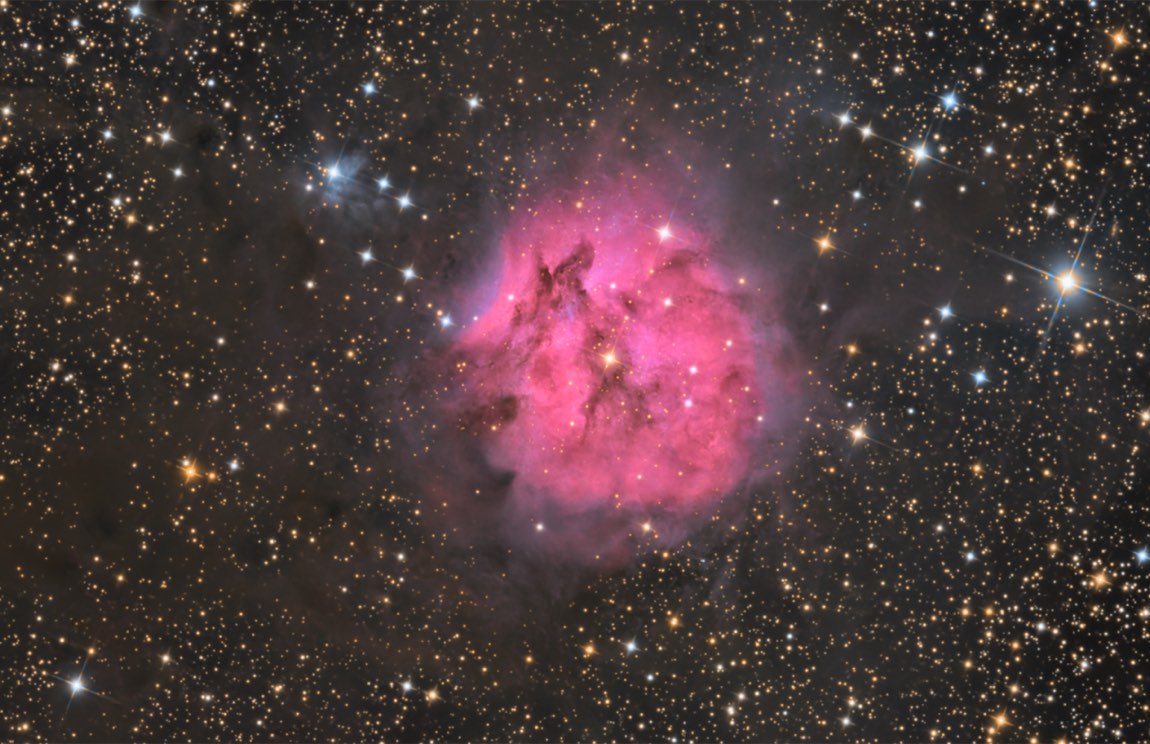
 Photograph · Outten Astrophotography · CC BY 4.0
Nebula · Deep guide
The Cocoon Nebula
Also called: Caldwell 19 · C19 · IC 5146 · Sh 2-125 · Collinder 470 · Barnard 168
A glowing star nursery in Cygnus trailing a long dark lane of dust behind it.
What is it?
The Cocoon Nebula is a mix of reflection and emission nebula in Cygnus, wrapped around a small cluster of stars. Its glowing patch is about 12 arcminutes wide and seems to drag a long dark tail, the dust cloud Barnard 168, off to the west. It is an active stellar nursery: the Spitzer and Chandra space telescopes have together identified hundreds of young stars here, both in the bright nebula and inside the dark tail. One of the most massive stars in the region, BD +46 3474, is estimated at about 14 times the mass of the Sun.
The deep dive
Researched for the Atlas from Wikipedia — IC 5146 (1,633 characters read) · updated Nov 15, 2026
01 A Nebula That Is Two Things at Once
Most nebulae earn a single classification, but IC 5146 carries two simultaneously. It is both a reflection nebula and an emission nebula, meaning different parts of it interact with starlight in fundamentally different ways. In the emission regions, radiation from massive young stars is energetic enough to strip electrons from hydrogen gas, causing it to glow with its own light as the electrons recombine. In the reflection regions, dust grains simply scatter starlight outward, the way fog scatters a streetlamp. The same cloud of gas and dust can do both things in different spots, depending on how intense and close the illuminating stars are. This dual nature makes IC 5146 a compact classroom for two of the main processes that make nebulae visible to us at all. The object also goes by an unusually long list of names — IC 5146, Caldwell 19, Sh 2-125, and Barnard 168 all refer to overlapping parts of the same complex, reflecting how different catalog traditions emphasized different features of the same region of sky.
02 The Dark Tail That Defines the Cocoon
The Cocoon Nebula gets its distinctive silhouette not just from the glowing cloud at its center but from the dark nebula Barnard 168, cataloged as B168, that wraps around the cluster and stretches westward like a trail behind the bright cocoon itself. This dark lane is not empty space — it is a dense molecular cloud so thick with dust that it absorbs background starlight rather than emitting or scattering any of its own. The result is a visual pairing that is, in the words of observers, inseparable: you cannot look at IC 5146 without taking in B168 as well. That dark filament is part of the same star-forming complex, a reservoir of cold gas and dust from which new stars may eventually emerge. The contrast between the luminous central nebula and the opaque dark lane trailing behind it is precisely what gives the object its cocoon-like appearance. Barnard 168 is therefore not merely a backdrop — it is structurally and physically connected to the star-formation story unfolding inside the bright nebula.
03 An Extraordinarily Young Central Star
At the heart of the Cocoon Nebula sits a single central star responsible for energizing much of the glow we see. This star is estimated to have formed only about 100,000 years ago — a blink in cosmic time. For comparison, our own Sun has been shining for roughly 4.6 billion years, making it about 46,000 times older than the Cocoon's central illuminating star. At 100,000 years old, this star has barely begun its main-sequence life, and the nebula surrounding it still bears the raw, unsettled character of a region where stellar birth has only just occurred. The surrounding cloud has not yet had time to be fully dispersed or sculpted by stellar winds and radiation. This extreme youth makes IC 5146 a particularly valuable target for astronomers studying the very earliest stages of how stars light up their nurseries and begin to clear away the gas and dust from which they were born.
04 The Heaviest Star in the Neighborhood Deeper
Among all the young stars embedded in IC 5146, the standout in terms of sheer mass is BD +46 3474. It is classified as a class B1 star — a hot, luminous blue-white type — and carries an estimated mass of 14 ± 4 times that of the Sun. The uncertainty range of plus or minus 4 solar masses is itself informative: pinning down stellar masses in active star-forming regions is genuinely difficult, because dust obscures direct measurements and models of very young stars still carry meaningful errors. A B1-class star burns through its fuel far faster than a Sun-like star and produces the fierce ultraviolet radiation responsible for ionizing the surrounding gas, creating the emission component of the nebula. Stars in this mass range live relatively short lives on astronomical timescales and will likely end their lives in supernova explosions. BD +46 3474 is therefore not just the most massive known member of this young cluster — it is the engine driving much of the nebula's visible glow.
05 HAeBe Stars: Adolescents of the Stellar World Deeper
IC 5146 hosts at least one example of a Herbig Ae/Be star — cataloged as BD +46 3471 — a class that occupies an important and somewhat awkward middle ground in stellar development. HAeBe stars are intermediate-mass stars, more massive than T Tauri stars but not yet as extreme as the O and B giants that dominate the brightest emission nebulae. What makes them recognizable is their spectra: they show strong emission lines, signatures of hot gas being excited in the disk and envelope of material still surrounding the young star. These emission features set them apart from ordinary stars of comparable temperature and luminosity. HAeBe stars are still contracting toward the main sequence, meaning BD +46 3471 has not yet settled into the stable hydrogen-burning phase that defines most of a star's life. Finding one of these objects within IC 5146 reinforces the nebula's status as an active, multi-generational stellar nursery where stars at several different stages of early development coexist.
06 Space Telescopes Reveal Hundreds of Infant Stars
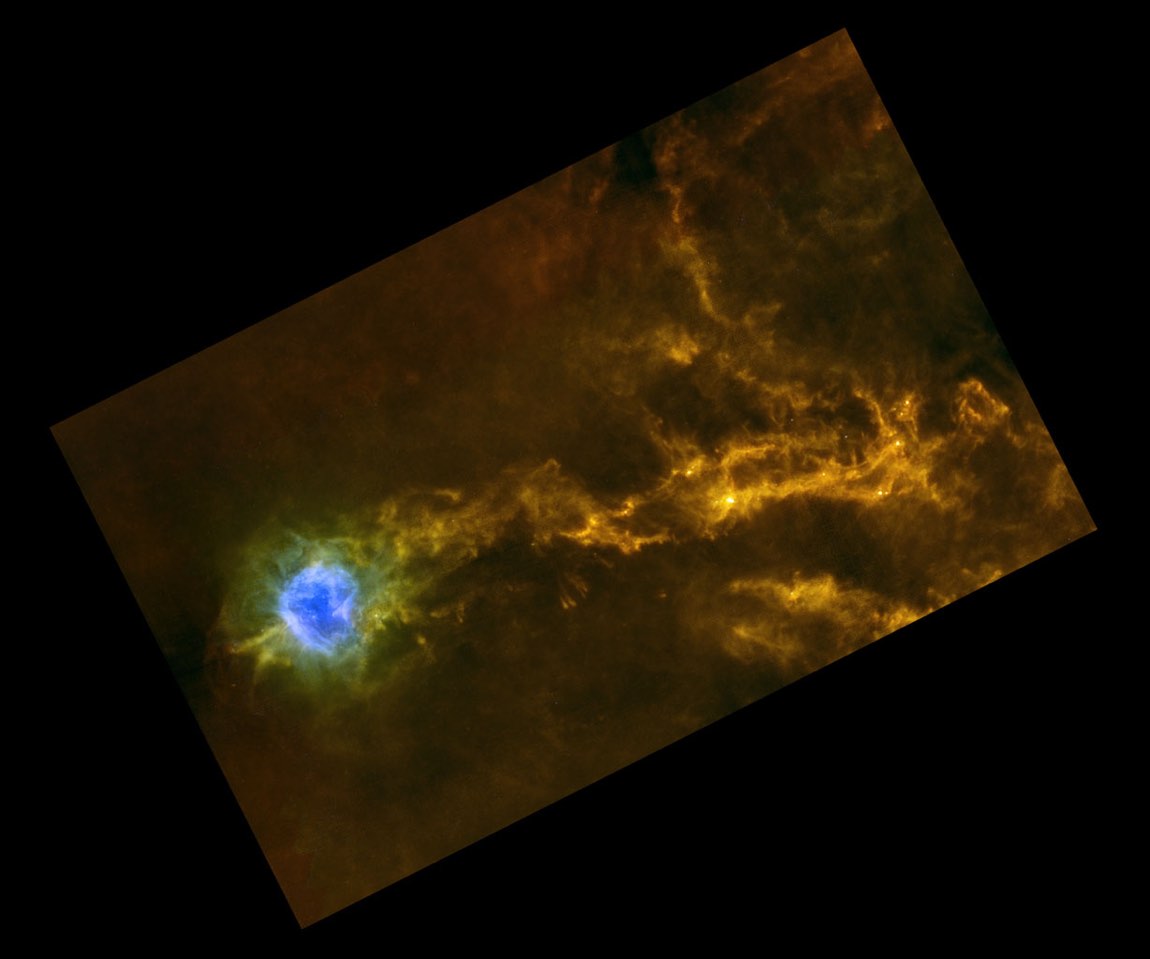
Ground-based telescopes can show the broad outlines of the Cocoon Nebula, but the full census of young stars hiding inside required two of NASA's most powerful space observatories. Both the Spitzer Space Telescope, which sees in infrared light, and the Chandra X-ray Observatory, which detects high-energy X-rays, have been trained on IC 5146. Together their observations have identified hundreds of young stellar objects embedded in the complex. Infrared observations are essential here because newborn stars are often still shrouded in the dust cocoons from which they formed, making them invisible at optical wavelengths. Spitzer cuts through that dust. Chandra adds another layer: very young stars are vigorous X-ray emitters because of intense magnetic activity in their hot coronae. By combining both datasets, astronomers can distinguish genuine young cluster members from unrelated foreground or background stars, building a more complete picture of just how prolific this stellar nursery really is.
07 Star Formation in Both the Bright and Dark Zones Deeper
One of the more striking findings about IC 5146 is that star formation is not confined to the bright, glowing emission nebula at the center — it is also actively underway inside the dark molecular cloud that forms the "tail," Barnard 168. The dark cloud is described as an infrared-dark molecular cloud, meaning it is cold, dense, and opaque even at infrared wavelengths. Young stars have been detected forming within it. This tells astronomers that the star-formation process is propagating through the complex rather than being isolated to the already-ionized cavity. The emission nebula and the dark cloud therefore represent different stages or environments within a single, coherent star-forming region. The ionized gas shows where massive stars have already switched on and begun reshaping their surroundings, while the dark molecular cloud preserves conditions closer to the pristine pre-stellar state. Having both zones within the same object offers a rare side-by-side comparison of early and very-early stellar evolution.
08 How to Find the Cocoon in the Night Sky
IC 5146 sits in Cygnus at celestial coordinates right ascension 21 hours 53.5 minutes, declination +47 degrees 16 arcminutes. For practical finding, the article points to three nearby landmarks visible to the unaided eye or in binoculars: the naked-eye star Pi Cygni, the open cluster NGC 7209 in the neighboring constellation Lacerta, and the bright open cluster M39. The nebula itself shines at around magnitude +10.0, which places it comfortably within range of amateur telescopes under reasonably dark skies, though some sources give values of +9.3 or +7.2 depending on which component is being measured. At 12 arcminutes across — just under half the apparent diameter of the full Moon — it presents a small but detectable glow. The embedded star cluster is separately cataloged as Collinder 470, and observers who know to look for it will find a grouping of roughly 9.5-magnitude stars embedded within the nebulosity.
09 Physical Scale: 15 Light-Years of Stellar Nursery
The Cocoon Nebula spans 12 arcminutes in the sky, an angular size that might sound modest, but at its distance of about 4,000 light-years that angle corresponds to a true physical diameter of roughly 15 light-years. To put that in everyday terms, the nearest star to our Sun, Proxima Centauri, is about 4.2 light-years away — so the Cocoon Nebula is wide enough to contain more than three such neighbor-to-neighbor distances laid end to end. That 15-light-year span encompasses the glowing emission and reflection nebula, the young star cluster Collinder 470, and the beginning of the dark Barnard 168 filament that stretches westward from it. These are not empty light-years: they are filled with ionized gas, dust grains, molecular hydrogen, and dozens upon dozens of stars in the earliest phases of their lives. The sheer volume of active star formation packed into this region is part of what makes IC 5146 a scientifically rewarding target.
10 A Cluster Inside a Cloud Inside a Catalog
The layered naming of IC 5146 reflects the layered nature of the object itself and the history of astronomy. The designation IC 5146 places it in the Index Catalogue, the supplement to the famous New General Catalogue compiled in the late nineteenth century. The Caldwell catalogue number — Caldwell 19 — comes from Patrick Moore's twentieth-century list of showpiece objects not in Messier's catalog. Sh 2-125 situates it in the Sharpless catalog of HII regions, emphasizing its emission character. Meanwhile Barnard 168, technically the dark nebula, carries the name of E. E. Barnard, the pioneering photographer of dark nebulae. The embedded cluster has yet another identity as Collinder 470 in Per Collinder's open cluster catalog. The NGC description of IC 5146 specifically calls it "a cluster of 9.5 mag stars involved in a bright and dark nebula" — a concise summary that captures, even in nineteenth-century language, the essential complexity of the object: cluster, bright nebula, and dark nebula all at once.
 ⤢