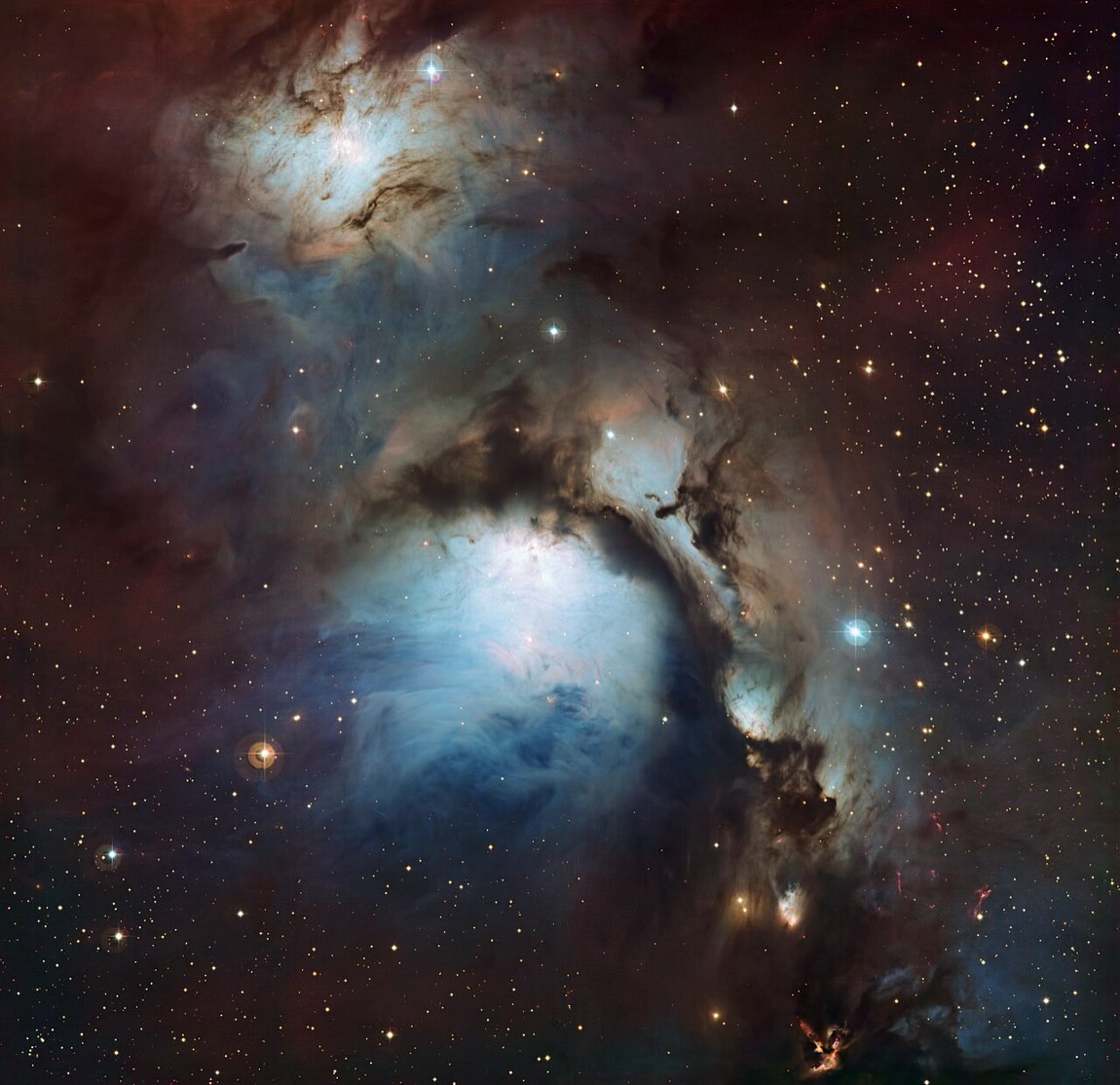
 Photograph · ESO/Igor Chekalin · CC BY 4.0
Nebula · Deep guide
Messier 78
Also called: M78 · NGC 2068 · Casper the Friendly Ghost Nebula
A ghostly reflection nebula in Orion, lit by two young stars and full of newborn ones.
What is it?
Messier 78 is a reflection nebula in Orion and the brightest of a small group of such nebulae in the Orion B molecular cloud. It does not glow on its own: its dust scatters the light of two young B-type stars, making a hazy patch visible in small telescopes. Amateurs nickname it Casper the Friendly Ghost Nebula. Infrared images show a cluster of stars still forming inside, including 45 young T Tauri stars and 17 Herbig–Haro jets. ESA's Euclid telescope released a detailed image of it in May 2024.
The deep dive
Researched for the Atlas from Wikipedia — Messier 78 (1,306 characters read) · updated Nov 15, 2026
01 A Ghost Made of Dust and Starlight
Messier 78 is not a glowing cloud in the way most people picture a nebula. It is a reflection nebula, meaning its dust grains do not emit light of their own but instead scatter and reflect light from nearby stars, much like fog around a streetlamp. The two stars doing the illuminating are HD 38563 A and HD 38563 B, a pair of hot, massive B-type stars shining at 10th and 11th magnitude. Their blue-white light bounces off surrounding dust particles and reaches us after a journey of approximately 1,350 light-years, making M78 the brightest diffuse reflection nebula in its local group. That group also includes NGC 2064, NGC 2067, and NGC 2071, all embedded within the same vast Orion B molecular cloud complex. Amateur astronomers have affectionately nicknamed M78 the Casper the Friendly Ghost Nebula because of the two bright lobes flanking a central dark lane, which together suggest a cartoonish face peering out of the sky.
02 Pierre Méchain Finds a Comet That Isn't
M78 entered the historical record in 1780, discovered by the French astronomer Pierre Méchain. That same year, Charles Messier added it to his famous catalog of comet-like objects — a list designed specifically to prevent confusion between fuzzy permanent features and the traveling comets Messier was hunting. From a small telescope M78 does look stubbornly comet-like: a hazy, diffuse patch without sharp edges. What Méchain and Messier saw was the reflected glow of two unseen stellar engines buried inside a dust cloud. The fact that it fooled experienced comet hunters underscores how effectively interstellar dust can mimic transient phenomena. Today M78 sits at catalog position 78, one of only a handful of reflection nebulae to earn a Messier number, cementing its place as one of the most historically significant and easily located star-forming regions visible from the Northern Hemisphere.
03 A Stellar Nursery Still in Full Swing Deeper
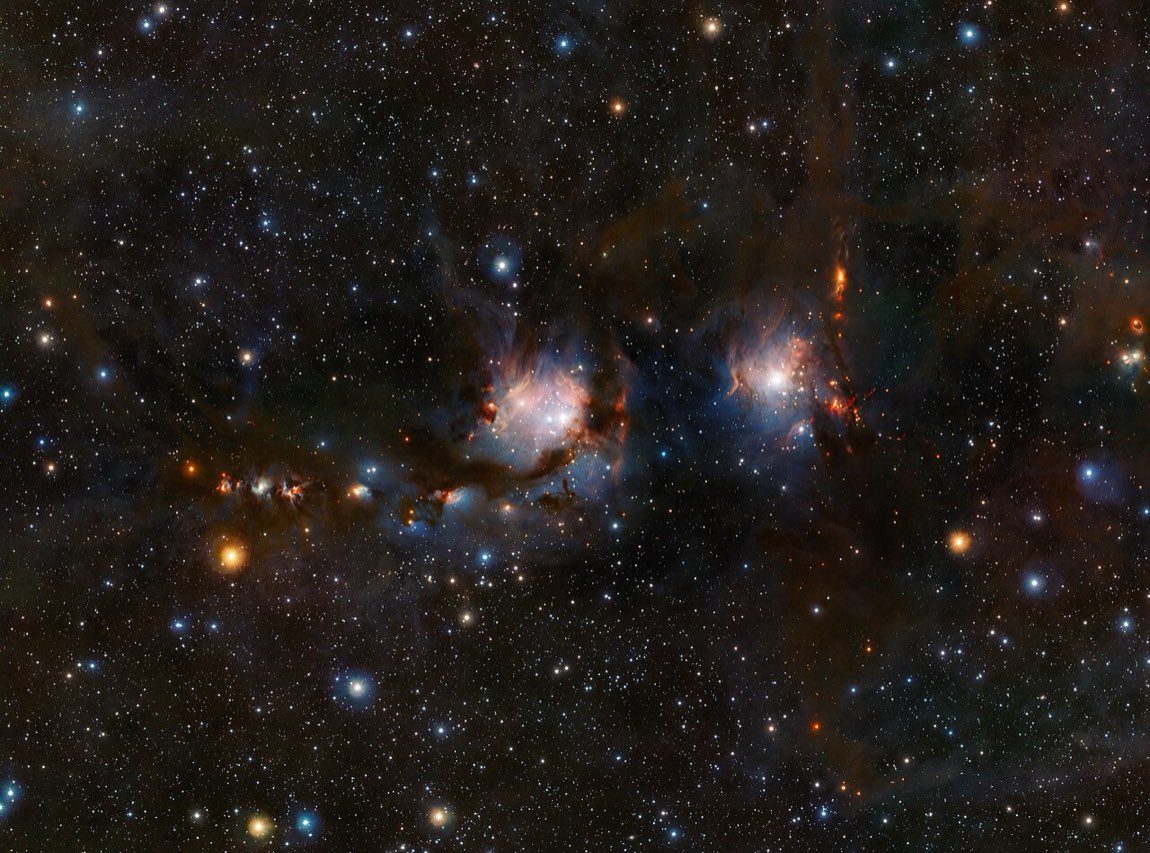
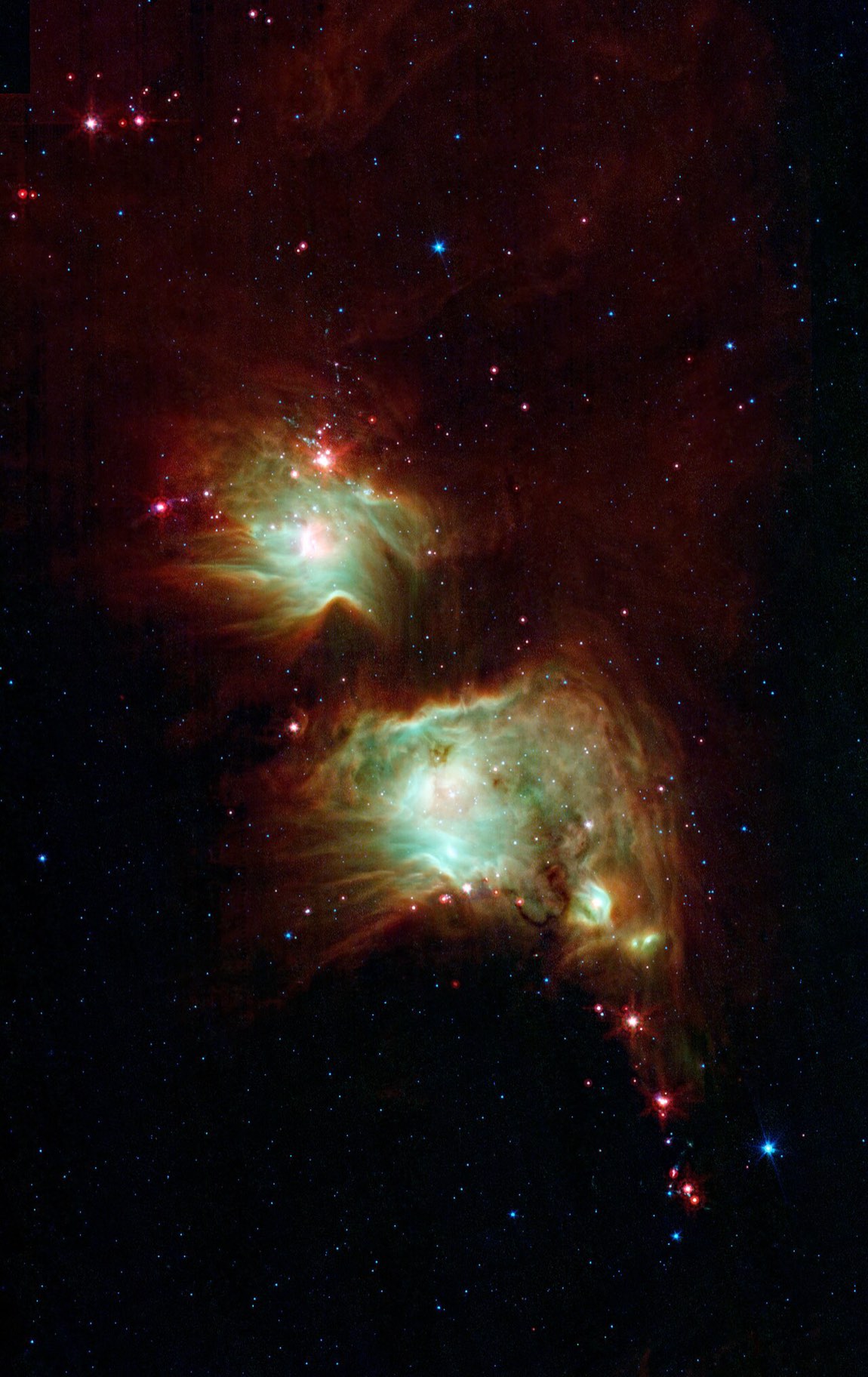
Infrared observations — able to pierce the dust that blocks visible light — have uncovered a hidden star cluster buried inside M78. The nebula hosts 45 T Tauri stars, which are young stellar objects still in the process of gravitational contraction, not yet hot enough at their cores to sustain the steady hydrogen fusion that defines a true main-sequence star. Alongside them, researchers have identified 17 Herbig-Haro objects, compact glowing knots produced when high-speed jets of gas ejected by newborn stars slam into surrounding material at supersonic speeds. The presence of both T Tauri stars and Herbig-Haro objects in the same region confirms that star formation is actively occurring right now inside M78, not in the distant past. Infrared data also reveal that the gas within the nebula is organized into a hierarchy of clumps rather than a uniform cloud, adding structural complexity to what appears featureless in visible light.
 ⤢
04 Clumps of Gas Waiting to Become Suns Deeper
The gas clumps detected inside M78 through infrared observations span a striking range of masses, from as little as 0.3 solar masses up to 5 solar masses. That lower end, 0.3 times the mass of our Sun, is roughly comparable to the mass of the planet Saturn multiplied by roughly a thousand — not enormous by stellar standards, but potentially sufficient to collapse into a low-mass red dwarf star given the right conditions. The upper end at 5 solar masses could produce a star significantly hotter and shorter-lived than our own Sun. These clumps represent distinct stages or sites of star formation rather than a single monolithic collapse event, suggesting that M78 is building an entire population of stars with varied masses simultaneously. The hierarchical arrangement of these clumps is consistent with the turbulent, fragmented nature predicted by modern models of molecular cloud collapse and star formation.
05 What Euclid Saw That No One Had Seen Before
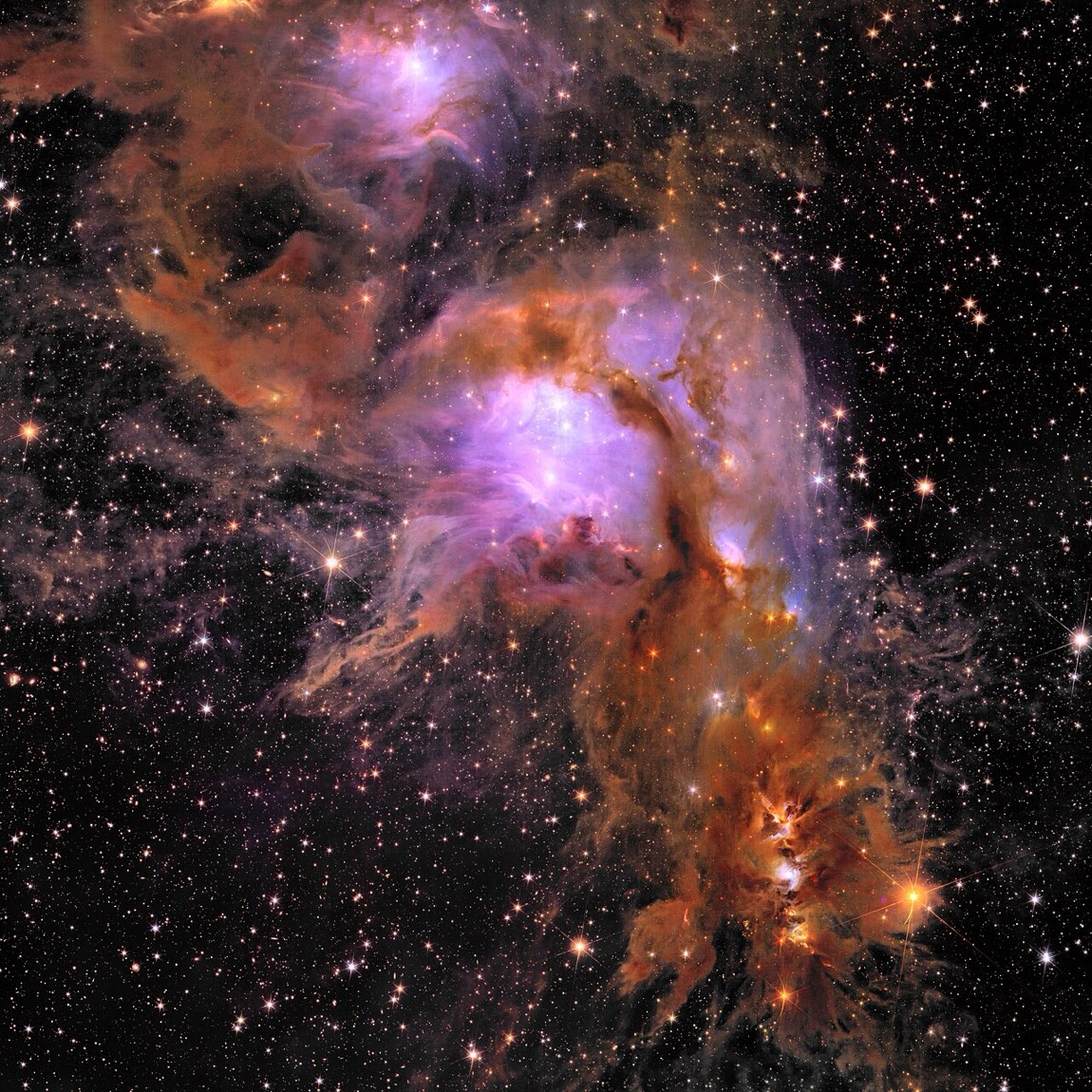
On May 23, 2024, the European Space Agency released a landmark image of M78 captured by its Euclid space telescope. The image revealed hundreds of thousands of previously unseen objects within and around the nebula, including substellar bodies — objects too small to ignite nuclear fusion and therefore not quite stars. This single observation dramatically expanded the known census of objects associated with M78. Euclid was designed primarily to study the large-scale structure of the universe and dark energy, but its extraordinary sensitivity and wide field of view made it equally powerful for examining nearby star-forming regions at a level of detail never before possible from space. The release of this image represents one of the most detailed looks ever taken at M78 and opens new avenues for understanding how the full spectrum of objects — from massive stars down to substellar bodies — forms within a single molecular cloud environment.
06 M78's Place in the Orion B Complex
M78 does not exist in isolation. It belongs to the Orion B molecular cloud complex, one of the most intensively studied star-forming regions in the entire sky. Within this complex, M78 is the brightest member of a small cluster of reflection nebulae that also includes NGC 2064, NGC 2067, and NGC 2071. All of these nebulae are illuminated by stars embedded within the same vast cloud of gas and dust that stretches across the constellation Orion. The Orion B complex sits at roughly the same distance from Earth as M78 itself — approximately 1,350 light-years — placing the entire group within the same neighborhood of the Milky Way's Orion Arm. Studying M78 alongside its companion nebulae gives astronomers a broader view of how star formation proceeds across an extended molecular cloud rather than at a single isolated point.
 ⤢
07 How to Find Casper with a Small Telescope
M78 is one of the most accessible reflection nebulae for amateur astronomers because it is genuinely visible through small telescopes. Located in the constellation Orion, it appears as a hazy patch — recognizably distinct from the surrounding star field but soft at the edges in the way all reflection nebulae tend to be. The two illuminating stars, HD 38563 A and HD 38563 B, are individually visible at 10th and 11th magnitude, bright enough to be seen with modest aperture under reasonably dark skies. The nebula's popular nickname, Casper the Friendly Ghost Nebula, reflects the visual impression many observers report: two bright cores surrounded by wispy brightness. Under good conditions with moderate magnification, the dark lane separating the two lobes becomes apparent, reinforcing the ghostly appearance. It is a rewarding object precisely because it rewards patience and careful observation rather than requiring professional equipment.
08 The Stars That Light the Cloud Deeper
The two stars responsible for making M78 visible are classified as B-type stars, placing them among the hotter and more luminous categories of main-sequence stars. B-type stars emit a large fraction of their energy in ultraviolet wavelengths, and it is this energetic radiation — along with the visible light it accompanies — that excites and illuminates the dust grains within M78. HD 38563 A shines at 10th magnitude and its companion HD 38563 B at 11th magnitude as seen from Earth. While neither is visible to the naked eye, both are intrinsically quite luminous; their modest apparent brightness is a consequence of the 1,350 light-year distance. B-type stars burn through their fuel relatively quickly compared to Sun-like stars, meaning the illuminated appearance of M78 is a temporary feature on cosmic timescales. As the nebula's own embedded T Tauri stars continue to evolve, future generations of local stars may eventually provide new sources of illumination.
09 Herbig-Haro Objects: Jets Frozen in Time Deeper
The 17 Herbig-Haro objects identified inside M78 offer a rare direct view of star birth caught in action. When a protostar accumulates material from a surrounding disk, it simultaneously expels narrow, high-velocity jets of gas perpendicular to that disk. These jets travel outward at speeds that can exceed hundreds of kilometers per second, and when they collide with the slower-moving interstellar gas ahead of them, they produce bright shocks that glow visibly. These glowing shock fronts are Herbig-Haro objects. They are transient on astronomical timescales — individual knots can visibly shift position over years to decades, making them one of the few astronomical phenomena where human-timescale change can actually be tracked. The concentration of 17 such objects within M78 confirms that multiple protostars are simultaneously undergoing this jet-ejection phase, making the nebula a genuinely active, dynamic environment rather than a static cloud of illuminated dust.
 ⤢