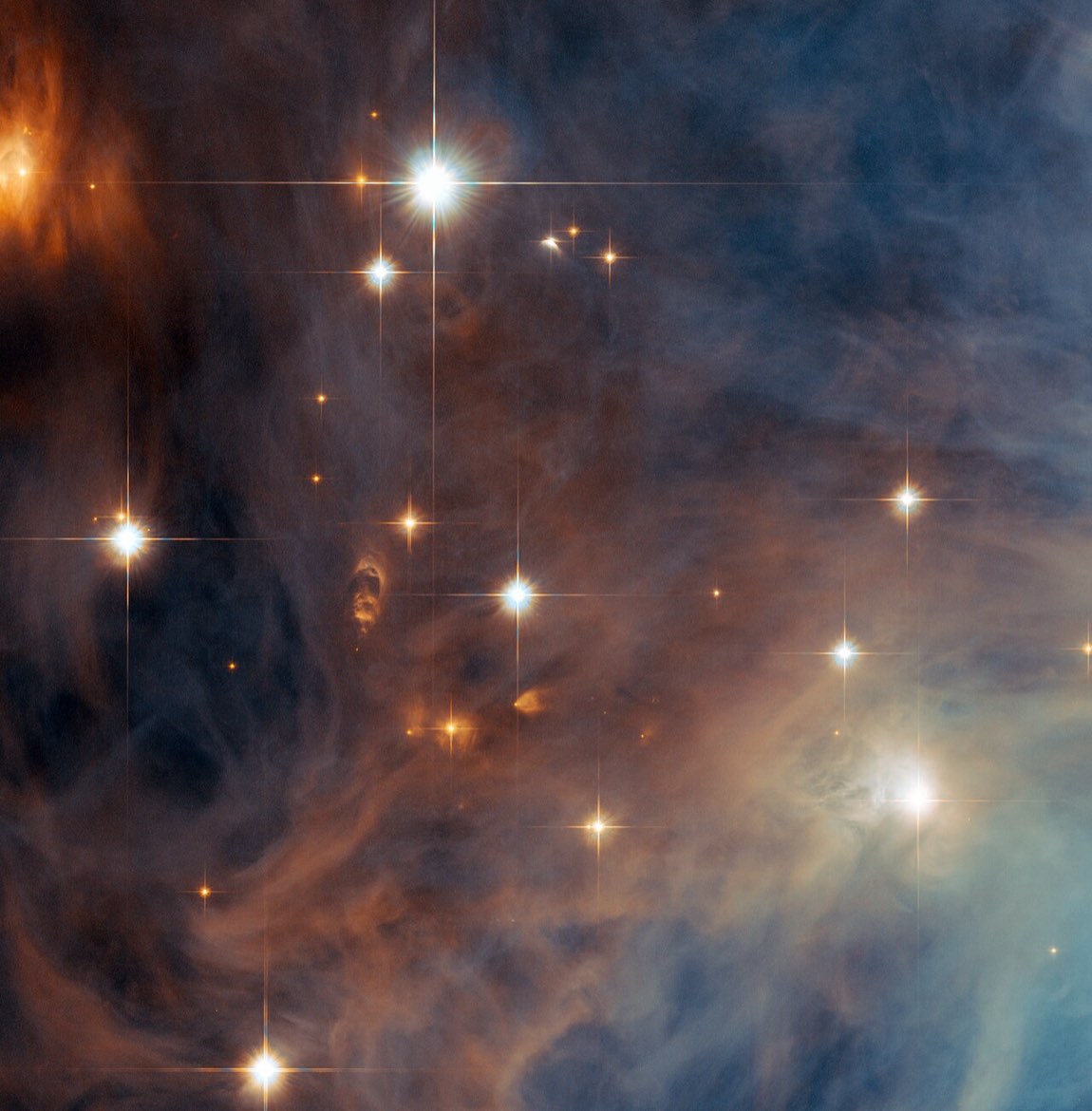
 Photograph · NASA, ESA, M. Robberto (Space Telescope Science Institute/ESA) and the Hubble Sp · Public domain
Nebula · Deep guide
Messier 43 (De Mairan's Nebula)
Also called: M43 · NGC 1982 · De Mairan's Nebula
A small, comma-shaped glow that is really part of the great Orion Nebula.
What is it?
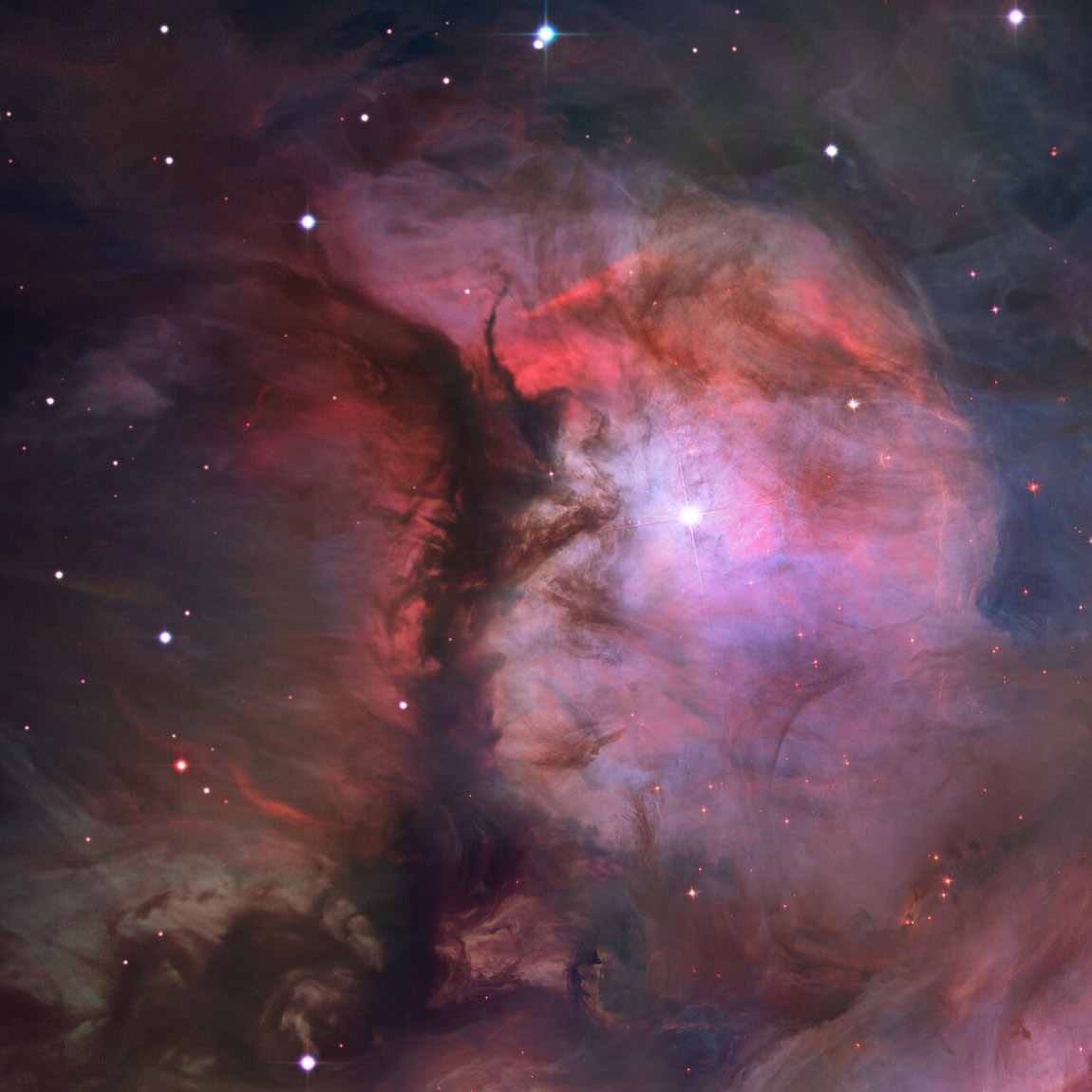
Messier 43 is a star-forming nebula in Orion, discovered by Jean-Jacques d'Ortous de Mairan before 1731 and catalogued by Messier in 1769. It is physically part of the Orion Nebula (M42), separated from the main cloud by a dark lane of dust. Its gas is lit by the multiple star NU Orionis, which is not hot enough to make the strong oxygen glow seen around the Trapezium in M42. Both nebulae belong to the larger Orion molecular cloud complex, about 1,300 light-years away.
The deep dive
Researched for the Atlas from Wikipedia — Messier 43 (1,417 characters read) · updated Nov 15, 2026
01 Separated by a curtain of dust
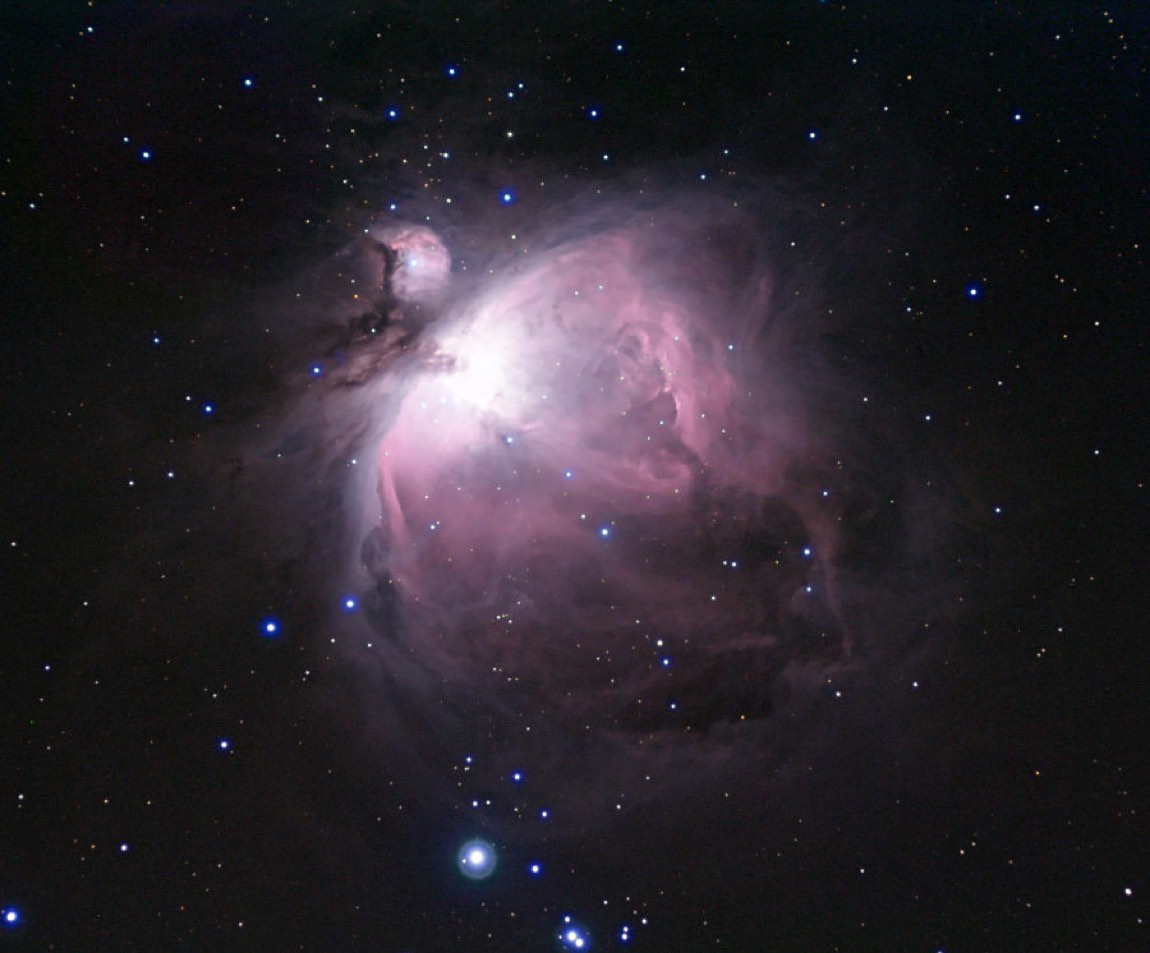
Although Messier 43 appears to float nearby the great Orion Nebula in photographs, the two are not simply different patches of the same glowing cloud. A dense lane of dust called the northeast dark lane physically divides them, acting like a thick curtain drawn between siblings. M43 sits on the northeastern side of that boundary, and what we see as a distinct nebula is really a pocket of ionized gas that the dust lane has carved off from its famous neighbor. Despite that visual separation, the two share the same cosmic address — both are embedded within the far larger Orion Molecular Cloud Complex, one of the most active star-forming regions in the entire Milky Way. Think of M43 as a smaller room inside a vast mansion, its doorway partly bricked up by interstellar grit.
02 Discovery before telescopes improved
The credit for first noticing De Mairan's Nebula goes to the French scientist Jean-Jacques d'Ortous de Mairan, who recorded it sometime before 1731. That places his observation in an era when reflecting telescopes were still new instruments and the nature of nebulae was entirely unknown — most astronomers of the day could not say whether such fuzzy patches were distant star clusters, unresolved gas, or something stranger altogether. Decades later, in 1769, Charles Messier added the object to his famous catalogue of things-that-are-not-comets, assigning it the number 43. Because Messier was primarily a comet hunter, his catalogue was essentially a sky-nuisance list, yet it accidentally preserved some of the richest deep-sky objects visible from northern latitudes. M43 therefore carries two identities honoring both its discoverer and its cataloguer.
03 The quadruple star powering the glow Deeper
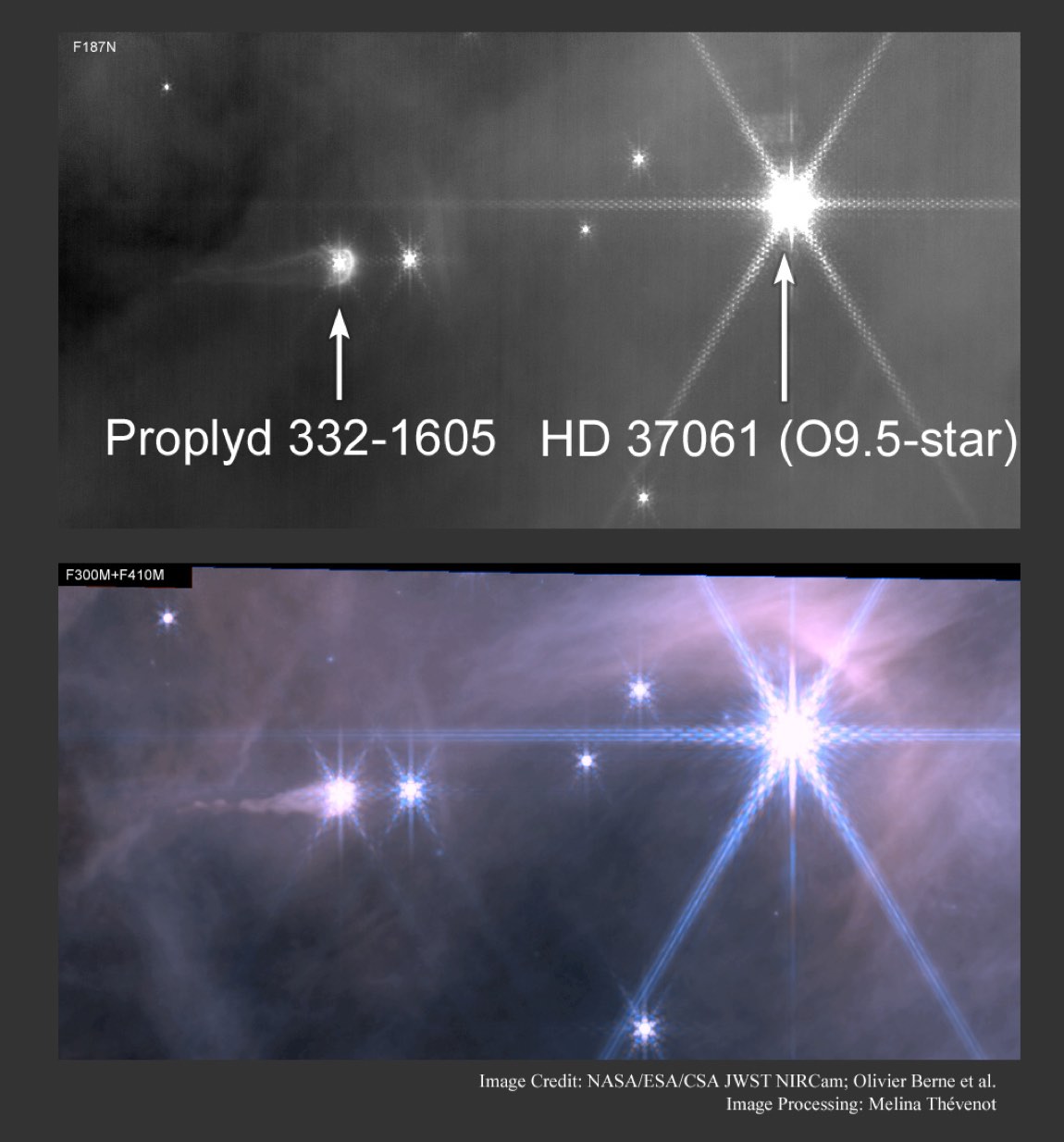
Unlike the Orion Nebula, which is lit by the famous Trapezium cluster, Messier 43 has a single dominant energy source: NU Orionis, also catalogued as HD 37061. This is not a lone star but a quadruple star system — four gravitationally bound stars sharing one center of mass. NU Orionis sits 1,360 ± 30 light-years away (417.0 ± 9.2 parsecs), placing it at essentially the same distance as the Orion Nebula itself, consistent with their physical connection. The system pumps out enough ultraviolet radiation to ionize the surrounding hydrogen and produce the nebula's characteristic red glow. However, its temperature falls short of what would be needed to excite doubly ionized oxygen, which produces the blue-green [O III] emission lines that give the Trapezium's neighborhood a distinctly different color palette. M43's ionizing engine is simply cooler.
 ⤢
04 How big is 2.1 light-years of glowing gas?
The H II region at the heart of Messier 43 — the volume of hydrogen gas that NU Orionis has managed to ionize — spans roughly 4.5 arcminutes on the sky. At the nebula's measured distance, that angular size translates to a true diameter of about 2.1 light-years, or 0.65 parsecs. To put that in perspective, the nearest star to our own Sun, Proxima Centauri, is about 4.2 light-years away, so the entire glowing bubble of M43 could fit comfortably between the Sun and its nearest neighbor with room to spare. The shape of this ionized region is notably roundish, which suggests that NU Orionis is radiating ultraviolet light fairly evenly in all directions and that the surrounding gas is relatively uniform — a tidy, contained pocket of ionization compared to the chaotic sprawl of M42 next door.
05 Measuring the nebula's light output Deeper
Astronomers have carefully measured how much light Messier 43 produces in the hydrogen-alpha emission line, the deep red glow that is the signature of ionized hydrogen recombining with electrons. The net luminosity — meaning the measurement excludes the light coming directly from NU Orionis itself, counting only the nebula gas — is (3.0 ± 1.1) × 10³⁵ ergs per second. Converting to solar units gives a luminosity equivalent to 78 times the total energy output of our Sun, all released purely as that single spectral color of red light. The uncertainty on that figure, plus or minus 1.1 × 10³⁵ ergs per second, is substantial, reflecting how difficult it is to separate the star's direct contribution from the gas's re-emitted light and to correct for dust absorption along the line of sight.
06 The dark lanes that define its shape
What gives Messier 43 much of its visual drama is not the glowing gas but the dark structures that cut through it. The most prominent internal feature is the M43 dark lane, a band of cold, dense dust that runs across the entire west-center strip of the nebula from north to south. Rather than stopping at M43's boundaries, this dark lane sweeps southward in a swirling arc and merges with Orion's northeast dark lane — the very same dust wall that separates M43 from M42. The combined effect creates structures that have been described as resembling smoke rising from a chimney, or broad and fine dark brushstrokes in a watercolor painting, visible across many different wavelengths of light. These lanes are not merely decorative; they mark the densest concentrations of molecular material where future stars may eventually ignite.
 ⤢
07 Why M43 lacks blue-green oxygen emission Deeper
One of the scientifically interesting contrasts between M43 and its neighbor M42 is in their emission spectra. The Orion Nebula blazes with [O III] emission — the doubly ionized oxygen that produces brilliant blue-green colors in long-exposure photographs. Messier 43 shows no significant amount of this emission. The reason is temperature: stripping a second electron from an oxygen atom requires far more energetic ultraviolet photons than stripping the first. The Trapezium stars in M42 are hot enough to produce that extreme ultraviolet flux, but NU Orionis in M43 is not. This makes M43 a comparatively cooler, softer-radiation environment. Scientifically, the contrast between the two adjacent nebulae gives astronomers a natural laboratory to study how the temperature and luminosity class of an ionizing star shapes the surrounding H II region's chemistry and structure.
08 M43 as part of a molecular cloud giant
Zooming out beyond the visible glow of M43 reveals that it is a relatively small piece of an enormous structure called the Orion Molecular Cloud Complex. This complex is one of the nearest and most studied large-scale regions of ongoing star formation in the Milky Way, and it spans far more of the sky than any single telescope field of view can capture. M43, M42, and many other nebulae and young star clusters are all embedded within this cloud like islands of light in a dark ocean of cold molecular hydrogen. The complex provides the raw material — gas and dust — that feeds star-forming regions like M43, and the energy those young stars release begins the slow process of dispersing the cloud around them. M43's position within this larger context means its story is inseparable from one of the galaxy's most productive stellar nurseries.
09 How to find and observe De Mairan's Nebula
Messier 43 sits in the equatorial constellation of Orion, placing it accessible to observers across virtually the entire inhabited world. Because it lies immediately adjacent to the far brighter Orion Nebula (M42), it is easy to locate but easy to overlook — the eye naturally gravitates to M42's greater glow. Under dark skies with a moderate telescope, M43 appears as a small, somewhat rounded patch of nebulosity separated from M42 by a subtle dark notch, which is the northeast dark lane cutting between them. Its apparent diameter on the sky is about 4.5 arcminutes. The dark lane running through its own interior is a rewarding challenge to trace with larger apertures or in long-exposure photographs. Because NU Orionis is not hot enough to produce the colorful [O III] glow, visual observers will see the nebula primarily in the warm tones of hydrogen-alpha emission rather than the vivid greens of its neighbor.
 ⤢
10 Two catalog numbers, one object
Messier 43 carries three widely used designations: M43 from Messier's 1769 catalogue, NGC 1982 from John Dreyer's New General Catalogue compiled in the 1880s, and the popular name De Mairan's Nebula honoring its original discoverer. The existence of multiple catalog entries for the same object is a common situation in deep-sky astronomy — different observers across different centuries independently logged objects without always knowing prior records existed. In M43's case, Messier was aware of De Mairan's prior observation and included it in his catalogue partly in tribute. The NGC number, assigned more than a century after Messier's work, was part of a systematic effort to unify centuries of telescope observations into a single reference. Today all three designations remain in active use depending on context, with M43 being the most common shorthand in amateur astronomy and NGC 1982 preferred in some technical literature.