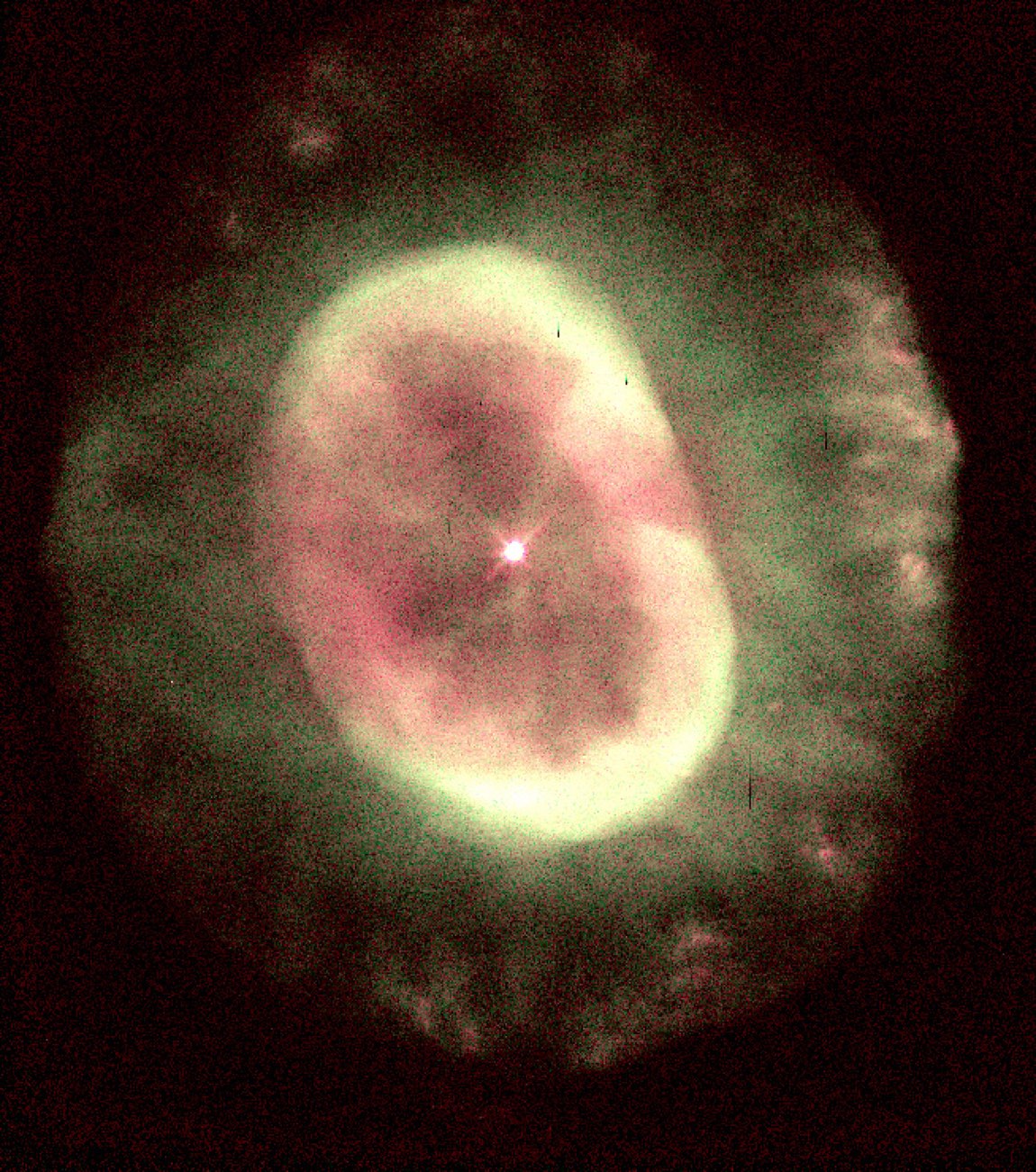
 Photograph · Judy Schmidt · CC BY 2.0
Nebula · Deep guide
The Blue Snowball Nebula (NGC 7662)
Also called: Caldwell 22 · C22 · NGC 7662 · Snowball Nebula · Blue Snowball
A small, bright, bluish disc in Andromeda that small telescopes show as a fuzzy star.
What is it?
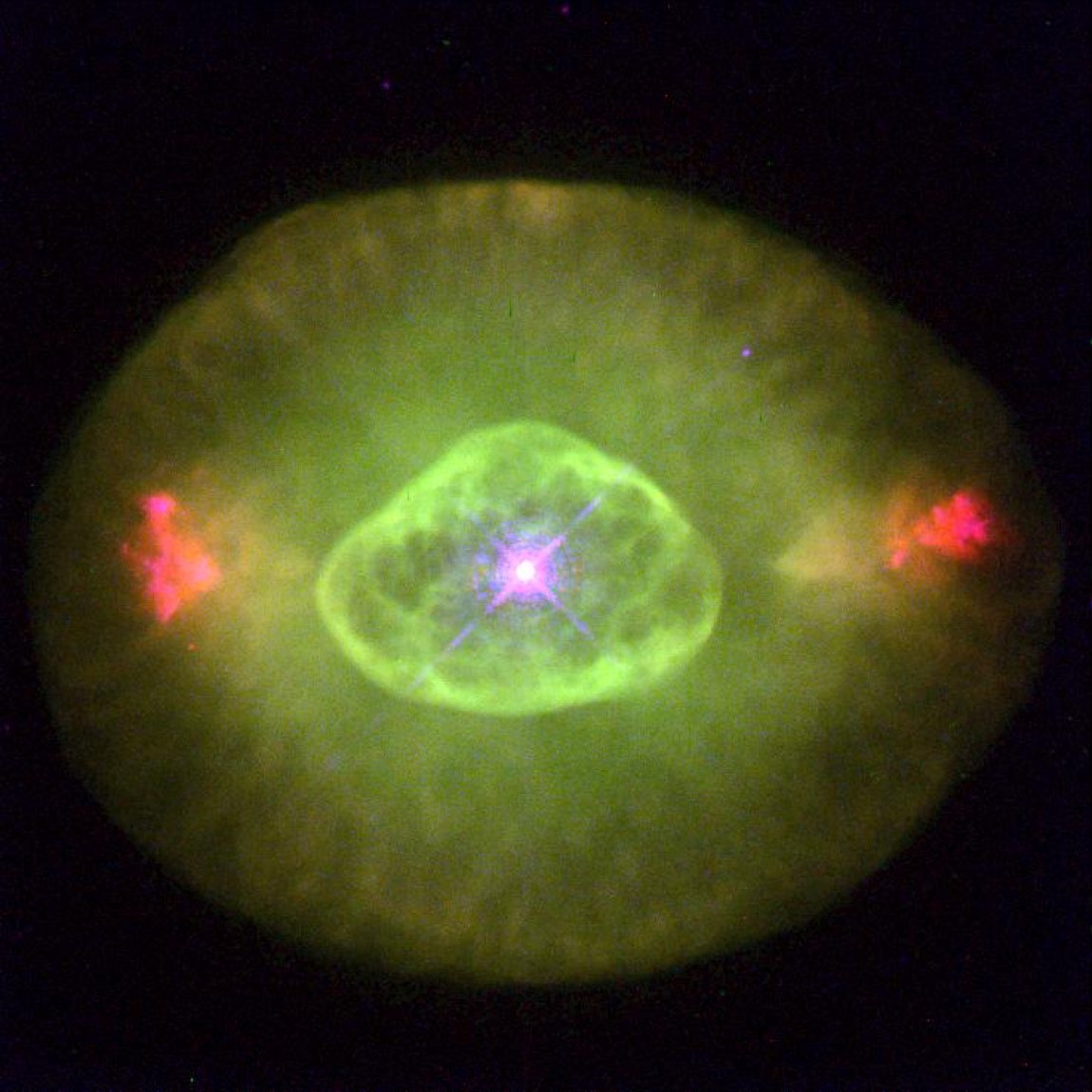
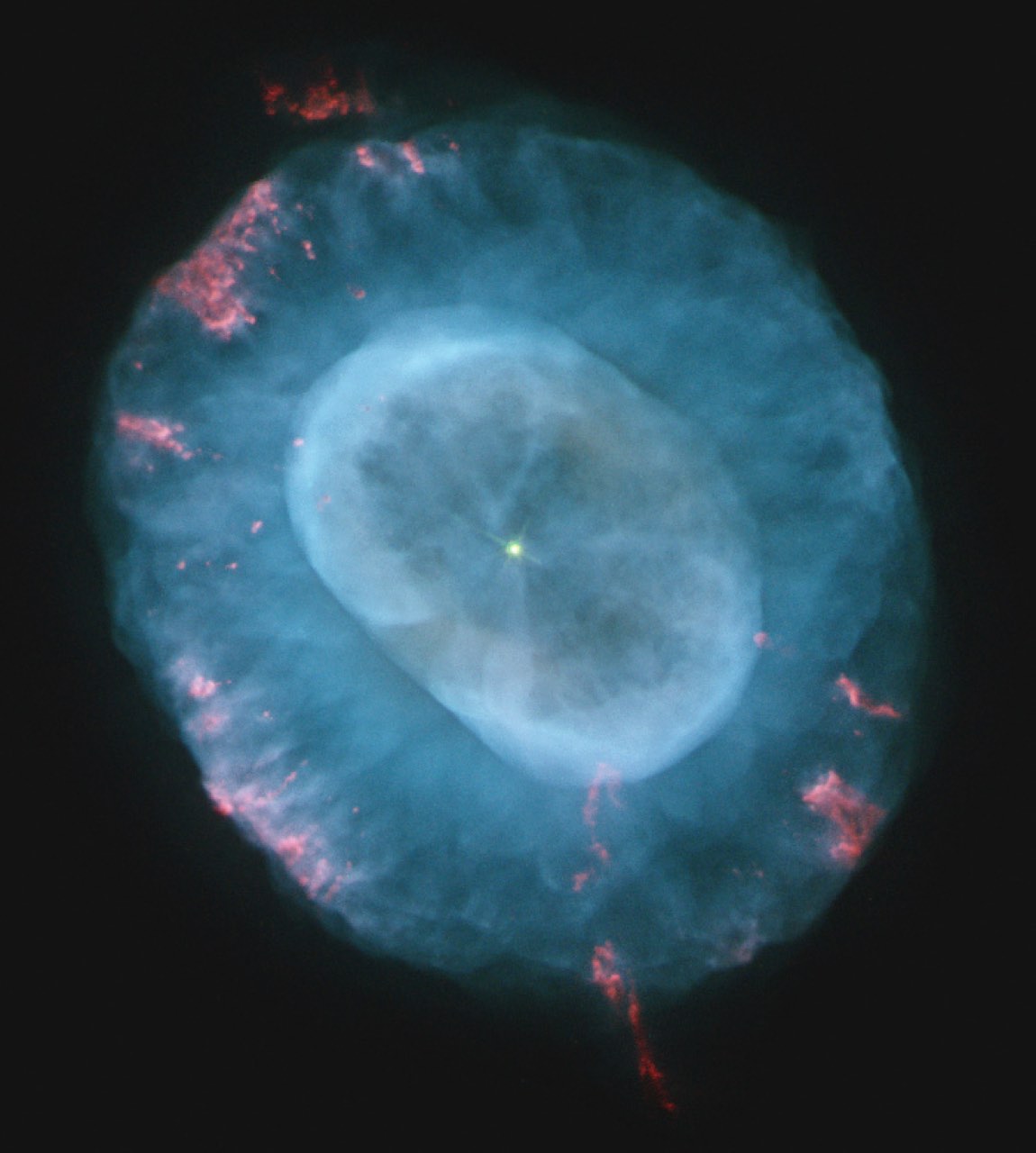
NGC 7662 is a planetary nebula in Andromeda, popularly called the Blue Snowball. A small telescope shows it as a star-like point with a little haze, while a 6-inch telescope reveals a slightly bluish disc. Its gas is arranged in three layers: a bright inner shell, a fainter elliptical outer shell, and a round, faint halo around both, with knots and a jet-like feature inside. William Herschel discovered it on 6 October 1784.
The deep dive
Researched for the Atlas from Wikipedia — NGC 7662 (1,969 characters read) · updated Nov 15, 2026
01 A Triple Shell Hidden Inside a Blue Disk
What looks like a simple blue dot through a small telescope is actually a remarkably layered structure. NGC 7662 is built from three nested shells, each distinct in brightness and shape. The innermost and brightest is the main shell, measuring 12″ × 18″ across the sky. Wrapped around it sits a fainter outer shell, also elliptical in outline. Both of these are then enclosed by an even fainter, nearly circular halo stretching 134″ in diameter — more than four times the width of the main shell. That halo is so dim that only careful observation reveals it at all. Astronomers can model the two inner shells mathematically as prolate spheroids, meaning they are elongated like a rugby ball rather than perfectly round. The inner shell has the greater elongation of the two, and its long axis is tilted about 50° relative to our line of sight. The hull — the thickness of the shell wall itself — is approximately 2.5″. This layered architecture tells the story of a star that shed material in multiple episodes, each pulse leaving its own ghostly membrane behind in space.
02 Knots, Jets, and Low-Ionization Structures Deeper
Beyond its smooth nested shells, NGC 7662 contains finer internal detail that rewards larger instruments and careful spectroscopy. Several distinct knots are visible within the nebula, along with a jet-like structure — an elongated feature that hints at directed outflow rather than purely spherical expansion. Both the knots and the jet-like structure display emission lines characteristic of low ionization, meaning the gas in those regions has not been stripped of as many electrons as the surrounding nebular material. This contrast in ionization level suggests that the knots may be denser pockets of gas that the ultraviolet radiation from the central star has not fully penetrated, shielding their interiors from complete ionization. Such low-ionization structures, sometimes called LIS in nebular research, are common in planetary nebulae but their exact formation mechanism remains debated — they may arise from instabilities at the shell boundary, from material shaped by magnetic fields, or from interactions between fast and slow winds. In NGC 7662 these features add asymmetry and texture to what would otherwise appear, at low resolution, as a smoothly glowing ellipse.
03 An Estimated Age of Just Over 3,000 Years
Planetary nebulae are fleeting on cosmic timescales, and NGC 7662 is relatively young even by that measure. By measuring how fast the shells are expanding outward and working backward, astronomers estimate the nebula's age at approximately 3,080 years. To put that in human terms, the material now forming the Blue Snowball's glowing shells was still inside its parent star around the time ancient civilizations were flourishing in Mesopotamia and Egypt. The expansion rate provides a kind of clock: if you know how big the nebula is today and how quickly its edges are moving apart, you can calculate when that expansion began. Of course this calculation carries assumptions — that the expansion rate has been roughly constant, and that the geometry of the shells is well understood — so the figure should be treated as an estimate rather than a precise date. Still, 3,080 years is a strikingly short time in astronomy, reminding us that some of the most beautiful objects in the night sky are also among the most transient.
04 The Extraordinarily Hot Star at the Center
Every planetary nebula is powered by the stellar remnant left behind after the original star shed its outer layers, and NGC 7662's central engine is a remarkable object in its own right. It is classified as a subdwarf O star — a compact, extremely hot stellar type designated sdO — with a best-fit effective temperature of 100,000 K. For comparison, the surface of our own Sun sits at roughly 5,778 K, making this central star nearly seventeen times hotter. Despite its compact size, measured at about 0.237 times the Sun's diameter, it pours out energy at a rate 5,250 times the Sun's luminosity. Its mass, however, is only 60.5% of the Sun's mass, reflecting the fact that the star has already expelled the bulk of its original material into the surrounding nebula. These extreme temperatures produce a fierce flood of ultraviolet photons that stream outward and ionize the surrounding gas, causing it to fluoresce with that characteristic blue-green glow visible through even modest telescopes.
05 How Stellar Wind Generates X-Ray Glow Deeper
NGC 7662 is not just an optical showpiece — it also emits X-rays, and the mechanism behind that emission reveals the dynamic physics still unfolding inside the nebula. The intensely hot central star drives a fast-moving stellar wind outward at high velocity. When this rapid wind slams into the slower, previously ejected matter that now forms the nebula's shells, the collision heats the gas to temperatures high enough to radiate in the X-ray portion of the spectrum. This process is sometimes described as a wind-blown bubble mechanism, and it is one of the primary ways that hot gas becomes trapped between the central star and the visible nebular shell in planetary nebulae. The X-ray emission essentially maps where these violent collisions are occurring. For NGC 7662, detecting this X-ray signal confirms that the stellar wind is still actively interacting with its surroundings, shaping the interior of the nebula even as the outer shells continue to expand slowly into the interstellar medium.
06 William Herschel and the Discovery Night
NGC 7662 was discovered on October 6, 1784, by William Herschel, the German-born English astronomer famous for systematic sweeps of the sky that dramatically expanded the known catalog of deep-sky objects. Herschel was extraordinarily prolific during this period, and the Blue Snowball was one of many nebulae he logged during those sweeps. His description of the object, preserved in the New General Catalogue, captures the essential character of what he saw: a "magnificent planetary or annular nebula, very bright, pretty small in angular size, round, blue, variable nucleus." That phrase "variable nucleus" is particularly interesting, suggesting Herschel noticed something irregular about the central region even with the instruments of the eighteenth century. His observation also cemented the object's reputation as visually striking — the word "magnificent" is not used lightly in a scientific catalog entry. More than two centuries later, the nebula he recorded in a single night of observing continues to draw attention from both professional astronomers and backyard observers.
07 Finding It: Observer's Notes for Any Telescope
NGC 7662 sits in the northern constellation Andromeda, making it well placed for observers in the Northern Hemisphere during autumn evenings. At an apparent visual magnitude of 8.3, it is too faint to see with the naked eye but well within reach of binoculars, though it will appear merely star-like at low magnification. A small telescope will begin to show slight nebulosity around that stellar point. Step up to a 6-inch telescope and push the magnification to around 100× and the nebula reveals itself as a slightly bluish disk — the distinctive color that earned it the Snowball name. For observers with a primary mirror of at least 16 inches in diameter, the experience deepens further: slight color and brightness variations within the interior become detectable, hinting at the complex shell structure that spectroscopy and imaging have fully revealed. The object spans 32″ × 28″ on the sky, about the apparent size of a small crater on the Moon, which is part of why higher magnifications reward the observer so well.
08 What Makes a Nebula "Planetary"?
The name "planetary nebula" has nothing to do with planets. Early telescopic observers noticed that some nebulae showed a round, disk-like appearance similar to the visual impression of a planet such as Uranus, and the term stuck even after the true nature of these objects was understood. NGC 7662 fits this historical definition well — through modest instruments it presents a smooth, circular, planet-like disk. In reality, planetary nebulae form when a medium-mass star like our Sun reaches the end of its life, puffs up into a giant, and then ejects its outer layers into space. The hot core left behind floods those expelled shells with ultraviolet radiation, making them glow. The New General Catalogue's own description of NGC 7662 as a "planetary or annular nebula" reflects the same visual impression, noting its round and bright appearance. The annular description refers to the ring-like appearance that many such nebulae take on when a shell is brightest at its projected edges and dimmer toward the center, an effect of looking through more glowing material at the rim than at the middle.
09 The Caldwell Catalogue and Amateur Legacy
NGC 7662 carries a second catalog designation as Caldwell 22, placing it in a list compiled specifically for amateur astronomers. The Caldwell Catalogue, assembled by British astronomer Patrick Moore using his middle name to avoid confusion with Charles Messier's famous list, gathers 109 notable objects not included in the Messier Catalogue that are nonetheless spectacular targets for backyard observers. Inclusion in that list reflects the nebula's reputation as a rewarding and accessible deep-sky object — something that delivers a satisfying visual experience across a wide range of telescope sizes. As Caldwell 22, the Blue Snowball is part of a standard tour that many amateur astronomers undertake, sitting alongside galaxies, star clusters, and other nebulae that span the sky from the far northern to the far southern celestial hemisphere. Its status as a "popular planetary nebula for casual observers," as the technical literature puts it, is thus formalized in two independent cataloging traditions separated by nearly two centuries.
10 Distance: Parallax Puts It 5,730 Light-Years Away Deeper
Measuring the distance to a planetary nebula is not straightforward, but NGC 7662 has been pinned down with reasonable precision using parallax — the same geometric technique used to measure distances to nearby stars by observing their apparent shift against the background sky as Earth orbits the Sun. Parallax measurements yield a distance estimate of 5,730 ± 340 light-years, or equivalently 1,757 ± 103 parsecs. The uncertainty of ± 340 light-years is a reminder that even modern astrometry carries meaningful error bars at this distance. To put 5,730 light-years in perspective, light leaving the nebula today will take nearly twice as long to reach Earth as modern humans have existed as a species. At that remove, the nebula's apparent size of 32″ × 28″ translates to a physical structure spanning a genuinely large volume of space, even though it appears as a tiny disk in the eyepiece. The parallax method provides one of the more direct and model-independent ways to establish such distances, lending confidence to the value compared to purely photometric or spectroscopic estimates.
11 Open Questions About the Shell Structure Deeper
Despite decades of observation, the triple-shell architecture of NGC 7662 still poses questions that astronomers have not fully resolved. The two inner elliptical shells can be approximated as prolate spheroids, but explaining exactly why the inner shell has a greater elongation than the outer one — and why both differ from the roughly circular outer halo — requires detailed models of how the mass-loss history of the central star varied over time. Different episodes of mass ejection at different speeds and with different geometries can produce nested shells, but matching the observed dimensions, brightness ratios, and ionization patterns simultaneously is challenging. The presence of knots and a jet-like structure adds further complexity, since these features suggest that the outflow was not purely symmetric. Whether the elongation reflects a binary companion influencing the mass-loss geometry, the star's own rotation, or magnetic field effects remains an area of active investigation in planetary nebula research broadly, and NGC 7662 represents one of the well-studied test cases for these competing models.
 ⤢