 Photograph · ESO · CC BY 4.0
Nebula · Deep guide
Coalsack Nebula
Also called: Caldwell 99 · Southern Coalsack · Magellan's Spot
A dark cloud of dust next to the Southern Cross that blots out the Milky Way.
What is it?
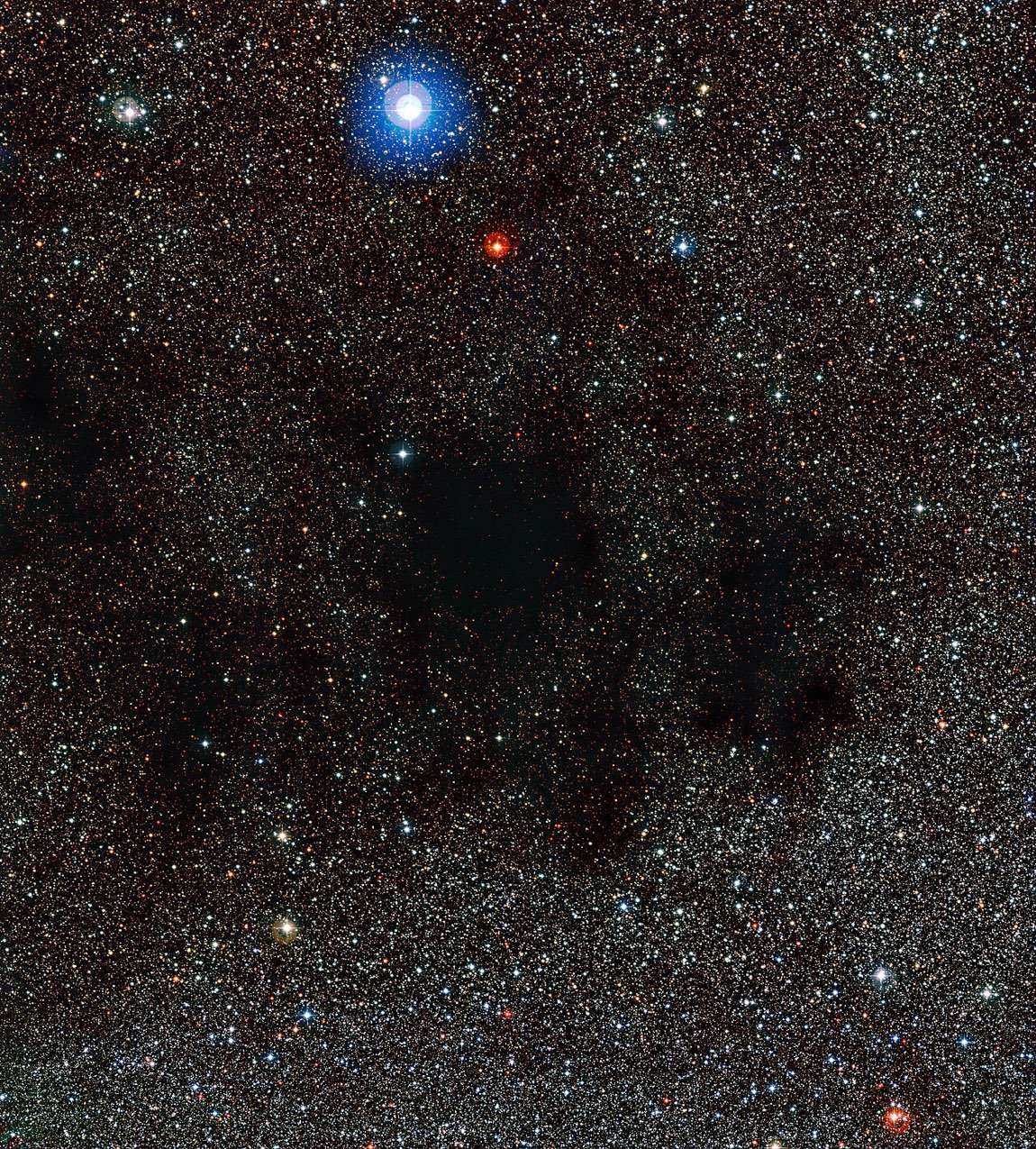
The Coalsack is a dark nebula, a cloud of dust that blocks the light of the Milky Way behind it, seen with the naked eye as a black patch beside the Southern Cross. It spans about 7° by 5° of sky and spills into Centaurus and Musca. Vicente Yáñez Pinzón reported it to Europeans in 1499, and later sailors called it Magellan's Spot. In several Australian Aboriginal traditions it forms the head of the Emu in the Sky.
The deep dive
Researched for the Atlas from Wikipedia — Coalsack Nebula (2,971 characters read) · updated Nov 15, 2026
01 A darkness you can see with bare eyes
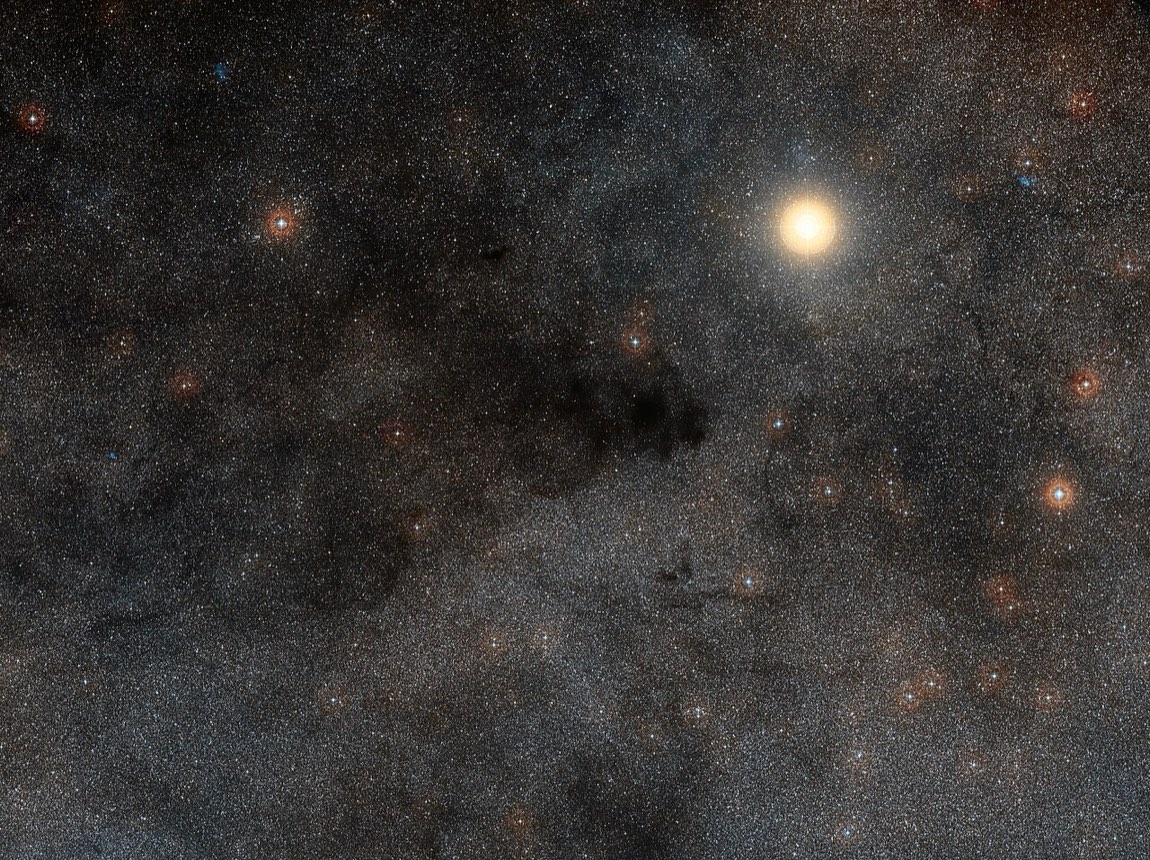
Most nebulae demand a telescope, but the Coalsack earns its reputation by being unmistakably visible to anyone under a dark southern sky. It appears as a conspicuous black patch blotting out the dense star fields of the Milky Way, sitting just east of Acrux — Alpha Crucis — the brightest star in the Southern Cross. The patch is not small: it spans nearly 7° by 5°, which is roughly the area covered by fourteen full Moons laid side by side. Its borders are ragged enough that the nebula spills beyond Crux into the neighboring constellations Centaurus and Musca. That apparent darkness is not a gap in the universe; it is an enormous cloud of cold dust and gas so thick that it absorbs the light of the stars behind it, creating what astronomers call a dark nebula. The contrast against the luminous band of the Milky Way is stark enough that the Coalsack has captured human attention for thousands of years across dozens of cultures, long before anyone understood what a nebula actually was.
02 Europe's first recorded sighting
The first documented observation of the Coalsack by a European came in 1499, reported by the Spanish explorer Vicente Yáñez Pinzón during his voyages into southern waters. Shortly afterward, the Italian navigator Amerigo Vespucci gave it the evocative name "il Canopo fosco" — the dark Canopus — drawing a comparison to the brilliant star Canopus that dominates southern skies, but inverting its brightness into shadow. Other early European names piled on quickly: it was also called "Macula Magellani," meaning Magellan's Spot, and even the "Black Magellanic Cloud," a deliberate counterpoint to the luminous Magellanic Clouds nearby. These multiple competing names hint at how striking and memorable the object was to navigators crossing into the southern hemisphere for the first time. The name "Coalsack" itself became so generic that Richard Hinckley Allen, writing in 1899, applied it to a completely different dark nebula in the northern constellation Cygnus, calling that one the Northern Coalsack — implying that any conspicuous dark patch in the sky deserved the same evocative label.
03 Indigenous skywatchers and the coal-black emu
Long before European contact, Aboriginal Australians had woven the Coalsack into sophisticated astronomical traditions. In several Aboriginal cultures, the nebula forms the head of a great emu traced not by stars but by the dark lanes of the Milky Way itself — an entirely different kind of constellation-making that privileges darkness over light. Different language groups give this celestial emu different names: in Gamilaraay it is called Gawaargay, while in Wergaia it is known as Tchingal. Among the Wardaman people the Coalsack takes on a more solemn character: it represents the head and shoulders of a law-man watching over the community to ensure traditional law is upheld. A legend recorded by W. E. Harney names this being Utdjungon, warning that only strict adherence to tribal law can prevent him from destroying the world with a fiery star. A separate account by Gaiarbau in 1880 connects the coalsacks to bora rings — ceremonial grounds typically oriented north–south — suggesting the southern Coalsack marks a celestial equivalent of those sacred spaces where spirits continue their ceremonies.
04 Andean and Balinese readings of the dark patch
Indigenous sky-knowledge of the Coalsack reaches well beyond Australia. In Inca astronomy the nebula was called Yutu, named after a partridge-like South American bird, the tinamou. The Inca tradition of forming constellations from dark patches in the Milky Way rather than from star patterns is known today as Andean dark constellation astronomy, and the Coalsack's role as Yutu places it within a rich celestial bestiary that also included a llama, a fox, and other animals familiar from the Andean landscape. On the Indonesian island of Bali, the same dark patch carries yet another name and meaning entirely: it is called Bubu Bosor, meaning a leaky fish trap — a humble, domestic image that connects the sky to everyday fishing life. Together these traditions from South America, Australia, and Southeast Asia demonstrate that the Coalsack's sheer naked-eye prominence made it culturally significant to people across the entire southern hemisphere, each community mapping their own world onto the same dark cloud.
05 Why "dark constellation" is its own category Deeper
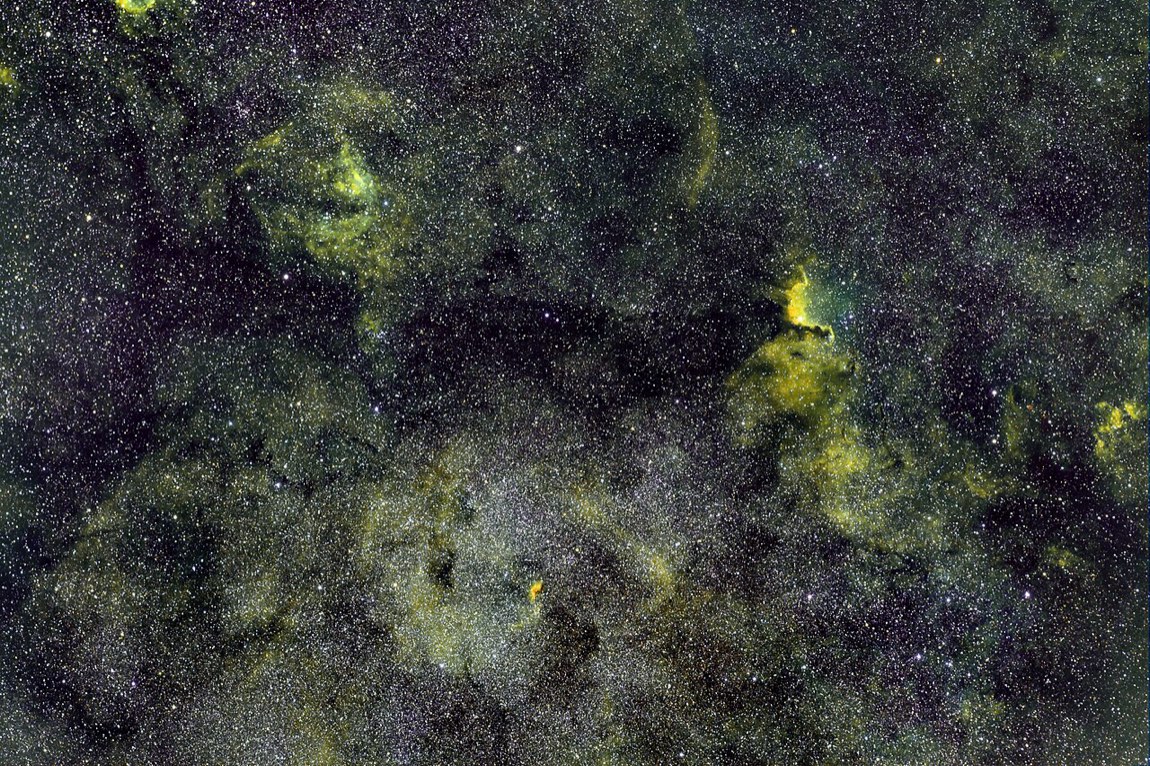
The article describes the Coalsack as "traditionally recognized as a dark constellation by many cultures," and that phrasing points to a genuinely distinct astronomical tradition. Western astronomy builds constellations by connecting bright stars into imagined figures — Orion's belt, the Big Dipper's cup — but dark-constellation traditions do the reverse. They trace the shapes of dark nebulae silhouetted against the glow of the Milky Way, turning absorption clouds into meaningful outlines. The Coalsack is one of the most prominent examples worldwide precisely because it is both large — nearly 7° by 5° — and positioned against one of the densest, brightest portions of the southern Milky Way, maximizing the contrast. This observational approach requires no instruments, only a dark sky and familiarity with the night. The fact that unconnected cultures in Australia, the Andes, and Bali all made the Coalsack a named, meaningful object confirms how visually commanding it is. Astronomers studying ethnoastronomy now treat dark constellations as a parallel system of celestial mapping with its own internal logic, richly documented and culturally specific.
 ⤢
06 The name that spread to other nebulae
One measure of the Coalsack's cultural grip is what happened to its name. By the nineteenth century "coalsack" had become a common noun in astronomy: any dark patch in the night sky could earn the label. Richard Hinckley Allen formalized this in 1899 when he designated a dark nebula in the northern constellation Cygnus as the Northern Coalsack, implicitly rebranding the original as the Southern Coalsack. This naming convention reveals something important about how striking dark nebulae are as a class of objects — striking enough that a single evocative name migrated across the sky. Today the Southern Coalsack usually travels simply as the Coalsack, its geographical qualifier quietly dropped because it remains the most famous example. The Northern Coalsack in Cygnus is a real and separate dark nebula, but it has never achieved the same cultural weight, partly because it lies in a part of the Milky Way less densely packed with background stars, reducing the visual drama that made the southern original so memorable.
07 The Coalsack in literature and fiction
The Coalsack's visual drama — a void carved into a star-filled sky — has made it irresistible to writers. In Kenji Miyazawa's story Night on the Galactic Railroad, the nebula appears as a charged symbol: the protagonist Giovanni watches his friend Campanella depart toward a personal afterlife called "True Heaven," where his dead mother waits. Giovanni cannot perceive True Heaven, and in the story's imagery the empty blackness of the Coalsack stands in for that unreachable destination — absence made cosmic. In a very different register, the Coalsack and the galactic region surrounding it play a central role in Jerry Pournelle's CoDominium Universe, particularly in the novel The Mote in God's Eye and its sequel The Gripping Hand, both co-authored with Larry Niven. In those books, a human-colonized star system called New Caledonia sits on the opposite side of the Coalsack from Earth. The nebula serves as a dramatic backdrop: a red supergiant is set against it, and between that supergiant and New Caledonia hangs a yellow F6 star nicknamed "The Mote in God's Eye" — a title that became the novel's name.
08 Open questions the article leaves unanswered Deeper
The Wikipedia article on the Coalsack is notably silent on several topics that researchers actively study in dark nebulae of this type — a silence that itself tells readers where the science becomes uncertain or incomplete. No mass estimate for the cloud is given, no internal temperature, no discussion of whether star formation is occurring or expected within it, and no detail about its distance beyond the implied association with the Crux region. The article does not mention any dust composition studies, polarization measurements, or molecular line observations that astronomers typically use to characterize dark clouds. It also does not discuss whether the Coalsack is gravitationally bound, what its relationship is to nearby star-forming regions, or how long it is expected to persist. These omissions are not failings of the article so much as reminders that the Coalsack's fame is primarily observational and cultural: its science, while real, is not what the existing article documents. Any reader seeking detailed astrophysical data on this cloud will need to look well beyond its Wikipedia entry.
09 Finding it in the southern sky tonight
Locating the Coalsack is straightforward for anyone under a genuinely dark sky in the southern hemisphere, or within the tropics where Crux clears the horizon. The key landmark is Acrux, Alpha Crucis, the brightest star in the Southern Cross. The Coalsack lies immediately to its east, and because it spans nearly 7° by 5°, it is impossible to mistake once you know what you are looking for: a region where the Milky Way's star fields abruptly thin out and darken. No optical aid is needed — in fact, binoculars can slightly undercut the effect by pulling in faint background stars that the naked eye ignores. The best conditions are a moonless night well away from city lights, with Crux high enough in the sky to clear atmospheric haze. Because the nebula extends into both Centaurus and Musca as well as Crux, its full extent slightly exceeds the boundaries of the Southern Cross asterism. Observers in the southern United States at low latitudes can glimpse Crux near the horizon during late northern spring evenings, but seeing the Coalsack well really rewards a trip south of the equator.
 ⤢