 Photograph · ESO/Y. Beletsky · CC BY 4.0
Star Cluster · Deep guide
Jewel Box (NGC 4755)
Also called: Caldwell 94 · NGC 4755 · Kappa Crucis Cluster · Herschel's Jewel Box
A tiny, sparkling cluster of coloured stars beside the Southern Cross.
What is it?
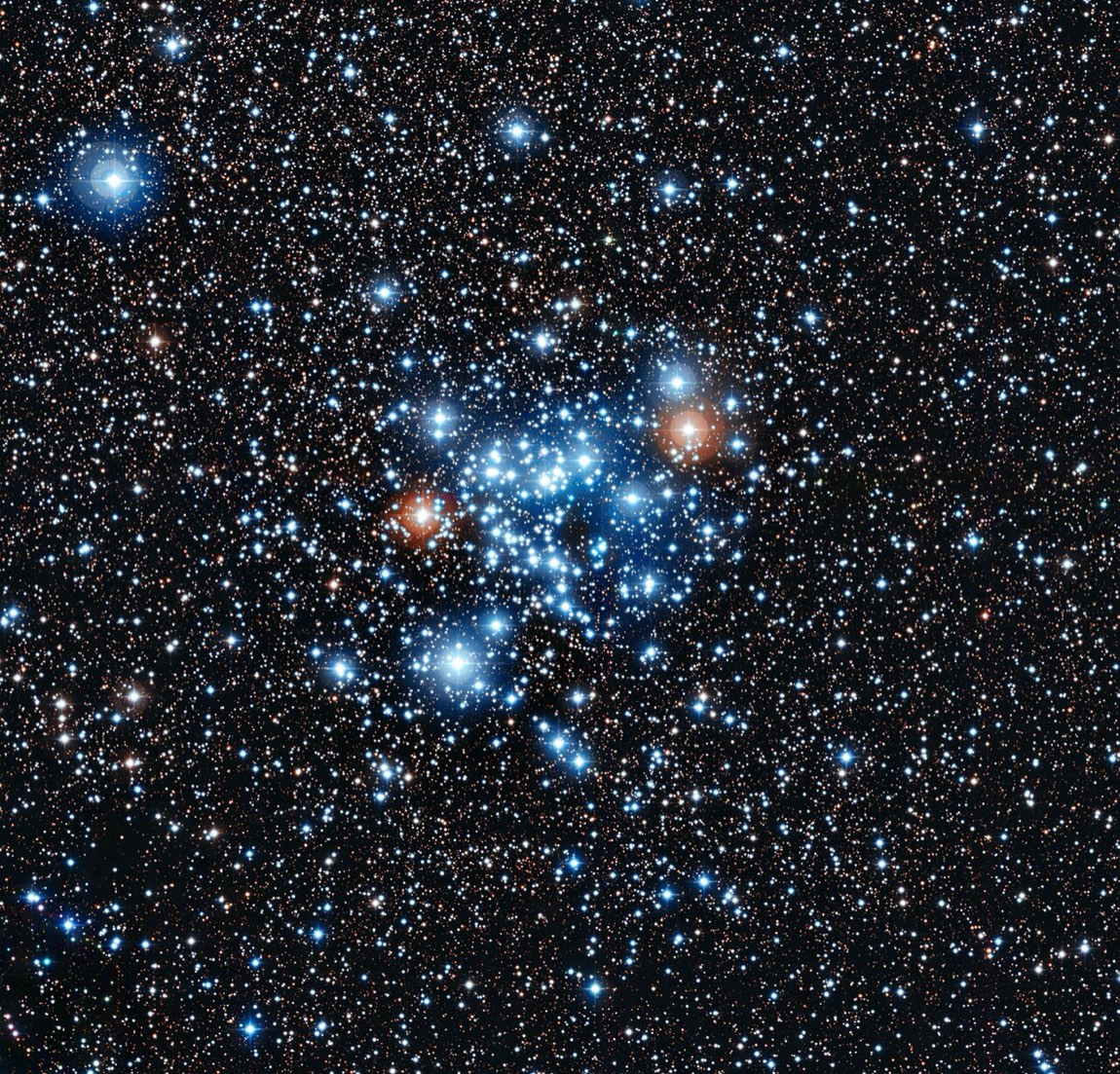
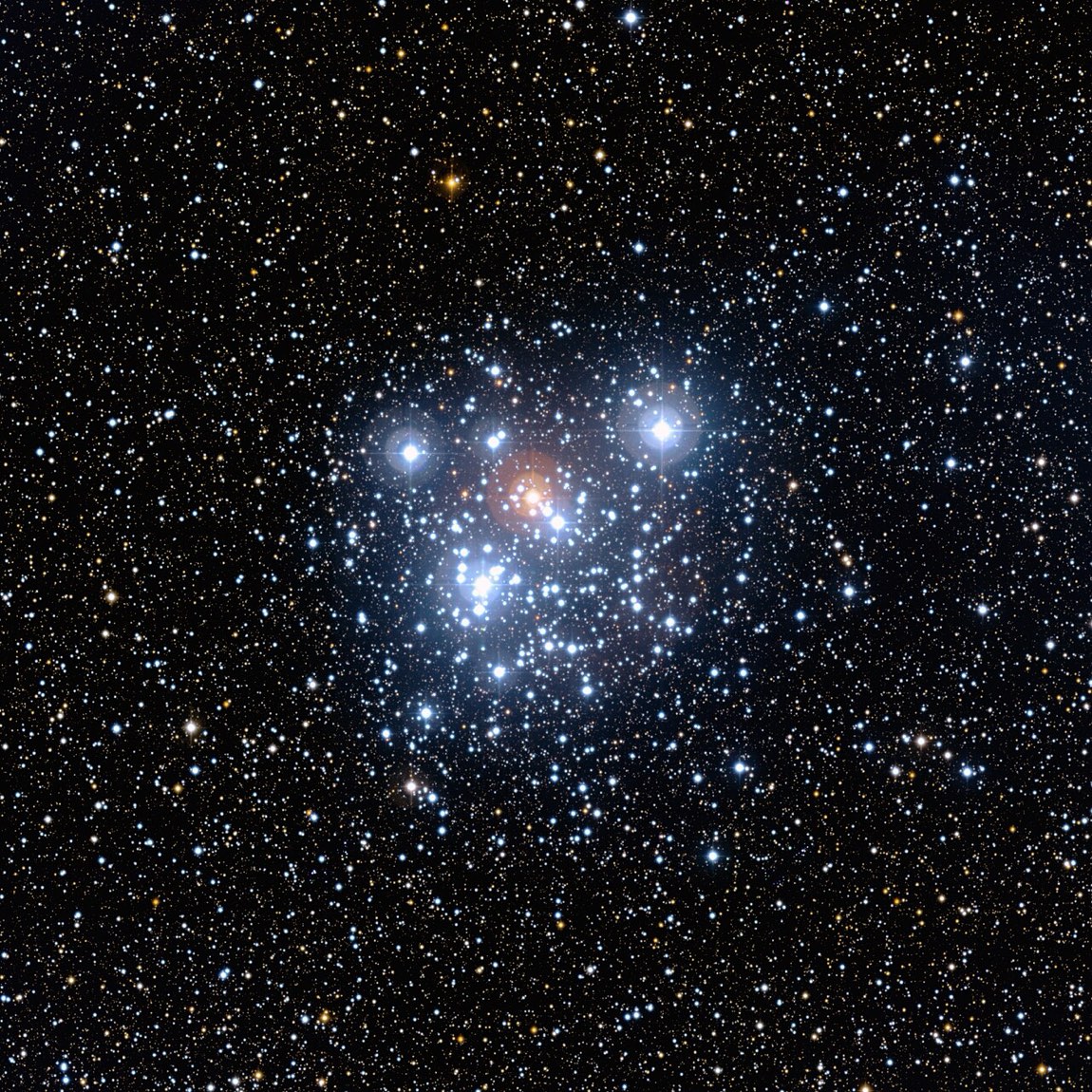
The Jewel Box is a young open cluster in Crux, about one degree from the bright star Mimosa. Lacaille found it in 1751–52, and John Herschel named it after its look in a telescope, comparing it to a fine piece of jewellery. To the naked eye it appears as a single hazy star, which is why it was given the star name Kappa Crucis. It contains just over 100 stars and is one of the youngest clusters known, only about 14–16 million years old.
The deep dive
Researched for the Atlas from Wikipedia — Jewel Box (star cluster) (3,966 characters read) · updated Nov 15, 2026
01 How Lacaille Found It with Half an Inch of Glass
The story of the Jewel Box begins at the southern tip of Africa. Between 1751 and 1752, the French astronomer Nicolas Louis de Lacaille was at the Cape of Good Hope compiling a southern star catalogue he called Cœlum Australe Stelliferum — a systematic survey of skies invisible from Europe. His instrument was remarkably modest: a telescope with a lens just 12 mm, roughly half an inch, across — narrower than a human thumb. Through that sliver of glass, what appeared to other observers as a single fuzzy star resolved into something more complex. Lacaille was the first to recognise it as a group of many stars rather than a nebulous smear. Because the cluster looked like a single hazy point to the unaided eye, it had already been catalogued as a star and given the Bayer designation Kappa Crucis. That name stuck so firmly that today it still serves as one of the cluster's common names, even though the modern designation Kappa Crucis has since been reassigned specifically to one of the individual stars within the cluster's A-shaped asterism.
02 The Phrase That Named a Star Cluster
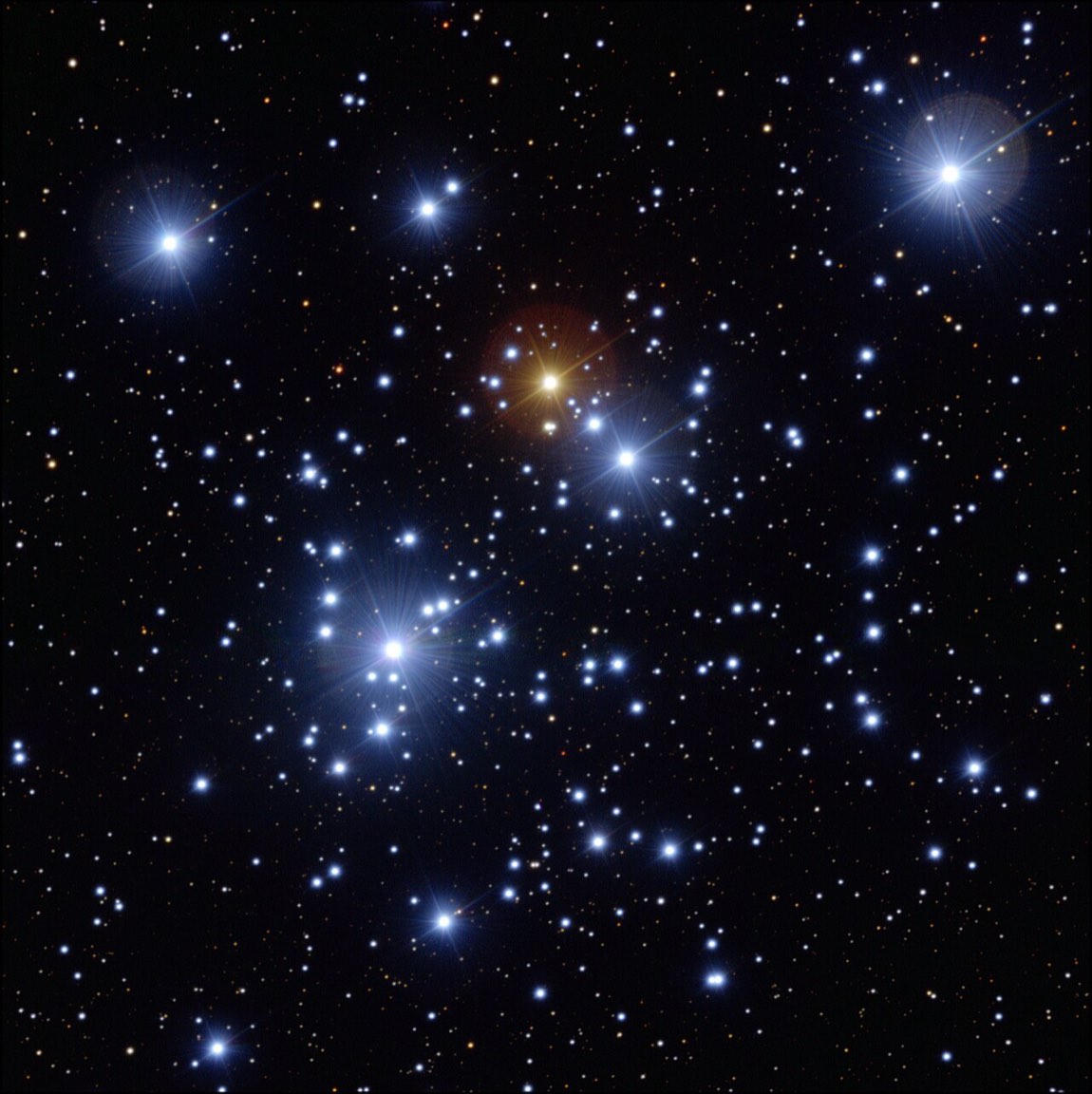
John Herschel observed the cluster between 1834 and 1838 at the Cape of Good Hope, recording the positions of just over 100 of its members. He was struck not simply by its brightness but by the striking color contrasts among its stars, and his published description gave the cluster the name it carries today. His exact words were that it presented "the effect of a superb piece of fancy jewellery" when viewed through an instrument of sufficient aperture to reveal the very different colors of its constituent stars. Herschel was careful to note that the cluster is "neither a large nor a rich one" by absolute standards, yet called it "extremely brilliant and beautiful." That honest qualification is worth remembering: the Jewel Box earns its reputation not through sheer star count but through the rare visual drama of hot blue supergiants set against at least one contrasting red supergiant, a color palette that binoculars or a small telescope can reveal. The name he coined has remained in use ever since, making this one of the few deep-sky objects whose popular name traces directly to a single surviving written sentence.
03 An A-Shape in the Sky and Its Traffic Lights
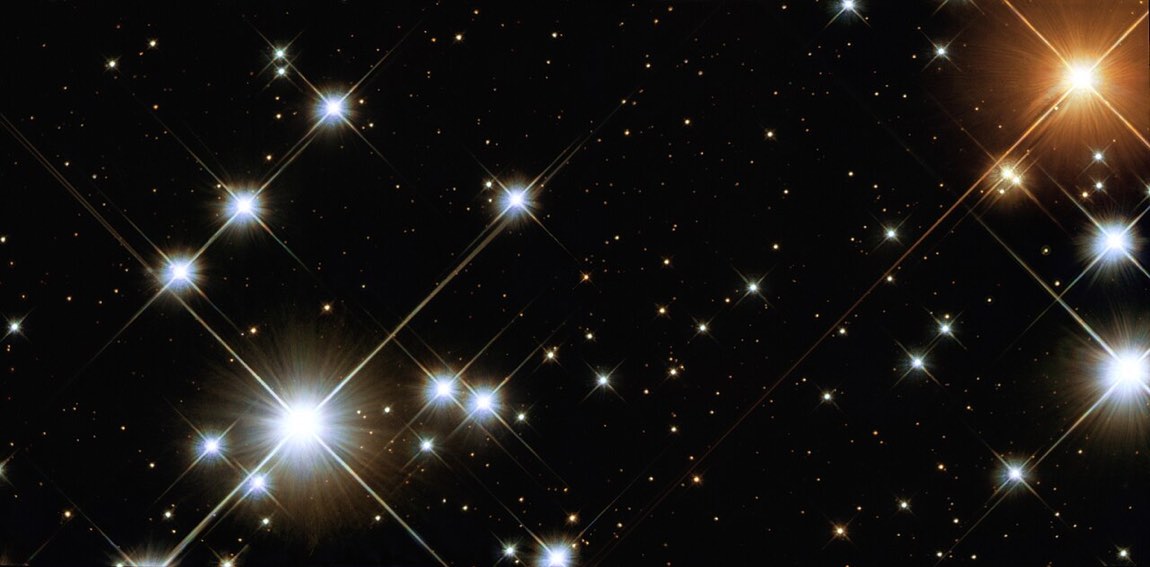
Look at the central part of the Jewel Box through a telescope and the brightest stars arrange themselves into an unmistakable letter A. The upper tip of that asterism is held by HD 111904, a B9 supergiant and suspected variable star that shines at magnitude 5.77, making it the brightest member of the A pattern itself. The crossbar of the A is formed by a straight line of four stars, three of which have earned the nickname "traffic lights" because of their markedly different colors. Reading from right to left, BU Cru is a magnitude 6.92 blue B2 supergiant that is also an eclipsing binary. Next comes BV Cru, a magnitude 8.662 blue B0.5 giant and Beta Cephei variable — a star that physically pulses in size. The color contrast arrives with DU Cru, an M2 red supergiant whose brightness wanders irregularly between magnitude 7.1 and 7.6, providing the vivid red in the traffic-light trio. Completing the bar is CC Cru, a magnitude 7.83 B2 giant classified as an ellipsoidal variable, meaning its shape is distorted by tidal forces. Each leg of the base of the A is anchored by a blue supergiant: HD 111990 at magnitude 6.77 and spectral type B1/2, and Kappa Crucis itself at magnitude 5.98 and type B3.
04 Supergiants: Some of the Milky Way's Brightest Stars Deeper
The Jewel Box punches well above its weight in terms of raw stellar luminosity. The brightest members of the cluster are supergiants — stars that have already exhausted hydrogen in their cores and swelled to enormous sizes — and the article notes that some of them rank among the intrinsically brightest stars in the entire Milky Way galaxy. That claim is significant: the cluster contains only just over 100 stars in total, yet within that modest population it has managed to produce multiple objects of extraordinary luminosity. This is a direct consequence of the cluster's extreme youth. At an estimated age of just 14 million years, the Jewel Box has not had time for its most massive members to complete their life cycles and disappear as supernovae. Those massive stars are still present, still blazing, still inflating into the supergiant phase. The presence of both blue supergiants and the red supergiant DU Cru in the same cluster also offers astronomers a snapshot of stellar evolution in action: stars of similar initial mass can end up at very different points on the Hertzsprung-Russell diagram depending on small differences in mass or evolutionary timing, and the Jewel Box displays several of those endpoints simultaneously.
 ⤢
05 Why Measuring Its Distance Is Tricky Deeper
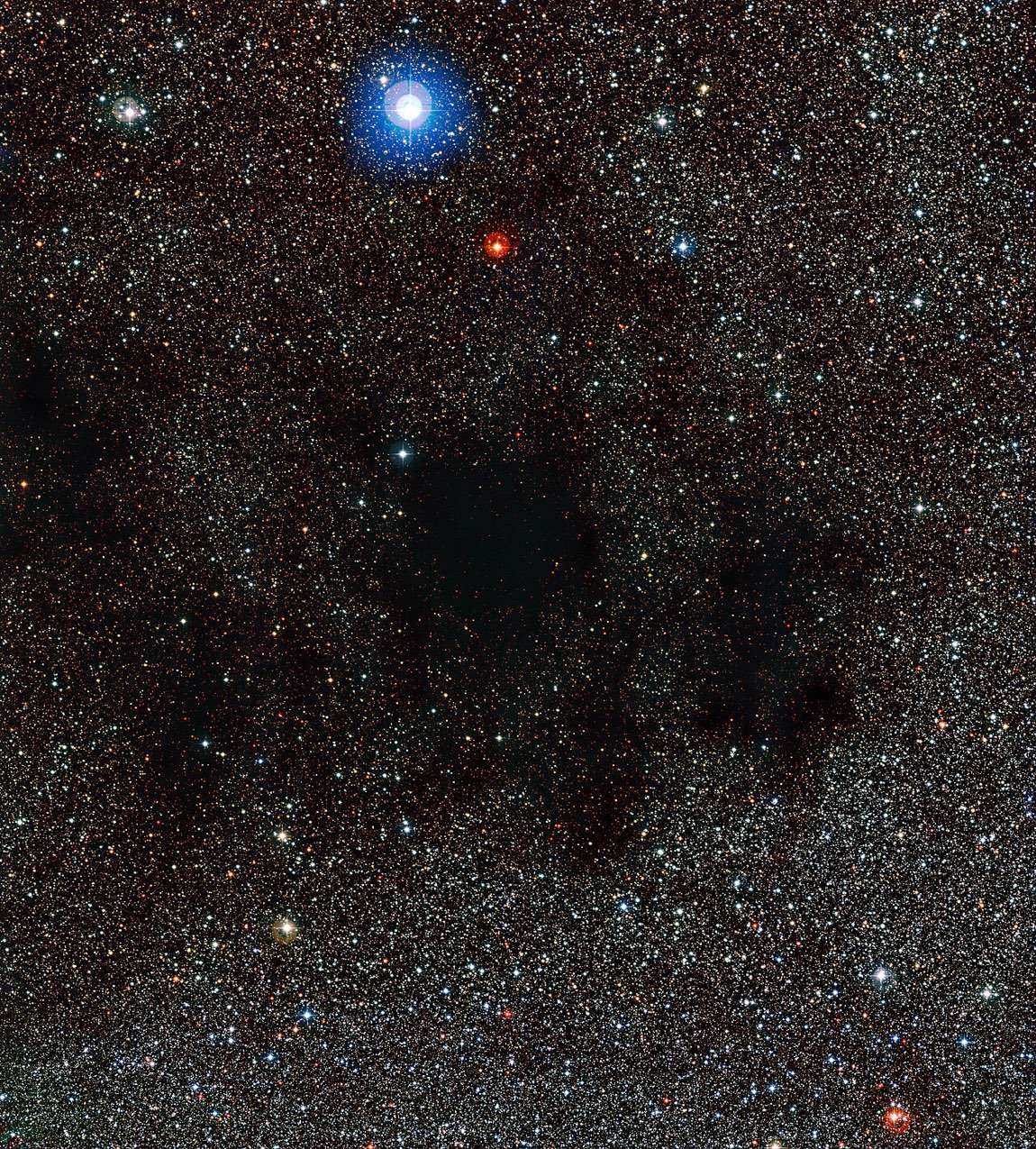
Pinning down the Jewel Box's distance with precision is harder than it might seem, and the reason is its unfortunate cosmic neighbor. The Coalsack Nebula, one of the most prominent dark nebulae in the southern sky, lies in close angular proximity to the cluster and physically obscures some of the cluster's light. Dark nebulae are clouds of cold dust and gas that absorb and redden the starlight passing through them, making stars appear both fainter and redder than they truly are. When astronomers use apparent brightness to estimate distance, any unaccounted absorption makes a star look farther away than it really is; unaccounted reddening can also mislead spectral classification. The accepted distance to the Jewel Box is 1.99 kiloparsecs, equivalent to 6,497 light-years — roughly 61 million billion kilometers from Earth. That figure is the best current estimate, but the Coalsack's interference means it carries more uncertainty than a cluster observed in a cleaner line of sight would. The mean radial velocity of the cluster has also been measured: the Jewel Box is approaching us at 21 kilometres per second, a figure independent of the dust-obscuration problem because it is derived from Doppler shifts in starlight rather than from brightness.
06 The Curious Case of the Foreground Imposter Deeper
The single brightest star in the apparent vicinity of the Jewel Box is not actually a member of the cluster. DS Cru, catalogued also as HD 111613 and HR 4876, has an average visual brightness of magnitude 5.72 — marginally outshining the cluster's true brightest member, HD 111904, at magnitude 5.77. DS Cru is classified as a B9.5 supergiant and an Alpha Cygni variable, a category of luminous supergiant that shows irregular pulsations driven by instabilities in its outer layers. Despite its apparent position well beyond the A-shaped asterism and its impressive brightness, DS Cru is thought to be a foreground object: a star that happens to lie along roughly the same line of sight as the Jewel Box but is physically unrelated to it. Its inclusion in casual descriptions of the cluster can therefore be misleading. This kind of foreground contamination is a common challenge when studying open clusters, especially in the direction of the Milky Way's disk where stars at many different distances pile up along any given line of sight. Properly separating true cluster members from chance alignments requires careful analysis of distances, velocities, and proper motions.
07 Fourteen Million Years: What Youth Means Here
An age of 14 million years sounds ancient by any human measure — it predates our earliest hominin ancestors by more than 10 million years — but in stellar terms the Jewel Box is a newborn. For comparison, our own Sun is about 330 times older. The Jewel Box is described as one of the youngest known open clusters, a designation that has real observational consequences. Young clusters have not yet had enough time to be gravitationally disrupted by encounters with giant molecular clouds or by the gentle but persistent tidal forces of the galaxy. Their most massive and luminous members, which burn through their fuel in only a few million years, are still alive. And the cluster has not yet undergone much "evaporation" — the slow leaking away of lower-mass stars that have been gravitationally kicked to speeds exceeding the cluster's escape velocity. All of this means that the Jewel Box we see today is relatively close to its original configuration, making it a valuable laboratory for testing theories of how massive stars form and evolve together in a single burst of star formation from the same parent cloud of gas and dust.
08 Locating the Jewel Box: A Practical Guide
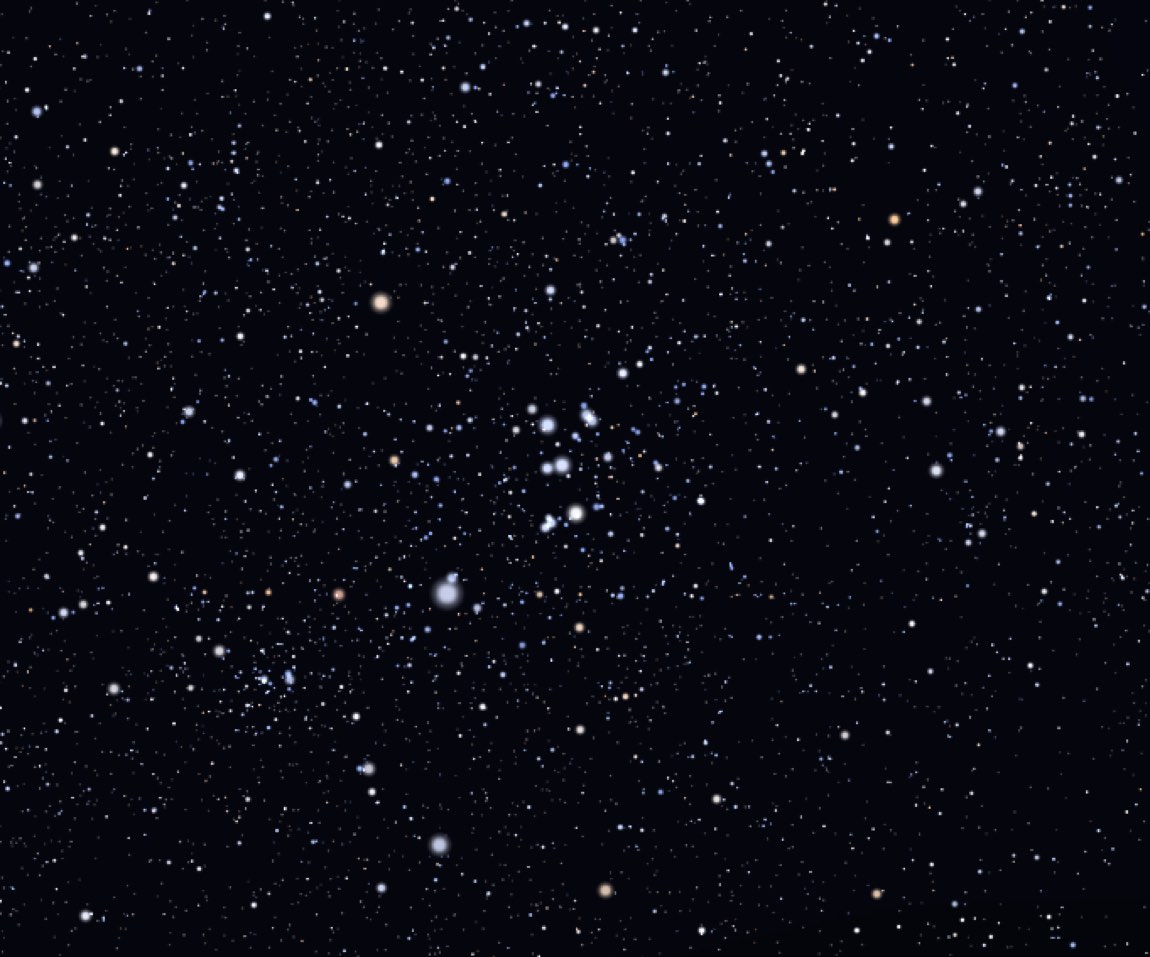
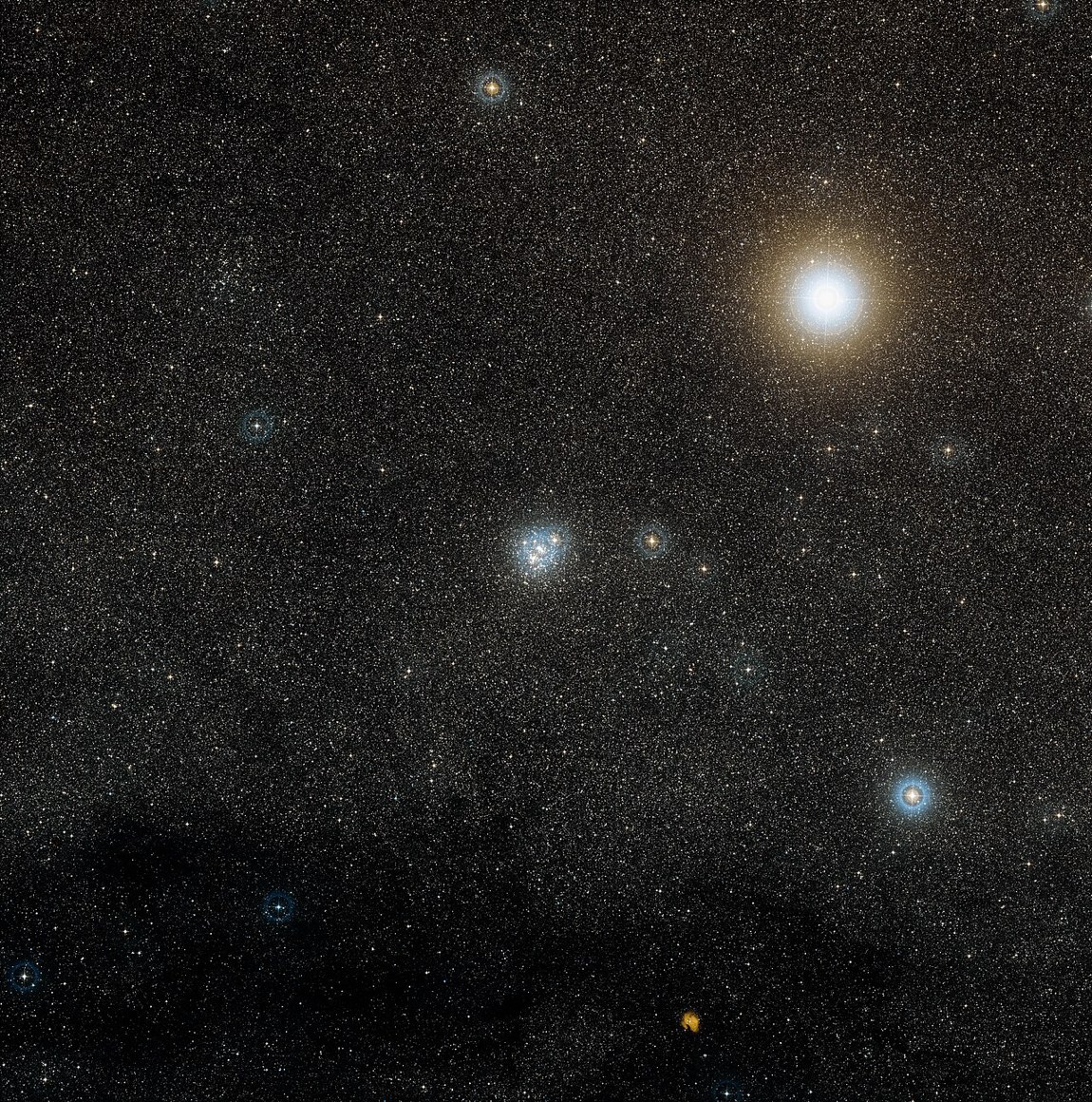
Finding the Jewel Box requires access to the southern sky — it sits in the constellation Crux, the Southern Cross, which never rises above the horizon for observers north of roughly 25 degrees north latitude. For those with a suitable view, the navigation is straightforward. The cluster lies approximately 1.0 degree southeast of Mimosa, also known as Beta Crucis, a first-magnitude star and one of the two brightest stars in the Southern Cross. That separation is about twice the apparent diameter of the full Moon, small enough that Mimosa serves as an unmistakable pointer. To the naked eye the cluster appears as a hazy star of the fourth magnitude — bright enough to see without optical aid but clearly not a point source under good conditions. Binoculars immediately begin to resolve individual stars and hint at the color contrasts that make the cluster famous. A small telescope brings out the A-shaped asterism and allows the traffic-light trio of blue and red supergiants to become visually apparent. The cluster carries a total integrated apparent magnitude of 4.2, and its reputation as one of the finest objects in the southern sky is well supported by even modest optical equipment.
 ⤢
09 Variable Stars Hidden Inside the Cluster Deeper
Several members of the Jewel Box are variable stars — objects whose brightness changes over time for different physical reasons — and the variety of variability types packed into one small cluster is remarkable. BU Cru is an eclipsing binary, meaning its brightness dips periodically as one star passes in front of the other from our line of sight; the variability is geometric rather than intrinsic to the star itself. BV Cru is a Beta Cephei variable, a class of star that pulsates in and out over periods of hours due to opacity-driven instabilities in its interior, with the pulsations producing regular oscillations in brightness and radial velocity. DU Cru, the red supergiant, varies irregularly between magnitudes 7.1 and 7.6, a behavior typical of M-type supergiants whose extended, loosely bound outer envelopes undergo complex, semi-chaotic convective motions. CC Cru is an ellipsoidal variable, which means it is tidally distorted into a non-spherical shape by a close companion, and as the system rotates, the varying projected surface area toward us causes apparent brightness changes without true eclipses. Even HD 111904 at the tip of the A is flagged as a suspected variable. The cluster thus offers multiple distinct variability mechanisms observable within a single field of view.
10 Open Questions the Jewel Box Still Poses Deeper
Despite being one of the most studied young open clusters in the southern sky, the Jewel Box leaves several questions open. The obscuring presence of the Coalsack Nebula introduces systematic uncertainties into the cluster's distance and reddening corrections that remain difficult to fully resolve. The status of DS Cru as a foreground object is described as a belief rather than a firmly established fact, and confirming or refuting that conclusion has implications for understanding the apparent luminosity function of the cluster. HD 111904, the tip star of the A asterism, is catalogued as a suspected variable but has not been definitively confirmed as one. More broadly, the cluster is young enough that its most massive members may still be evolving rapidly, meaning that the distinction between blue and red supergiants in the same cluster — such as the coexistence of multiple B-type supergiants with the M2 red supergiant DU Cru — raises questions about stellar evolution pathways that theorists continue to refine. How the cluster's membership, mass, and structure will change over the next few tens of millions of years as it ages and disperses into the galactic disk is itself an active area of open-cluster dynamics research.
11 The Cluster's Place in Astronomical Catalogues
The Jewel Box carries an unusually large number of catalogue designations, each reflecting a different era of astronomical record-keeping. Its most formal modern identifier is NGC 4755, from the New General Catalogue compiled by J. L. E. Dreyer in the late nineteenth century. It also appears as Caldwell 94, from Patrick Moore's Caldwell Catalogue published in 1995 as a list of notable deep-sky objects not included in Messier's famous catalogue — the Jewel Box was overlooked by Messier simply because it lies too far south to be observed from France, where he worked. The designation Kappa Crucis Cluster recalls the original Bayer label given to what observers thought was a single star; that historical name now refers formally to one specific star within the cluster. The popular name Jewel Box, meanwhile, is one of the few instances in observational astronomy where a name coined in a published description — Herschel's evocative phrase about fancy jewellery — passed directly into standard usage and has remained there for nearly two centuries without being replaced by a more systematic label. The cluster thus exists simultaneously in the formal numerical world of the NGC, the curated list of the Caldwell catalogue, the historical Bayer system, and the vivid tradition of descriptive popular naming.
 ⤢