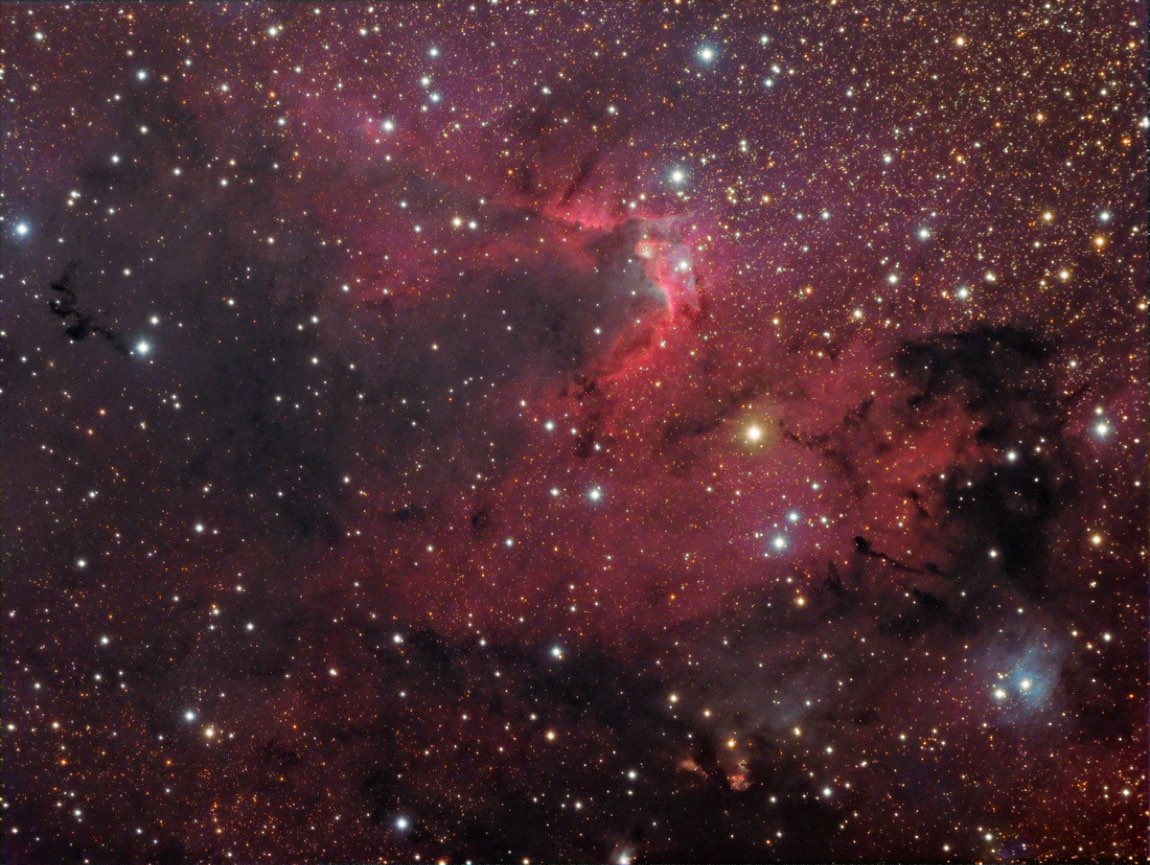
 Photograph · Hewholooks · CC BY-SA 3.0
Nebula · Deep guide
The Cave Nebula
Also called: Caldwell 9 · C9 · Sh 2-155 · Sharpless 155 · S155
A glowing cloud where light from hot young stars may be squeezing out the next generation of suns.
What is it?
The Cave Nebula, catalogued as Sharpless 2-155, is a cloud of glowing hydrogen gas in Cepheus, lit by young stars of the Cep OB3 association. It sits at the edge of a larger dark molecular cloud, and the radiation from a hot O-type star appears to be compressing that cloud and triggering new star birth; X-ray and infrared studies show star ages getting younger toward the cloud. Patrick Moore gave it the name, likely after a curved arc that looks like a cave mouth, though the name had earlier been used for a different nebula. It is faint, but a moderate telescope under dark skies shows some of its structure.
The deep dive
Researched for the Atlas from Wikipedia — Sh 2-155 (1,939 characters read) · updated Nov 15, 2026
01 A nebula hiding inside a larger nebula
Sh 2-155 is not an isolated cloud floating alone in space — it sits embedded within a much larger nebula complex that contains three distinct types of nebulosity at once: emission nebulosity (gas glowing from the energy of nearby stars), reflection nebulosity (dust scattering starlight like fog around a streetlamp), and dark nebulosity (dense cold clouds that block everything behind them). The nebula itself is classified as an H II region, meaning it is a pocket of ionized hydrogen gas. Specifically, it lies at the edge of the Cepheus B cloud, which is itself part of the sprawling Cepheus molecular cloud — a vast stellar nursery spread across the constellation Cepheus. Think of Sh 2-155 as a bright, active blister on the surface of a much darker, colder giant. This layered setting makes the region unusually rich in structure, with warm glowing gas, reflective dust, and opaque dark lanes all visible in the same field of view.
02 How the Cave got its shape
The name "Cave Nebula" was coined by the British astronomer Patrick Moore, and it was inspired directly by photographs of the object. In those images, a curved arc of emission nebulosity sweeps across the field in a shape that resembles the opening of a cave mouth — a dark interior framed by a glowing rim. That hollow, recessed appearance is not simply a photographic illusion. The ionized gas is being shaped by the intense radiation streaming outward from young, hot stars associated with the Cep OB3 stellar association. Those stars are energetic enough to push and sculpt the surrounding gas into arcs and shells. The specific O-type star HD 217086 has been singled out as a particularly powerful driver of this sculpting process, with its radiation compressing the nearby gas cloud. It is this compression, pressing inward on the Cepheus B cloud, that gives the nebula both its distinctive curved appearance and its ongoing star-forming activity.
03 Triggered star formation: a chain reaction Deeper
One of the most scientifically compelling aspects of Sh 2-155 is the evidence it provides for triggered star formation — the idea that one generation of stars can physically cause the next generation to be born. The mechanism here is relatively straightforward in concept: radiation from the hot O-type star HD 217086 compresses the edge of the Cepheus B cloud, squeezing gas until it becomes dense enough to collapse under its own gravity and form new stars. What makes this more than just a hypothesis is observational evidence gathered by two of the most powerful space-based observatories ever built. Studies combining data from the Chandra X-ray Observatory and the Spitzer Space Telescope examined the young stellar objects in and around Sh 2-155 and found a telling pattern: a progression of stellar ages spread out in front of the cloud. Stars closer to the ionizing radiation source tend to be older, while those deeper into the cloud are younger — exactly the sequence expected if a compression wave has been sweeping inward through the cloud over time, triggering new star births as it goes.
04 The telescopes that decoded the region Deeper
Understanding what is truly happening inside Sh 2-155 required instruments capable of seeing far beyond ordinary visible light. The Chandra X-ray Observatory contributed by detecting the X-ray glow of young stellar objects — newly formed stars that are often intensely magnetically active and emit high-energy radiation in their early lives. X-ray observations pierce through the dust that obscures visible light, revealing stars still deeply embedded in their birth clouds. The Spitzer Space Telescope worked in the infrared part of the spectrum, also capable of seeing through dust, and excelled at identifying young stellar objects by detecting the warm infrared glow of the dusty disks and envelopes surrounding them. Together, these two observatories provided a multi-wavelength census of the stellar population in and around the nebula. That census is what made the age progression across the region visible, supplying the clearest evidence yet that the star formation happening here is not random but is being systematically triggered by the pressure of HD 217086's radiation.
05 The Cep OB3 association: the nebula's parent cluster
Sh 2-155 did not arise in isolation — it is a part of, and ionized by, the Cep OB3 stellar association, a loose grouping of young, massive, hot stars in Cepheus. OB associations are not gravitationally bound clusters in the traditional sense; they are regions where massive O-type and B-type stars were born together from the same molecular cloud and have not yet had time to drift far apart. The stars of Cep OB3 are energetic enough to blast ultraviolet radiation into the surrounding gas, stripping electrons from hydrogen atoms and creating the ionized H II region we observe as Sh 2-155. When the nebula was first formally catalogued in 1959 in the extended second edition of the Sharpless catalogue, it was already recognized as a component of this much larger Cep OB3 association rather than a standalone object. This context is essential: the nebula's shape, its ionization, and its star-forming activity are all downstream consequences of the powerful young stars that make up Cep OB3.
06 A catalog entry with a complicated identity
Sh 2-155 carries an unusual number of names and catalog designations, and its identity has been genuinely confused in popular astronomy for decades. Its formal designations include Sh 2-155, Sharpless 155, S155, LBN 529, and Caldwell 9 — that last one being the most recognizable to amateur astronomers, since it comes from Patrick Moore's widely used Caldwell catalogue. Moore also coined the common name "Cave Nebula" for this object, drawing the name from the cave-mouth shape visible in photographs. The confusion arises because the name "Cave Nebula" was already in use earlier for a completely different object: Ced 201, also known as VdB 152, a brighter but unrelated reflection nebula also located in Cepheus, at coordinates R.A. 22h 13m 27s, Dec. +70° 15′ 18″ (epoch 2000). The astronomical database SIMBAD recognizes "Cave Nebula" as a name for Ced 201, not for Sh 2-155 — meaning that professional and popular astronomy currently disagree on which object the name belongs to.
07 Seeing the Cave Nebula with your own eyes
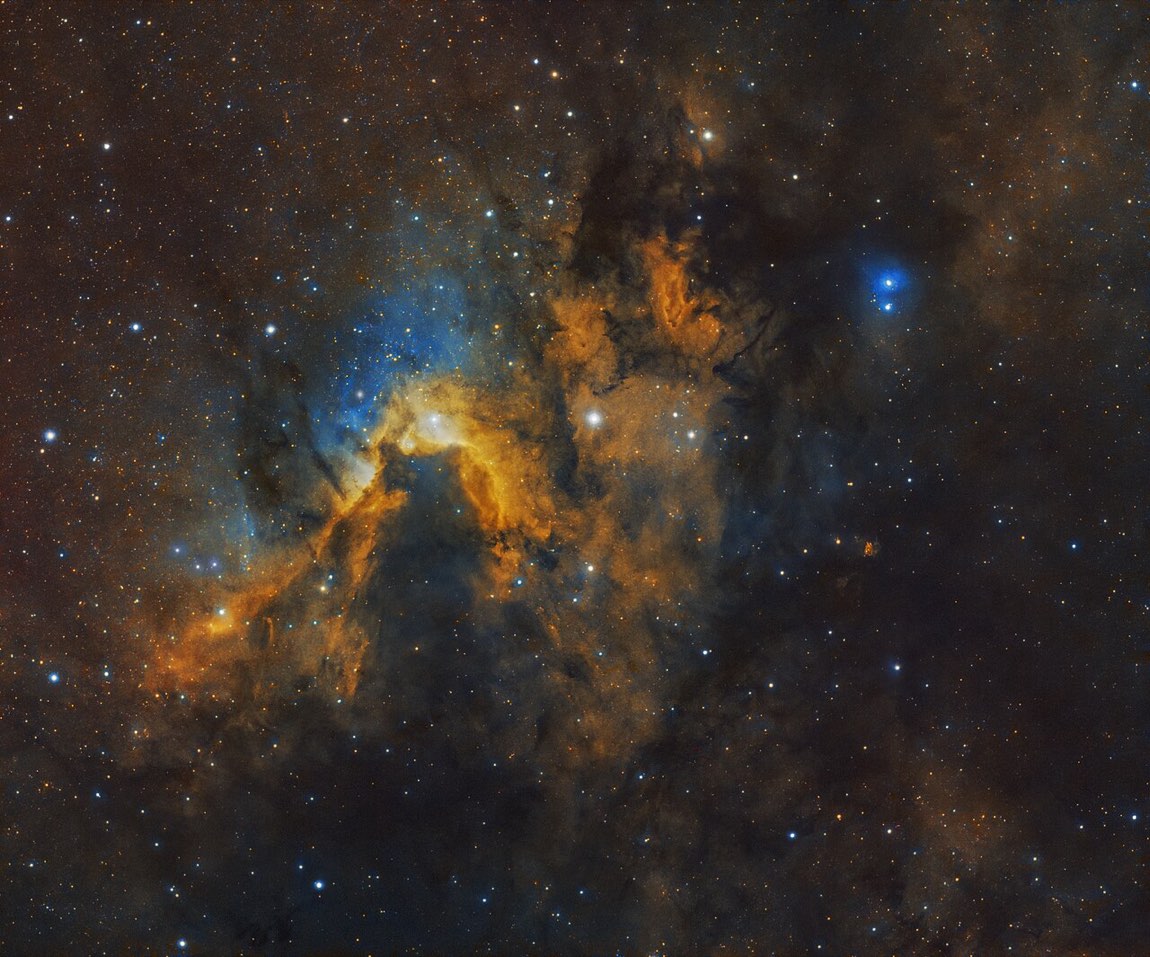
Sh 2-155 sits in the constellation Cepheus, a region of sky that is circumpolar for most observers in the Northern Hemisphere, meaning it never sets below the horizon at mid-northern latitudes. Despite this favorable position in the sky, the Cave Nebula is considered relatively faint by amateur observation standards. The article is candid about this: some of its structure may be seen visually through a moderately sized telescope under dark skies, but it is not an easy or impressive visual target the way some emission nebulae can be. Its apparent magnitude reflects this difficulty. Where the nebula rewards the patient observer is in long-exposure astrophotography, where the cave-mouth arc of glowing emission gas and the surrounding complex of reflection and dark nebulosity can be captured in striking detail. The mixture of red emission light and blue-white reflection nebulosity in photographs is part of what has made Sh 2-155 a popular imaging target despite its subtlety at the eyepiece.
08 Patrick Moore and the naming question
The story of how Sh 2-155 came to be called the Cave Nebula is a small but telling episode in how popular astronomy names take hold. Patrick Moore, the prolific British astronomer and broadcaster, coined the name for this object — presumably, the article notes, based on photographic images that showed the curved emission arc resembling a cave entrance. Moore also included the object in his Caldwell catalogue as Caldwell 9, a list of deep-sky objects he assembled specifically to complement the famous Messier catalogue. It is the Caldwell listing more than anything else that brought Sh 2-155 into broad amateur awareness and cemented the "Cave Nebula" name in popular use. The irony is that "Cave Nebula" had already been used for the nearby and unrelated Ced 201, also in Cepheus. This prior usage is still reflected in SIMBAD's data. So Moore's popularization of the name for Sh 2-155 succeeded in common usage while the professional database maintained the older attribution — a naming collision that remains unresolved.
09 What 725 parsecs actually means
The estimated distance to Sh 2-155 is 725 parsecs, which works out to approximately 2,400 light-years from Earth. A light-year is already an almost unimaginably large distance — roughly 9.46 trillion kilometers — so 2,400 of them places the Cave Nebula in a realm that makes direct exploration or even meaningful communication completely impossible with any technology humans have ever built or seriously proposed. For comparison, the nearest star system to our Sun, Alpha Centauri, is a little over 4 light-years away; the Cave Nebula is about 600 times farther than that. The light leaving Sh 2-155 and entering a telescope today departed the nebula around the time of the late Bronze Age or early Iron Age on Earth. That ancient light carries information about the nebula's structure, ionization, and stellar population — and it is from that information alone that everything described on this page has been deduced.
 ⤢