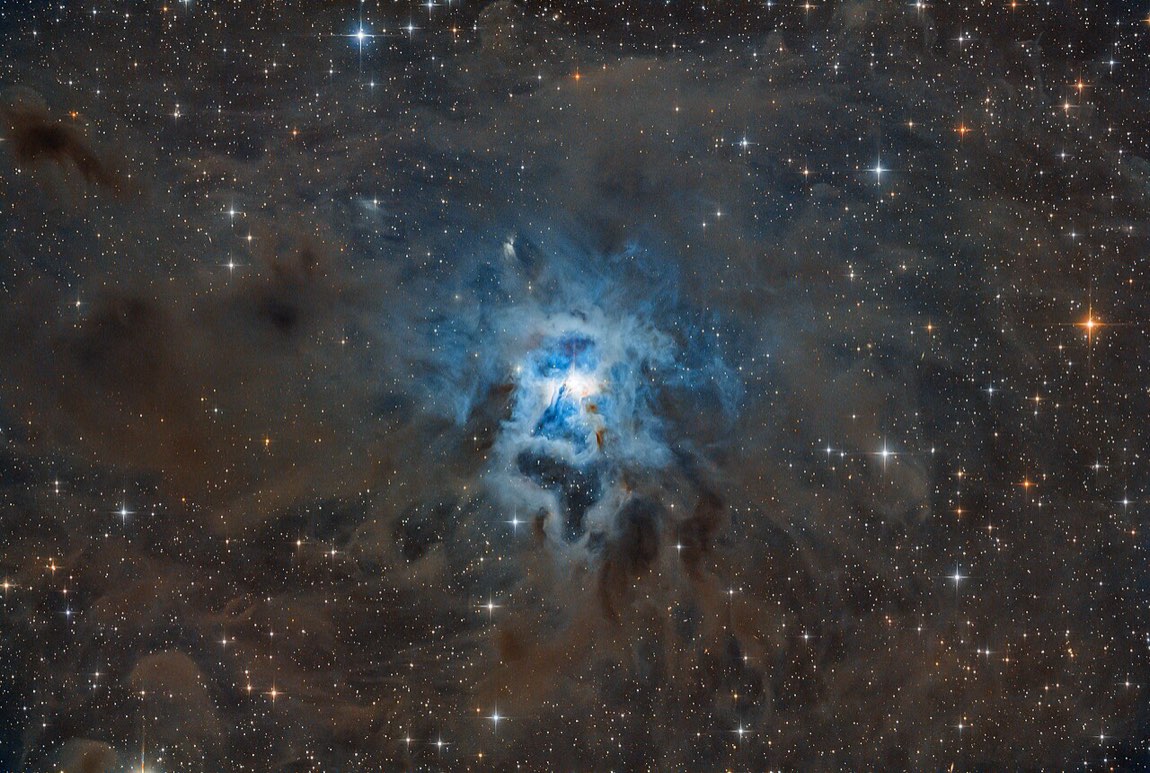
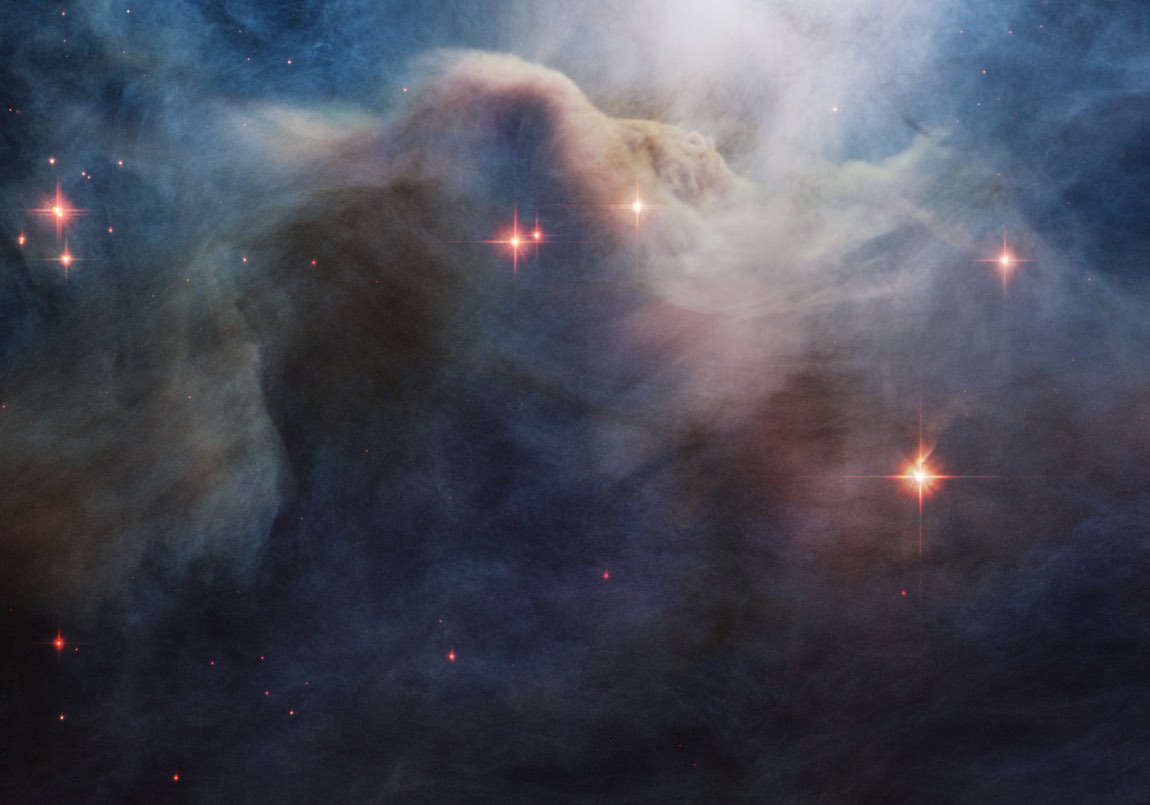
 Photograph · Andreigusan This is a featured picture on the Persian language Wikipedia ( نگاره · CC BY-SA 4.0
Nebula · Deep guide
The Iris Nebula
Also called: Caldwell 4 · C4 · NGC 7023 · LBN 487 · Collinder 429
A blue flower of starlit dust in Cepheus, lit up by a single bright young star.
What is it?
The Iris Nebula is a reflection nebula: a cloud of dust that does not glow on its own but scatters the light of a nearby star. Its light source is the magnitude 7.4 star HD 200775. The cloud is about six light-years across and is laced with dense filaments and ridges where starlight is breaking molecules apart. It belongs to a dusty region called the Cepheus Flare, and William Herschel discovered it in 1794.
The deep dive
Researched for the Atlas from Wikipedia — Iris Nebula (7,314 characters read) · updated Nov 15, 2026
01 A Reflection Nebula, Not an Emission One
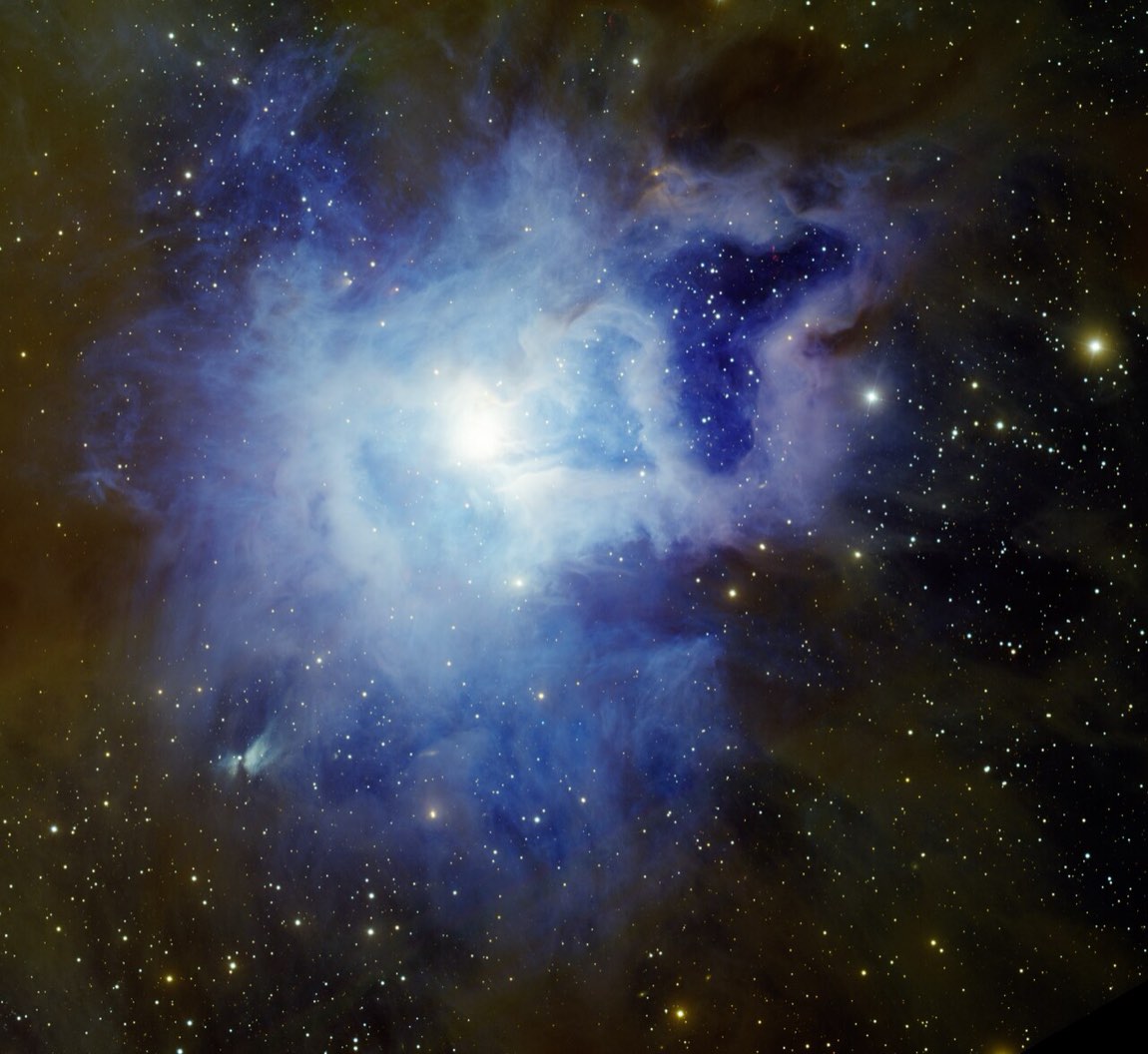
The Iris Nebula glows not because its gas is energized enough to emit its own light, but because dust grains within it scatter and reflect starlight outward — the same optical trick that makes Earth's sky blue. The light source doing all the work is a binary system of Herbig Ae/Be stars sitting at the nebula's center. The dominant partner is a magnitude +7.4 star designated HD 200775, classified as a B2Ve type, while the second is a B5-type star. Together they are the sole illuminators of the entire six-light-year-wide structure. What makes the Iris particularly striking among reflection nebulae is its structural complexity: rather than a simple glowing shell, it contains a web of clouds and filamentary structures whose distribution is described by researchers as highly inhomogeneous. Dense irradiated clumps sit alongside thinner material, and the whole system is threaded by photodissociation fronts where ultraviolet radiation from the central binary is actively breaking apart molecules at the cloud boundaries.
02 How a Cavity Was Carved in the Cloud
At the heart of the Iris Nebula, the central binary stars have not simply lit up their surroundings — they have physically reshaped them. Outflows from the binary system have excavated a biconical cavity in the surrounding molecular cloud, blasting material away in two opposing directions like a slow-motion cosmic blowtorch. This process also triggered the formation of several distinct photodissociation regions, labeled PDR 1 and PDR 2, which sit at the boundary between the cavity and the denser cloud material beyond it. Illuminated ridges bridge across toward the northwest, southwest, and eastern directions, glowing where radiation fields with effective temperatures of 18,000 Kelvin strike the cloud edges. The radiation intensity in these regions is characterized by a G0 value of approximately 2.6 × 10³, a measure of how much stronger the local ultraviolet field is compared to the average interstellar value. Cloud densities in this region range enormously, from 10⁴ to 10⁶ particles per cubic centimeter at their maximum, dropping off toward the cloud interiors.
03 The Strange Glow Called Extended Red Emission Deeper
Threading through the Iris Nebula is a phenomenon called extended red emission, or ERE — a diffuse luminescence distinct from ordinary starlight scattering. Remarkably, every filament of molecular hydrogen in the nebula has a corresponding ERE filament running alongside it, and those ERE filaments are consistently about 10% wider than the hydrogen structures they shadow. The process that creates ERE requires two separate steps. First, a photon carrying at least 10.5 eV of energy must strike a precursor molecule and produce what researchers call an ERE carrier. Second, abundant optical and near-ultraviolet photons must then pump energy into those carriers, exciting them into luminescence. The leading candidate for the ERE carrier is polycyclic aromatic hydrocarbons, or PAHs, because they satisfy three specific requirements: they have ionization or dissociation potentials exceeding 10.5 eV, they absorb strongly in the optical and near-ultraviolet spectral range, and they are capable of efficient photoluminescence. The mechanism likely involves photoionization and photodissociation of a suitable precursor molecule, though the precise identity of that precursor remains an open question in the field.
04 Buckyballs Born in an Unexpected Place
One of the most surprising discoveries made in the Iris Nebula was the detection of carbon-60 fullerenes — the soccer-ball-shaped carbon molecules famously nicknamed buckyballs. Using the Infrared Spectrograph aboard the Spitzer Space Telescope, Sellgren and colleagues in 2007 obtained spectra of the Iris Nebula and NGC 2023, finding prominent emission lines at 7.04 ± 0.05 micrometers that clearly indicated the presence of neutral C60. This was the first firm detection of neutral fullerenes in interstellar space, and C60 ranks among the largest molecules ever detected anywhere in the cosmos. What made the finding scientifically disruptive was its setting: conventional thinking held that fullerenes form in the hot, dense envelopes surrounding evolved stars. The Iris Nebula is instead a cold, tenuous interstellar cloud. The discovery demonstrated that fullerenes can form efficiently in environments illuminated by strong ultraviolet fields, requiring an entirely different formation pathway than previously assumed. Within the nebula, the fullerenes are concentrated closer to the central star and within the carved-out cavity, distinctly separated from the surrounding PAH-rich regions.
 ⤢
05 From Flat Molecules to Hollow Cages Deeper
Because the Iris Nebula forced scientists to rethink where fullerenes come from, researchers have worked to identify exactly how C60 assembles itself in a cold irradiated cloud. Laboratory and theoretical studies point to polycyclic aromatic hydrocarbons as the raw material. The proposed pathway begins with a large PAH molecule called circumovalene, which carries the chemical formula C60H20. Under ultraviolet radiation from massive stars like HD 200775, circumovalene undergoes complete dehydrogenation — it loses all of its hydrogen atoms one by one. The resulting all-carbon sheet then folds into a floppy, closed cage structure. That cage then shrinks through the sequential loss of C2 units until it reaches the perfectly symmetric 60-carbon molecule. Photochemical modeling by Berné and colleagues in 2015 tested this scenario and found that the shrinkage step is the main kinetically limiting bottleneck in the entire process. This has a precise consequence: molecules larger than circumovalene are unlikely to contribute significantly to fullerene production, while molecules containing fewer than 60 carbons tend to be destroyed before reaching stability. Molecules in the range of 60 to 66 carbon atoms appear to be the sweet spot. Once formed, C60 fullerenes are remarkably durable, remaining stable on timescales greater than 10 million years when radiation fields stay below G0 = 10⁴.
06 Newborn Stars Hiding in the Dust
The Iris Nebula is not just a spectacular light show — it is actively making stars. The nebula hosts several young stellar objects, or YSOs, with the highest concentration found in the Cepheus Flare region of which the Iris is a member. Four candidate YSOs cluster within the nebula's northwestern region alone. Among them, one designated YSO 2101328+6811202 is a probable Class 0 object, the youngest possible stage of stellar formation, in which a protostar is still deeply embedded in its birth envelope. Its location far from any ionization fronts is a significant clue: it argues against formation scenarios driven by radiation pressure or ionization shock waves. Two other embedded objects, designated YSO 2101264+6810385 and YSO 2101271+6810380, are probable Class II YSOs buried deeper in the dust clouds. Class II objects are further along in development, typically sporting planet-forming disks. Their existence also carries a physical implication: temperatures in that part of the nebula were not so high that thermal pressure prevented gravitational collapse and star formation from proceeding.
07 Four Theories for How Stars Form Here Deeper
Astronomers have proposed four distinct mechanisms by which the young stellar objects in the Iris Nebula might have formed, and the observational evidence already rules two of them out. The first scenario involves gravitational instabilities at small scales producing dense shells and chains of YSOs along ionization fronts. The second involves large-scale gravitational collapse producing local star-forming regions and young clusters. The third imagines instabilities growing in thin, finger-like turbulent structures irradiated by O-type stars. The fourth centers on pre-existing condensations in the cloud that were compressed by hot gas, triggering local collapse. Observations of the Iris Nebula find no chains of YSOs and no finger-like filamentary structures, which eliminates the first and third scenarios. The distribution and isolation of the detected YSOs — particularly the Class 0 object sitting well away from ionization fronts — provide positive support for the fourth scenario, in which compression of pre-existing dense clumps drives the collapse. The existence of the Class II objects embedded in the dust further reinforces this picture.
08 A Tangled, Clumped Magnetic Field Deeper
The Iris Nebula possesses measurable magnetic fields, and their geometry tells a story of disruption. Rather than threading smoothly through the cloud, the fields follow a curved, clumped morphology — a shape inconsistent with an undisturbed primordial field. Researchers believe the most likely explanation is that the magnetic field has been reordered by the high-velocity outflow of gas emanating from the central binary star system, which has physically pushed and twisted the field lines over time. The field strength varies depending on the local environment. In the starless core of the nebula, the magnetic field strength is measured at 179 ± 50 microgauss. Within the protostellar core hosting a Class I source it measures 121 ± 34 microgauss, and within the protostellar core hosting a Class II source it is 150 ± 42 microgauss. These are the kinds of field strengths that can influence how material collapses during star formation, potentially competing with or aiding gravity depending on local conditions. The clumped, reorganized morphology distinguishes the Iris from simpler nebulae and reflects the dynamic interplay between stellar outflows and the surrounding molecular environment.
 ⤢
09 The Iris in Its Wider Neighborhood
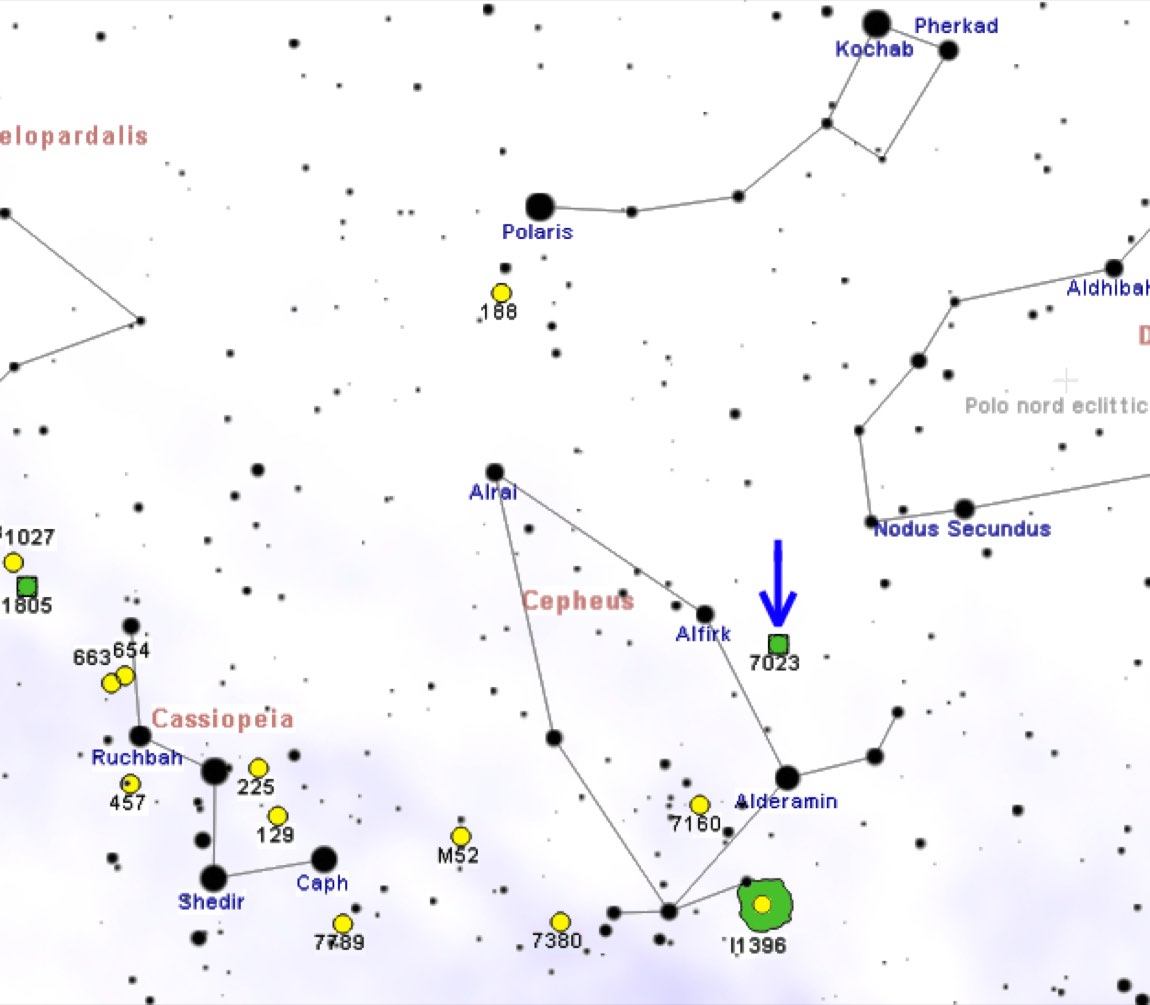
The Iris Nebula does not sit in isolation. It is a member of the Cepheus Flare, a large complex of molecular clouds in the constellation Cepheus. Its celestial neighbors include T Cephei, a Mira-type variable star whose brightness pulses over long periods, and Beta Cephei — also known by its proper name Alfirk — a bright magnitude +3.23 variable star that is itself the prototype of an entire class of pulsating stars. These neighbors are coincidental companions on the sky rather than physically related objects, but they make the region a rich one for observers scanning through Cepheus. The designation NGC 7023, assigned when the nebula entered the New General Catalogue, technically refers only to the open star cluster embedded within the larger reflection nebula. The surrounding reflection nebula carries its own separate catalog identity as LBN 487, a distinction that matters to researchers who study each component separately. The nebula also carries the designation Caldwell 4 in the amateur-friendly Caldwell catalogue, making it a popular target for telescope users.
10 William Herschel's 1794 Discovery
The Iris Nebula was discovered in 1794 by Sir William Herschel, one of the most prolific observers in the history of astronomy, best known for his discovery of Uranus in 1781. Herschel recorded the object during his systematic sweeps of the sky, and it was subsequently added to the New General Catalogue, the comprehensive listing of nebulae, clusters, and galaxies compiled later in the nineteenth century. The NGC remains one of the most widely used reference catalogs in observational astronomy today. Herschel would have seen the Iris as a faint misty patch surrounding a relatively bright star through his telescope — the full complexity of its filamentary structure, its photodissociation regions, its fullerenes, and its young stellar objects were entirely beyond the reach of eighteenth-century instrumentation. It took more than two centuries, culminating in observations with the Spitzer Space Telescope in the 2000s, to reveal the nebula's true molecular richness. The gap between Herschel's initial sketch and the current scientific picture of the Iris is a vivid illustration of how dramatically observational technology reshapes our understanding of familiar objects.
11 PAHs: The Nebula's Organic Scaffolding
Among the most chemically interesting constituents of the Iris Nebula are polycyclic aromatic hydrocarbons, universally abbreviated as PAHs. These are large organic molecules built on a framework of carbon atoms arranged in interlocking hexagonal rings — the same honeycomb geometry found in graphene — with hydrogen atoms bonded around the outer edges. PAHs are widespread in the interstellar medium and are thought to account for a significant fraction of all carbon in the galaxy. In the Iris Nebula they play a dual scientific role. On one hand, they are strong candidates for the carriers responsible for the extended red emission filaments that parallel the nebula's hydrogen structures. On the other hand, they appear to serve as the raw material from which the nebula's C60 fullerenes are assembled under ultraviolet radiation. The photochemical modeling work on circumovalene — itself a PAH with the formula C60H20 — treats PAHs as the upstream feedstock of fullerene chemistry. This positions the Iris Nebula as one of the best natural laboratories in the sky for studying PAH photochemistry and the larger question of how complex carbon molecules originate and evolve in space.
 ⤢