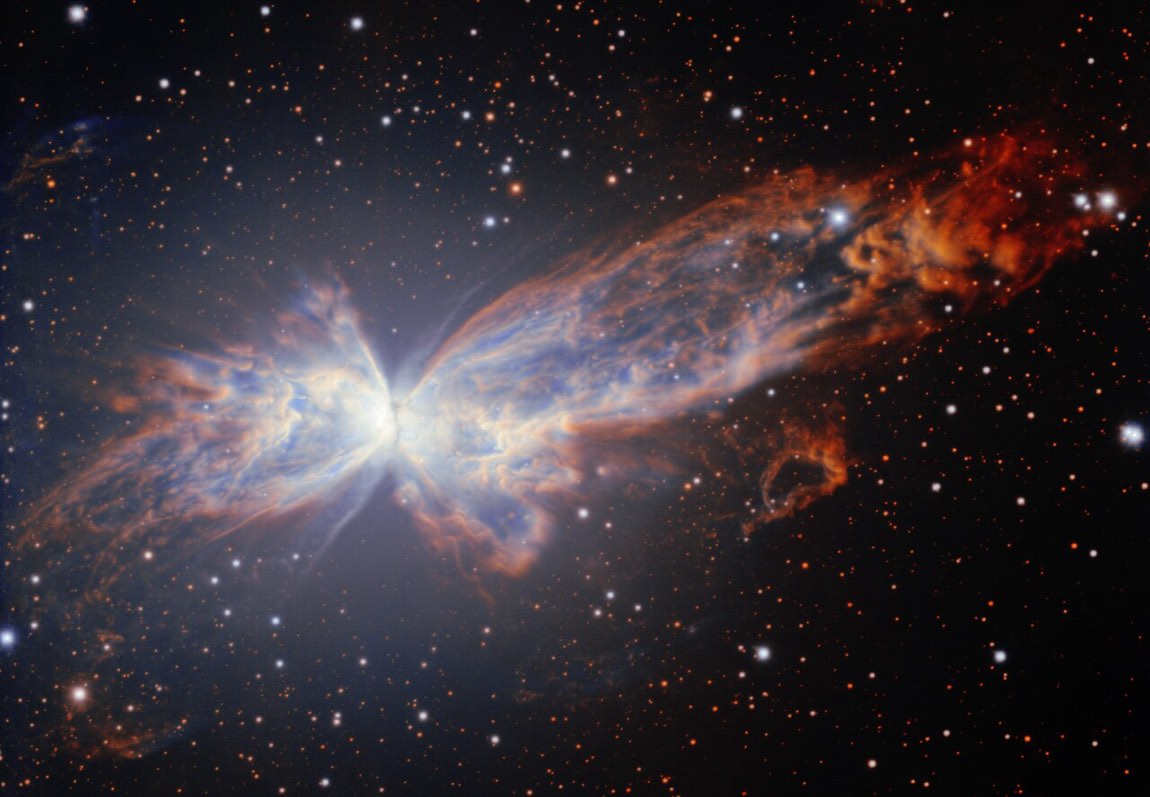
 Photograph · International Gemini Observatory/NOIRLab/NSF/AURA Image Processing: J. Miller &a · CC BY 4.0
Nebula · Deep guide
Bug Nebula (NGC 6302)
Also called: Caldwell 69 · NGC 6302 · Butterfly Nebula · Bug Nebula
Twin wings of gas blasted out by one of the hottest stars known.
What is it?
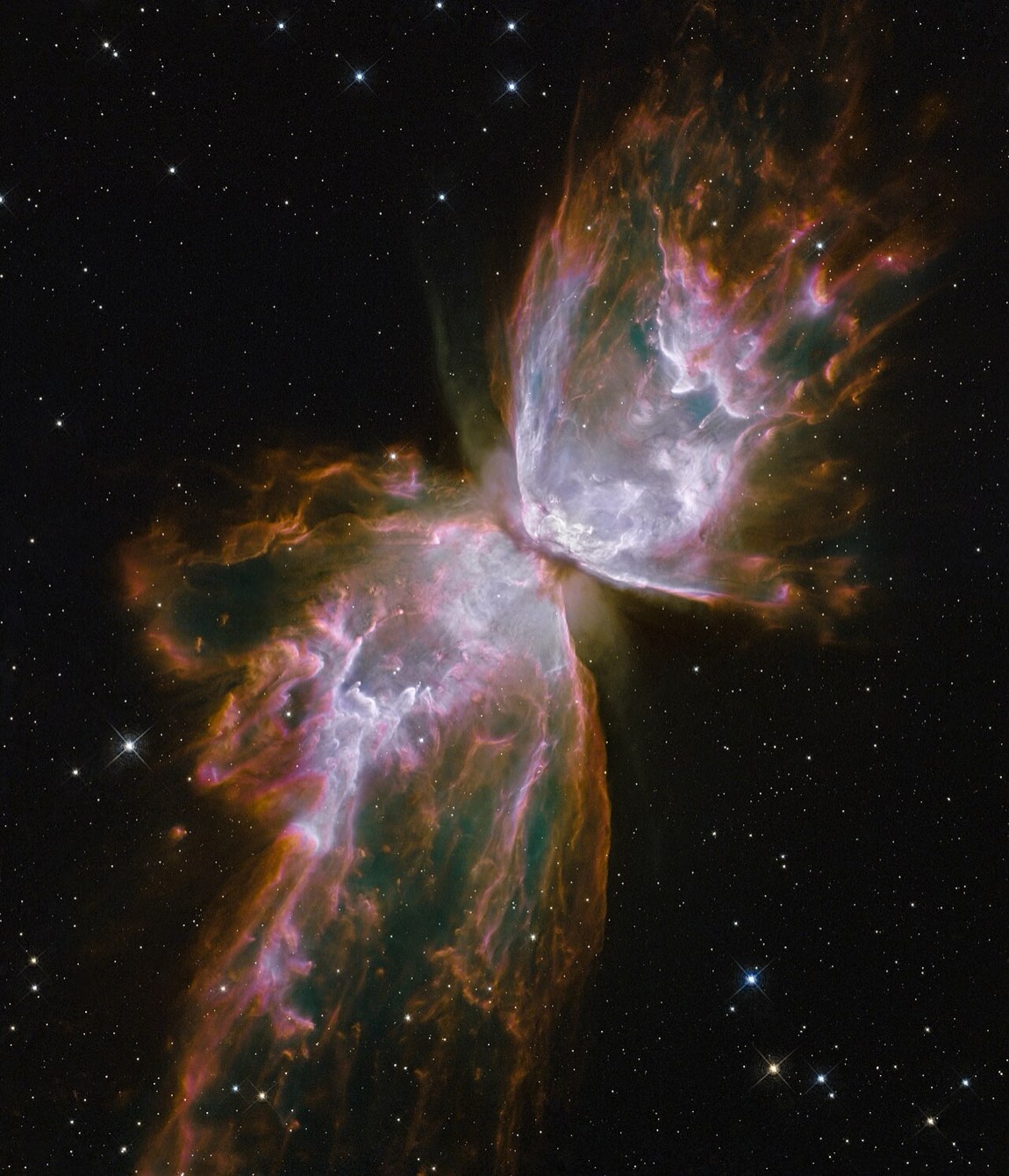
NGC 6302, called the Bug or Butterfly Nebula, is a bipolar planetary nebula in Scorpius with one of the most complex structures ever seen in such an object. Its central white dwarf, first identified by Hubble in 2009, has a surface hotter than 250,000 °C. A thick disc of gas and dust around the star pinches the outflow at its waist, so the ejected gas streams out in two lobes like an hourglass. Hubble images of it were among the first released after the 2009 servicing mission.
The deep dive
Researched for the Atlas from Wikipedia — NGC 6302 (4,341 characters read) · updated Nov 15, 2026
01 A nebula hiding its own star
For decades, astronomers suspected a central star powered the glowing clouds of NGC 6302, but no one could actually see it. Three obstacles conspired to keep it hidden. First, the star's extraordinary heat — indicated to be around 200,000 Kelvin — means it pours most of its energy into ultraviolet light rather than visible wavelengths, making it nearly invisible to ordinary instruments. Second, a thick, dusty torus encircles the star at the nebula's waist, absorbing a large fraction of the light that does escape, especially in the ultraviolet. Third, the dazzling brightness of the surrounding nebula itself washes out any faint point source at the centre. The star even eluded the original Hubble Space Telescope cameras. It was only in 2009, when astronauts installed the upgraded Wide Field Camera 3 during Hubble's final servicing mission, that the faint white dwarf was finally pinned down. The discovery was announced as part of the first images released after that servicing mission, making the Bug Nebula a showcase object for the new instrument's improved resolution and sensitivity.
02 From five solar masses to barely half Deeper
The white dwarf sitting at the heart of NGC 6302 today carries a mass of only about 0.64 solar masses — yet the article tells us it began life as a star of around five solar masses, most likely a B-type main-sequence star, probably in the B5–9V range. That means the star shed roughly four-fifths of its entire bulk during the violent event that created the planetary nebula, blasting that material outward to form the lobes and dust structures we now observe. The enormous original mass is itself a clue: a star had to be very large to reach the surface temperatures now measured in excess of 250,000 degrees Celsius. White dwarfs of this heat are among the most extreme stellar remnants known. By the time astronomers found it, the star had already ceased nuclear burning entirely and is now simply cooling. The predicted fading rate is 1 percent per year — slow by human standards, but geologically rapid for a stellar corpse that could otherwise persist for billions of years.
03 Wings shaped by a belt of dust
The butterfly silhouette of NGC 6302 is not random. A dense equatorial disc of gas and dust encircles the central star, acting like a nozzle that channels outflowing material away from the star's poles rather than in all directions equally. This produces the characteristic bipolar structure — two lobes stretching in opposite directions, superficially similar to an hourglass. The dark lane created by this disc is so opaque that it hides the central star at every observed wavelength, not just in ultraviolet or visible light. What makes NGC 6302 stand out even among bipolar planetary nebulae is the sheer complexity layered on top of this basic shape: the lobes display ionization walls, knots of denser material, and unusually sharp edges. There is also evidence suggesting a second pair of lobes that may represent an earlier, separate phase of mass loss from the star, implying the outflow history here was not a single clean eruption but a series of events across time.
04 A northwest lobe born 1,900 years ago Deeper
The northwest lobe of NGC 6302 extends up to 3.0 arcminutes away from the central star on the sky — a substantial stretch in a nebula of this kind. Astronomers have estimated it formed during an eruptive event approximately 1,900 years ago, meaning light from that explosion first reached Earth roughly during the second century CE. The lobe has a circular cross-section, and its walls are expanding in a distinctive pattern: each part of the wall moves outward at a speed proportional to its distance from the central star, a signature known from other highly dynamic outflows. At an angular distance of 1.71 arcminutes from the star, the measured flow velocity is 263 kilometres per second — fast enough to cross the distance from Earth to the Moon in roughly 1.5 seconds. At the extreme outer edge of this same lobe, the outward velocity exceeds 600 kilometres per second. The western edge of the lobe shows signs of having collided with pre-existing globules of gas, and that collision appears to have deflected and modified the outflow in that region.
05 Dust that defies simple chemistry Deeper
The dark lane bisecting NGC 6302 contains one of the most chemically unusual dust compositions identified in any planetary nebula. Spectroscopic analysis has revealed multiple crystalline silicates — minerals typically associated with rocky, oxygen-rich environments — alongside crystalline water ice and quartz. More controversially, features in the spectrum have been interpreted as the first detection of carbonates outside the Solar System. Carbonates are significant because they usually require liquid water to form, making their presence in a nebular environment deeply puzzling. That interpretation has been disputed by other researchers who point to the difficulty of producing carbonates in a non-aqueous setting, and the debate remains unresolved. Separately, the dust contains both oxygen-bearing silicate molecules and carbon-bearing polycyclic aromatic hydrocarbons simultaneously. Stars are generally expected to be either oxygen-rich or carbon-rich, not both, so NGC 6302 belongs to a rare class of objects where hydrocarbon molecules managed to form inside a predominantly oxygen-rich environment — a chemical puzzle that challenges standard models of stellar evolution and dust formation.
06 Among the most complex nebulae known
Even among the thousands of planetary nebulae catalogued by astronomers, NGC 6302 is flagged as exceptional. Its internal structure is described as among the most complex ever seen in any planetary nebula — a remarkable statement in a field full of intricate objects. The two primary lobes are themselves layered with ionization walls, where the energetic radiation from the central star has carved sharp boundaries between ionized and neutral gas. Knots of denser material punctuate the lobes. The edges of the lobes are unusually sharp rather than diffuse, suggesting confined, directed outflows rather than a gentle stellar wind. And the possible second pair of lobes hints at multiple eruption episodes rather than a single dying gasp. All of this makes NGC 6302 a valuable laboratory for testing theories of how stars shed their outer layers at the end of their lives — particularly for stars that were originally several times more massive than the Sun, a regime where mass-loss processes are still not fully understood.
07 Edward Barnard's first look in 1907
NGC 6302 entered the scientific literature as part of the New General Catalogue, which means it was catalogued by 1888 at the latest. But the earliest known dedicated study of the nebula was carried out by Edward Emerson Barnard, the prolific American astronomer famous for his sharp eyes and meticulous observational records. In 1907, Barnard drew and described the nebula — a time when photography was only beginning to displace hand-drawn astronomical sketches, and when the concept of a planetary nebula as a dying star shedding its envelope was still being worked out. Barnard could have had no way of knowing that the object he was sketching harboured one of the hottest stellar remnants known, hidden inside a dust lane opaque enough to withstand more than a century of increasingly powerful telescopes. His drawing predates the Hubble Space Telescope's eventual identification of the central star by over a hundred years, making it a striking example of how long some astronomical mysteries can remain open even after a target has been in plain sight.
08 Hubble's final servicing mission showcase
NGC 6302 played a starring role in a historic public moment for space astronomy. In September 2009, NASA released the first images taken by the Hubble Space Telescope after its fifth and final servicing mission, during which astronauts installed the Wide Field Camera 3, among other upgrades. The Bug Nebula was selected as one of the showpiece targets for those inaugural images, partly because the new camera's improved resolution and sensitivity immediately revealed something the original Hubble instruments had missed: the faint white dwarf at the nebula's core. The images served a dual purpose — demonstrating the telescope's renewed capability to the public while simultaneously delivering a genuine scientific discovery. The 2009 servicing mission was particularly significant because Hubble's designers had not originally planned for another visit, and there had been years of uncertainty about whether the telescope would receive the upgrades it needed. NGC 6302's debut with the new camera thus marks a specific, datable moment when both engineering achievement and astronomical discovery coincided.
09 Open questions still circling the Bug Deeper
Despite decades of observation and two rounds of Hubble imaging, NGC 6302 leaves several questions genuinely unresolved. The possible second pair of lobes is intriguing but not definitively confirmed — if real, it would mean the star underwent at least two distinct phases of large-scale mass loss, which would need to be reconciled with models of how stars of around five original solar masses evolve. The carbonate detection in the dark lane remains actively disputed; confirming or ruling it out has implications for how complex molecules form in space without liquid water as a catalyst. The mechanism by which polycyclic aromatic hydrocarbons managed to form in an oxygen-rich environment is similarly unexplained and connects NGC 6302 to a broader class of chemically anomalous objects whose formation pathways are still debated. And while the star's temperature is indicated at around 200,000 Kelvin and its mass at 0.64 solar masses, the precise cooling track and timeline for its eventual transition to a cold, inert white dwarf depend on internal physics that remain subject to refinement as stellar evolution models improve.
 ⤢