Moon · Deep guide · orbits Saturn
Thrymr
Also called: Saturn XXX · S/2000 S 7
A slow-turning, possibly double-lobed moon on a collision course with Phoebe.
What is it?
Thrymr is a retrograde irregular moon of Saturn, about 8 km across, discovered by Gladman and colleagues in 2000. It orbits roughly 20.5–20.8 million km out on an eccentric path that overlaps Phoebe's, so it will probably hit Phoebe one day. Its rotation of about 39 hours is the slowest among the retrograde moons Cassini measured, and its light curve suggests it may be a contact binary.
The deep dive
Researched for the Atlas from Wikipedia — Thrymr (moon) (1,458 characters read) · updated Nov 14, 2026
01 A moon born from a collision with Phoebe
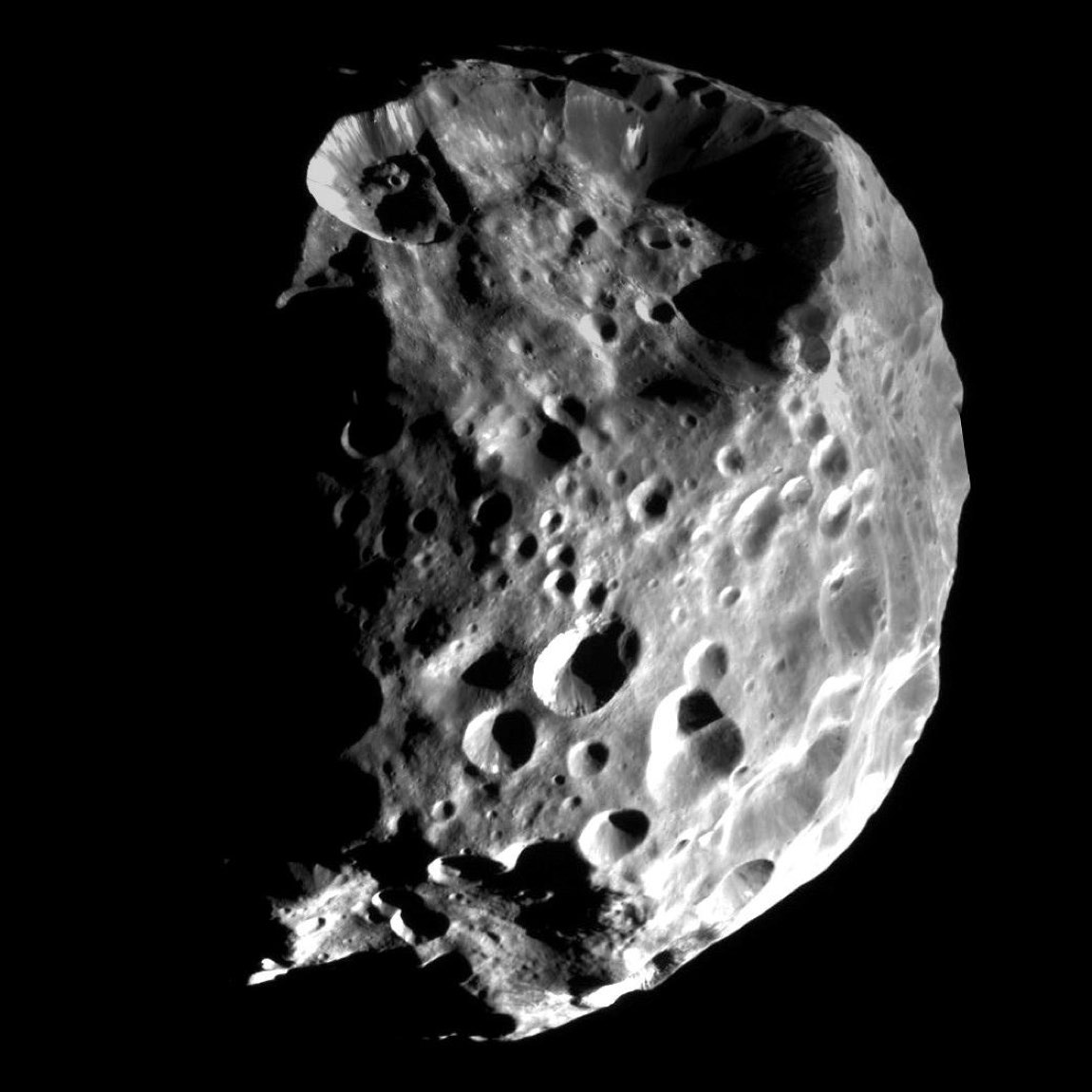
Thrymr almost certainly did not form the way most moons do — by accreting material in orbit around a young planet. Instead, the leading hypothesis is that it is a chunk of debris knocked off Phoebe, Saturn's large, dark, captured outer moon, during some ancient impact event early in the Solar System's history. This idea is supported by more than one line of evidence. Thrymr's gray surface color closely matches those of Suttungr and Mundilfari, two other small Saturnian moons that are also suspected Phoebe fragments. The orbital geometry reinforces the story further: Thrymr's path around Saturn overlaps strongly with Phoebe's own orbit, which is exactly what you would expect from debris that was blasted off Phoebe but never escaped the gravitational neighborhood entirely. Rather than being a pristine, primordial body, Thrymr is better understood as a shard of something much larger — a piece of cosmic shrapnel still drifting near the scene of a very old accident.
02 The slowest spinner among Saturn's retrograde moons Deeper
Of all the retrograde outer moons of Saturn that the Cassini–Huygens spacecraft managed to measure, Thrymr rotates the most slowly, with a measured rotation period of 38.79 ± 0.25 hours — roughly one and a half Earth days per spin. To put that in perspective, our own Moon takes about 655 hours to complete one rotation, but among small irregular moons that have been clocked, Thrymr stands out as a sluggish outlier. It is only the second-slowest rotator overall in Saturn's irregular moon population, edged out by Tarqeq. This slow spin is not merely a curiosity of timing: the rotation rate carries real information about the moon's shape, internal structure, and collisional history. A very slow rotation in a small body often hints that something — a past collision, gravitational torques, or an unusual mass distribution — has bled away the angular momentum the object once had. The fact that Cassini could measure this period at all, for a body only about 8 kilometres across from hundreds of millions of kilometres away, is itself a testament to the mission's photometric precision.
03 Could Thrymr be two rocks touching each other?
When astronomers study a small moon's brightness over time — its light curve — they look for patterns that reveal its shape. Thrymr's light curve shows two brightness peaks and two brightness dips per rotation cycle. That double-peaked pattern is a classic signature of a contact binary: two separate lobes or chunks pressed together into a single peanut-shaped body, rotating end over end. Each time one of the wider ends faces the observer, the total reflected light increases; each time the narrower waist turns toward us, the brightness dips. The article is careful to note, however, that this interpretation is considered less likely for Thrymr than it is for two other Saturnian moons, Kiviuq and Bestla. So the double-humped light curve is real, but whether it means a true contact binary or simply an elongated, lumpy single object remains an open question. At only about 8 kilometres in diameter, Thrymr is far too small for any existing telescope to resolve directly, so the light curve is currently the only shape evidence available.
04 An orbit heading toward a future collision Deeper
Thrymr travels around Saturn on a highly elongated, retrograde path with an orbital eccentricity of 0.453 — meaning its distance from Saturn swings dramatically between a closest and a farthest point rather than tracing a neat circle. Its average orbital distance is 20,810 megametres, and it completes one full orbit in 1,120.809 days, which is just over three Earth years. Because this path is retrograde — meaning Thrymr orbits in the opposite direction to Saturn's rotation — and because that path overlaps substantially with the orbit of Phoebe, the two bodies are on a slow collision course. The same is true for Ijiraq and Kiviuq, two moons in a similar predicament. This is not a collision that will happen soon by any human measure; orbital mechanics work on timescales of millions to hundreds of millions of years. But it does mean that Thrymr is gravitationally entangled with Phoebe in a way that will eventually end with one absorbing the other — perhaps completing the cycle that began when Phoebe was first struck and produced this debris in the first place.
05 A family of fragments with shared ancestry
Planetary scientists group Saturn's outer irregular moons into dynamical families — clusters of objects that share similar orbital characteristics and are thought to descend from a common parent body. Thrymr is considered part of the same dynamical family as Suttungr, another small gray moon with comparable surface properties. The surface color similarity is not trivial; color in this context reflects the composition of the top layer of a moon, which in turn reflects what it was made of. That Thrymr and Suttungr are both gray and both compositionally similar to Phoebe strengthens the case that they share an origin. Interestingly, the article also notes that the moon designated Saturn LXVII is probably even more closely related to Thrymr than Suttungr is — meaning the family tree has finer branches than a simple two-member grouping suggests. As more small moons are discovered and characterized around Saturn, the picture of which fragments belong to which family, and therefore which impacts produced them, is expected to become clearer.
06 How Thrymr was found and briefly named
Thrymr was discovered in the year 2000 by Gladman and colleagues, who gave it the temporary designation S/2000 S 7. That kind of alphanumeric placeholder is standard practice for newly found solar system objects: the S indicates a satellite of Saturn, 2000 is the year of discovery, and S 7 means it was the seventh such Saturn satellite reported that year. Once the discovery was confirmed and the orbit secured, the International Astronomical Union awarded it a permanent name drawn from Norse mythology. Thrymr is a Jotun — a giant — in Norse tradition, fitting the convention that Saturn's outer retrograde moons receive names from Norse mythology. There was then a small naming complication: the IAU Circular 8177 announced the name in its oblique grammatical form, Thrym, without the nominative suffix. The IAU Working Group on Planetary System Nomenclature later corrected this, deciding to add the nominative suffix -r to the root Thrym, producing the form Thrymr that is now the official designation. It is a small but telling detail about how carefully the IAU manages the linguistic conventions behind planetary naming.
07 What Cassini's light show revealed about tiny moons Deeper
Thrymr is only about 8 kilometres across — smaller than many Earth cities — yet the Cassini–Huygens spacecraft was able to measure its rotation period with an uncertainty of just ± 0.25 hours. This was done not by flying close enough to photograph the surface in detail, but by monitoring the tiny fluctuations in reflected sunlight as the moon tumbled through space. The technique, called photometric monitoring, allowed Cassini to characterize multiple small irregular moons that would otherwise be little more than points of light. The fact that Thrymr turned up as the slowest-spinning retrograde moon in Cassini's sample is a result that could only emerge from a systematic survey — measuring one moon in isolation would not reveal its significance. Cassini's extended mission around Saturn, which lasted from 2004 until the spacecraft's deliberate entry into Saturn's atmosphere in 2017, was the only close-range investigation of the Saturnian system in history, and the rotation period data it collected for moons like Thrymr remain the definitive measurements available today.
08 The peculiar geometry of a retrograde inclination Deeper
Thrymr's orbit is inclined at 175 degrees to the ecliptic plane — almost perfectly upside down relative to the plane in which the planets orbit the Sun. Measured instead against Saturn's own equatorial plane, the inclination is 151 degrees. These two numbers together describe an orbit that is not only retrograde but tilted in a complex way that reflects the history of how Thrymr was captured or created. A perfectly prograde orbit would have an inclination near 0 degrees; a perfectly retrograde one would be near 180 degrees. Thrymr at 175 degrees is very close to that retrograde extreme. This extreme tilt, combined with the orbit's high eccentricity of 0.453, places Thrymr firmly in the class of irregular moons — objects whose orbits are too distant, too tilted, and too elliptical to have formed in place around Saturn. They are either captured interlopers from elsewhere in the solar system or debris from collisions involving captured bodies. For Thrymr, the debris hypothesis is favored, with Phoebe as the likely source.
09 Open questions that remain unanswered
Despite everything Cassini taught us, Thrymr remains poorly understood in several important ways. Its contact binary nature is suggested but not confirmed; without resolved images of the surface, the double-peaked light curve is ambiguous. The exact relationship between Thrymr and Saturn LXVII — described as probably more closely related to Thrymr than Suttungr is — has not been fully worked out, in part because characterizing very small, faint, distant moons is technically demanding even with large ground-based telescopes. The precise timeline of when Phoebe was struck to produce the debris field that includes Thrymr is unknown, as is the number and size distribution of other fragments still undetected. No mission is currently planned to visit Saturn's outer irregular moons up close, so the rotation, shape, composition, and origin questions will likely remain active research topics for years to come, addressable only through careful telescopic observations and improved dynamical modeling rather than direct exploration.