Moon · Deep guide · orbits Neptune
Neso
Also called: Neptune XIII · S/2002 N 4
A remote moon of Neptune, around 50 million km out, with an orbit lasting about 27 years.
What is it?
Neso was discovered in August 2002 at Cerro Tololo in Chile by stacking long exposures from the Blanco Telescope. It is roughly 40–60 km wide, the largest member of the Neso group of fragments. Its backwards, elongated orbit averages about 49.9 million km from Neptune and takes nearly 27 years to complete. Neso is in the Kozai resonance, so the Sun's pull slowly trades its orbital tilt against its stretch.
The deep dive
Researched for the Atlas from Wikipedia — Neso (moon) (10,518 characters read) · updated Nov 15, 2026
01 How Neso was pulled out of the dark
Finding Neso required a clever trick called the shift-and-add technique. Because Neptune drifts slowly against the background stars, a team led by Matthew Holman stacked many long-exposure images by sliding each one to match Neptune's motion before combining them. Any moon traveling with Neptune would reinforce into a sharp dot of light, while unrelated stars would smear and wash out. Using this method with the 4-meter Víctor M. Blanco Telescope at Cerro Tololo Inter-American Observatory in Chile, the team spotted Neso on 14 August 2002 — in the same set of images that also revealed two other Neptunian moons, Halimede and Sao. That a single night's data yielded three moons at once speaks to both the power of the technique and how many distant companions Neptune had been hiding. The search campaign itself had begun a year earlier, in 2001, requiring sustained commitment before the payoff arrived.
02 A year of watching before the world was told
Discovering a moon and confirming it are two very different things. After the initial detection, astronomers had to track Neso long enough to calculate a reliable orbit — otherwise it could easily have been an unrelated background object or a near-Earth asteroid drifting through the field. Brett Gladman's team examined it on 3 September 2002 with the 8.2-meter Very Large Telescope at Cerro Paranal; Holman's team observed it the same day with the 2.5-meter Nordic Optical Telescope at La Palma. Then came a gap: Neso was not recovered again until 19 August 2003, more than a year after discovery, using the same 4-meter Blanco Telescope. Final confirmation observations ran from 28 to 30 September 2003 with Las Campanas Observatory's 6.5-meter Magellan Clay Telescope. Only then did the Minor Planet Center announce Neso's discovery on 30 September 2003, making it the fifth and last Neptunian moon announced that year and pushing Neptune's known moon count to 13.
03 From a code name to a mythological identity
Until its formal name was assigned, Neso carried the dry bureaucratic label S/2002 N 4 — shorthand for "satellite discovered in 2002 orbiting Neptune, fourth one reported that year." The International Astronomical Union's Working Group for Planetary System Nomenclature upgraded it on 3 February 2007, bestowing both the name Neso and the Roman numeral designation Neptune XIII. The name follows a strict IAU convention: irregular moons of Neptune must be named after Nereids, the fifty sea-nymph daughters of the sea god Nereus and the Oceanid Doris in Greek mythology. Neso (Νησώ) is one of those fifty daughters. The convention gives Neptune's chaotic outer retinue a coherent mythological identity, linking the planet's most distant and unruly satellites to the ancient ocean traditions that inspired the planet's own name.
04 An orbit almost as wide as Mercury's path
Neso's average distance from Neptune is 49.9 million km — a figure that becomes vivid when you compare it to Mercury's orbital distance from the Sun, which is 57.9 million km. In other words, if you placed Neptune where the Sun is, Neso would orbit at nearly the same distance Mercury does from our star. That is extraordinary for a moon. Over a 10,000-year span, the semi-major axis wanders between 47.7 and 52.8 million km (0.319 to 0.353 AU), driven by the Sun's gravitational nudging. Standing on Neso and looking back toward Neptune, the planet would appear as a tiny disc with an average angular diameter of roughly 3 arcminutes — barely visible to the naked eye and far smaller than even a full Moon in our sky. Neso currently sits at 43 percent of Neptune's Hill radius, placing it just over halfway to the theoretical outer edge where retrograde moons can remain gravitationally bound to Neptune.
05 Eccentricity taken to an extreme Deeper
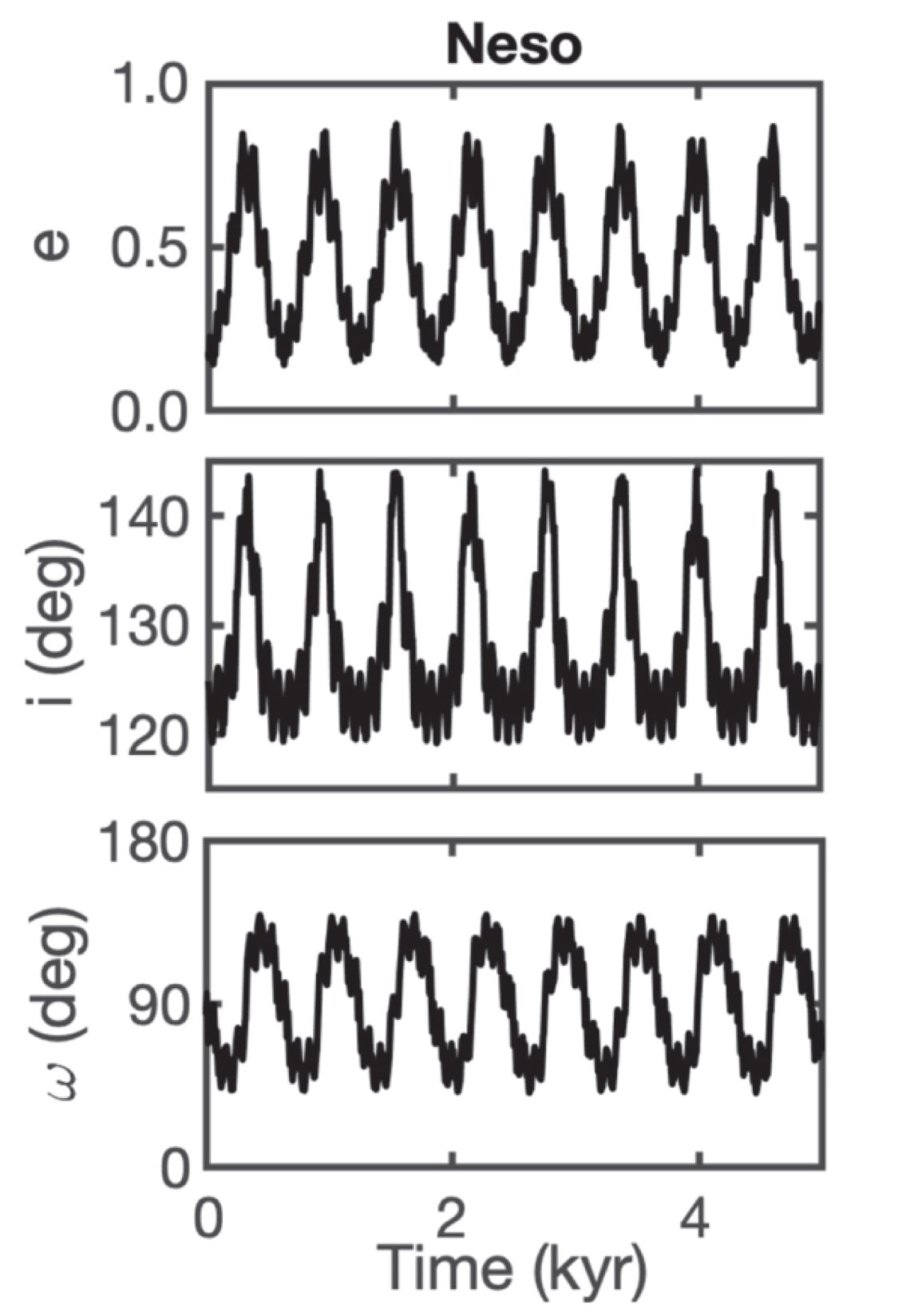
With an average orbital eccentricity of 0.46, Neso traces a noticeably elongated ellipse, but the Sun's perturbations push that figure far beyond its average. The eccentricity ranges from as low as 0.14 — nearly circular — to as high as 0.88, which is a dramatically flattened orbit approaching comet-like territory. The practical consequence is a huge swing in Neptune distance: in October 2010, Neso passed periapsis at 17.8 million km, but in January 2038 it will come as close as 10.6 million km. At apoapsis the spread is similarly large, ranging from 85.6 million km in July 2025 to 89.0 million km in July 2050. The orbital period fluctuates accordingly, stretching from about 25.05 years at its shortest to 29.23 years at its longest, with an average of 26.84 years (9,805 days). That variability means no two orbits are quite alike.
06 The 600-year Kozai resonance rhythm Deeper
Among Neso's most remarkable dynamical properties is its entrapment in the Kozai resonance, first recognized for Neso by Matija Ćuk and Joseph A. Burns in 2004. In this phenomenon, solar gravity periodically trades orbital eccentricity for orbital inclination and back again, keeping them locked in a synchronized oscillation over a cycle of about 600 years. Because Neso's orbit is retrograde — its inclination averages 128° and ranges from 117° to 145° — "maximum inclination" actually means the orbit sits closest to the ecliptic plane rather than furthest from it, an initially counterintuitive result of retrograde geometry. One striking consequence is that Neso cannot undergo normal apsidal precession: instead of its argument of pericenter circulating through the full 0° to 360°, it librates back and forth around 90° with that same ~600-year period, ensuring the moon always reaches periapsis above the ecliptic plane. Separately, its orbital node does precess, completing a full circuit in about 1,116 years.
07 A family born from a catastrophic collision
Neso is the largest known member of the Neso group, a family of retrograde Neptunian irregular moons that also includes Psamathe and the recently discovered S/2021 N 1. The grouping was first suspected in 2004 when astronomers noticed how similar Neso's and Psamathe's orbits were, but it was not confirmed as a genuine family until S/2021 N 1 was identified as a third member in 2024. The key diagnostic is their mutual dispersion velocity — the speed at which the members would need to have been flung apart to reach their current orbits — which is around 100 m/s. That figure matches the escape velocities typical of collisions, strongly implying the group formed when a single larger body was smashed apart by an asteroid or comet impact billions of years ago. The original parent was probably an irregular moon gravitationally captured by Neptune during the Solar System's chaotic early history. Many more tiny fragments likely exist within the group but remain too faint to detect with current telescopes.
08 What little we know about Neso's surface
Neso is so remote and so small that most of its physical properties are simply unknown. Its apparent magnitude is 25.6 in visible light and between 24.7 and 25.3 in red light — far dimmer than anything a backyard telescope could reach, requiring long exposures on the largest instruments on Earth. Because its diameter has never been measured directly, astronomers estimate it by assuming a reflectivity: at a geometric albedo of 0.04 (roughly as dark as charcoal), the diameter works out to about 60 km; at a slightly higher albedo of 0.06, it shrinks to about 43 km. A 2018 analysis of Very Large Telescope observations found that Neso's surface color is similar to — or slightly redder than — typical trans-Neptunian objects and centaurs, but not the resonant trans-Neptunian objects. Notably, Neso lacks the "ultrared" material common on Kuiper belt objects, which may indicate its surface has been reshaped by collisions or by the sublimation of volatile ices. Its rotation period remains unknown.
09 Cold enough to rival Triton
Because Neso orbits so far from the Sun — well beyond Neptune itself, which already sits about 30 AU from our star — its surface receives almost no solar warmth. Astronomers estimate its surface temperature is comparable to that of Neptune's large moon Triton, whose surface registers approximately 38 K (−235.2 °C; −391.3 °F). That is less than 40 degrees above absolute zero, cold enough to freeze most gases solid. Sunlight at that distance is roughly 900 times fainter than what Earth receives, leaving Neso in perpetual deep-space twilight. Even at noon, the Sun would appear as little more than a brilliant star rather than the disc we know. This extreme cold almost certainly means any surface volatiles that once existed have either frozen out permanently or been driven off by the same energetic processes — impacts and slow sublimation — that stripped Neso of its ultrared coloring.
10 Gravity so weak that falling takes half a minute
With a diameter estimated at only 43 to 60 km, Neso is a small body by any standard, and its surface gravity is correspondingly tiny. Planetary scientist Erich Karkoschka calculated a vivid illustration of this: an object dropped from human height on Neso would take roughly 30 seconds to reach the ground. On Earth the same drop takes about half a second. That 60-fold difference means Neso's surface gravity is around 1/3,600th of Earth's — so feeble that a person could throw a baseball fast enough to escape the moon entirely. Any loose material on the surface sits at the edge of escape with every small disturbance, which helps explain why collisional debris from Neso's supposed parent-body breakup could have spread across a wide range of orbits to form the extended Neso group.
11 Open questions and the limits of current knowledge Deeper
Despite more than two decades since discovery, Neso remains poorly characterized, and several fundamental questions are unresolved. Its rotation period has never been measured. Its diameter is known only within a range tied to an assumed albedo, and that albedo itself is uncertain. The collisional family hypothesis for the Neso group predicts that all members should share similar surface colors, but as of 2022, Neso is the only group member with a measured surface color, leaving the prediction untested. The group is also expected to contain many smaller fragments, yet none have been found because they fall below current telescope detection limits. Even the stability of Neso's orbit is conditional: the article notes that if its inclination dropped below 120° and its semi-major axis exceeded 60% of Neptune's Hill radius, the Kozai resonance would destabilize it. Understanding how long Neso has maintained its current dynamical state — and how the original parent body was captured by Neptune — remains an active area of investigation.
12 Observing a magnitude-25 target from Earth Deeper
Neso sits at an apparent magnitude of 25.6 in visible light, placing it among the faintest objects ever tracked in the outer Solar System. For context, the faintest stars visible to the naked eye are around magnitude 6, and even large amateur telescopes typically cap out near magnitude 14 to 15 under ideal conditions. Reaching magnitude 25.6 requires a telescope with a primary mirror several meters across combined with modern digital detectors and long exposure times — the kind of equipment found at professional facilities like Cerro Tololo, the Very Large Telescope at Cerro Paranal, or Las Campanas Observatory, all of which were used in Neso's discovery and confirmation campaigns. Even with such instruments, the shift-and-add stacking technique was essential to coax Neso's faint signal above the noise. Future larger facilities may eventually resolve the rotation period or refine the size, but for now Neso remains at the very edge of what ground-based astronomy can routinely monitor.
 ⤢