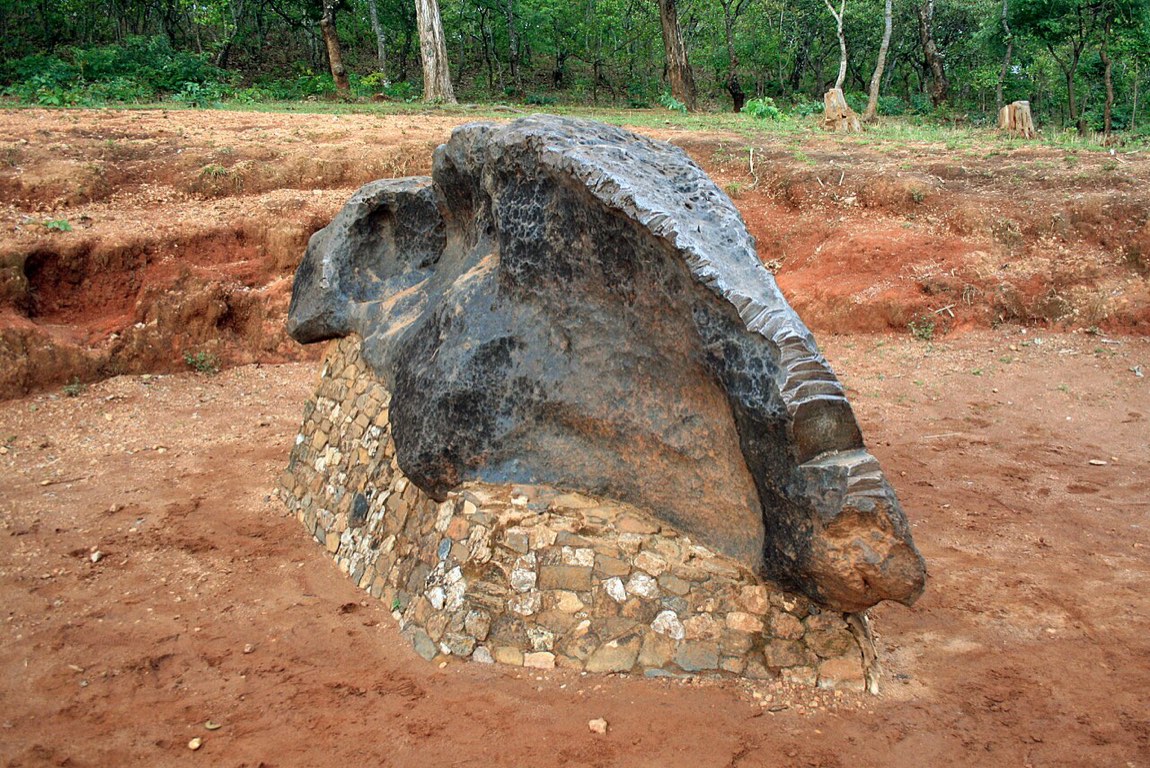
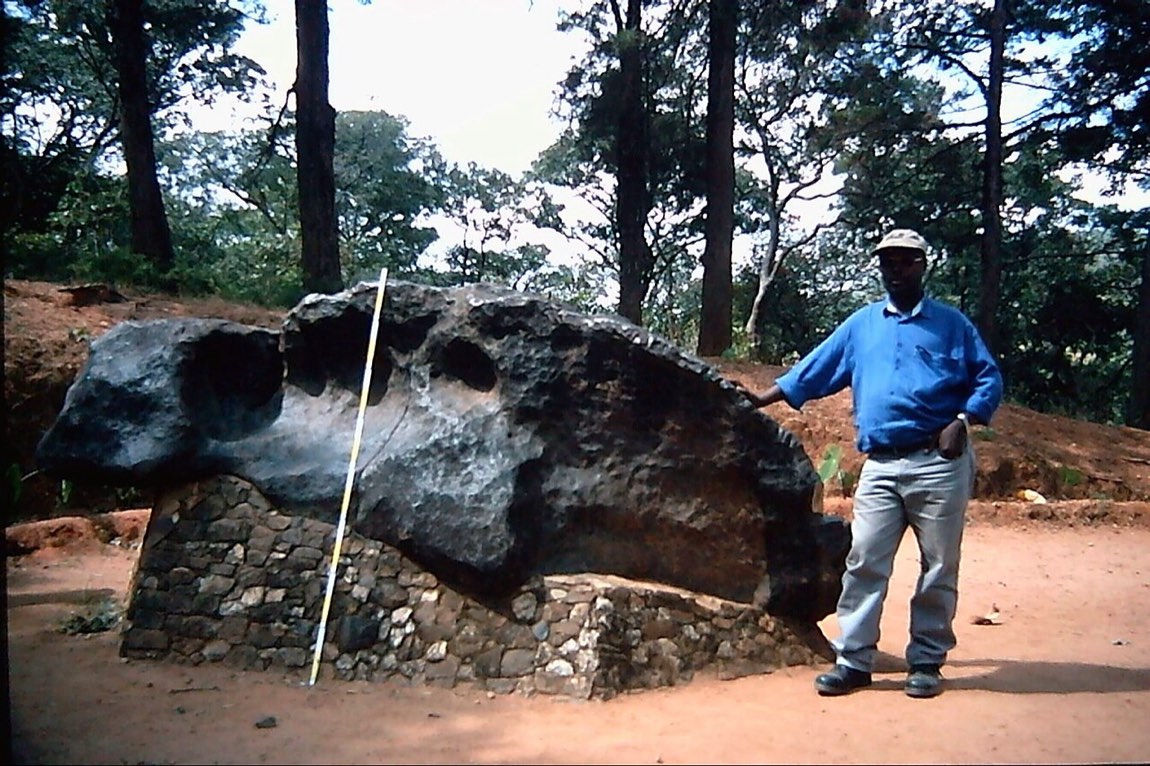
 Photograph · Christiaan Zeelenberg · CC BY-SA 2.0
Meteorite · Deep guide
Mbozi Meteorite
Also called: Mbosi · Kimondo
A 16-tonne iron lying on a hillside in Tanzania, long known to locals as 'kimondo'.
What is it?
Mbozi is one of the largest meteorites in the world, a 3-metre-long mass of iron resting near the city of Mbeya in southern Tanzania. Local people knew it for generations and called it kimondo, but scientists only learned of it in 1930. It left no crater. Its iron holds about 8% nickel and small glassy silicate inclusions, and it does not fit neatly into any standard chemical group, so it is classed as an 'ungrouped' iron. Estimates rank it anywhere from the fourth to the eighth largest meteorite known.
The deep dive
Researched for the Atlas from Wikipedia — Mbosi meteorite (1,369 characters read) · updated Nov 15, 2026
01 Long known locally, late to science
The Mbozi meteorite has sat in Tanzania's southern highlands for an unknown length of time, quietly familiar to the people living nearby. Local communities have long called it kimondo, a Swahili word for meteorite, suggesting generations of awareness and perhaps cultural significance — though the article does not record specific traditions attached to it. Despite this deep local familiarity, the rock only entered the scientific record in the 1930s, when outsiders first documented it. That decades-long gap between local knowledge and formal scientific recognition is a reminder of how much natural history was catalogued through a narrow colonial lens during that era. The meteorite takes its official name not from the nearest major settlement but from Mbozi District, within the Mbeya region of southern Tanzania, where it was found. This kind of district-level naming is common for African meteorites and helps anchor the find to administrative geography that persisted after discovery.
02 A giant with no crater to show for it
When scientists formally examined the Mbozi meteorite in 1930, they noted something immediately puzzling: there was no impact crater surrounding it. For a mass estimated at 16 metric tons — roughly the weight of two fully loaded African elephants — the absence of an excavated pit is striking. On fresh impact, a meteorite of this size traveling at typical cosmic velocities would be expected to blast out a noticeable depression. The lack of one suggests either that the fall happened so long ago that erosion, vegetation, and soil creep have entirely erased any crater that once existed, or that the approach geometry and velocity were unusual enough to limit the energy deposited at the surface. The article does not resolve this question, and the missing crater remains one of the more intriguing unanswered aspects of Mbozi's story. Its rank among the world's largest meteorites is itself uncertain — estimates place it anywhere from fourth to eighth largest globally, depending on the source and measurement method used.
03 Widmanstätten patterns: a billion-year fingerprint Deeper
Cut and polished iron meteorites often reveal a spectacular crystalline crosshatch known as the Widmanstätten pattern, and Mbozi is no exception. These interlocking bands of kamacite and taenite — iron-nickel alloys — form only when a metallic melt cools at an extraordinarily slow rate, on the order of a few degrees Celsius per million years. That pace of cooling is achievable only deep inside a planetary body, insulated by kilometers of rock. The presence of this pattern in Mbozi therefore tells scientists that this chunk of metal was once part of the core or deep interior of a differentiated asteroid: a small world large enough to have melted, separated into layers of rock and metal, and then cooled over geological timescales before a catastrophic collision shattered it and sent fragments drifting through the solar system. Mbozi's nickel content of 8% is consistent with that kind of deep-core origin, since terrestrial surface iron is nearly nickel-free by comparison.
04 What 8% nickel tells us about its origin Deeper
The nickel concentration in Mbozi's meteoric iron is measured at 8%. This number matters because nickel content in iron meteorites is a primary chemical fingerprint linking a sample to its parent body and to a broader meteorite group. Pure terrestrial iron contains almost no nickel, so any significant nickel fraction is an immediate sign of an extraterrestrial origin. At 8%, Mbozi sits in a range consistent with iron meteorites that crystallized from the metallic core of a differentiated asteroid. Combined with the Germanium-to-Gallium ratio — which the article reports as greater than 10 — geochemists can begin to narrow down which family of parent bodies Mbozi might belong to. That Ge/Ga ratio greater than 10 is notably shared with the IIF iron meteorite group and the Eagle Station pallasite group, though Mbozi does not fit cleanly into either, which is precisely why it carries the ungrouped classification.
05 Silicate inclusions with a hidden architecture Deeper
Iron meteorites are mostly metal, but Mbozi carries small silicate inclusions — pockets of rocky material trapped within the iron matrix. Under thin-section microscopy these inclusions reveal a layered architecture: a distinct core surrounded by a mantle, like a tiny planet within the meteorite. The mantle is composed of glass, a rapidly quenched silicate melt, though this glass has partially devitrified — meaning it has begun the slow solid-state transformation back into crystalline minerals, specifically pyroxene and plagioclase. The core of each inclusion consists of quartz. This nested structure suggests that the silicate material experienced a complex thermal history: rapid cooling fast enough to produce glass, followed by later low-temperature annealing that allowed partial recrystallization. Such inclusions offer a rare window into the rocky mantle environment of the asteroid whose metallic core eventually became Mbozi, preserving chemistry and texture that the surrounding iron cannot.
06 Why "ungrouped" is its own discovery
Iron meteorites are normally sorted into about a dozen chemical groups — labeled with letters and numbers like IIIAB or IVA — each representing the core of a distinct asteroid that broke apart long ago. Being assigned to a group means sharing a parent body with dozens or hundreds of other recovered samples. Mbozi, however, does not fit cleanly into any established group. Its chemical and mineralogical profile shows clear similarities to IIF iron meteorites and to Eagle Station pallasites, and it has also been compared to a handful of other ungrouped irons such as the Bocaiuva meteorite. Yet those similarities are not strong enough for a formal grouping. The ungrouped label is not a failure of classification — it is a positive scientific statement that Mbozi likely samples a parent asteroid different from any currently represented by a named group. That makes it scientifically valuable precisely because of its oddness, potentially preserving chemistry from a world that otherwise left no other known fragments on Earth.
07 Connections to Eagle Station pallasites Deeper
Among the chemical cousins that Mbozi most resembles are the Eagle Station pallasites, a small and unusual family of stony-iron meteorites. Pallasites contain beautiful olivine crystals embedded in a metallic iron-nickel matrix and are thought to form at the boundary between a rocky mantle and a metallic core inside a differentiated asteroid. The Eagle Station group is itself anomalous within pallasites, with distinct chemistry that sets it apart from the main pallasite group. The fact that Mbozi — a pure iron meteorite — shares a Germanium-to-Gallium ratio greater than 10 with both Eagle Station pallasites and IIF irons raises the intriguing possibility that these different meteorite types could originate from related or even the same parent body, sampled from different depths or regions. The article does not confirm this hypothesis, and the relationship remains a subject of active classification research rather than settled science.
08 Physical scale: how big is 16 metric tons?
The Mbozi meteorite measures 3 metres long and 1 metre high — roughly the footprint of a small car but far, far heavier. Its estimated mass of 16 metric tons means that if you wanted to move it, you would need industrial lifting equipment; it cannot be budged by any number of people pushing. For comparison, a typical passenger car weighs about 1.5 metric tons, so Mbozi outmasses roughly ten cars stacked together. Despite this bulk, the meteorite is exposed at the surface without obvious disturbance to the surrounding landscape, which speaks to how long it may have rested in place and how thoroughly any initial impact effects have been erased by time. The object is accessible to visitors near the city of Mbeya in Tanzania's southern highlands, making it one of the rare world-class meteorites that can be seen and touched in the country where it fell rather than in a museum case halfway around the world.
09 Tanzania's southern highlands as a find site
The Mbozi meteorite rests in Tanzania's southern highlands, near the city of Mbeya. This elevated region of East Africa sits far from the major meteorite recovery corridors — such as the ice fields of Antarctica or the hyper-arid Saharan and Arabian deserts — that have yielded thousands of specimens in modern times. The southern highlands receive enough rainfall and biological activity that surface rocks weather and are covered over millennia, which makes the preservation of Mbozi's exposed surface all the more remarkable. The site has been prepared for public access, with the earth around the base of the meteorite excavated to expose more of its underside and allow visitors and researchers to examine it from multiple angles. This in-situ preservation means Mbozi has never been transported to a laboratory for destructive analysis in the way that smaller meteorites routinely are, so much of what is known about it comes from surface and thin-section studies of small samples rather than from bulk analysis of the whole mass.
 ⤢