Meteorite · Deep guide
Allan Hills 81005 (first lunar meteorite)
Also called: ALH A81005 · ALHA81005 · ALH 81005
A 31-gram pebble from Antarctica that proved pieces of the Moon land on Earth.
What is it?
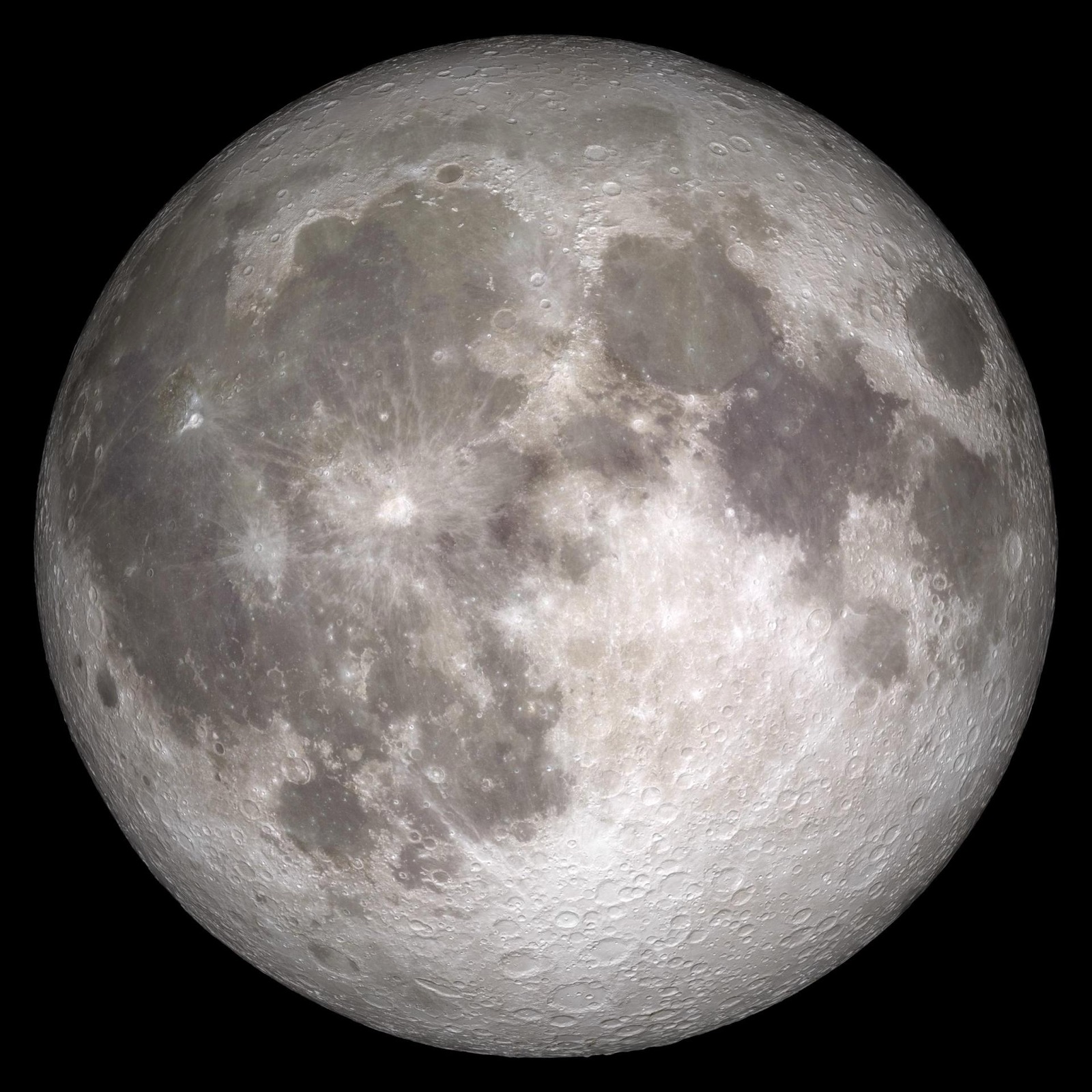
On 17 January 1982, John Schutt and Ian Whillans of the ANSMET program picked up a small stone in the Allan Hills of Antarctica. Smithsonian scientist Brian Mason found that it closely matched rocks brought back from the lunar highlands by Apollo astronauts, and the evidence was presented in March 1983. ALH A81005 became the first meteorite recognised as coming from the Moon. That showed impacts can throw lunar rock all the way to Earth. An older find, Yamato 791197, was only recognised as lunar in 1984.
The deep dive
Researched for the Atlas from Wikipedia — Allan Hills A81005 (4,019 characters read) · updated Nov 15, 2026
01 How Antarctica became a meteorite treasure chest
Allan Hills A81005 was recovered on 17 January 1982 during an ANSMET expedition — the Antarctic Search for Meteorites — in the Allan Hills at the end of the Transantarctic Mountains. Antarctica turns out to be one of the best places on Earth to collect meteorites, and the reason is partly logistical: dark rocks stand out vividly against white ice and snow, making them far easier to spot than they would be on a rocky plain. Expeditions return to the same mountain chains year after year, gradually building a remarkable library of space rocks. The sheer volume of specimens gathered there created a naming problem, however. There are simply not enough distinct geographic features in Antarctica to give every find a unique location-based name. That practical difficulty led directly to the creation of the so-called Antarctic rules for meteorite naming, a systematic labeling scheme that converted a logistical headache into a tidy scientific catalog.
02 Cracking the Antarctic naming code
The name ALH A81005 encodes its entire discovery history in just a handful of characters. ALH stands for Allan Hills, the mountain chain where it was found. The "A" prefix signals that it was recovered by an ANSMET expedition rather than another collecting program, though the article notes this letter is considered optional. The digits "81" refer not to the calendar year of discovery but to the year the expedition began — a deliberate design choice. ANSMET field seasons run through the Austral summer from December to March, meaning the calendar year can flip mid-expedition. Without that convention, rocks gathered on the same trip could end up with two different years in their names. Because the 1981 expedition was still underway on 17 January 1982, the meteorite carries "81" despite being physically picked up in 1982. The final three digits, "005," simply mean it was the fifth specimen logged in that sequence.
03 A tiny rock with a dramatic interior
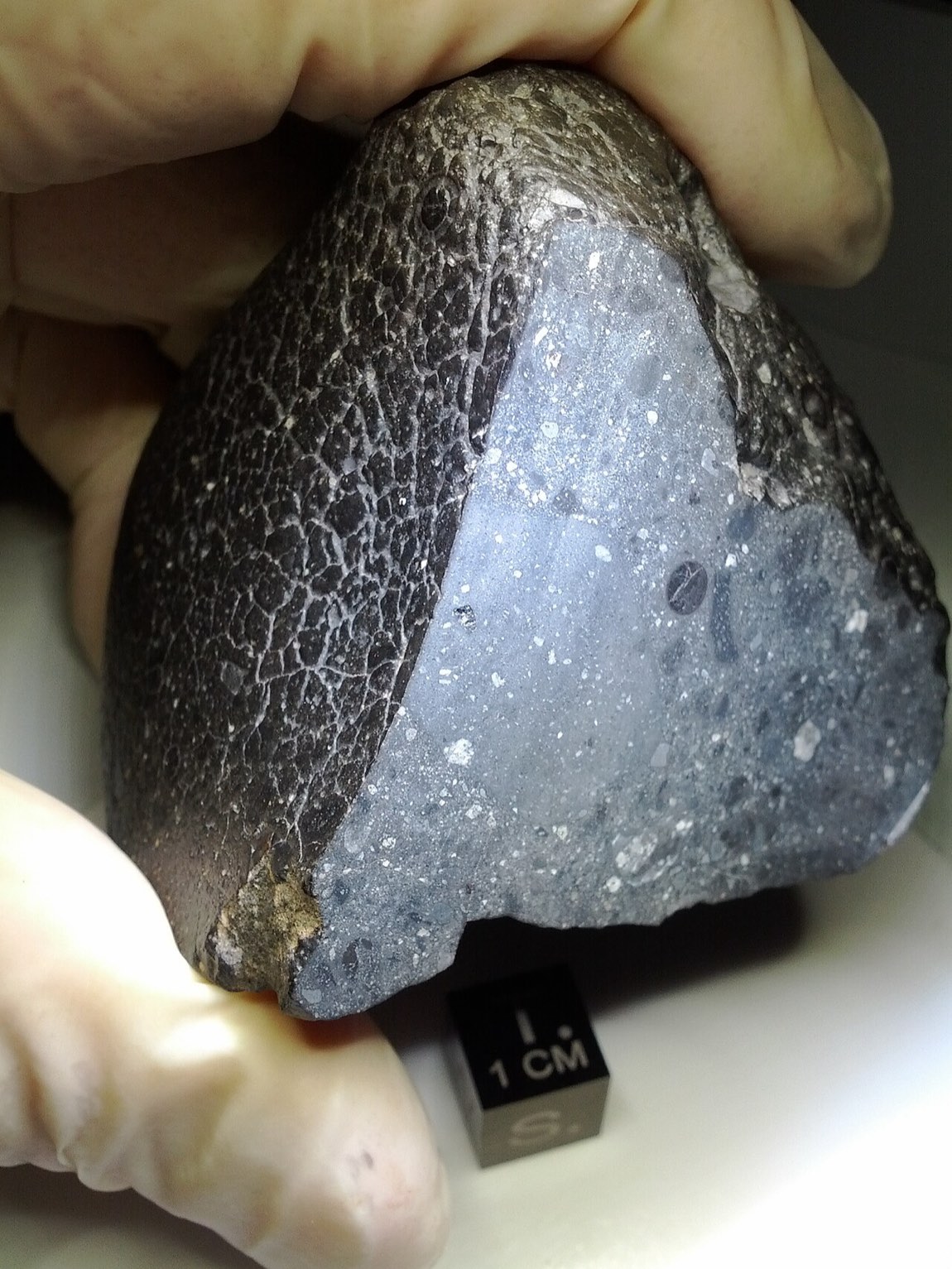
ALH A81005 is a remarkably small object — just 3 × 2.5 × 3 centimetres, roughly the size of a large walnut. Its outside is coated in a dark fusion crust, the glassy shell that forms when a meteorite's surface melts during its fiery plunge through Earth's atmosphere. Crack it open, however, and the interior tells a different story: a black to dark grey groundmass studded with larger angular crystals that range in color from grey to white. That texture — fine-grained background material packed with coarser fragments — is the hallmark of a breccia, a rock type produced when violent impacts shatter and re-cement existing material. Breccias form on Earth too, so this feature alone was not enough to establish a lunar origin. The crystals themselves range from sub-millimeter specks up to 8 millimetres in diameter, giving the rock a visibly speckled, almost salt-and-pepper appearance under close inspection.
04 Minerals that point to the lunar highlands Deeper
Thin section analysis — slicing the rock thin enough for light to pass through — revealed that the dominant mineral is plagioclase feldspar, accompanied by smaller amounts of pyroxene and olivine. Microprobe measurements showed the plagioclase to be extraordinarily calcium-rich: a solid solution of 97% anorthite and just 3% albite. Such calcium-saturated plagioclase is a defining fingerprint of the lunar highlands, where ancient igneous rocks crystallized from a magma ocean early in the Moon's history. The pyroxenes are compositionally variable, sitting somewhere in the triangle between enstatite, ferrosilite, and wollastonite end-members. The olivine ranges from 11 to 40% fayalite, with forsterite making up the remainder. Taken together, these mineral proportions resemble terrestrial gabbro or basalt, as the article notes, but the extreme anorthite content pushed scientists to classify the specimen formally as a lunar anorthosite breccia, belonging to the group abbreviated Lun-A.
05 The chain of scientists who made the call
Identifying a rock as lunar was not a one-person verdict. The chain of reasoning for ALH A81005 began with Smithsonian Institution scientist Brian Harold Mason, who determined that the meteorite's chemical and isotopic composition closely resembled rocks brought back to Earth by Apollo astronauts from lunar highland regions. That similarity caught the attention of Robert Clayton and Toshiko Mayeda, researchers at the University of Chicago, who then confirmed its lunar origin through further analysis. The formal announcement came at the 18 March 1983 meeting of the Lunar and Planetary Institute — roughly fourteen months after the rock was physically plucked from the Antarctic ice. The evidence presented at that meeting was comprehensive, drawing on fabric data, mineralogical data, compositional data, oxygen isotope data, noble gas data, cosmic ray exposure history, magnetic properties, nuclear particle tracks, and thermoluminescence data. No single measurement was decisive; the case was built from an interlocking network of independent lines of evidence.
06 Oxygen isotopes and cosmic ray clocks Deeper
Among the many analytical techniques applied to ALH A81005, oxygen isotope measurements and cosmic ray exposure history deserve special attention because they address fundamentally different questions. Oxygen isotopes — the relative proportions of oxygen-16, oxygen-17, and oxygen-18 — form a kind of planetary fingerprint. Every large body in the solar system has a characteristic isotopic signature, and ALH A81005's signature matched the Moon rather than Mars, the asteroid belt, or any other known source. Cosmic ray exposure history, by contrast, works like a clock: high-energy particles from space gradually produce distinctive nuclear byproducts in a rock's minerals, and the accumulation of those byproducts tells scientists how long the rock spent traveling through interplanetary space after being ejected from its parent body. Noble gas measurements contributed complementary data, while nuclear particle tracks preserved in the mineral grains provided yet another independent record of radiation exposure over geological time.
07 Why Yamato 791197 lost the "first" title
ALH A81005 is celebrated as the first recognized lunar meteorite, but that phrasing hides an interesting historical footnote. The Japanese meteorite Yamato 791197 was actually discovered earlier, in 1979, making it physically older in the collection. However, its lunar origin was not recognized until 1984 — a full year after ALH A81005 was confirmed in March 1983. Discovery and recognition are two distinct events in meteoritics, and it is the recognition that earns the historical priority. This situation illustrates how the identification of a truly novel meteorite type depends not just on finding the rock but on having the analytical framework and comparative reference material — in this case, the Apollo lunar samples — to understand what you are looking at. Without the Apollo collection sitting in labs for comparison, neither meteorite might have been identified as lunar for many more years.
08 Apollo samples as the essential Rosetta Stone
The Apollo program did far more than land astronauts on the Moon; it created a precisely documented library of lunar rocks that decades later would become the key to unlocking the origin of ALH A81005. Brian Harold Mason's critical insight was that this small Antarctic specimen shared its chemical and isotopic character with Apollo samples returned from the lunar highlands specifically. Without that reference collection — carefully curated, extensively analyzed, and freely shared with the scientific community — no comparison would have been possible. The Highland samples returned by Apollo are dominated by anorthositic rocks, consistent with the 97% anorthite composition found in ALH A81005. This connection turned a puzzling Antarctic find into a window onto the Moon's ancient crust, demonstrating that the Moon regularly sheds fragments of itself into space, and that some of those fragments eventually fall to Earth.
09 A rover on the Moon revisits an Antarctic rock Deeper
Decades after ALH A81005 was classified, it became relevant to active lunar exploration in an unexpected way. Data from the Alpha Particle X-ray Spectrometer instrument aboard the Chandrayaan-3 rover Pragyan was used by scientists from PRL — the Physical Research Laboratory — to conduct a comprehensive geochemical study of the lunar surface, with findings reported in 2026. That analysis found that the composition of ALH A81005 closely matched measurements taken by Pragyan at its landing site near Statio Shiv Shakthi in the lunar south polar region. The researchers stopped short of concluding that the meteorite definitively originated from the South Pole, but the geochemical overlap prompted new theoretical work. The study proposed multiple hypotheses about how the formation of the South Pole–Aitken Basin — one of the largest and oldest impact structures in the solar system — may have altered the geochemical character of the Shiv Shakthi landing site, potentially redistributing material across vast distances.
10 What thermoluminescence reveals about lunar history Deeper
Among the analytical techniques listed in the evidence presented at the 1983 Lunar and Planetary Institute meeting, thermoluminescence stands out as one of the more unusual. When minerals are exposed to ionizing radiation — from cosmic rays or radioactive decay — they trap energy in defects within their crystal lattices. Heating the mineral later causes it to release that stored energy as light, and the amount of light emitted is proportional to the radiation dose accumulated over time. For a meteorite, this technique can help reveal its thermal history: how hot it got during ejection from the Moon, how long it drifted through cold interplanetary space, and how long it sat on Earth before collection. Combined with nuclear particle track measurements — physical damage trails left by high-energy particles plowing through crystal grains — thermoluminescence helped build a coherent picture of ALH A81005's journey from the lunar highlands to the Antarctic ice.
11 Open questions the meteorite still poses Deeper
Even after more than four decades of study, ALH A81005 leaves important questions unanswered. The most fundamental is its precise source location on the Moon. While the geochemical match with Apollo Highland samples established a general provenance, pinpointing which impact event ejected it and from exactly which region remains uncertain. The 2026 Chandrayaan-3 comparison study raised the intriguing possibility of a south polar origin but explicitly could not confirm it. The South Pole–Aitken Basin connection remains a postulated hypothesis rather than a settled conclusion. Additionally, the article does not specify the meteorite's cosmic ray exposure age — the duration of its interplanetary journey — leaving the timeline from lunar ejection to Antarctic arrival as an open data point in the public record. As more lunar south polar geochemical data accumulates from future missions, the debate over where exactly this small but historically pivotal rock came from is likely to sharpen rather than resolve quickly.