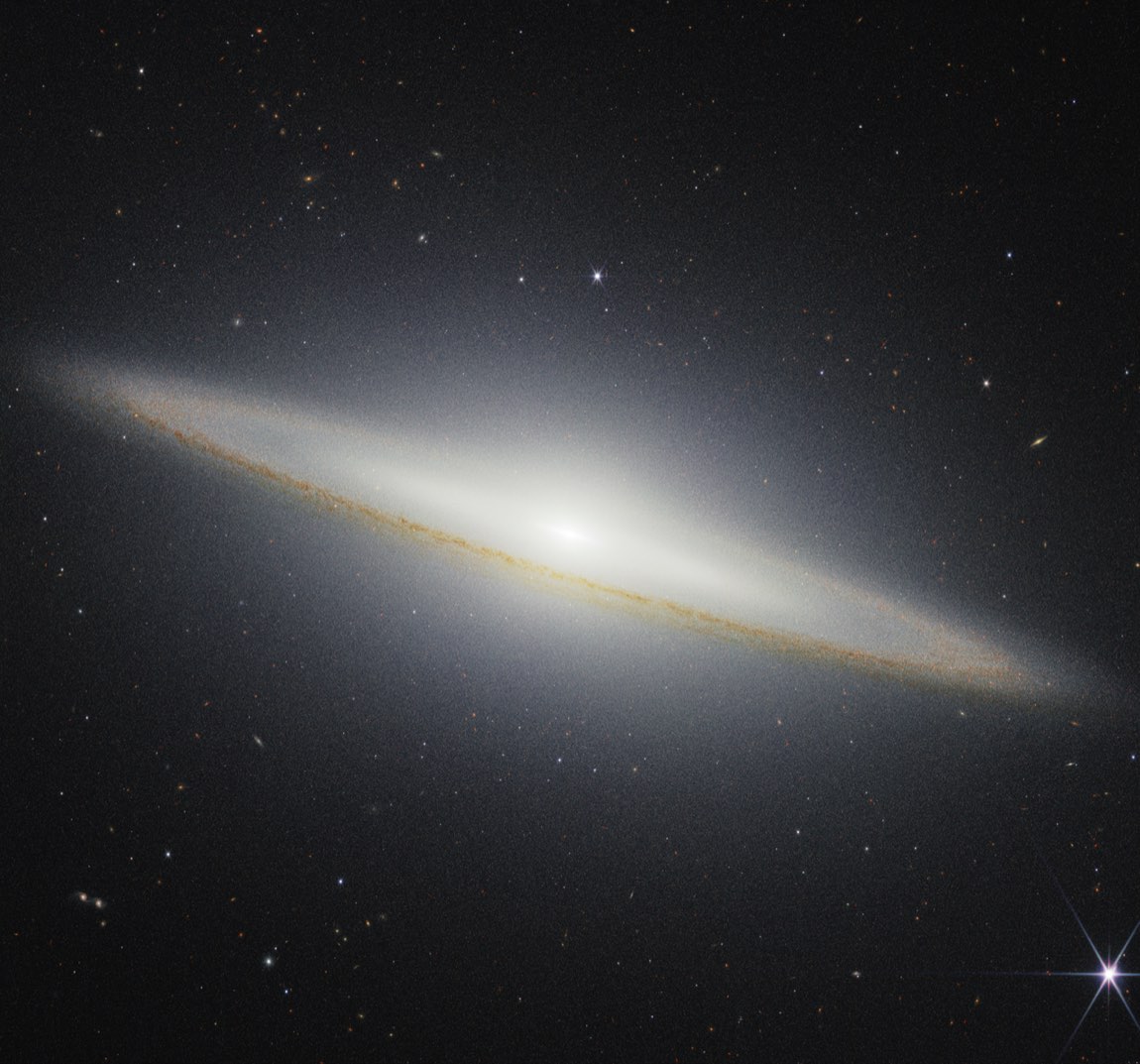
 Photograph · ESA/Hubble & NASA, K. Noll · CC BY 4.0
Galaxy · Deep guide
The Sombrero Galaxy
Also called: M104
A luminous hat brim in Virgo: bulge, dust lane, and a billion-sun black hole.
What is it?
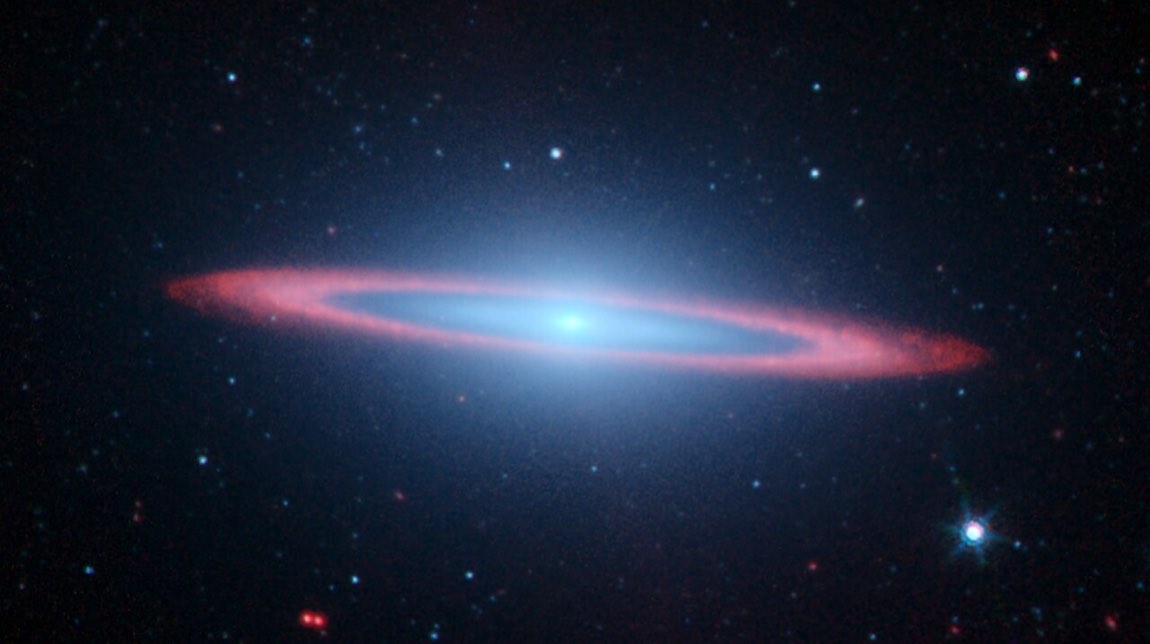
The Sombrero (M104), roughly 30 million light-years away, is the sky's most elegant edge-on galaxy: a brilliant, puffy bulge of ancient stars crossed by a knife-sharp lane of dust — unmistakably a hat. It hosts one of the most massive black holes in our neighborhood, on the order of a billion Suns, and swarms of globular clusters.
The deep dive
Researched for the Atlas from Wikipedia — Sombrero Galaxy (9,440 characters read) · updated Sep 20, 2026
01 A Hat-Shaped Galaxy That Defies Classification
The Sombrero Galaxy occupies an awkward position in the cosmic catalogue: astronomers cannot agree on what kind of galaxy it actually is. It sits on the border between the constellations Virgo and Corvus, and its identity is equally border-straddling. For decades it was assumed to be a spiral galaxy because its halo appeared small and lightweight, consistent with that family. Then the Spitzer Space Telescope looked more carefully and found the halo to be significantly larger and more massive than anyone had measured before — a signature more typical of a giant elliptical galaxy. Neither label fits perfectly, so the Sombrero is officially listed as a galaxy of unclear classification. This ambiguity is not a gap in knowledge to be embarrassed about; it is a genuine scientific puzzle, and the Sombrero has become a test case for understanding how galaxies are categorized in the first place. Its unusually large central bulge relative to its disk sits at the heart of the confusion, because most spirals wear far more modest bulges.
02 Two Astronomers, One Dark Stripe, a Long Wait
The Sombrero Galaxy has one of the more complicated discovery stories in the Messier catalogue. Pierre Méchain first spotted it on May 11, 1781, and described it in a letter to J. Bernoulli that was eventually published in the Berliner Astronomisches Jahrbuch. Charles Messier read that letter and added the object, along with five others, in a handwritten note to his personal copy of his catalogue — but those additions were never formally published in his lifetime. William Herschel independently found the galaxy in 1784, and crucially he recorded the presence of a 'dark stratum' across its disc, the feature now called the dust lane. Later astronomers eventually matched Méchain's and Herschel's separate observations to the same object. The galaxy then waited in an official limbo until 1921, when Camille Flammarion discovered Messier's personal annotated list, identified the object with entry 4594 in the New General Catalogue, and formally declared it should join the Messier Catalogue as M104 — nearly 140 years after it was first seen.
03 The Dust Ring Hiding in Plain Sight
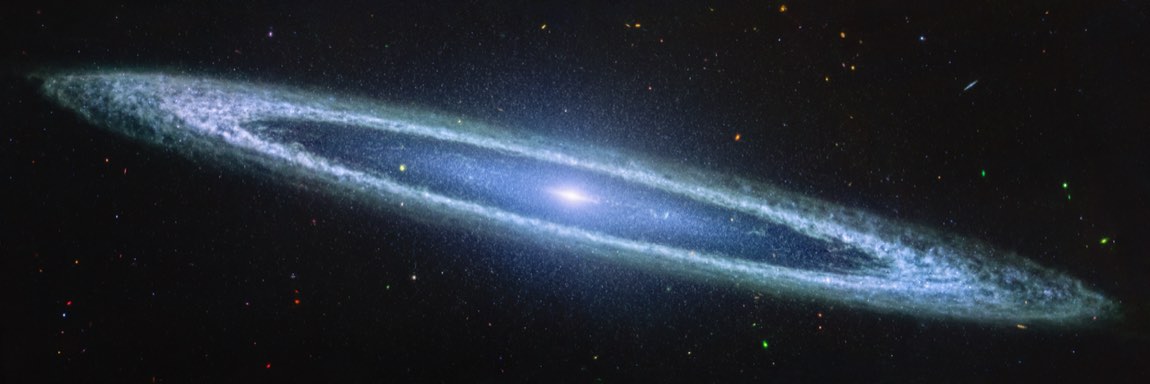
What looks from Earth like a simple dark lane slicing across the Sombrero's bright core is, in three dimensions, a symmetrical ring that completely encircles the galaxy's bulge. Most of the cold atomic hydrogen gas and dust in the entire galaxy are concentrated within this ring structure. Astronomers also suspect the ring holds the majority of the Sombrero's cold molecular gas, though that conclusion comes with a caveat: it rests on observations made at low resolution with only weak detections, and additional higher-quality data are still needed to confirm it. What is firmly established, based on infrared spectroscopy, is that the dust ring is the primary site of star formation within the galaxy. In other words, almost all of the Sombrero's ongoing stellar birth is happening not in a spread-out disc as in the Milky Way, but concentrated in this single ring-shaped structure wrapped around the galaxy's enormous central hub.
04 A Nucleus That Glows for the Wrong Reasons Deeper
The Sombrero's core is classified as a low-ionization nuclear emission-line region, or LINER — a category describing nuclei where gas is ionized but only weakly so, meaning the atoms present have lost relatively few electrons. What powers a LINER has been argued about for years. One camp points to young, hot stars in star-forming regions as the energy source; the other camp argues that a supermassive black hole acting as an active galactic nucleus is responsible. For the Sombrero, infrared spectroscopy has effectively ruled out significant star formation activity in the nucleus, tipping the balance strongly toward the black hole explanation. This makes physical sense given that the galaxy does host a well-confirmed supermassive black hole at its center. The nucleus is also a strong source of synchrotron radiation at both radio and X-ray wavelengths — radiation produced when high-velocity electrons spiral through strong magnetic fields, a hallmark of active galactic nuclei. Unlike some active nuclei whose radio emission fluctuates dramatically, the Sombrero's radio luminosity varies by only 10–20%.
 ⤢
⤢
05 The Billion-Solar-Mass Heart of the Sombrero
In the 1990s, a research group led by John Kormendy set out to measure what lurks at the Sombrero's center. Using spectroscopy data gathered from both the Canada–France–Hawaii Telescope and the Hubble Space Telescope, they tracked how fast stars near the core are orbiting. The speeds were so high that only an enormous concentration of mass — 1 billion times the mass of the Sun, or 10⁹ solar masses — could explain them. That figure would place the Sombrero's black hole among the most massive measured in any nearby galaxy, and make it the nearest billion-solar-mass black hole to Earth. A 2016 study, however, returned a somewhat lower value of 6.4 ± 0.4 × 10⁸ solar masses, so there is still some range in the estimates. Even at the lower figure, this is an extraordinarily massive black hole. For comparison, the Milky Way's central black hole, Sagittarius A*, has a mass of roughly 4 million solar masses — meaning the Sombrero's black hole outweighs ours by a factor of over 100.
06 A Radiation Puzzle No One Has Solved Yet Deeper
In 2006, two independent research groups published measurements of terahertz radiation coming from the Sombrero's nucleus at a wavelength of 850 micrometers. The interesting problem is what the radiation is not: it is not thermal emission from dust, which is the common explanation for infrared and submillimeter glow; it is not synchrotron radiation, which accounts for the radio emission; it is not bremsstrahlung from hot gas, which occasionally shows up at millimeter wavelengths; and it is not the result of molecular gas emission lines, which frequently appear at submillimeter wavelengths. After systematically eliminating every standard explanation, both groups were left without an answer. The source of this terahertz signal from the Sombrero's nucleus remains unidentified. It stands as one of the cleaner open questions the galaxy poses to astrophysicists — a clearly detected phenomenon with no agreed mechanism, sitting at the center of an already puzzling object.
07 A Swarm of Ancient Star Cities
Globular clusters — dense, spherical collections of ancient stars — orbit the Sombrero in impressive numbers. Observational studies have estimated the total population at somewhere between 1,200 and 2,000, a range that reflects genuine uncertainty in the counts. That number is high relative to the galaxy's total luminosity compared to the Milky Way and other galaxies with small central bulges. However, it is entirely consistent with what is seen around other galaxies that, like the Sombrero, possess unusually large bulges. This pattern has made the Sombrero an important data point in the broader argument that globular cluster populations scale with bulge size rather than with total galaxy mass or luminosity. The spatial arrangement of these clusters adds another detail: their surface density across the sky generally tracks the brightness profile of the bulge, with one exception — near the very center of the galaxy, the distribution deviates from that pattern.
08 Pinning Down the Distance: Three Methods, One Answer Deeper
Measuring the Sombrero's distance has required multiple independent techniques that astronomers have progressively refined. The first method compares the observed brightness of planetary nebulae in the Sombrero to the known luminosity of equivalent objects in the Milky Way, yielding a distance of 29 ± 2 million light-years. The second method, surface brightness fluctuations, exploits the fact that nearby galaxy bulges look grainy in images while distant ones appear smooth; early results gave 30.6 ± 1.3 million light-years, later refined to 32 ± 3 million light-years, and refined again in 2003 to 29.6 ± 2.5 million light-years. Averaging the two techniques gives 29.3 ± 1.6 million light-years. A 2016 study added a third approach, using the Hubble Space Telescope to identify the tip of the red-giant branch — a predictable luminosity marker in stellar evolution — and obtained 9.55 ± 0.13 ± 0.31 megaparsecs, consistent with the earlier average. The convergence of three different methods on roughly the same answer gives astronomers confidence that the Sombrero sits about 31 million light-years away.
 ⤢
⤢
09 The Sombrero's Uncertain Place in Its Neighborhood Deeper
The Sombrero belongs to the Virgo II Groups, a filament-like chain of galaxies and galaxy clusters trailing from the southern edge of the Virgo Supercluster — but its precise social standing within that neighborhood is genuinely contested. When astronomers use hierarchical methods, which look at whether individual galaxies belong to a larger aggregate, the Sombrero comes out as part of a group that includes NGC 4487, NGC 4504, NGC 4802, and UGCA 289, among possibly a few others. But when the friends-of-friends method is applied — which links galaxies pair by pair to build up groups — the results are quite different: either the Sombrero belongs to no group at all, or it forms only a simple pair with the galaxy UGCA 287. The two approaches give contradictory answers, and the article does not resolve which is correct. Adding a smaller companion to the picture, a ultra-compact dwarf galaxy discovered in 2009 orbits the Sombrero; it has an absolute magnitude of −12.3, an effective radius of just 47.9 light-years, and a mass of 3.3 × 10⁷ solar masses.
10 How Bright Is It, and How Massive?
The Sombrero Galaxy's total mass is estimated at 800 billion solar masses — roughly comparable to, though possibly larger than, the Milky Way. Its apparent magnitude as seen from Earth is +8.0, which places it just beyond naked-eye visibility but squarely within reach of modest binoculars or small telescopes. Its absolute magnitude in blue light is estimated at −21.9 when calculated at a reference distance of 30.6 million light-years, or −21.8 at the average measured distance. That figure makes it a strong candidate for the galaxy with the highest absolute magnitude within a radius of 10 megaparsecs — roughly 32.6 million light-years — of the Milky Way. In plain terms, among all the many galaxies in our extended cosmic neighborhood, the Sombrero may outshine every one of them in intrinsic luminosity. Its isophotal diameter spans approximately 29.09 to 32.32 kiloparsecs, or 94,900 to 105,000 light-years, making it slightly larger than our own galaxy.
11 Watching It Yourself on a Clear Night
The Sombrero Galaxy is one of the more accessible targets in the spring and early summer sky for observers in the Northern Hemisphere. To find it, start at Spica, the bright blue-white star in Virgo, and move 11.5° to the west; alternatively, move 5.5° to the northeast from Eta Corvi. The galaxy is visible through 7×35 binoculars or a 4-inch (100 mm) aperture telescope, though at that scale it will appear as little more than a fuzzy elongated smudge. To see the distinction between the bright central bulge and the surrounding disk, an 8-inch (200 mm) telescope is necessary. To actually resolve the dark dust lane — the feature that gives the galaxy its name — observers need a 10-inch or 12-inch (250 or 300 mm) instrument under good conditions. That progression of detail with aperture makes the Sombrero a satisfying target for astronomers at every level of equipment, rewarding those who push to larger instruments with progressively more of the galaxy's defining character.
 ⤢
⤢