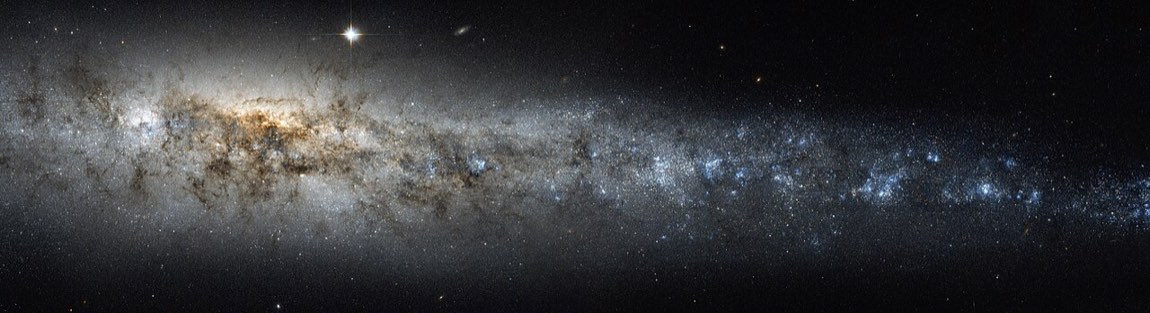
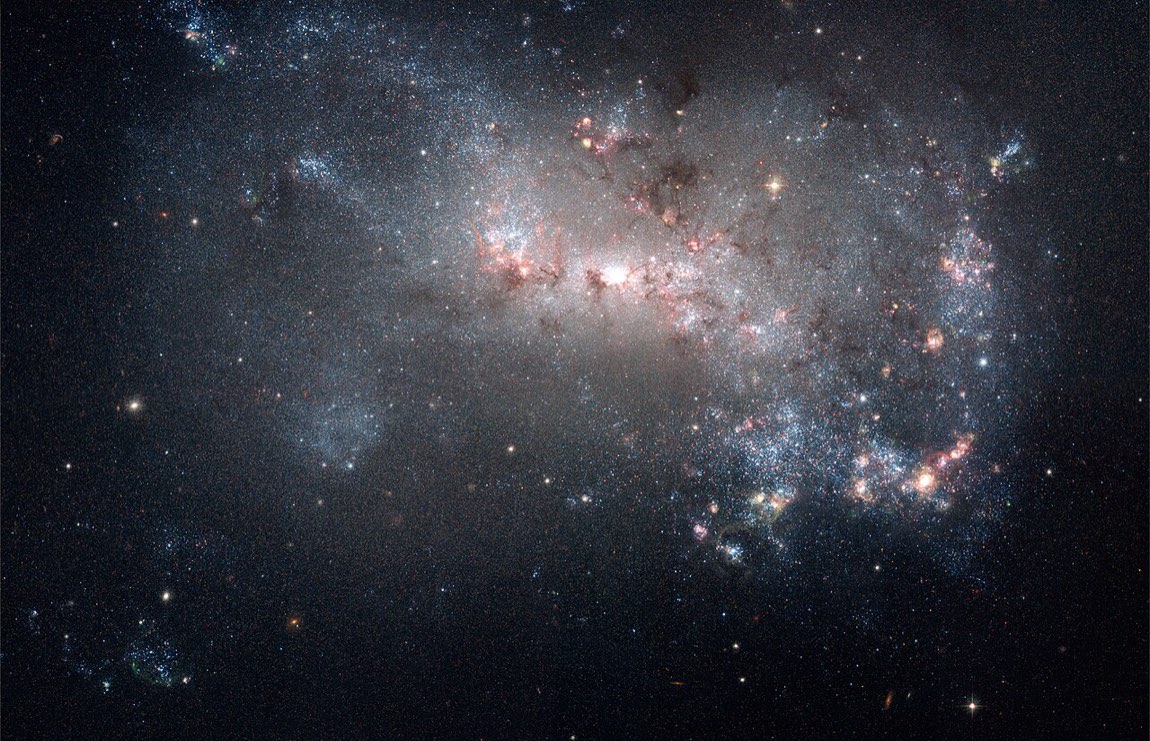
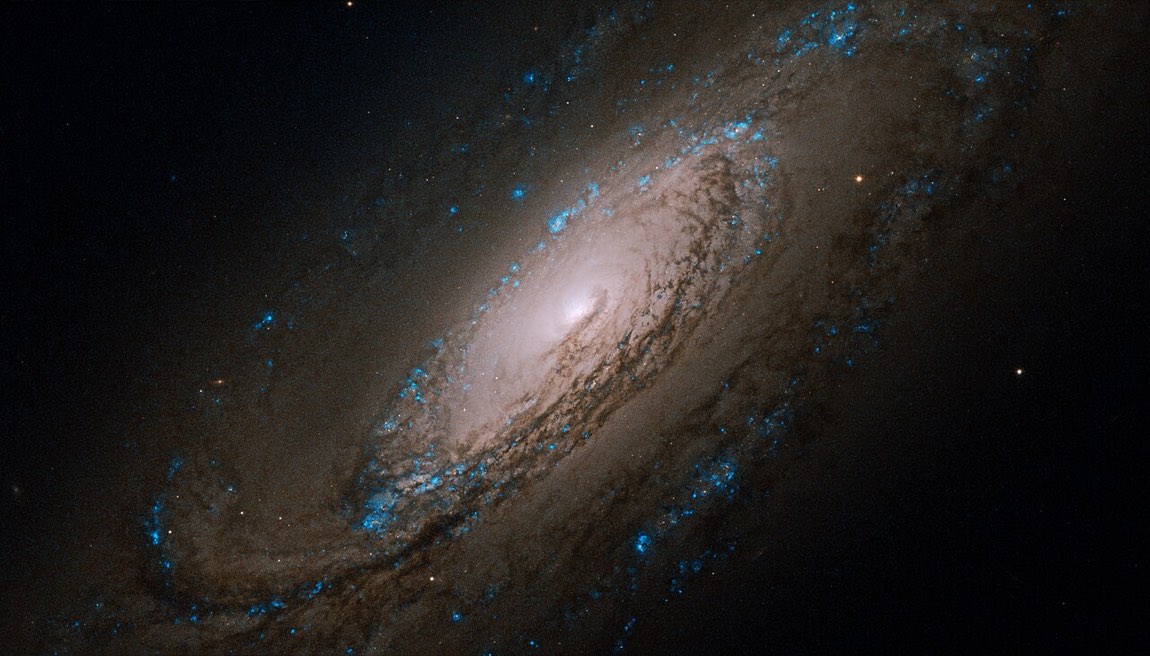
 Photograph · NASA Hubble Space Telescope · CC BY 2.0
Galaxy · Deep guide
NGC 5005
Also called: Caldwell 29 · C29 · UGC 8256 · PGC 45749
A dusty, bright-cored spiral in Canes Venatici with a mildly active nucleus.
What is it?
NGC 5005 is an inclined spiral galaxy in Canes Venatici with a bright nucleus and a disc threaded with several dust lanes. Its high surface brightness makes it a good target for larger amateur telescopes. The core is a LINER, a kind of weakly active nucleus whose energy source is still debated. Distance estimates vary widely, from about 45 to 113 million light-years. William Herschel discovered it on 1 May 1785.
The deep dive
Researched for the Atlas from Wikipedia — NGC 5005 (1,835 characters read) · updated Nov 15, 2026
01 A Galaxy Tilted Toward Us
NGC 5005 is described as an inclined spiral galaxy, meaning we see it at an angle rather than face-on or perfectly edge-on. This orientation is actually useful for astronomers: it lets them study both the disk structure and the nucleus without either being completely hidden or foreshortened. The disk is notably bright and laced with multiple dust lanes — dark streaks of interstellar material silhouetted against the glow of billions of stars behind them. Those dust lanes are a hallmark of spiral galaxies seen at an inclination, tracing the arms and interarm regions where gas and dust pile up. The galaxy's high surface brightness, combined with this tilted geometry, is precisely what makes NGC 5005 a rewarding target even for amateur astronomers with large telescopes. It sits in the constellation Canes Venatici, the Hunting Dogs, a region of sky that hosts a remarkable concentration of bright galaxies.
02 William Herschel's Discovery in 1785
NGC 5005 was discovered by William Herschel, described in the article as a German-British astronomer, on 1 May 1785. Herschel is one of the most prolific galaxy discoverers in history, and this galaxy joined his extensive catalog of nebulae and star clusters compiled during his systematic sweeps of the sky. The date — 1 May 1785 — predates photography entirely; Herschel would have recorded the galaxy as a faint, hazy patch seen through his large reflecting telescope by eye alone. It was later incorporated into the New General Catalogue as NGC 5005 and also carries the designation Caldwell 29, a modern observer's list compiled to highlight rewarding deep-sky objects that the older Messier catalog missed. The Caldwell designation reflects how genuinely impressive NGC 5005 looks through a telescope, even nearly two and a half centuries after Herschel first noted its existence.
03 Why Its Distance Is So Hard to Pin Down Deeper
One striking fact about NGC 5005 is how widely its published distance estimates diverge. Measurements range from 13.7 megaparsecs — roughly 45 million light-years — all the way to 34.6 megaparsecs, or about 113 million light-years. That is not a small discrepancy; the upper estimate is more than twice the lower one. The article notes that these measurements average out to about 20 megaparsecs, or 65 million light-years. Such spread is a real phenomenon in extragalactic astronomy and not simply measurement error. Different distance-indicator methods — such as the Tully-Fisher relation, surface brightness fluctuations, or redshift-based estimates with different assumed values of the Hubble constant — can yield substantially different results for the same galaxy, especially one that is moderately distant. Until a more precise anchor, like a well-observed Type Ia supernova distance ladder measurement or a resolved stellar population, is applied consistently, the true distance to NGC 5005 remains uncertain within this broad range.
04 A Supernova Caught in 1996
On 16 June 1996, astronomer Claudio Bottari discovered a supernova inside NGC 5005. Designated SN 1996ai, it was classified as a Type Ia supernova and reached an apparent magnitude of 14.5. Type Ia supernovae are especially important to astronomers because they arise from a white dwarf star in a binary system accreting enough mass to trigger a runaway thermonuclear explosion. They are famously used as standard candles for measuring cosmic distances because their intrinsic brightness is relatively consistent. At magnitude 14.5, SN 1996ai was bright enough to be detected with relatively modest equipment, though still far fainter than anything visible to the naked eye — for context, the faintest stars visible without a telescope are around magnitude 6. The event provides a snapshot of violent stellar death occurring within this galaxy, and in principle a well-observed Type Ia event like this could contribute to refining the distance to NGC 5005, though the wide range of published distances suggests the measurement challenge persists.
05 The LINER Nucleus and Its Mysterious Power Source Deeper
At the heart of NGC 5005 lies a low ionization nuclear emission region, abbreviated LINER. LINER nuclei are defined by the presence of weakly ionized gas — gas that has absorbed enough energy to have electrons stripped away, but not to the extreme degree seen in quasars or classic Seyfert galaxies. What makes LINERs scientifically contentious is the question of what is powering that ionization. As the article states, researchers have debated this extensively, with one camp arguing that LINERs are driven by active galactic nuclei containing supermassive black holes, and another arguing that star formation activity is responsible. NGC 5005 is therefore not just an interesting object in its own right — it is a case study in one of the ongoing disputes in galactic astrophysics. Resolving which mechanism dominates in any given LINER requires combining multiple observational techniques, including optical spectroscopy, radio imaging, and crucially, X-ray observations, which for NGC 5005 have provided particularly telling evidence.
06 X-Ray Evidence for a Black Hole Deeper
X-ray observations of NGC 5005 have produced some of the most compelling evidence for what is happening in its nucleus. Those observations revealed a variable, point-like hard X-ray source sitting at the galaxy's center. Both characteristics matter. A point-like source means the emission is concentrated in an extremely compact region, consistent with the environment immediately surrounding a supermassive black hole rather than being spread across a star-forming region. Variability is equally significant: the X-ray brightness changes over time, which is a signature of the hot, compressed gas swirling in the extreme gravitational environment just outside a black hole in an active galactic nucleus. Diffuse star formation activity does not produce this kind of rapid, coherent variability. According to the article, these results imply that NGC 5005 does contain a supermassive black hole, lending support to the active galactic nucleus interpretation of its LINER emission, though the debate about LINER power sources more broadly continues across the field.
07 NGC 5005 and Its Companion NGC 5033
NGC 5005 is not alone in space. It forms a physical pair with another spiral galaxy, NGC 5033, the two comprising what astronomers call a galaxy pair. The article is careful to note that while they do weakly influence each other gravitationally, they are not yet close enough to be distorted by tidal forces. This distinction matters enormously. Many famous interacting galaxy pairs — like the Antennae Galaxies — show dramatic warping, long tidal tails of stars, and triggered bursts of star formation precisely because they are in the midst of or have already experienced close gravitational encounters. NGC 5005 and NGC 5033 are at an earlier or more separated stage of potential interaction, still feeling each other's gravity gently but not yet showing the dramatic structural distortions that signal a more advanced encounter. Watching such a pair offers astronomers a view of galaxy interaction at its quieter, early phase — a kind of gravitational courtship before any eventual merger.
08 Observing NGC 5005 With a Telescope
NGC 5005 is explicitly noted as being visible to amateur astronomers using large amateur telescopes, a distinction earned by its high surface brightness. Surface brightness refers to how concentrated a galaxy's light is per unit of angular area on the sky — a galaxy can be moderately faint overall but still appear vivid if its light is packed into a compact apparent size. NGC 5005 benefits from this, making it a satisfying target where many galaxies at comparable distances would appear as dim, diffuse smudges. Its inclined orientation and bright disk add visual interest. The galaxy resides in Canes Venatici, a constellation well-placed for northern hemisphere observers during spring evenings. Its Caldwell 29 designation is a useful pointer — the Caldwell catalog was specifically assembled to highlight non-Messier objects that reward telescope time, so inclusion there is a mark of genuine visual quality.
09 What Makes a Nucleus "Bright"? Deeper
The article describes NGC 5005 as having a relatively bright nucleus, which connects directly to its classification and the physics happening at its center. In a galaxy hosting a LINER — and potentially a supermassive black hole feeding as an active galactic nucleus — the central region can outshine what simple stellar populations would produce. Even at the low-luminosity end of active galactic nuclei, the energy released by infalling material onto a black hole contributes excess light concentrated at the very center. This creates a nucleus that stands out visually from the surrounding disk. For NGC 5005, the bright nucleus is consistent with the X-ray evidence of a compact, variable hard X-ray source at its core. Together, the optical brightness of the nucleus and the X-ray variability paint a coherent picture: something energetic is happening in that central compact region, most likely accretion onto a supermassive black hole, even if the total luminosity is modest compared to more powerful active galaxies.
10 Open Questions Surrounding This Galaxy Deeper
NGC 5005 sits at the intersection of several unresolved problems in modern astrophysics. The fundamental question of what powers its LINER emission — an active galactic nucleus, star formation, or some combination — remains debated, as the article explicitly states. The wide spread in its distance measurements, from 45 million to 113 million light-years, means that derived physical properties like the galaxy's true size and luminosity carry corresponding uncertainty. The future of its gravitational relationship with companion galaxy NGC 5033 is also an open story: the pair weakly influence each other now, but whether they will eventually merge, make a close pass that triggers star formation, or simply drift apart on cosmological timescales depends on their three-dimensional relative velocities, which are not fully constrained from sky-plane observations alone. Even the mass of the implied supermassive black hole at its center is not stated in the available data, leaving that fundamental parameter unspecified for this otherwise well-studied nearby galaxy.