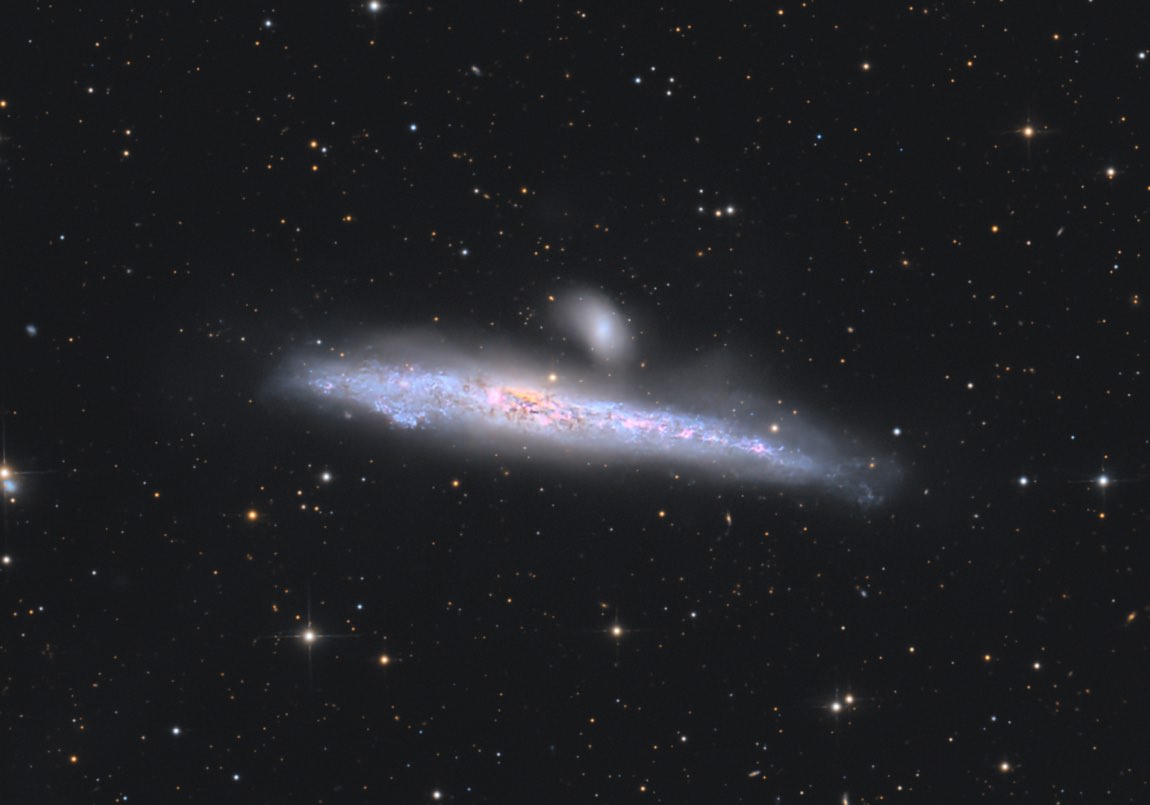
 Photograph · NASA Hubble · CC BY 2.0
Galaxy · Deep guide
The Whale Galaxy (NGC 4631)
Also called: Caldwell 32 · C32 · NGC 4631 · Arp 281 · UGC 7865 · PGC 42637
An edge-on spiral shaped like a whale, with a starburst blowing gas out of its disc.
What is it?
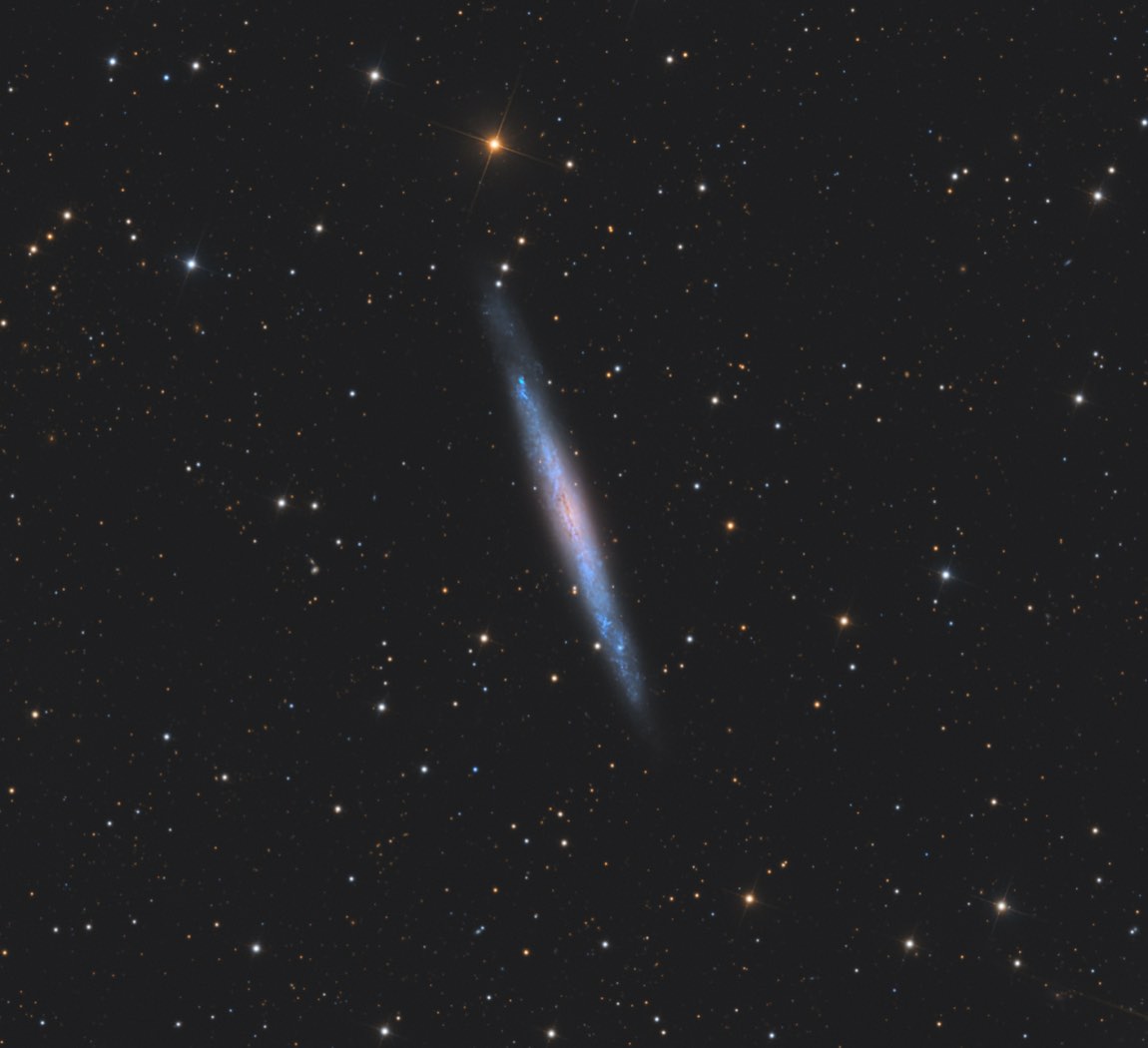
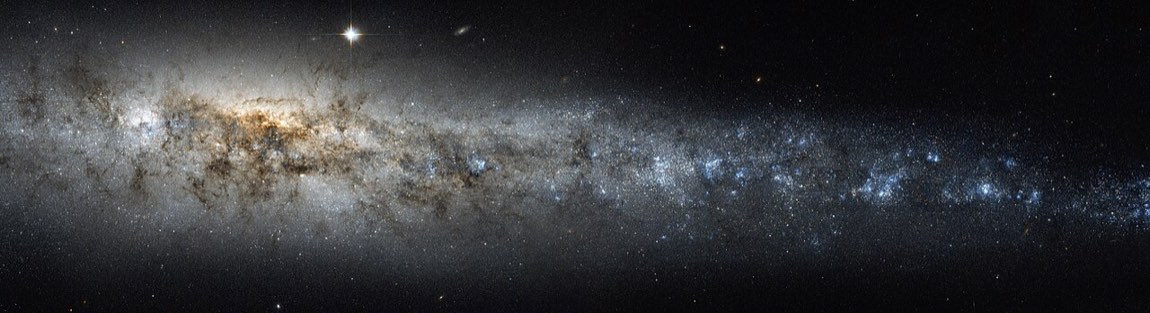
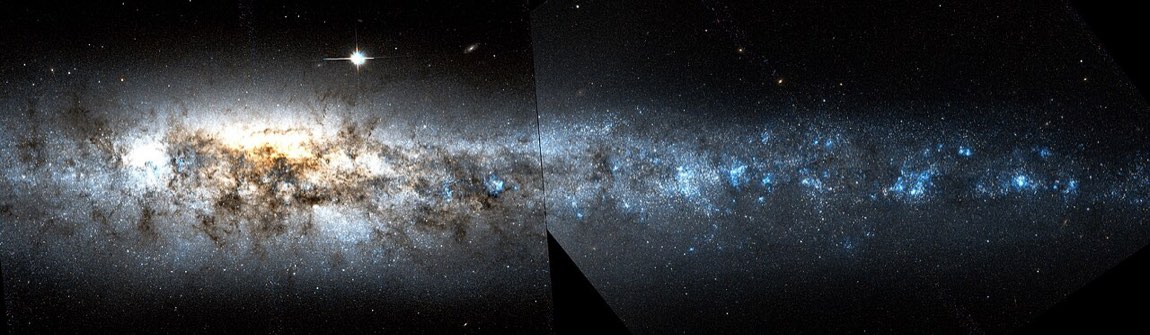
NGC 4631 is a barred spiral galaxy in Canes Venatici seen edge-on, and its slightly bent wedge shape looks like a whale or a herring. Its centre is a starburst, a zone of intense star formation, and so many massive stars there have exploded as supernovae that they drive a 'superwind' of hot gas out above and below the disc, visible in X-rays. Because it is close and edge-on, astronomers use it to study gas and stars lying outside a galaxy's plane. William Herschel discovered it on 20 March 1787.
The deep dive
Researched for the Atlas from Wikipedia — NGC 4631 (2,430 characters read) · updated Nov 15, 2026
01 Why astronomers love an edge-on galaxy
NGC 4631's orientation in the sky is a rare gift to researchers. Because we see it perfectly edge-on from Earth, the flat disk of the galaxy is spread out like a cross-section, letting astronomers peer directly at the vertical structure of the galaxy — the gas, dust, and stars that exist above and below the main plane. Most galaxies appear at tilted or face-on angles, which mixes all those layers together and makes them impossible to separate. With NGC 4631, professional astronomers can distinguish what belongs to the disk itself from what has been pushed, blown, or pulled out into the space surrounding it. This edge-on geometry is precisely why the starburst activity at the galaxy's center and the resulting outflows have been studied so closely. The wedge shape that gives it its whale nickname is also a direct consequence of this viewing angle — what looks like a slightly distorted slab is actually a full spiral galaxy roughly comparable in size to our own Milky Way, simply seen from the side.
02 A stellar baby boom at the galaxy's core
At the heart of NGC 4631 lies a starburst — a region where stars are forming at a dramatically elevated rate compared to the rest of the galaxy. The evidence for this fierce activity shows up in two distinct ways that astronomers can measure directly. First, ionized hydrogen glows with a characteristic red emission, produced when ultraviolet radiation from hot, newborn stars strips electrons from surrounding hydrogen gas. Second, interstellar dust grains heated by those same young stars radiate strongly in the infrared. Together, these two signals act like thermometers pointing directly at the starburst region, confirming that star formation there is intense and ongoing. The most massive stars born in this environment are profligate with their energy — they burn through their hydrogen fuel rapidly and have short lives measured in millions rather than billions of years. This rapid stellar lifecycle has enormous consequences, because when those massive stars die, they do so explosively, as supernovae, and the collective energy of so many blasts fundamentally reshapes the galaxy around them.
03 Supernovae ganging up to blow a galactic wind Deeper
Individual supernovae are already among the most energetic events in the universe, but in NGC 4631 they are not acting alone. So many massive stars have formed and died in the galaxy's central starburst that their supernovae have been exploding in rapid enough succession to combine their energy into a coherent outflow known as a superwind. This is not a gentle breeze on a stellar scale — it is a torrent of gas being physically expelled from the plane of the galaxy, driven upward and downward by the cumulative shock waves and hot gas from dozens or hundreds of overlapping supernova remnants. Astronomers can detect this superwind in two separate ways: through X-ray observations that reveal extremely hot, shocked gas, and through spectral line emission that traces the motion and composition of the outflowing material. The fact that the superwind is visible in both high-energy X-rays and in optical and radio spectral lines tells researchers that the outflow contains gas at a wide range of temperatures, from millions of degrees down to much cooler phases, all being swept outward simultaneously.
04 The hot halo that wraps the whole galaxy Deeper
The superwind blowing out of NGC 4631's center does not simply disperse into nothing. Over time, the expelled gas has accumulated into a giant, diffuse corona of hot, X-ray emitting material that now envelops the entire galaxy. This corona is a dramatic large-scale consequence of the starburst activity at the core — energy generated by star formation in one compact region has redistributed hot gas across a volume far larger than the galaxy's disk itself. X-ray telescopes are the essential tool for studying this corona, because gas heated to millions of degrees emits most of its light at X-ray wavelengths invisible to the human eye or ordinary optical telescopes. The existence of such a corona around NGC 4631 makes it a valuable laboratory for understanding galactic feedback — the process by which star formation regulates itself by heating and expelling the raw material needed for future star birth. Similar processes are thought to operate in many galaxies, but NGC 4631's edge-on orientation and relative proximity at about 30 million light-years make its corona unusually accessible to study.
05 A stellar merger caught in the act: AT 2021biy
On 29 January 2021, the ATLAS survey discovered a luminous red nova in NGC 4631, designated AT 2021biy. Luminous red novae are a distinct class of transient event — not to be confused with ordinary novae or supernovae — thought to arise when two stars merge together in a violent stellar collision. AT 2021biy was recorded at magnitude 18.1, making it faint enough to require dedicated survey telescopes but bright enough to study in considerable detail. Analysis of the progenitor system — the star or stars that existed at that location before the event — suggested either a luminous yellow supergiant or, more probably, a binary star system whose primary star had a mass of 17 to 24 times that of the Sun. Interestingly, despite the vigorous supernova activity implied by the galaxy's starburst, no actual supernovae have been directly observed in NGC 4631 yet, making AT 2021biy the most dramatic stellar explosion recorded there so far.
06 The record-breaking plateau of AT 2021biy Deeper
Luminous red novae are known to have a characteristic two-peaked light curve. After an initial bright peak, the event settles into a second phase where its luminosity remains roughly constant for an extended period — a plateau. This plateau is thought to reflect the cooling and expansion of the merged stellar envelope. What made AT 2021biy exceptional within its class was the extraordinary duration of this plateau phase: 210 days. That is the longest plateau ever observed in a luminous red nova at the time of its study, far exceeding what had been recorded in comparable events elsewhere. A duration of 210 days is roughly seven months — meaning astronomers had an unusually extended window in which to observe this phase of the stellar merger's aftermath. This record-breaking plateau gives researchers a prolonged look at the physical processes unfolding after two massive stars collide, providing data that can be used to refine theoretical models of how stellar mergers evolve and how they eventually fade from view.
 ⤢
07 NGC 4627: the whale's small companion
Hovering near NGC 4631 in the sky is a much smaller galaxy called NGC 4627, a dwarf elliptical galaxy that serves as a close companion to the Whale Galaxy. The pairing of NGC 4627 and NGC 4631 was considered notable enough that it was listed in the Atlas of Peculiar Galaxies, a landmark catalog compiled to highlight galaxies with unusual or interacting appearances. There, the duo appears as an example of a double galaxy, or galaxy pair — two gravitationally associated systems caught in each other's company. Dwarf elliptical galaxies like NGC 4627 are far smaller and rounder than the spiral disk of NGC 4631, and they typically contain older stellar populations with little ongoing star formation. The gravitational influence that larger spirals exert on their dwarf companions over billions of years can distort the companions' shapes and even strip stars away, though the precise nature of the interaction between NGC 4627 and NGC 4631 is not fully detailed in current observations.
08 A galaxy group with a fuzzy membership list
NGC 4631 and NGC 4627 belong to a larger collection of galaxies called the NGC 4631 Group, which also includes the interacting pair NGC 4656 and NGC 4657. However, defining exactly which galaxies belong to this group turns out to be surprisingly difficult. The region of sky containing NGC 4631 is relatively crowded, meaning that many galaxies appear close together on the sky even if they are not physically associated with one another. This projection effect makes it hard to distinguish true gravitational group members from background or foreground galaxies that simply happen to lie in the same direction. As a result, different studies have arrived at wildly different conclusions: estimates of the total number of galaxies in the NGC 4631 Group range all the way from 5 to 27, and no two major studies agree on the same list of member galaxies. This uncertainty is an honest reflection of how challenging galaxy group identification remains, even for relatively nearby systems.
09 William Herschel's March night in 1787
NGC 4631 was discovered on 20 March 1787 by William Herschel, the German-British astronomer who is one of the towering figures in the history of observational astronomy. Herschel is best known for discovering the planet Uranus in 1781, but he spent decades systematically sweeping the sky and cataloging thousands of nebulae and star clusters, many of which we now recognize as galaxies. At the time of his discovery of NGC 4631, the technology and theoretical framework to understand what a galaxy actually was did not yet exist — that understanding would only come more than a century later. Herschel simply recorded it as a nebulous object. The galaxy also carries the designation Caldwell 32, placing it in the Caldwell Catalogue, a modern list of deep-sky objects compiled to complement the older Messier Catalogue. Its nickname, the Whale Galaxy, is a purely descriptive modern label inspired by the elongated, slightly tapering shape visible through telescopes, which resembles a herring or a whale in profile.
10 Its shape: a herring, a whale, a barred spiral
The Whale Galaxy's distinctive silhouette arises from two overlapping facts about its nature. Structurally, NGC 4631 is classified as a barred spiral galaxy — a type in which a linear bar of stars runs through the center, with spiral arms curling outward from the bar's ends. Barred spirals are common; our own Milky Way is thought to be one. But the barred structure of NGC 4631 is not what most observers notice first, because the galaxy's edge-on orientation conceals the spiral arms. What is visible instead is the wedge-shaped or slightly distorted profile of the disk, which tapers toward one end and bulges slightly at the center where the dense nuclear region and bar lie. This silhouette is described as resembling a herring or a whale, which inspired both its popular nickname and its Caldwell catalogue inclusion as a visually rewarding target. The slight distortion in the disk's shape, rather than a perfectly flat line, may hint at tidal interactions with its neighboring galaxies.
11 How to find the Whale Galaxy in your telescope
NGC 4631 lies in the constellation Canes Venatici, the Hunting Dogs, a northern constellation positioned between the more prominent Ursa Major and Boötes. With an apparent magnitude of roughly 9, the Whale Galaxy sits just below the threshold of naked-eye visibility but is accessible through binoculars under dark skies and shows considerable detail through modest amateur telescopes. Its edge-on orientation actually helps observers detect it, because the elongated shape stands out clearly against the background of stars, making it easier to identify than a face-on galaxy that might look like a faint circular smudge. At about 30 million light-years away — meaning that the light entering your eye tonight left the galaxy 30 million years ago, when our earliest hominin ancestors had not yet appeared on Earth — it is close enough by extragalactic standards to reward observation with hints of its structure, including the slight bulge at its center and the subtle asymmetry in the disk that inspired its nickname.
 ⤢