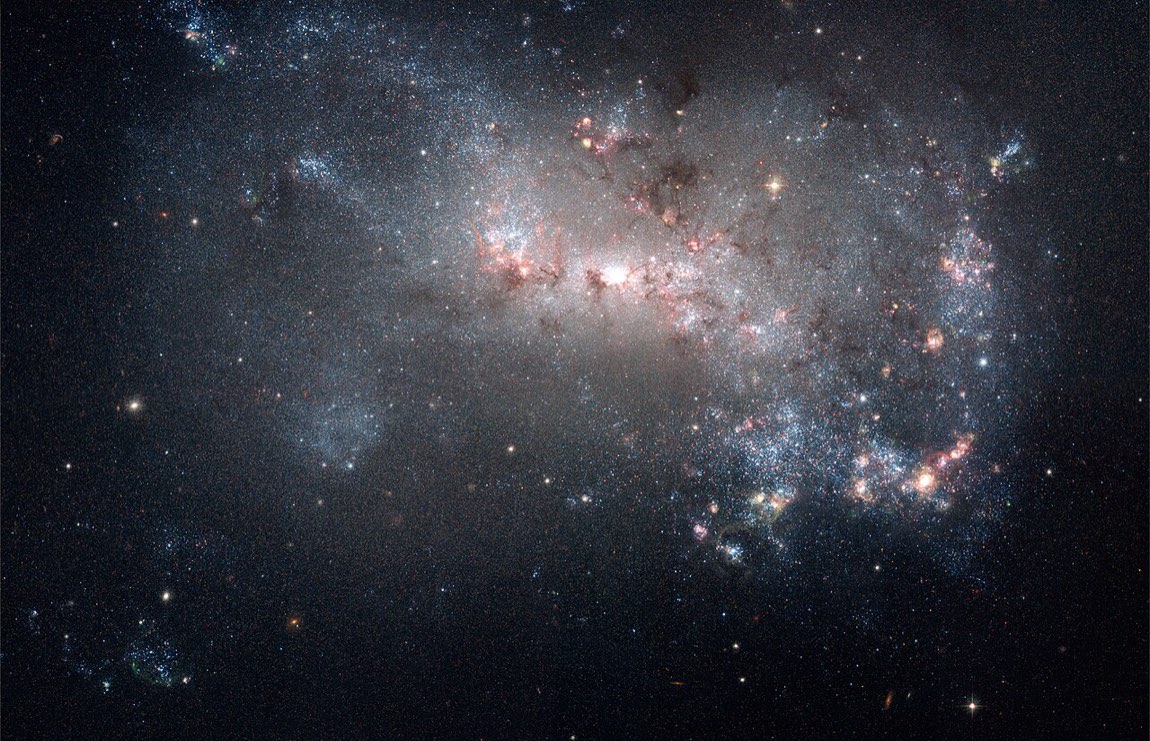
 Photograph · NASA, ESA, A. Aloisi (STScI/ESA), and The Hubble Heritage (STScI/AURA)-ESA/Hubbl · Public domain
Galaxy · Deep guide
NGC 4449
Also called: Caldwell 21 · C21 · UGC 7592 · PGC 40973
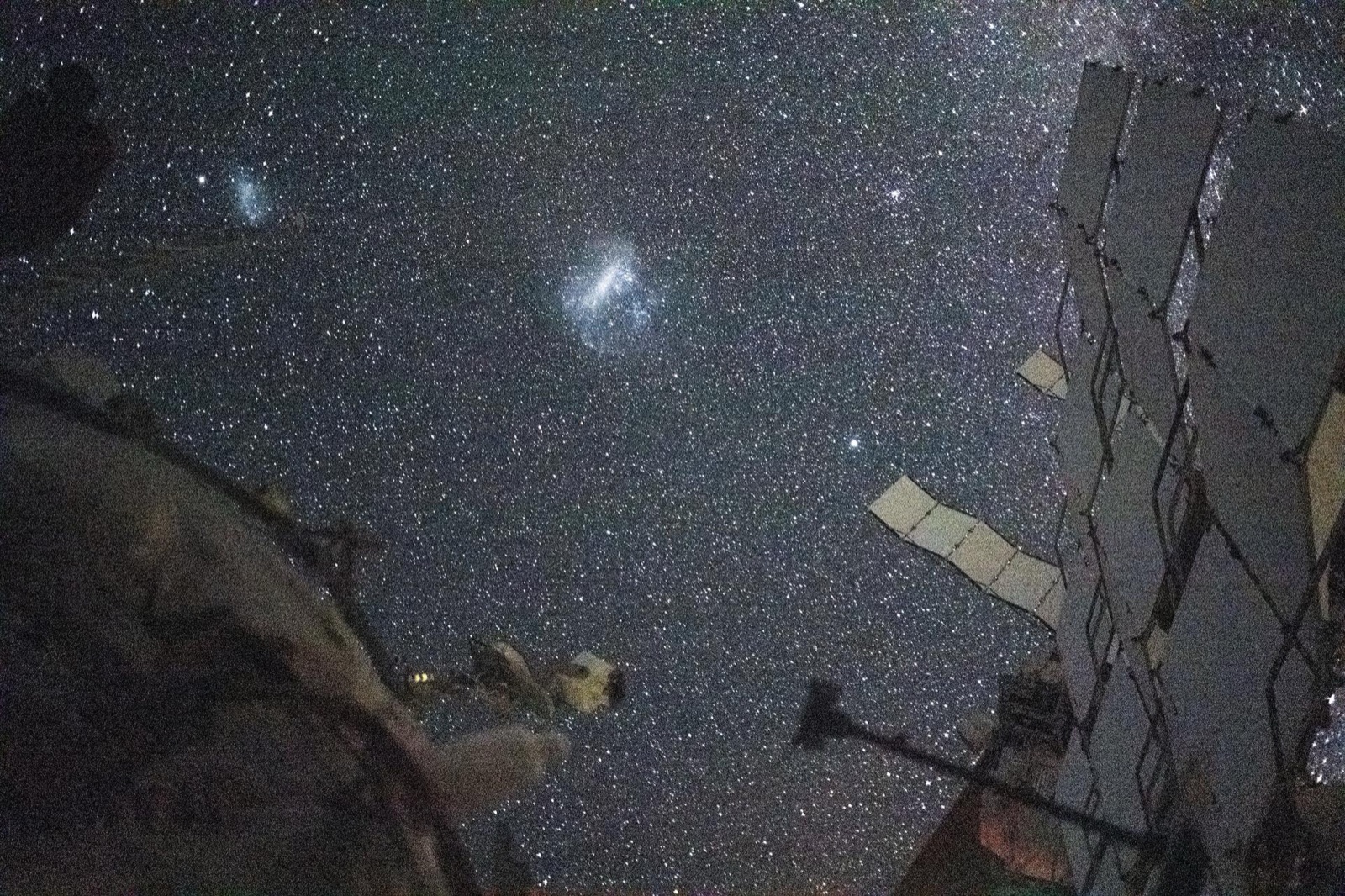
A small irregular galaxy like the Large Magellanic Cloud, but forming stars twice as fast.
What is it?
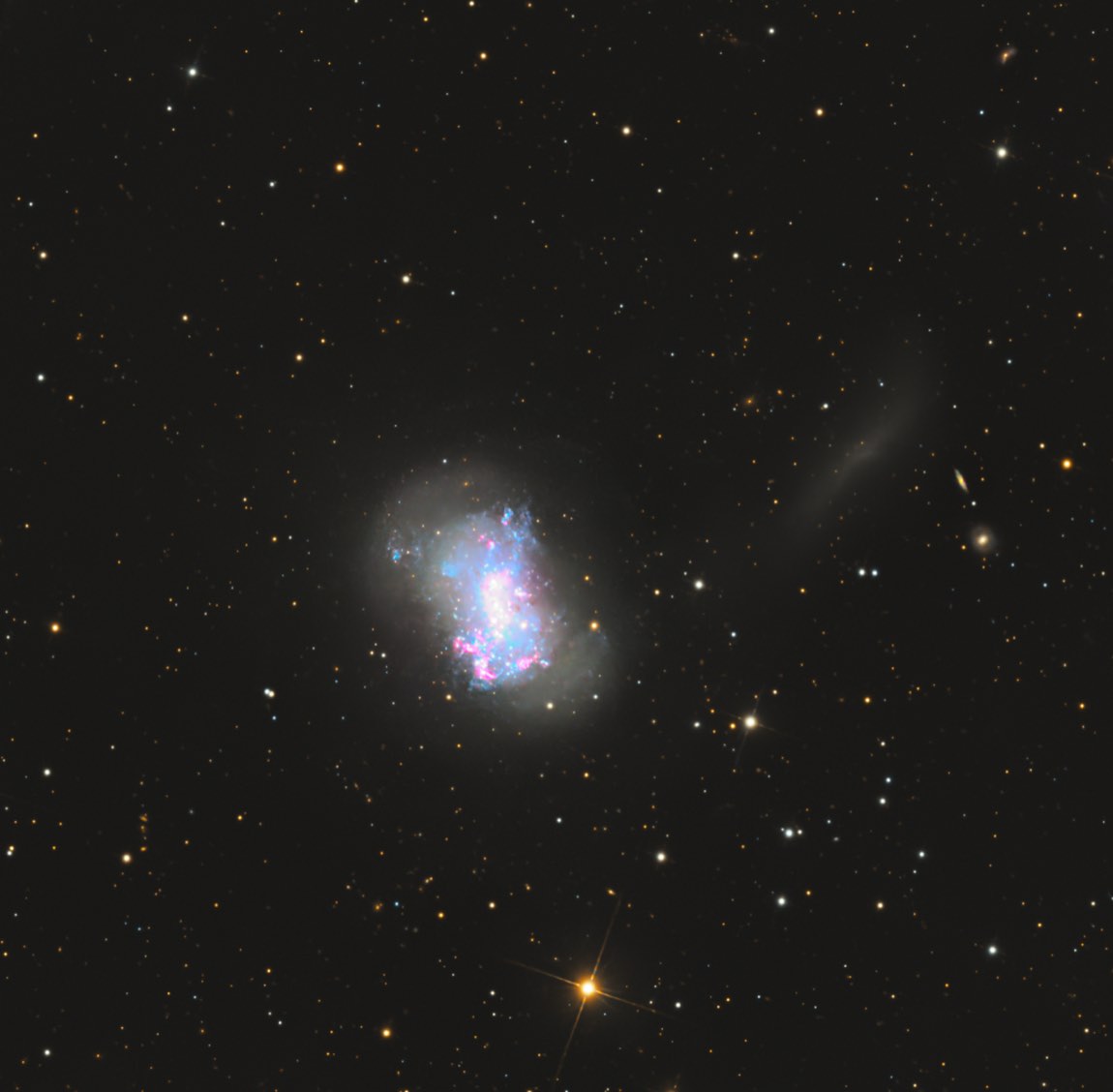
NGC 4449 is an irregular galaxy in Canes Venatici that looks a lot like our neighbour the Large Magellanic Cloud, with a rough bar and scattered clusters of young blue stars, though it is fainter and smaller. It is a starburst galaxy, making stars at about twice the LMC's rate, and photos show the pink glow of hydrogen gas around its newborn clusters. It belongs to the M94 Group, also called the Canes Venatici I Group, close to our Local Group. William Herschel discovered it on 27 April 1788.
The deep dive
Researched for the Atlas from Wikipedia — NGC 4449 (2,247 characters read) · updated Nov 15, 2026
01 A Cosmic Twin of the Large Magellanic Cloud
NGC 4449 belongs to a special class called Magellanic-type irregular galaxies, and its closest analogue in our cosmic neighbourhood is the Large Magellanic Cloud — the Milky Way's most prominent satellite. The two share a recognisable bar-shaped structure and both are peppered with young, blue star clusters that give them a speckled, vivid appearance in photographs. Despite the resemblance, NGC 4449 is neither as large nor as bright as the LMC. What makes it stand out is its energy: NGC 4449 is classified as a starburst galaxy, meaning it is manufacturing new stars at a furious pace — roughly twice the rate of the LMC. That elevated star-birth rate fills the galaxy with massive, short-lived stars that ionise surrounding hydrogen gas, producing the characteristic pinkish glow visible in deep photographs. This warm-pink nebulosity is a reliable tracer of active star-forming regions, and in NGC 4449 it appears throughout the galaxy rather than being confined to a single zone, signalling that the starburst is widespread and vigorous.
02 The Enormous Hydrogen Envelope Around It Deeper
Beyond the stars and glowing gas that define NGC 4449's visible face lies a vast, invisible shell of neutral hydrogen gas stretching across 75 arc minutes of sky. To put that in perspective, this envelope is 14 times larger than the galaxy's optical diameter — imagine a city surrounded by a haze that reaches fourteen times further than the city limits. Neutral hydrogen at this scale is detected through its characteristic radio emission at the 21-centimetre wavelength rather than through visible light, making it accessible only to radio telescopes. What the maps of this envelope reveal is not a smooth, symmetrical shroud but a disturbed and irregular structure, with distortions that betray the gravitational fingerprints of nearby galaxies tugging and reshaping it. The sheer extent of the envelope suggests NGC 4449 has accumulated, or retained, a substantial reservoir of raw star-forming material. This reservoir, combined with the gravitational stirring provided by neighbours, may help explain why the galaxy has sustained such an elevated rate of star formation rather than exhausting its fuel supply and quietening down.
03 Two Galaxies Being Swallowed Right Now
In 2012, astronomers announced the discovery of two small galaxies caught in the act of being torn apart and absorbed by NGC 4449. The first is a dwarf spheroidal galaxy of extremely low surface brightness — so faint it had escaped detection until careful analysis of deep imaging revealed it. Despite its ghostly appearance, this dwarf carries a stellar mass comparable to NGC 4449's own halo, yet it harbours between five and ten times more dark matter relative to its stars than NGC 4449 itself does, making it an unusually dark-matter-rich object. The second companion is a highly flattened globular cluster adorned with two tails of young stars stretching away from it — a sign of tidal disruption — and astronomers suspect it may be the surviving nucleus of a once gas-rich galaxy. Both objects appear to have already been disrupted by NGC 4449's gravity and are in the process of being absorbed into it. These ongoing mergers offer a rare, real-time view of galaxy growth through cannibalism, a process thought to have built large galaxies like our own Milky Way over billions of years.
04 Dark Matter Hiding in a Faint Companion Deeper
The disrupted dwarf spheroidal galaxy discovered interacting with NGC 4449 carries an unusually high ratio of dark matter to stellar matter — between five and ten times that of NGC 4449. This disparity is scientifically significant. Dark matter cannot be seen directly; its presence is inferred from the gravitational influence it exerts on visible stars and gas. A dwarf galaxy with a ratio this extreme means that the vast majority of its mass is invisible, locked up in a dark-matter halo far more dominant than the halo around NGC 4449. Such dark-matter-heavy dwarfs are predicted to exist by theoretical models of cosmic structure formation, and finding one in the act of merging with NGC 4449 gives astronomers a chance to study how that dark matter behaves when the host galaxy is disrupted. As the dwarf is shredded, stars are pulled into streams, but dark matter may disperse differently, potentially leaving detectable signatures in the dynamics of NGC 4449's outer regions. This system is therefore a valuable laboratory for probing the nature and distribution of dark matter in small galaxies.
05 Ultraluminous X-Ray Source NGC 4449 X7 Deeper
Buried within NGC 4449 is at least one ultraluminous X-ray source, designated NGC 4449 X7. Ultraluminous X-ray sources are compact objects — likely black holes or neutron stars — that radiate X-rays at luminosities so extreme they exceed what a stellar-mass black hole should theoretically be capable of producing under standard accretion models, making them objects of intense debate. Three candidate optical counterparts for NGC 4449 X7 have been identified: all three are early-type supergiants, specifically ranging from B-type to F-type stars. These massive stars are estimated to be between 40 and 50 million years old and carry approximately eight times the mass of the Sun. The connection to such young, massive stars is telling: it places the X-ray source in an environment of recent, vigorous star formation, consistent with the galaxy's starburst nature. Whether one of these supergiants is the true companion of the compact X-ray-emitting object — perhaps donating material to it through mass transfer — remains an open question. Each candidate offers a different set of physical implications for understanding how ultraluminous X-ray sources are powered.
06 Star Clusters Scattered Across the Galaxy
One of NGC 4449's most visually striking features is its population of young, massive star clusters scattered across its body like bright beads. The images reveal clusters of hot blue stars that have formed relatively recently on cosmic timescales, their intense ultraviolet radiation ionising surrounding hydrogen and producing the pinkish glow that makes the galaxy so photogenic. Notably, one of these massive young star clusters sits at the very centre of NGC 4449, an unusual placement that hints at conditions in the galaxy's core that favour concentrated star formation. The presence of such clusters throughout the galaxy — rather than only in a ring or a single arm — reflects the widespread, galaxy-wide nature of the starburst. Each cluster represents a burst of near-simultaneous star births triggered by compressed gas, possibly driven by gravitational interactions with the neighbouring galaxies that have also distorted NGC 4449's neutral hydrogen envelope. These clusters will eventually age: the most massive stars will explode as supernovae within millions of years, enriching the surrounding gas with heavy elements and potentially triggering yet another generation of star formation.
07 Membership in the M94 Galaxy Group
NGC 4449 is not an isolated wanderer. It belongs to the M94 Group, also called the Canes Venatici I Group, a collection of galaxies located in the constellation Canes Venatici at roughly 13 million light-years from Earth. This group sits relatively close to the Local Group — the family of galaxies that includes the Milky Way, the Andromeda Galaxy, and dozens of smaller companions. The proximity of the M94 Group to the Local Group makes NGC 4449 one of the more accessible starburst galaxies for detailed study. The gravitational environment of a galaxy group matters enormously for the evolution of its members: galaxies interact, merge, strip gas from one another, and trigger each other's star formation. NGC 4449's distorted hydrogen envelope and its two in-progress mergers with smaller companions are almost certainly shaped by its membership in this group. Studying NGC 4449 within this context helps astronomers understand how group environments accelerate or sustain star formation compared to galaxies that live in complete isolation.
08 William Herschel's Discovery in 1788
NGC 4449 was discovered on 27 April 1788 by William Herschel, the German-British astronomer whose systematic sweeps of the sky with his reflecting telescopes catalogued thousands of nebulae and star clusters. Herschel at the time had no way of knowing that the faint smudge he recorded was an entire galaxy — the concept of island universes beyond the Milky Way would not be observationally confirmed until well into the twentieth century. To Herschel, it would have appeared as a faint, slightly extended nebulosity, unremarkable among the many objects he catalogued on his prolific observing nights. The galaxy later received the designation NGC 4449 in John Louis Emil Dreyer's New General Catalogue, published in 1888, which systematised the discoveries of Herschel and others into the reference list that astronomers still use today. It is also listed as Caldwell 21 in Patrick Moore's Caldwell Catalogue, a modern list of showpiece objects beyond the Messier catalogue designed specifically to guide amateur observers to interesting targets.
09 Tidal Interactions Shaping Star Formation Deeper
The interactions NGC 4449 is experiencing with nearby galaxies are not merely cosmetic. Astronomers believe these gravitational encounters have played an active role in driving the galaxy's elevated rate of star formation. When galaxies approach one another, tidal forces compress gas clouds, raising densities beyond the threshold needed for gravitational collapse, which triggers bursts of new star formation. The irregularities and distortions seen in NGC 4449's enormous neutral hydrogen envelope are the visible evidence of these forces at work, stretching and sloshing the raw fuel for star formation in ways that an undisturbed, isolated galaxy would never experience. The two companions currently being absorbed — the disrupted dwarf spheroidal and the tailed globular cluster — represent the most recent chapter in this history of gravitational encounters. Absorbing their gas and stellar material may add fresh fuel to the starburst or redistribute mass in ways that sustain the elevated star-formation rate further into the future. Untangling which interactions triggered which episodes of star formation is an active area of research, as it requires piecing together the orbital histories of objects now being torn apart.
10 How to Find and Observe NGC 4449
NGC 4449 lies in the constellation Canes Venatici, the Hunting Dogs, a northern constellation that climbs high in the sky during spring evenings for observers in the northern hemisphere. With an apparent magnitude visible in the article's catalogue data, it is reachable with a modest amateur telescope under reasonably dark skies. The galaxy rewards patience: larger apertures and darker sites will reveal the irregular, bar-like shape and hints of patchiness caused by the embedded star clusters, though the pinkish hydrogen nebulosity that makes it so spectacular in long-exposure photographs remains invisible to the human eye at the eyepiece. Its membership in the M94 Group means that the surrounding area of sky contains other group members that can be visited in the same session. Because of its relatively close distance of about 13 million light-years — close by extragalactic standards — NGC 4449 is one of the best-studied and most photographically rewarding starburst irregulars accessible to both professional observatories and dedicated amateur astrophotographers seeking a vivid target beyond the Milky Way.
11 Open Questions About NGC 4449 Deeper
Despite decades of study, NGC 4449 leaves several important questions unresolved. The exact nature of NGC 4449 X7 remains unclear: astronomers have three candidate optical counterparts for the ultraluminous X-ray source, but which of the three B-type to F-type supergiants is truly associated with the compact X-ray emitter — if any — has not been confirmed. The mechanism sustaining the starburst is also not fully pinned down: it is widely attributed to gravitational interactions with neighbours, but the precise sequence of encounters and their relative contributions to triggering star formation is still being reconstructed. The disrupted dwarf spheroidal companion's extreme dark-matter-to-stellar-mass ratio, between five and ten times that of NGC 4449, raises questions about how such dark-matter-dominated systems form and whether the dark matter will remain associated with the stellar streams as the dwarf is absorbed. Additionally, the long-term fate of NGC 4449's starburst is uncertain: will the absorption of its companions inject new gas and prolong the elevated star-formation rate, or will stellar feedback from supernova explosions eventually blow away the remaining gas and bring the starburst era to an end?
 ⤢