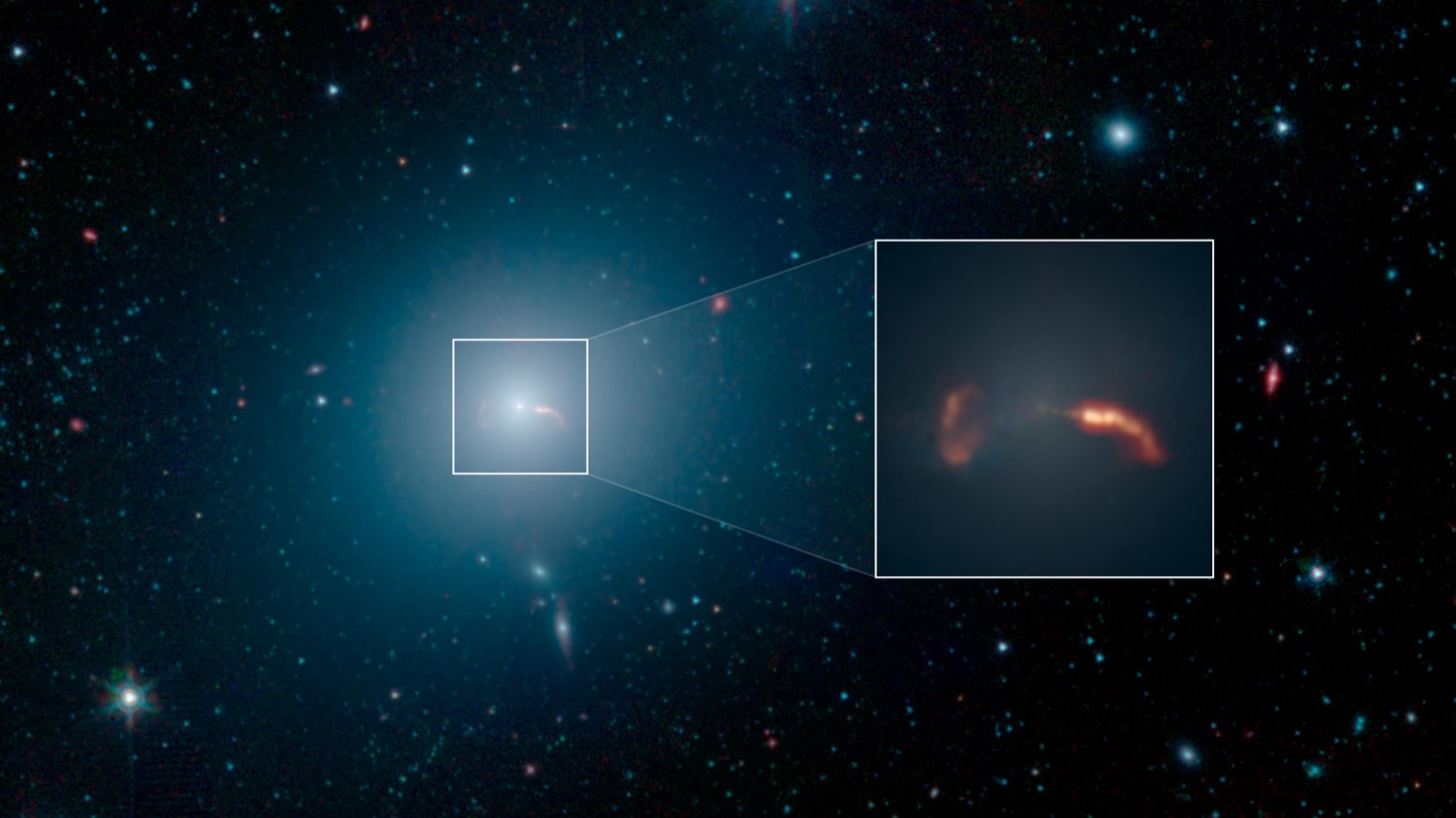
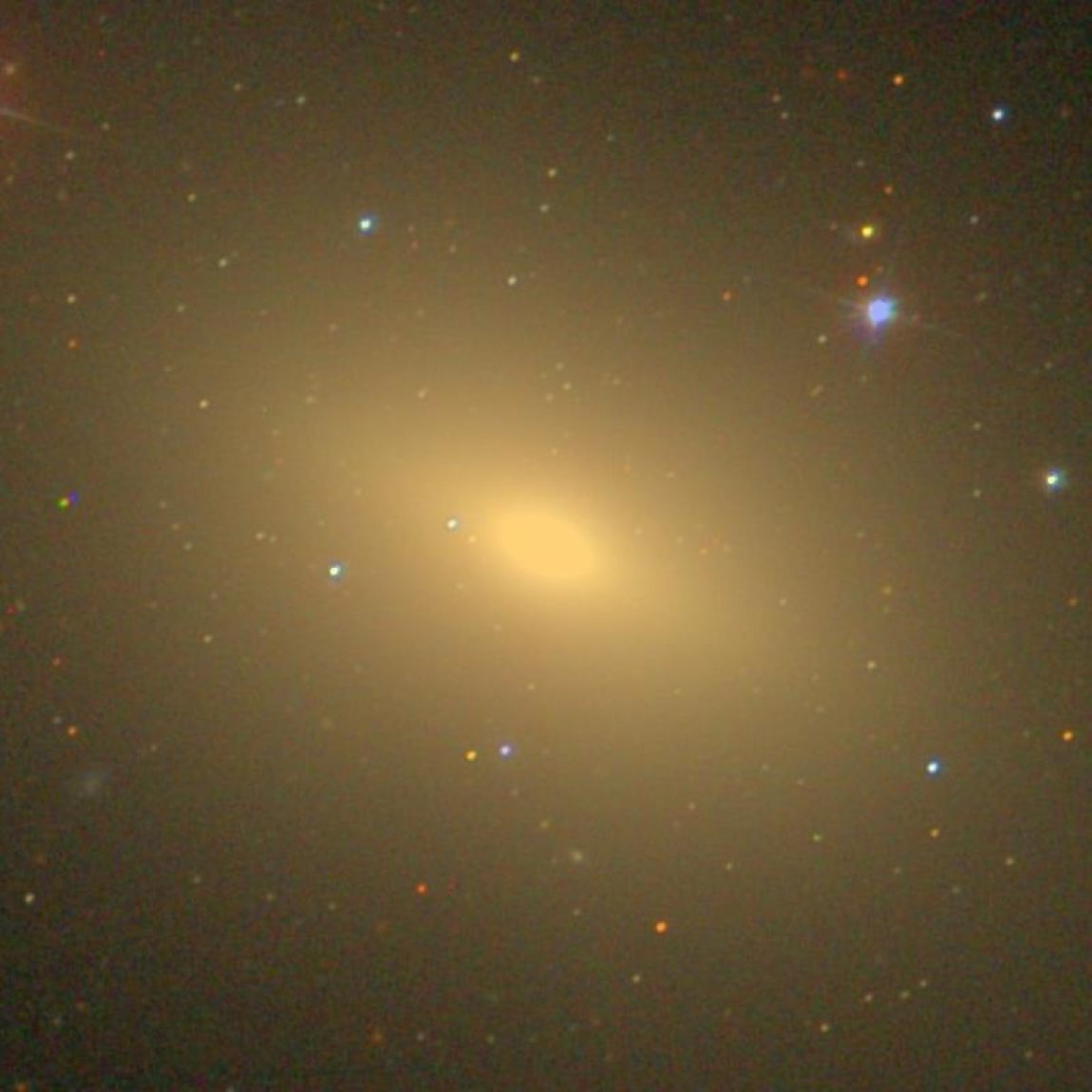
 Photograph · Sloan Digital Sky Survey · CC BY 4.0
Galaxy · Deep guide
NGC 4697
Also called: Caldwell 52 · C52 · UGCA 300 · PGC 43276
A bright elliptical galaxy in Virgo, occasionally hidden by the Moon during lunar eclipses.
What is it?
NGC 4697 is an elliptical galaxy in Virgo, the leading member of the NGC 4697 Group, one of the Virgo II Groups that form a southern extension of the Virgo Supercluster. Its distance is uncertain, with measurements ranging from 28 to 76 million light-years; averages fall around 38 to 50 million. ALMA observations of a gas disc at its centre put the mass of its supermassive black hole at about 130 million Suns. William Herschel discovered it on 24 April 1784.
The deep dive
Researched for the Atlas from Wikipedia — NGC 4697 (1,528 characters read) · updated Nov 15, 2026
01 A galaxy with a surprisingly uncertain address
For a galaxy that astronomers have studied for well over two centuries, NGC 4697 has a surprisingly fuzzy address. Its distance has been measured many times, yet estimates range all the way from 28 to 76 million light-years — a spread so wide that the far end is nearly three times the near end. The NASA Extragalactic Database averages those measurements at about 38 million light-years, while SIMBAD, another major astronomical database, settles on roughly 50 million light-years. Neither figure is considered definitive. This uncertainty matters because almost every derived property of the galaxy — its true size, its intrinsic brightness, the actual mass budget of its stars — scales with distance. Until astronomers pin down where NGC 4697 really sits, all those values carry the same inherited fuzziness. The working range of 40 to 50 million light-years represents a practical compromise, but it is an honest reminder that even nearby, well-studied galaxies can keep their secrets.
02 William Herschel's April night in 1784
NGC 4697 entered the astronomical record on 24 April 1784, when German-British astronomer William Herschel swept it up during one of his systematic surveys of the northern sky. Herschel was at the height of his cataloguing career at the time, methodically working through the heavens with large reflecting telescopes of his own construction. The galaxy later received the designation Caldwell 52 in Patrick Caldwell-Moore's catalogue of showpiece deep-sky objects — a list compiled specifically to complement Messier's famous catalogue with objects Messier had overlooked. That Herschel found it at all, using eighteenth-century instruments and candlelight record-keeping, speaks to both his observational skill and the galaxy's relative brightness. At an apparent magnitude recorded in later surveys as sufficient for modest telescopes, NGC 4697 is one of the more accessible elliptical galaxies in the constellation Virgo for modern amateur astronomers following in Herschel's footsteps.
03 Membership in the Virgo Supercluster's southern arm Deeper
NGC 4697 is not a lone wanderer. It anchors the NGC 4697 Group, a gravitationally bound collection of galaxies that also includes the spiral galaxy NGC 4731 along with several considerably smaller companions. The group as a whole sits about 55 million light-years away. What makes this membership cosmologically interesting is the group's larger affiliation: the NGC 4697 Group is one of the Virgo II Groups, a chain of galaxy groups that form a southern extension of the Virgo Supercluster. The Virgo Supercluster — sometimes called the Local Supercluster because our own Milky Way belongs to it — is one of the great structural features of our cosmic neighbourhood. The Virgo II Groups trace a filament branching away from the supercluster's core, and NGC 4697's group is one bead on that filament. Studying the dynamics and distances of such groups helps astronomers map the large-scale architecture of matter in the local universe.
04 Weighing the monster at the galaxy's heart Deeper
At the centre of NGC 4697 lurks a supermassive black hole whose mass has been pinned down with unusual precision. Observations from the Atacama Large Millimeter Array — a powerful interferometric radio telescope in the Chilean desert — tracked the rotation of the central gas disk surrounding the black hole. That rotation betrays the gravitational pull at the core, allowing astronomers to calculate a mass of 1.3 times 10 to the power of 8 solar masses, with an uncertainty of plus 0.18 or minus 0.17 times 10 to the power of 8 solar masses. In everyday terms, that is 130 million times the mass of our Sun packed into a region far smaller than the solar system. The use of millimeter-wave interferometry to measure gas disk rotation represents a relatively modern technique, capable of resolving the tiny central regions of galaxies tens of millions of light-years away and providing black hole mass estimates that complement older stellar-dynamics methods.
05 A Type Ia supernova spotted in 2018
On 14 November 2018, prolific Japanese supernova hunter Kōichi Itagaki discovered a stellar explosion inside NGC 4697. Designated SN 2018imd, it was classified as a Type Ia supernova and reached an apparent magnitude of 15.5 — bright enough for dedicated amateur telescopes but invisible to the naked eye. Type Ia supernovae are particularly valued by cosmologists because they behave as standardisable candles: their intrinsic peak luminosity can be calibrated, making them powerful tools for measuring cosmic distances. Finding one in a galaxy whose own distance is poorly constrained creates an interesting situation — SN 2018imd could in principle help refine the distance to NGC 4697 itself, though the full analysis of such events takes time. Itagaki's discovery added NGC 4697 to the relatively short list of nearby elliptical galaxies known to have hosted an observed supernova in the modern era of digital sky surveys.
06 When the Moon swallowed a galaxy — four times
NGC 4697 has the rare distinction of being repeatedly occulted by the Moon during total lunar eclipses — a doubly unusual coincidence of geometry and timing. The first recorded event was on 2 April 1950, when the eclipsed Moon slid in front of the galaxy as seen from the Iberian Peninsula, Africa, Madagascar, Arabia, and the Indian Ocean. The same alignment repeated on the April 1996 lunar eclipse over the same broad region, and again during the April 2015 lunar eclipse, that time visible from extreme northeastern Siberia and North America. The next such event is predicted for 4 April 2080, when the occultation will be visible from the Pacific Ocean, including Hawaii. These occultations are scientifically interesting because the Moon's sharp, well-defined limb can be used to probe the structure of background sources as they disappear and reappear, though NGC 4697's extended nature as a galaxy makes such analysis more complex than for a point-like star or quasar.
07 How to find NGC 4697 in the night sky
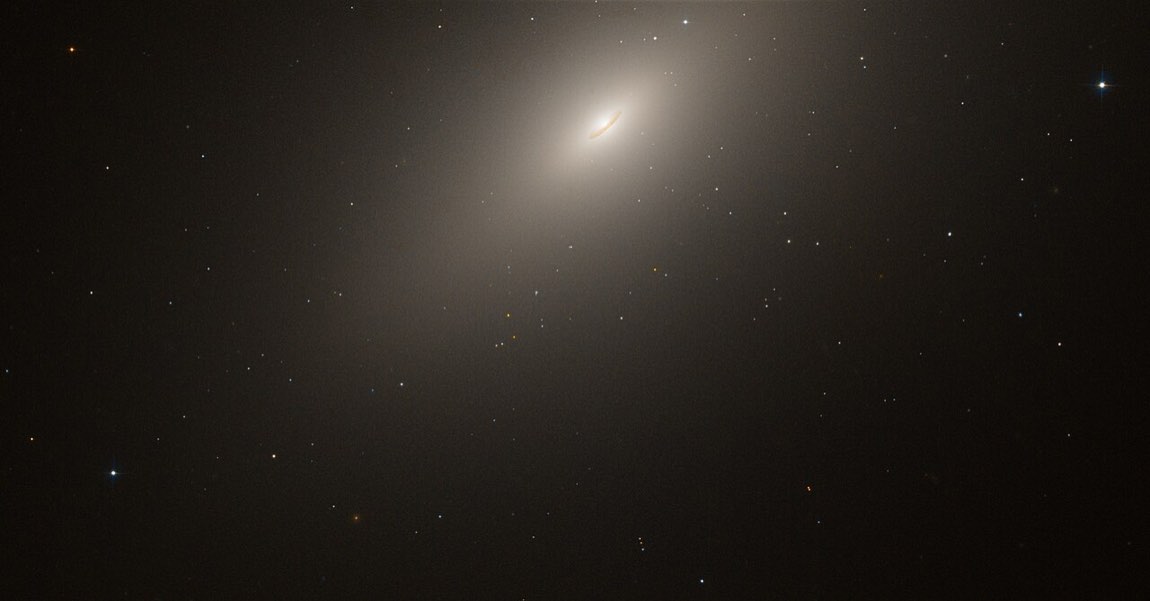
NGC 4697 lies in the constellation Virgo, a region of sky famously rich in galaxies due to our relatively close proximity to the Virgo Cluster and the broader Virgo Supercluster. Because it carries the Caldwell 52 designation, it appears in many amateur observing lists as a recommended target that Messier passed over. With a dark sky and a moderate-aperture telescope, the galaxy presents itself as an oval glow — the typical appearance of an elliptical galaxy whose smooth, featureless disk of old stars lacks the dramatic spiral arms or dust lanes that make other galaxy types visually striking. Its apparent magnitude makes it accessible under good conditions, and observers in the mid-latitudes of both hemispheres can find it during Virgo's spring evening apparition in the northern hemisphere. The surrounding NGC 4697 Group means that nearby galaxies, including NGC 4731, may be visible in the same or adjacent fields of view.
08 What elliptical galaxies like this one tell us Deeper
NGC 4697 belongs to the elliptical class — galaxies dominated by old, red stars arranged in smooth, roughly ellipsoidal distributions with little ongoing star formation and minimal cold gas and dust compared to spiral galaxies. Ellipticals are thought to represent a later stage of galactic evolution, often built up through mergers of smaller galaxies over billions of years. The presence of a well-measured supermassive black hole at NGC 4697's centre fits a broader pattern: virtually every large elliptical galaxy examined closely enough turns out to harbour such an object, and the black hole's mass tends to correlate with the mass of the surrounding stellar bulge. The gas disk whose rotation ALMA measured to weigh NGC 4697's black hole is itself somewhat unusual for an elliptical, since these galaxies typically contain very little cold gas. Its presence hints at a minor accretion event — perhaps gas acquired from a small companion or cooling from the hot gas halo that surrounds many elliptical galaxies.
09 The NGC 4697 Group in context Deeper
While NGC 4697 is by far the most studied member of its group, the group itself — sitting at roughly 55 million light-years — is one node in a much grander web. The Virgo II Groups collectively constitute a southern extension of the Virgo Supercluster, stretching away from the supercluster's dense core in the direction of the constellation Virgo as seen from Earth. This makes the NGC 4697 Group a kind of outpost on the supercluster's periphery. The companion galaxy NGC 4731 is a spiral, making the group an example of a mixed morphology group — containing both elliptical and spiral members — which is common at the outskirts of superclusters where galaxy mergers and the environmental effects that transform spirals into ellipticals are less advanced than in denser cores. Mapping the full membership and dynamics of the NGC 4697 Group, including its many smaller galaxies, remains an open observational task that feeds into broader studies of how superclusters are assembled.
 ⤢