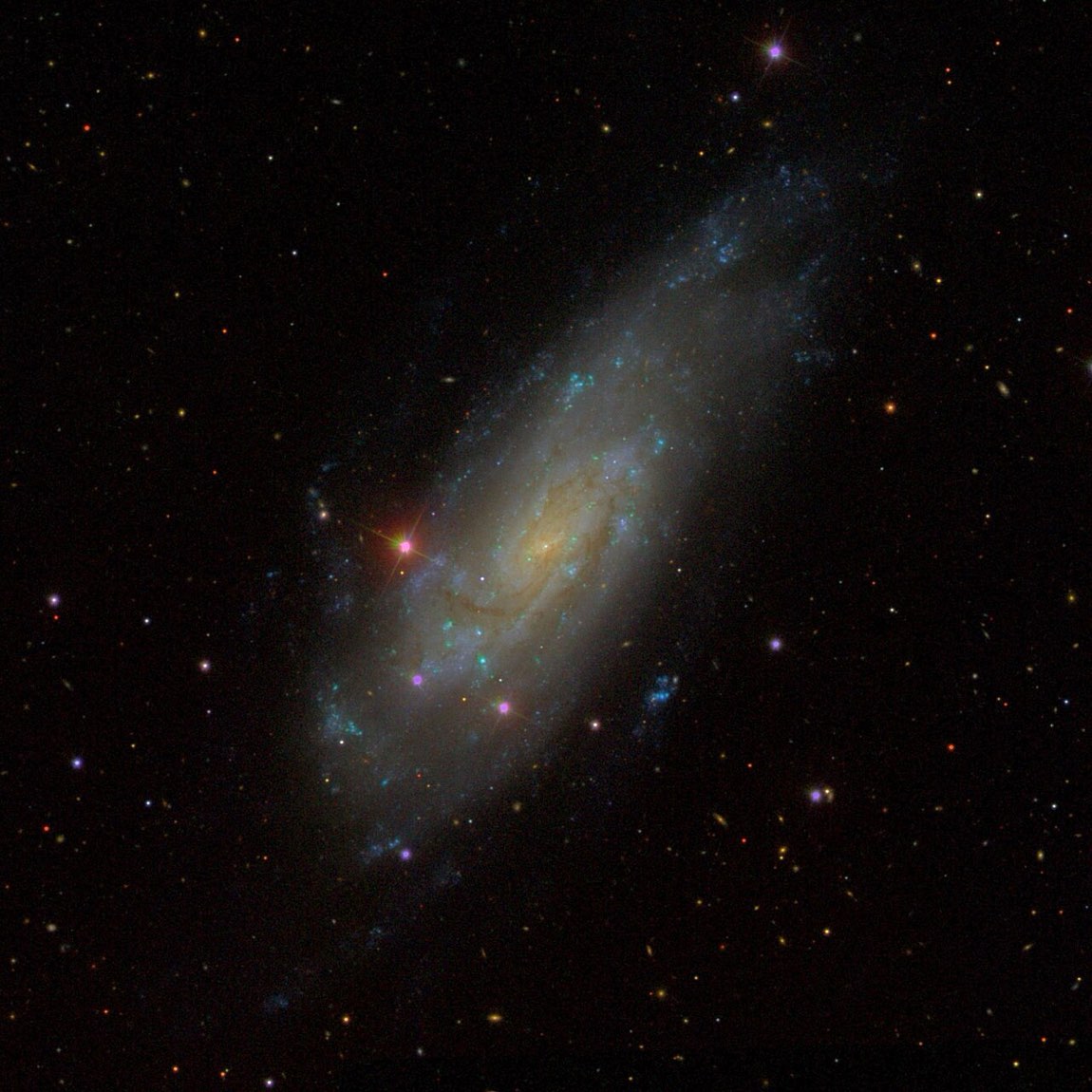
 Photograph · Sloan Digital Sky Survey · CC BY 4.0
Galaxy · Deep guide
NGC 4559
Also called: Caldwell 36 · C36 · UGC 7766 · PGC 42002
A loosely wound spiral in Coma Berenices hosting a star that keeps erupting like a supernova.
What is it?
NGC 4559 is a barred spiral galaxy in Coma Berenices with a weak inner ring and loosely wound arms, tilted 67° to our line of sight. It is a member of the Coma I Group and forms stars at a fairly brisk rate. One supernova, SN 1941A, has been recorded in it, and it also hosts the luminous blue variable AT2016blu, a star that has had repeated supernova-like outbursts since it was found in 2012. William Herschel discovered the galaxy on 11 April 1785.
The deep dive
Researched for the Atlas from Wikipedia — NGC 4559 (1,704 characters read) · updated Nov 15, 2026
01 A Galaxy Caught Between Two Identities
NGC 4559 carries a classification that reflects genuine ambiguity in galactic structure: SAB(rs)cd. That string of letters is a precise shorthand. The "SAB" part means the galaxy sits between a pure spiral and a fully barred spiral — its central bar is real but not dominant, making it what astronomers call an intermediate barred spiral. The "(rs)" tag signals a weak inner ring structure, a subtle loop of stars and gas that traces the bar's gravitational influence without forming a crisp, closed ring. Finally, "cd" describes spiral arms that are loosely wound, sprawling outward in an open, relaxed pattern rather than tightly coiled around the core. Together these features paint a portrait of a galaxy that hasn't committed fully to any single structural category — a common condition in the universe, but one that makes NGC 4559 a useful reference point for studying how bars and rings evolve over cosmic time.
02 Why the Distance to NGC 4559 Is Disputed Deeper
Pinning down exactly how far away NGC 4559 is turns out to be surprisingly contentious. The galaxy's velocity relative to the cosmic microwave background — 1,096 ± 20 km/s — implies a Hubble distance of 52.7 ± 3.8 million light-years, using the expansion of the universe as a cosmic ruler. But 26 independent measurements that don't rely on redshift at all converge on a much closer figure: just 24.56 ± 1.58 million light-years. That is roughly half the redshift-based estimate. The discrepancy likely reflects the galaxy's peculiar velocity — its own motion through space, pulled by the gravitational tug of nearby mass concentrations, superimposed on the general cosmic expansion. Until more precise distance indicators are applied, both values remain in circulation in the literature, and any derived physical quantity — luminosity, star formation rate in absolute terms, the true brightness of past supernovae — carries that same fundamental uncertainty along with it.
03 William Herschel's April Discovery
NGC 4559 entered the astronomical record on 11 April 1785, catalogued by William Herschel, the German-British astronomer who systematically swept the sky with reflective telescopes of his own construction. Herschel was in the midst of the most ambitious observing campaign of the eighteenth century, compiling thousands of nebulae and star clusters that would eventually form the basis of the New General Catalogue published decades after his death. Finding a loosely wound spiral galaxy in Coma Berenices would have meant little to Herschel in structural terms — the nature of spiral nebulae as independent "island universes" vast distances away wasn't established until the twentieth century. To him, NGC 4559 was simply a faint, extended smudge. The galaxy is also catalogued as Caldwell 36, part of the alternative deep-sky list compiled by Patrick Moore as a companion to Messier's famous catalogue.
04 A Tilted View From Earth
From our vantage point, NGC 4559 is inclined at 67 degrees to the plane of the sky. That angle is steep enough that the galaxy appears noticeably elongated — not quite edge-on, which would be 90 degrees, but far from face-on. At 67 degrees of inclination, observers can see the disk's extent and the sweep of the loosely wound arms while still gaining some view of their depth and thickness. This tilt is scientifically useful: it allows astronomers to measure both the radial velocity of gas across the disk using Doppler shifts and the geometric shape of the arms simultaneously. The inclination also partially reveals the central region, letting researchers study the weak bar and inner ring structure without the arms folding entirely behind one another as they would in a nearly edge-on system. For visual observers, that same tilt gives NGC 4559 an attractively elongated, lens-shaped silhouette in a telescope eyepiece.
05 The Supernova That Rebecca Jones Found
On 24 February 1941, astronomer Rebecca Jones discovered a supernova blazing inside NGC 4559, designated SN 1941A. When researchers went back through archival photographs of the galaxy, they were able to push the discovery date even earlier: the supernova had already been visible in images taken on 5 February 1941, nearly three weeks before Jones caught it. SN 1941A was classified as a Type II-L supernova, meaning it arose from the core collapse of a massive star and its light curve declined in a roughly linear fashion rather than showing the plateau typical of some other Type II events. At peak, it reached magnitude 13.2 — bright enough to be a conspicuous point of light within the galaxy's disk when observed through a modest telescope. It remains the only confirmed supernova recorded in NGC 4559, though the galaxy's active star formation means more massive stars are being born that will eventually meet the same fate.
06 AT 2016blu: A Star That Won't Stay Quiet Deeper
Among the most remarkable inhabitants of NGC 4559 is AT 2016blu, a luminous blue variable also catalogued as PSN J12355230+2755559 and NGC 4559OT. It was first detected by the Lick Observatory Supernova Search — known by the acronym LOSS — on 11 January 2012. What makes it extraordinary is not a single dramatic event but persistent, repeated eruptions: supernova-like outbursts were recorded when it was discovered, then again in 2014, 2016, 2017, 2018, 2019, 2020, 2021, 2022, 2024, 2025, and 2026. Luminous blue variables are massive stars that sit near the edge of stability, prone to ejecting enormous shells of material without fully destroying themselves — sometimes called "supernova impostors" because they can mimic the brightness spike of a true stellar death. AT 2016blu's relentless series of outbursts makes it an unusually active example of this already dramatic class, offering a rare extended window into the final unstable centuries of a very massive star's life.
07 An Ultraluminous X-Ray Source Inside the Galaxy Deeper
NGC 4559 harbors an ultraluminous X-ray source — an object radiating X-rays at luminosities so extreme that, if powered by a single compact object obeying ordinary physics, it would appear to exceed the theoretical Eddington limit for stellar-mass black holes. This particular source sits inside a star-forming region of the galaxy, a location that is itself informative. The leading interpretation is that the source is a black hole actively accreting material from a companion star that has evolved into the supergiant phase of its life. Supergiant donor stars are massive and lose material through powerful stellar winds, feeding a compact accretor at a high rate. Whether the black hole in question is a stellar-mass object accreting in a super-Eddington regime, or something more massive in an intermediate category, remains an open question. Its placement in a region of active star formation fits the pattern seen in other ultraluminous X-ray sources, which tend to cluster where young, massive stars are abundant.
08 Star Formation Still Running Hot
NGC 4559 is not a quiet, aging galaxy. Its star formation rate is estimated at 1.3 solar masses per year — meaning that, on average, the galaxy assembles new stellar material equivalent to 1.3 times the mass of our Sun every single year. That figure places it in the category of moderately active star-forming spirals. The process is not uniform across the disk; it tends to concentrate in the spiral arms and in knots of dense gas, which is consistent with the galaxy hosting both its ultraluminous X-ray source and its restless luminous blue variable within regions of active star production. High star formation rates also mean a steady supply of massive, short-lived stars — the kind that explode as supernovae and generate the conditions that give rise to ultraluminous X-ray sources in the first place. In this sense, NGC 4559's energetic features are not coincidental but are direct products of a galaxy still vigorously building itself.
09 NGC 4559's Place in the Coma I Group
NGC 4559 is a member of the Coma I Group of galaxies, a loose association of spirals and other systems gathered by gravity in the direction of the constellation Coma Berenices. Galaxy groups are the most common environment in the universe — most galaxies, including our own Milky Way, belong to one rather than living in complete isolation. Membership in a group means NGC 4559 experiences gravitational interactions with its neighbors over cosmic time, which can stir gas reservoirs, trigger star formation, and slowly reshape a galaxy's structure. The Coma I Group is distinct from the much larger and more famous Coma Cluster, though both lie in the same broad region of sky. The group environment may partly explain why NGC 4559 retains loosely wound, open spiral arms rather than tightly structured ones — the intermediate gravitational stresses of group membership can influence how efficiently a bar and ring system develops and how wound the arms become.
10 How to Find and Observe NGC 4559
NGC 4559 sits in Coma Berenices, a northern constellation best placed for observation during spring evenings from the Northern Hemisphere. The galaxy carries an apparent magnitude bright enough to be accessible to amateur telescopes, and its 67-degree inclination gives it an elongated shape that is easier to distinguish from a point source than a face-on galaxy would be. At moderate apertures, the loosely wound arms begin to show structure, and the slightly brighter central region hints at the weak bar within. The galaxy's alternative designation, Caldwell 36, places it on Patrick Moore's Caldwell Catalogue — a popular observing list designed to complement Messier's catalogue by including notable objects Messier never recorded. Observers who work through the Caldwell list will encounter NGC 4559 as one of its galaxy targets, and those equipped with astrophotography setups can capture the elongated disk and begin to resolve the knots of star formation scattered through the arms, including the region hosting the ultraluminous X-ray source.
11 Open Questions Surrounding This Galaxy Deeper
Several threads remain genuinely unresolved in the study of NGC 4559. The distance discrepancy — a factor of roughly two between the redshift-based value of 52.7 ± 3.8 million light-years and the 26 non-redshift measurements averaging 24.56 ± 1.58 million light-years — propagates uncertainty into almost every derived property of the galaxy. The nature of the ultraluminous X-ray source is debated: stellar-mass black hole accreting beyond the Eddington limit, or an intermediate-mass object? The classification "may be" a black hole accreting from a supergiant donor is the current best interpretation, not a confirmed fact. And AT 2016blu continues to erupt, leaving open the question of when, or whether, it will finally cross the threshold into a genuine supernova — or whether it will continue its series of outbursts indefinitely. Each new eruption adds a data point to a dataset that is unlike almost anything else recorded in a nearby galaxy, making AT 2016blu one of the more closely watched individual stellar objects in current transient astronomy.
 ⤢