Galaxy · Deep guide
NGC 3115 (Spindle Galaxy)
Also called: Caldwell 53 · C53 · Spindle Galaxy · UGCA 199 · PGC 29265
An edge-on lenticular galaxy with a billion-Sun black hole and almost no gas left for new stars.
What is it?
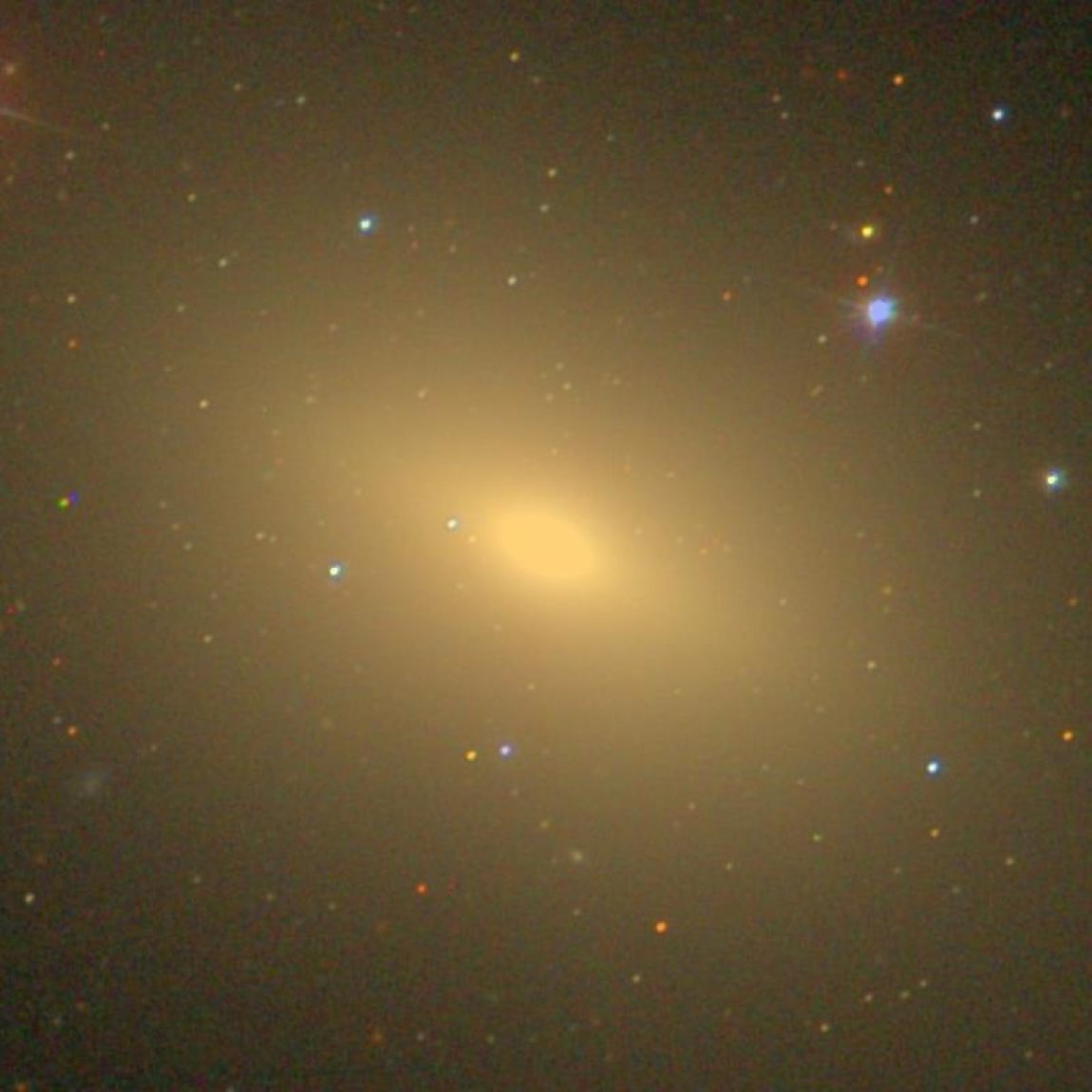
NGC 3115, the Spindle Galaxy, is a lenticular galaxy in Sextans: it has a disc and a central bulge but no spiral arms, and we see it nearly edge-on. About 32 million light-years away, it is several times larger than the Milky Way. It has used up most of its gas, so its stars are mostly very old. At its centre is a supermassive black hole of about a billion Suns, and in 2011 the Chandra X-ray Observatory imaged hot gas flowing toward it, the first clear evidence of such a flow into any black hole. William Herschel discovered it on 22 February 1787.
The deep dive
Researched for the Atlas from Wikipedia — NGC 3115 (2,096 characters read) · updated Nov 15, 2026
01 Why It Looks Like a Spindle in the Sky
NGC 3115 earned its popular name because of a remarkable coincidence of geometry: we happen to view it almost exactly edge-on from Earth. That orientation compresses the galaxy's full disk into a slim, elongated sliver of light — a shape that early observers compared to a spindle used in hand-spinning thread. Because the disk is presented edge-on rather than face-on, any spiral structure that might have once existed would be nearly impossible to detect from our vantage point. This is partly why the galaxy was misclassified for a long time as an elliptical rather than a lenticular. Only careful analysis of stellar motions and the distinct flattening of the light profile revealed the true disk-plus-bulge structure that defines a lenticular, or S0, galaxy. The edge-on view is actually scientifically valuable: it lets astronomers measure the thickness of the disk, the prominence of the central bulge, and the dynamics of stars at different heights above the galactic plane — information that a face-on view would blur together.
02 A Galaxy That Stopped Making Stars
The story of star formation in NGC 3115 is essentially a story that has already ended. In its early life, the galaxy possessed a youthful accretion disk rich in the gas and dust that are the raw ingredients for new stars. Over billions of years, however, it consumed nearly all of that material. Today, very little gas and dust remain, and without those ingredients the galaxy cannot manufacture new generations of stars. The vast majority of the stars visible in NGC 3115 are therefore very old — survivors from an era of active star birth that has long since passed. This makes the galaxy what astronomers sometimes call a "red and dead" system, dominated by cool, long-lived stars rather than the hot blue ones that signal recent or ongoing star formation. The exhaustion of its natal gas supply is likely connected to the same processes that ended the growth of its central black hole, suggesting that star formation and black hole feeding shut down together as the galaxy aged.
03 The First Clear View of Gas Falling Into a Black Hole Deeper
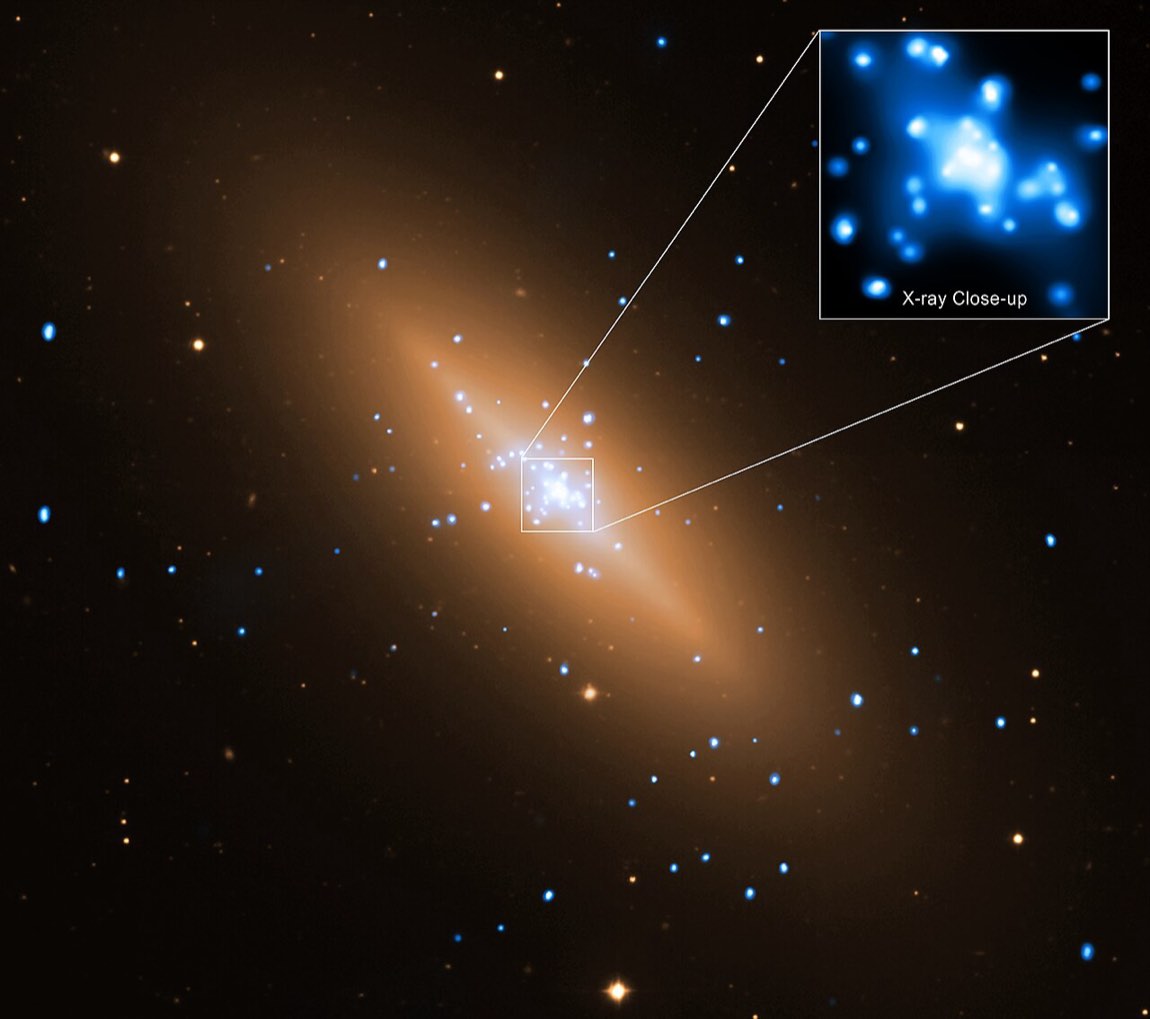
In 2011, NASA's Chandra X-ray Observatory achieved something that had never been done before with any black hole: it produced clear observational evidence of a flow of hot gas streaming directly toward a supermassive black hole. The target was the black hole at the center of NGC 3115. As gas falls inward under the black hole's gravity, it heats up and brightens, and Chandra was able to image that progression — capturing the moment where infalling material crosses the threshold from the galaxy's general environment into the gravitational domain of the black hole itself. The researchers identified the precise point where the gas temperature begins to rise sharply, located about 700 light-years from the black hole. This boundary is known as the Bondi radius, and its location provided an independent way to estimate the black hole's mass. The measurement yielded a figure of about two billion solar masses — consistent with earlier optical estimates — and confirmed that NGC 3115 hosts the nearest black hole of that extraordinary scale to Earth.
04 Two Estimates, One Monster Black Hole Deeper
The supermassive black hole at the heart of NGC 3115 has been weighed by two independent methods, and both point toward a staggering mass. The first estimate came in 1992, when John Kormendy of the University of Hawaii and Douglas Richstone of the University of Michigan announced their findings based on the orbital velocities of stars near the galactic core. Stars close to a very massive object orbit faster, and the measured speeds implied a central mass of approximately one billion solar masses. Nearly two decades later, the Chandra X-ray observations of 2011 used the location of the Bondi radius — the point where hot gas begins its final plunge — to independently estimate a mass of about two billion solar masses. The two values are consistent within the uncertainties of each method and together reinforce the conclusion that NGC 3115 harbors one of the most massive black holes in the nearby universe. At roughly 32 million light-years away, no other black hole in this mass range is known to sit closer to Earth.
05 When NGC 3115 May Have Been a Quasar
Looking at NGC 3115 today, it appears quiet and inert — an aging galaxy with an overfed but dormant black hole and almost no raw material left to stir up activity. Yet some researchers have speculated that in its youth, the galaxy may have looked radically different. If the central black hole was actively consuming large quantities of gas during the galaxy's early, gas-rich phase, it could have blazed as a quasar: one of the most luminous objects in the universe, outshining entire galaxies and visible across billions of light-years. Quasars are now understood to be the extremely active feeding phases of supermassive black holes. The speculation about NGC 3115's quasar past fits a broader picture in which many present-day quiet galaxies went through violent, luminous youth before their gas supplies ran out. The galaxy's current stillness — little gas, little star formation, a black hole that has stopped growing — would then represent the natural endpoint of that energetic early life.
06 Bigger Than the Milky Way, Yet Overlooked
NGC 3115 sits about 32 million light-years from Earth in the constellation Sextans — far enough away that it appears as a faint smudge without a telescope, yet close enough to be studied in considerable detail with modern instruments. Despite its relative proximity in cosmic terms, it has never achieved the same fame as showpiece galaxies like Andromeda or the Whirlpool. Part of the reason may be its edge-on orientation, which hides any dramatic face-on structure. Yet the galaxy is physically impressive: at 32 million light-years, it is described as several times bigger than the Milky Way. Its apparent magnitude places it within reach of amateur telescopes, and it is catalogued as Caldwell 53 in the popular observing list compiled by Patrick Moore — a designation that has introduced it to generations of backyard astronomers hunting objects beyond the Messier catalog. Its lenticular classification places it in an intermediate category between the spiral and elliptical families, making it a useful object for understanding how galaxies evolve.
07 William Herschel's Discovery in 1787
NGC 3115 was first recorded by the German-British astronomer William Herschel on February 22, 1787. Herschel was one of the most systematic sky surveyors of his era, methodically sweeping the sky with large reflecting telescopes he built himself. His cataloguing efforts uncovered thousands of nebulae and star clusters that had escaped earlier observers, and NGC 3115 was one of many deep-sky objects added to astronomy's inventory through his work. At the time of its discovery, there was no way to know the object's true nature — whether it was a cluster of stars, a cloud of gas within the Milky Way, or an entirely separate island of billions of stars far beyond our own galaxy. The concept of external galaxies as independent stellar systems was not established until the twentieth century. Herschel would have recorded it simply as a nebula, leaving later generations to unravel its identity as one of the nearest large lenticular galaxies, complete with a billion-solar-mass black hole at its center.
08 A Supernova Frozen in the Historical Record
NGC 3115 has hosted at least one confirmed stellar explosion: SN 1935B, a supernova observed in 1935. The historical record for this event is frustratingly sparse — neither the type of supernova nor its peak brightness, or apparent magnitude, is known from the surviving documentation. This is not unusual for supernovae discovered during the early decades of systematic supernova searches, when observational tools and record-keeping methods were far less standardized than they are today. A supernova's type matters enormously to astronomers: Type Ia events are used as standardizable distance indicators and can be used to map the expansion of the universe, while core-collapse supernovae signal the deaths of massive stars. Without knowing which category SN 1935B belonged to, its scientific utility is limited. What it does confirm is that at least one star in NGC 3115 ended its life catastrophically within the span of recorded astronomical observation — a reminder that even a quiet, gas-poor, apparently inactive galaxy is not entirely changeless.
09 The Bondi Radius as a Cosmic Measuring Stick Deeper
The concept of the Bondi radius — named after the physicist Hermann Bondi — describes the distance from a massive object at which its gravity begins to dominate over the pressure and thermal energy of surrounding gas. Inside this radius, gas inevitably falls inward; outside it, gas can still escape or remain in equilibrium with its surroundings. The fact that the Chandra observations of NGC 3115 were able to identify the Bondi radius at about 700 light-years from the central black hole was a significant achievement. At 32 million light-years away, resolving a feature only 700 light-years across requires exceptional angular resolution, which the Chandra X-ray Observatory provided. The measured radius then fed directly into an equation relating the Bondi radius to the black hole's mass and the temperature and density of the surrounding gas, yielding the estimate of approximately two billion solar masses. This technique — using the Bondi radius as a physical ruler — was demonstrated more clearly in NGC 3115 than in any previous target, making the galaxy a landmark case study in black hole astrophysics.
10 How to Find the Spindle Galaxy
NGC 3115 resides in the constellation Sextans, a faint and obscure constellation tucked between the more prominent Leo and Hydra. Sextans contains no bright stars of its own, which can make star-hopping to NGC 3115 a mild challenge, but the galaxy's apparent magnitude is bright enough to be detected with a modest amateur telescope under reasonably dark skies. It is listed as Caldwell 53, placing it in a popular observing catalog that many amateur astronomers work through alongside or after completing the Messier list. Through an eyepiece, its edge-on orientation presents a distinctive elongated glow — the spindle shape that gives it its common name is apparent even at moderate magnification. The bright central bulge stands out against the thinner disk on either side. Larger aperture telescopes reveal more of the disk's extent and the contrast between the dense nucleus and the surrounding stellar halo. Because of its relatively high surface brightness for a galaxy of its type, NGC 3115 is considered one of the more rewarding lenticular galaxies for visual observers.
11 What Lenticular Means — and Why It Matters
The term lenticular comes from the Latin word for lens, referring to the lens-like, disk-shaped form these galaxies take when viewed at an angle. Astronomers classify lenticular galaxies as type S0, positioning them in the Hubble sequence between elliptical galaxies, which are smooth and featureless, and spiral galaxies, which have distinct arms. NGC 3115 fits this intermediate category precisely: it has both a disk and a prominent central bulge — features shared with spirals — but lacks any detectable spiral pattern, which aligns it with ellipticals in terms of its smooth stellar distribution. Its edge-on orientation initially led to its misidentification as an elliptical, illustrating how viewing angle can fundamentally mislead classification. Lenticular galaxies like NGC 3115 are thought to represent an evolutionary endpoint: galaxies that once had spiral structure or active star formation but have since exhausted their gas and settled into a quieter, more uniform state. Studying NGC 3115 in detail offers clues about how and when this transformation happens across the broader galaxy population.
 ⤢