 Photograph · ESO · CC BY 4.0
Galaxy · Deep guide
NGC 247 (Claw Galaxy)
Also called: Caldwell 62 · NGC 247 · Claw Galaxy
A nearby spiral with a strange empty gap carved into one side of its disc.
What is it?
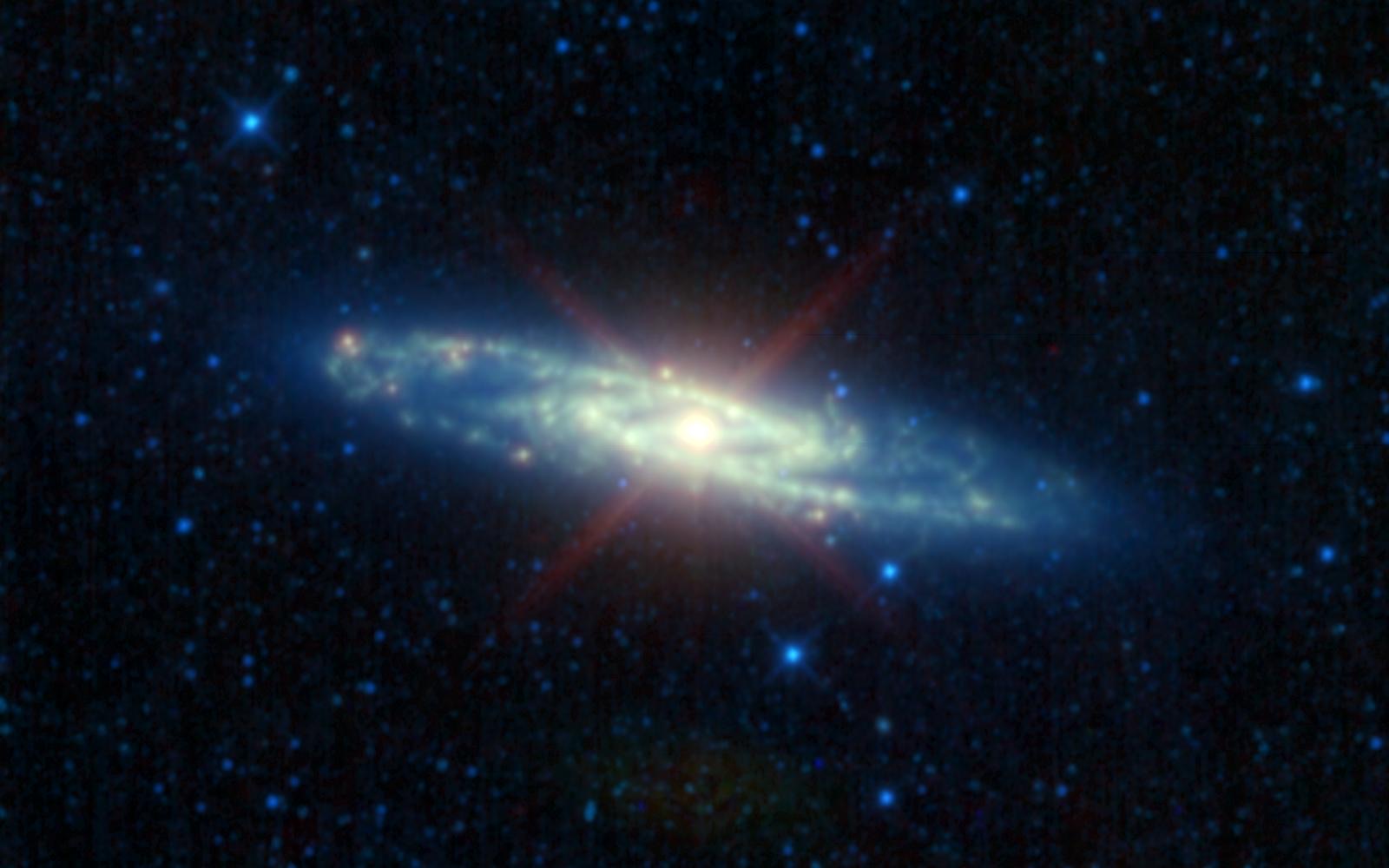
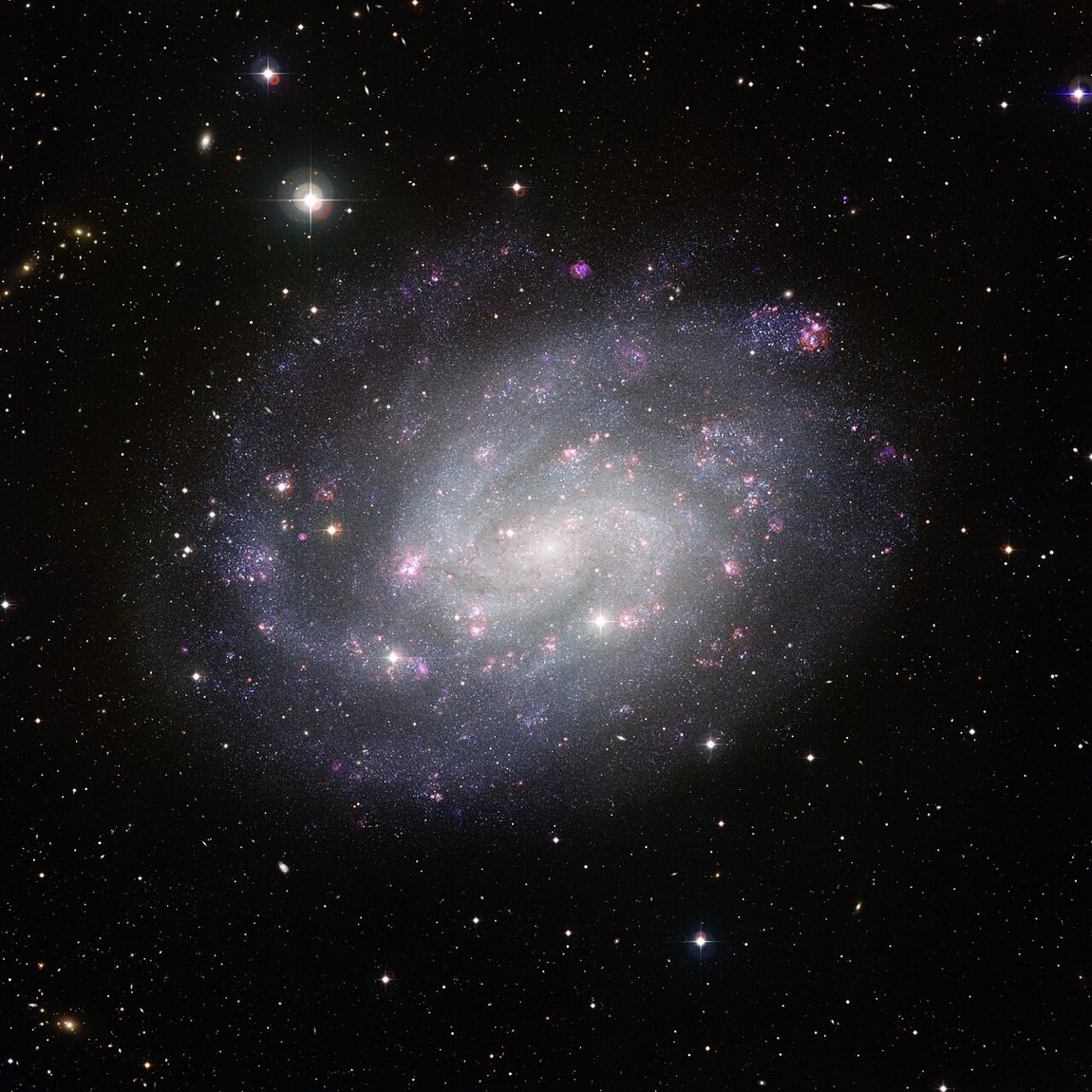
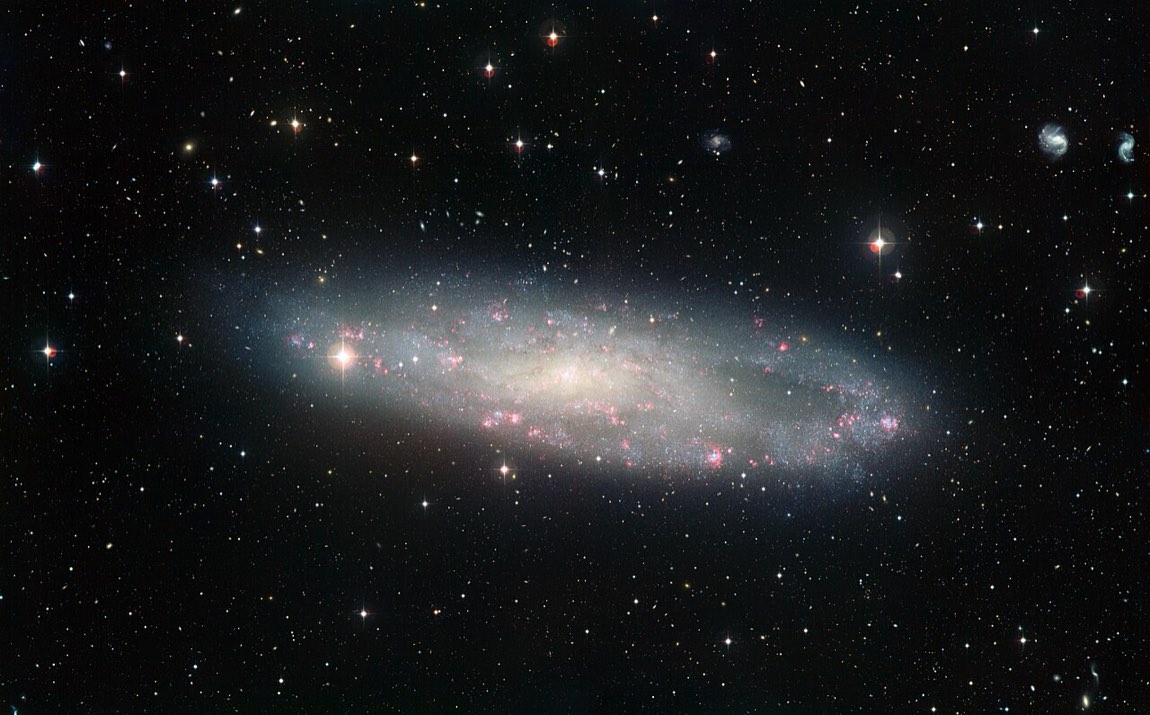
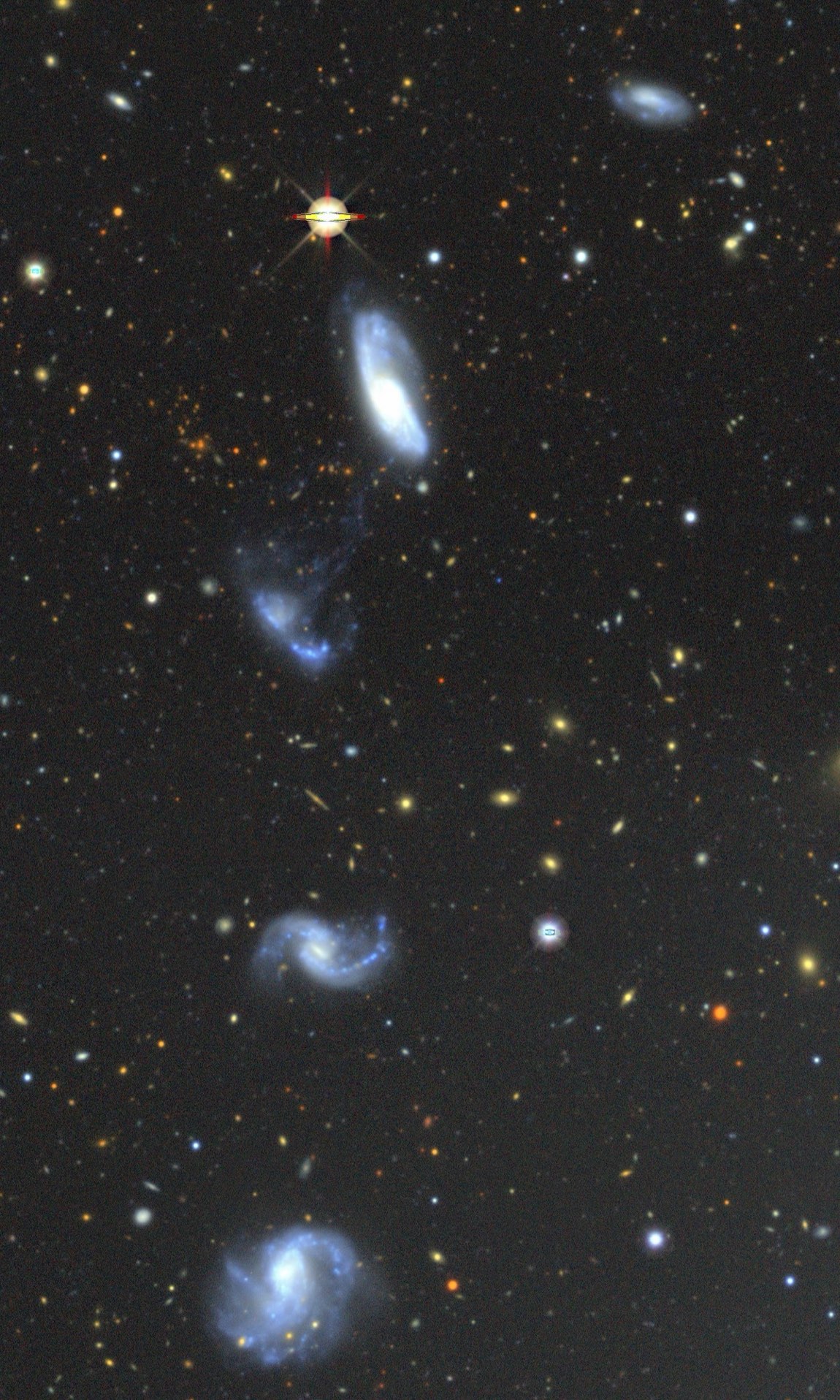
NGC 247 is an intermediate spiral galaxy in Cetus and a member of the Sculptor Group, one of the closest galaxy groups to the Milky Way. William Herschel discovered it in 1784. Its distance was measured using Cepheid variable stars observed in near-infrared light. One side of its disc holds an unusually large void that contains older, redder stars but no young blue ones. Nearby on the sky lies Burbidge's Chain, a line of five much more distant background galaxies.
The deep dive
Researched for the Atlas from Wikipedia — NGC 247 (1,431 characters read) · updated Nov 15, 2026
01 A galaxy with a mysterious hole in it
The most striking thing about NGC 247 is not what it has, but what it is missing. One side of its spiral disk contains an unusually large void — a region conspicuously empty of young, blue stars. The void does harbor some older, redder stars, so it has not been entirely evacuated of stellar material, but the absence of fresh star formation makes it stand out sharply against the rest of the disk. This feature is unusual enough that astronomers have taken particular notice of it, and it is one of the defining characteristics that makes NGC 247 scientifically interesting beyond its status as a nearby spiral. The exact mechanism behind this one-sided void remains a subject of investigation. Whatever process suppressed or displaced star formation in that region left the older stellar population intact, hinting that the disruption is relatively recent in cosmic terms rather than something that swept the area clean billions of years ago.
02 Pinning down the distance with Cepheids Deeper
Getting an accurate distance to NGC 247 required a technique that goes far beyond simply measuring how bright the galaxy appears in the sky. Astronomers used near-infrared photometry of Cepheid variables — a class of pulsating stars whose brightness cycles with a period directly linked to their intrinsic luminosity. By measuring how bright those Cepheids appear from Earth and comparing that to how bright they must truly be, researchers derived a distance of 11.02 ± 0.20 million light-years, equivalent to 3.38 ± 0.06 megaparsecs. That measurement came with impressively tight error bars. It also overturned a previously accepted value of about 12.2 million light-years, bringing NGC 247 meaningfully closer than once thought. The difference of roughly 1.2 million light-years matters because distance estimates ripple through every other derived property of a galaxy — its true physical size, its luminosity, and its position within its galaxy group all shift when the distance is revised.
03 William Herschel's October night in 1784
NGC 247 was discovered by William Herschel on 20 October 1784. Herschel, a German-British astronomer celebrated for his systematic sweeps of the entire sky, was in the midst of one of the most productive observational campaigns in the history of astronomy. Working from England with reflecting telescopes of his own construction, he catalogued thousands of nebulae and star clusters that would later be incorporated into the New General Catalogue — the same list that gives NGC 247 its name. At the time of discovery, there was of course no way to know that the faint smudge Herschel recorded was an entire galaxy of stars lying roughly eleven million light-years away. It would take more than a century of further astronomical development before the true nature of such objects became clear. Nevertheless, Herschel's careful documentation ensured that NGC 247 entered the permanent record of the sky.
04 NGC 247's place in the Sculptor Group
NGC 247 is not an isolated galaxy drifting alone through the cosmos. It belongs to the Sculptor Group, one of the nearest groups of galaxies to the Milky Way, making it one of our closest galactic neighbors in a broader sense. Within that group, NGC 247 is part of a compact, gravitationally tightly bound subcluster centered on the much larger and more famous Sculptor Galaxy, NGC 253. Several galaxies share this inner gravitational embrace with NGC 247, forming a dense core within the larger, more loosely associated Sculptor Group. Most other galaxies tied to the Sculptor Group sit much farther out and are only weakly gravitationally bound to this central core. This layered structure — a tight core embedded within a looser association — is a common pattern in galaxy groups and gives astronomers a natural laboratory for studying how gravity shapes the environments of spiral galaxies over time.
05 How big is 93,000 light-years across?
NGC 247 spans about 93,000 light-years in diameter. For comparison, our own Milky Way is commonly estimated to be around 100,000 light-years across, which means NGC 247 is slightly smaller than our home galaxy — not dramatically so, but noticeably compact for a spiral. That 93,000 light-year figure is itself a product of knowing the galaxy's true distance; the revised Cepheid-based distance of 11.02 million light-years feeds directly into calculating the physical size from the observed angular span. Had the older distance estimate of 12.2 million light-years remained in use, the computed diameter would have been proportionally larger. The galaxy's intermediate spiral classification places it in a broad morphological category between the most tightly wound grand-design spirals and more loosely structured irregular galaxies, suggesting a moderately organized disk structure despite the prominent void on one side.
06 Burbidge's Chain: five galaxies in a line Deeper
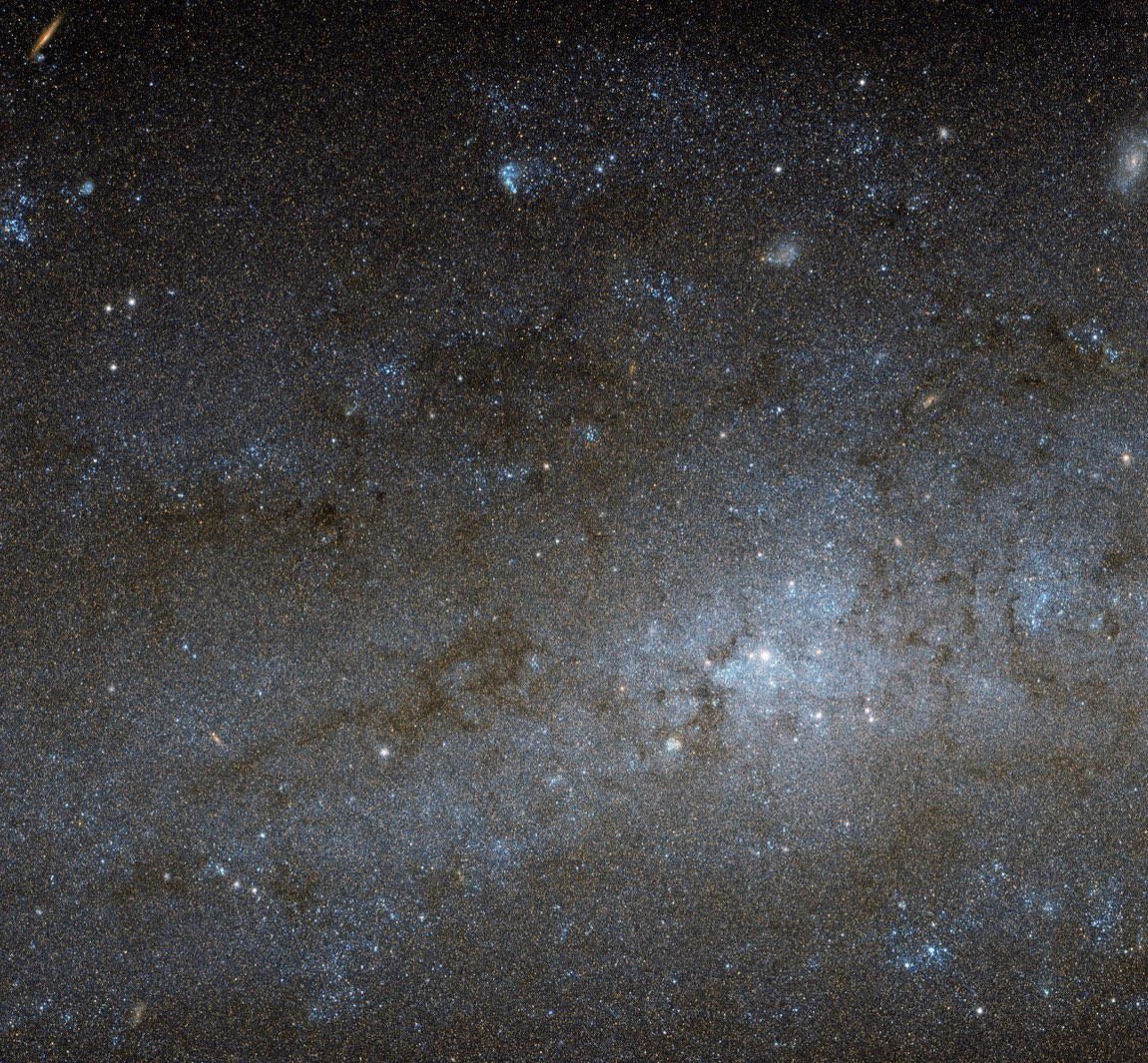
In 1963, the astronomers Geoffrey Burbidge and Margaret Burbidge identified something unusual in the direction of NGC 247: a grouping of five background galaxies positioned to the northeast of the spiral. This linear arrangement came to be called Burbidge's Chain, a name honoring the couple whose work brought it to attention. The five galaxies in the chain are individually catalogued as NGC 247A, NGC 247B, NGC 247C, NGC 247D, and ESO 540-025. The grouping is entirely coincidental in terms of line-of-sight placement near NGC 247 — these are background objects, not physical companions — but their proximity on the sky made them easy to identify as a distinct cluster of targets. By 1977, Burbidge's Chain had been formally listed in the VV catalog under the designation VV 518, cementing its status as a recognized grouping in the astronomical literature. The chain is a reminder that the sky often layers unrelated structures at different distances along the same line of sight.
 ⤢
07 An older void, or a recent disruption? Deeper
The large void on one side of NGC 247's spiral disk poses a puzzle about timing and cause. The fact that older, redder stars are still present within the void tells astronomers that the region was not always sterile — stars formed there in the past and have since aged. What the void lacks is any younger, bluer population, meaning star formation stopped or was suppressed at some point after earlier generations of stars had already ignited. This age differentiation within the void is an important clue. If the region had been empty from the beginning, one would expect no stars at all. Instead, the evidence points toward a process that halted new star formation while leaving older residents undisturbed. Whether that process involved a gravitational interaction with a passing galaxy, a large-scale gas removal event, or some other mechanism is not settled by the article's information, but the coexistence of old stars and absent young stars frames the question sharply.
08 How to find the Claw Galaxy in the sky
NGC 247 sits in the constellation Cetus, the sea monster, which sprawls across the equatorial sky and is best observed from both hemispheres during the northern autumn and southern spring months when Cetus rides high. With an apparent magnitude that places it within reach of moderate amateur telescopes, NGC 247 is accessible to dedicated backyard observers under reasonably dark skies, though its low surface brightness — a consequence of its extended size — means it rewards patience and dark-adapted eyes far more than casual glancing. The galaxy is also catalogued as Caldwell 62, a designation from the Caldwell catalogue compiled to give amateur astronomers a curated list of showpiece objects beyond the more famous Messier list. Finding NGC 247 in a good pair of binoculars or a small telescope will reveal an elongated glow, though the famous void in its disk requires larger aperture and very dark conditions to perceive visually.
09 What 'intermediate spiral' really means
NGC 247 is classified as an intermediate spiral galaxy, a designation that places it somewhere between two extremes on the standard morphological scale astronomers use to sort galaxies by shape. At one end sit barred spirals, whose central regions feature a distinct elongated bar of stars from which the spiral arms extend. At the other end sit unbarred spirals, whose arms wind directly out from a more circular central bulge. Intermediate spirals show partial or weakly developed bar structures — not fully absent, not dramatically prominent. This middle-ground classification is common in the universe; many spirals, including candidates in the Milky Way's own category, fall into this in-between range. For NGC 247 specifically, the intermediate classification combined with its modestly sized disk makes it a relatively typical member of the spiral family in structure, even if its one-sided void sets it apart in terms of star-formation history.
10 The Sculptor Group as a cosmic neighbor Deeper
The Sculptor Group's status as one of the nearest galaxy groups to the Milky Way makes it a frequent target for detailed study. Proximity in astronomy is a rare luxury — nearby objects can be resolved into individual stars, Cepheid variables can be tracked across pulsation cycles, and the three-dimensional structure of a group can be mapped with greater fidelity. NGC 247's membership in the tight inner core of the Sculptor Group, bound gravitationally alongside NGC 253 and a handful of other galaxies, means it has likely spent billions of years in a relatively dense gravitational environment by group standards. Such environments can drive galaxy interactions, gas stripping, and altered star formation histories — all topics relevant to understanding why NGC 247's disk looks the way it does. The loose outer members of the Sculptor Group, only weakly tied to this core, contrast with the compact central cluster and illustrate the range of gravitational binding energies present even within a single nearby group.
11 Geoffrey and Margaret Burbidge's legacy
The identification of Burbidge's Chain in 1963 was a small but characteristic piece of work by one of astronomy's most productive partnerships. Geoffrey Burbidge and Margaret Burbidge are far better known for their roles in the landmark 1957 paper on stellar nucleosynthesis — the process by which stars forge the elements heavier than hydrogen and helium — but their careers spanned decades of observational and theoretical work across many subfields. Cataloguing a chain of background galaxies near NGC 247 exemplifies the kind of careful sky survey work that filled the notebooks and papers of mid-twentieth-century astronomy. The chain now carries their name permanently in the literature, listed as VV 518 in the Vorontsov-Velyaminov catalog of interacting galaxies since 1977. It is a reminder that even relatively modest observational discoveries — a grouping of five faint background objects — can earn lasting recognition when made with care and published in a durable form.
 ⤢