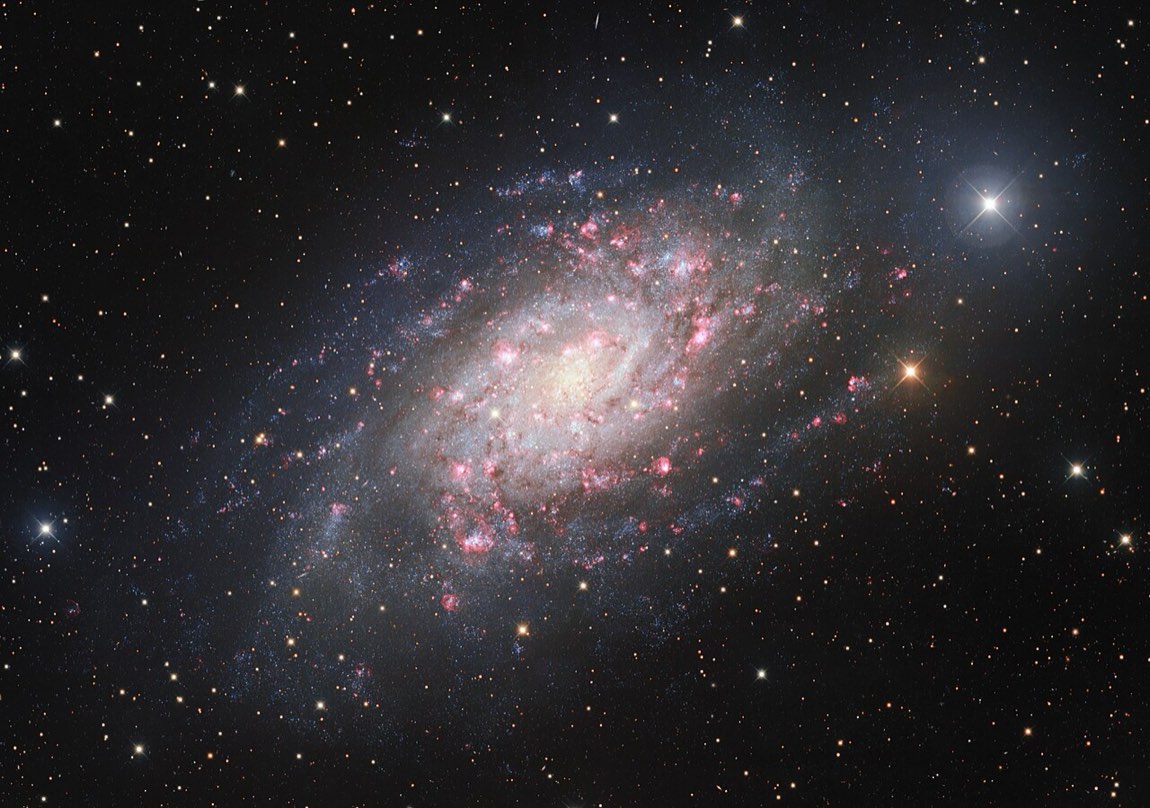
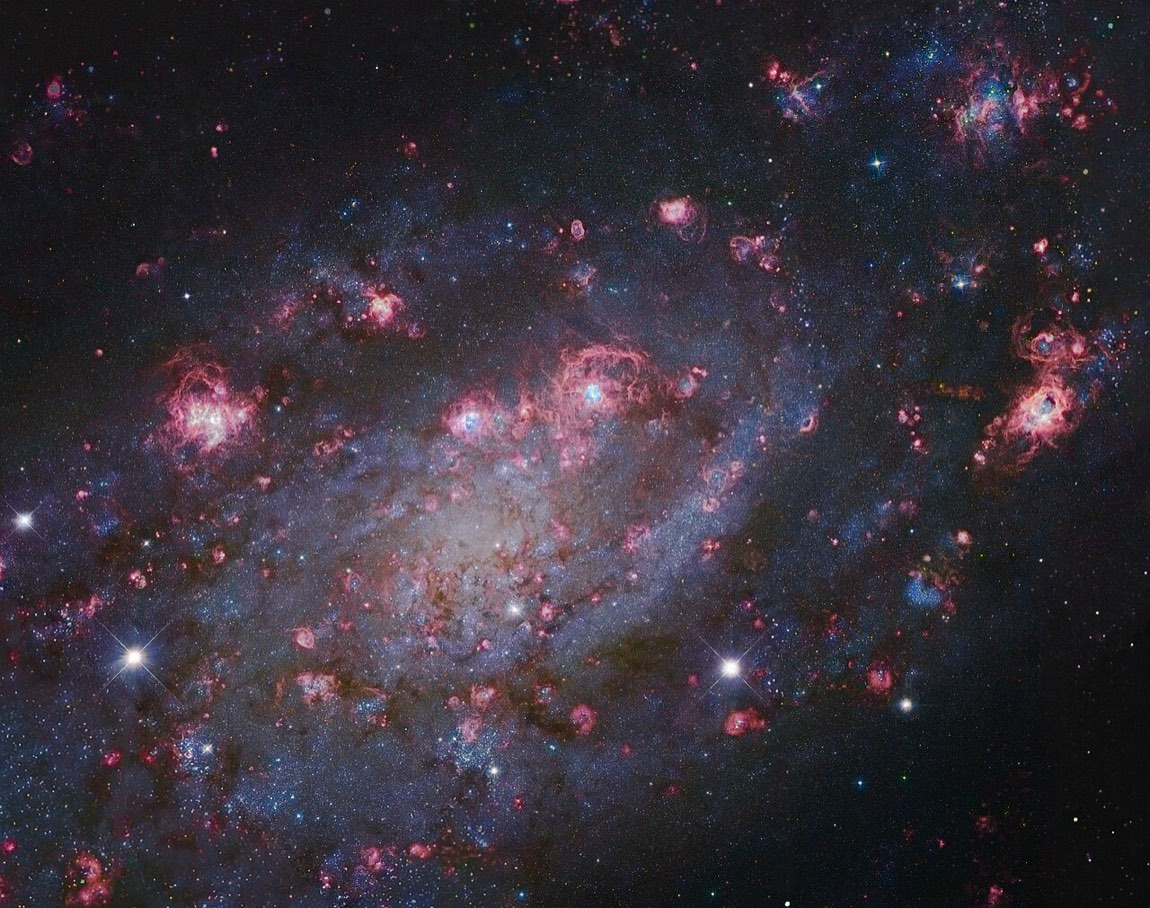
 Photograph · KPNO/NOIRLab/NSF/AURA/M. T. Patterson (New Mexico State University) Image proces · CC BY 4.0
Galaxy · Deep guide
NGC 2403
Also called: Caldwell 7 · C7 · UGC 3918 · PGC 21396
The first galaxy beyond our Local Group in which a Cepheid variable star was found.
What is it?
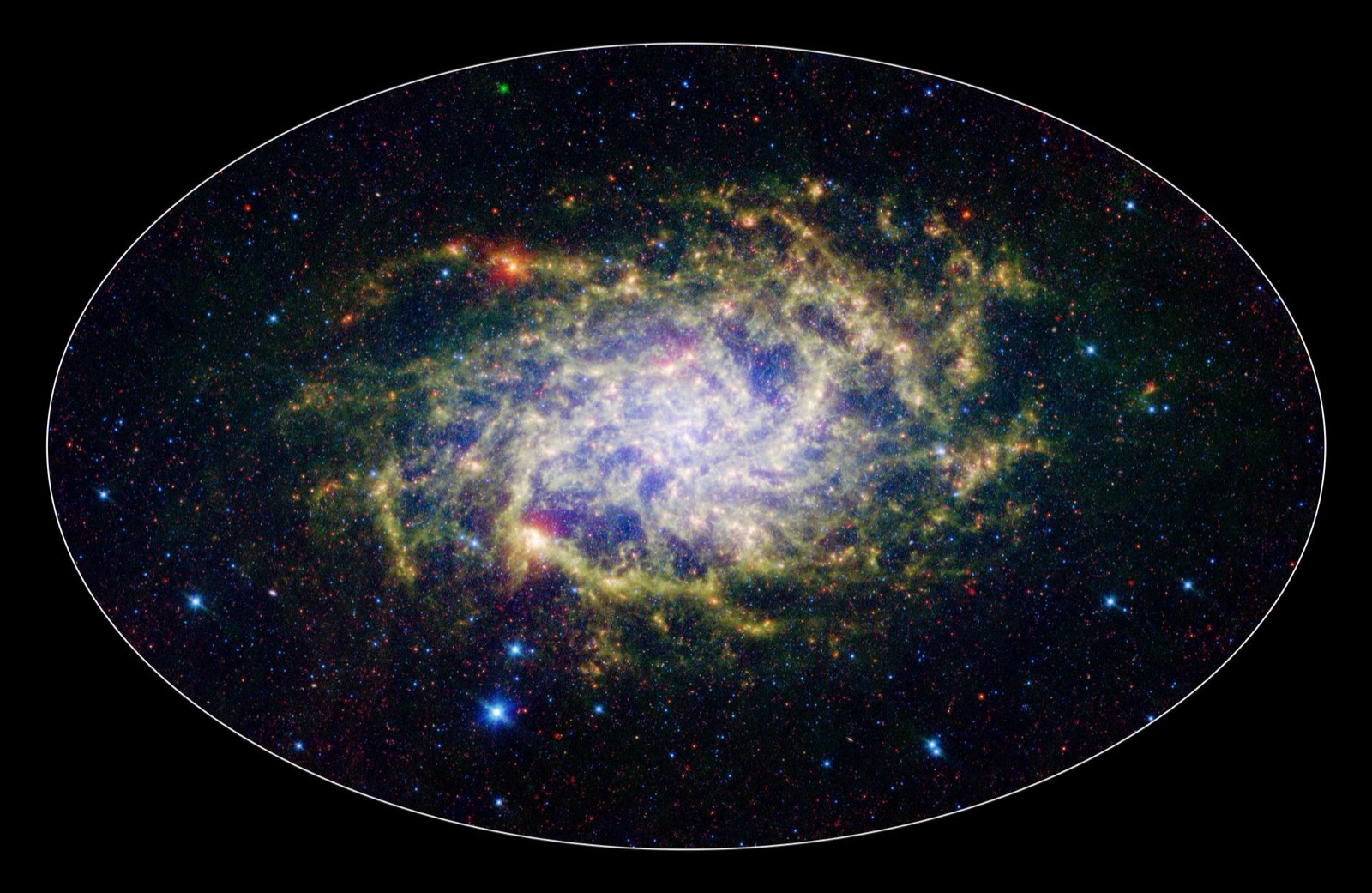
NGC 2403 is a spiral galaxy in Camelopardalis and an outlying member of the M81 Group. It resembles the Triangulum Galaxy, with short, patchy arms dotted with star-forming regions, though it is somewhat larger. Edwin Hubble spotted Cepheid variable stars in it, the first found in any galaxy outside the Local Group; those pulsating stars later helped astronomers correct its distance upward by almost five times. It can be seen with 10×50 binoculars. William Herschel discovered it on 1 November 1788.
The deep dive
Researched for the Atlas from Wikipedia — NGC 2403 (3,729 characters read) · updated Nov 15, 2026
01 William Herschel and the First Sighting
On 1 November 1788, the German-British astronomer William Herschel turned his telescope toward the constellation Camelopardalis and recorded what would become one of the more scientifically consequential galaxies in the northern sky. At the time, of course, Herschel had no way of knowing he was looking at an independent stellar city millions of light-years away — the concept of external galaxies was still more than a century from acceptance. His observation was simply logged as a faint nebulous smudge among the stars of the giraffe constellation. The galaxy later received two catalog designations that persist today: NGC 2403 in the New General Catalogue and Caldwell 7 in Patrick Caldwell-Moore's observer-friendly list. That dual identity reflects how central NGC 2403 has become to amateur and professional astronomy alike — notable enough to earn a place in both a systematic survey and a curated highlights list.
02 How Hubble Stretched the Universe with This Galaxy
NGC 2403 sits at the center of one of astronomy's great distance-measurement stories. Edwin Hubble used the Hale Telescope to detect Cepheid variable stars inside the galaxy, making NGC 2403 the first galaxy beyond the Local Group in which a Cepheid was ever discovered — a landmark achievement. Cepheids are stars that pulse in brightness with a period directly tied to their true luminosity, so measuring how long they take to brighten and fade reveals how intrinsically bright they are, and from there, how far away they must be to appear as dim as they do. By 1963, astronomers had identified 59 variable stars in the galaxy, of which 17 were confirmed Cepheids with pulsation periods ranging from 20 to 87 days. The payoff was dramatic: as late as 1950, Hubble himself was still using a distance of just under 2 million light-years for NGC 2403, but by 1968 the refined Cepheid analysis pushed that figure upward by almost a factor of five, landing within 0.2 magnitudes of the value accepted today.
03 A Flocculent Spiral: Patchy Arms, Not Grand Design
NGC 2403 belongs to a class called flocculent spiral galaxies — a description that immediately separates it from the sweeping, continuous arms of a galaxy like the Milky Way or M51. Instead of bold, unbroken spirals wrapping elegantly around a bright core, NGC 2403 displays short, patchy, disconnected arm segments scattered across its disk. The effect in images is almost cloud-like, fluffy rather than architectural. This texture arises from local star-formation activity rather than a coherent density wave propagating through the disk. Despite the disordered appearance, NGC 2403 is a substantial galaxy: its diameter is approximately 90,000 light-years, meaningfully larger than its often-cited lookalike M33, which spans only about 61,100 light-years. The similarity to M33 goes beyond mere appearance — both galaxies host numerous star-forming H II regions scattered throughout their disks, giving each a speckled, active character when viewed in hydrogen-alpha light.
04 NGC 2404: One of the Largest H II Regions Known Deeper
The northern spiral arm of NGC 2403 reaches out and connects physically to a glowing cloud of ionized hydrogen called NGC 2404. This is not a minor feature: NGC 2404 spans 940 light-years in diameter, earning it a place among the largest known H II regions anywhere. For comparison, the famous Orion Nebula in our own galaxy is only about 24 light-years across, so NGC 2404 is roughly forty times wider — a colossus of star-birth activity. Astronomers have drawn a direct parallel between NGC 2404 and NGC 604, the giant H II region in M33. The two regions resemble each other both in physical size and in their position relative to the outer arms of their respective host galaxies, suggesting that the processes driving the formation of extreme H II regions may play out similarly in galaxies of this morphological type. The connection between NGC 2403's spiral arm and this enormous stellar nursery makes the northern part of the galaxy a particularly active zone of ongoing star formation.
05 Four Dramatic Outbursts in One Galaxy
NGC 2403 has produced an unusually eventful record of stellar transients. The first, SN 1954J, was originally spotted by Gustav Tammann and Allan Sandage as a bright blue irregular variable they labeled V12, with a major outburst on 2 or 3 November 1954 reaching a peak magnitude of 16. Fritz Zwicky classified it in 1972 as a Type V supernova, but later analysis recast it as a supernova imposter — a massive, highly luminous eruptive star wrapped in a dusty nebula, drawing direct comparison to the 1843 Great Eruption of Eta Carinae in the Milky Way. The second, SN 2002kg, was found by the Lick Observatory and Tenagra Observatory Supernova Searches on 26 October 2002, initially called a Type IIn supernova or possibly a luminous blue variable outburst; it was reclassified as a Gap transient as recently as 24 August 2021. The third event, SN 2004dj, a Type II-P supernova at magnitude 11.2 discovered by Kōichi Itagaki on 31 July 2004, was at that moment the nearest and brightest supernova of the 21st century. The fourth, AT 2016ccd, is a luminous blue variable still producing outbursts as recently as November 2021.
06 Supernova Imposters and What They Tell Us Deeper
Two of the four transients recorded in NGC 2403 — SN 1954J and AT 2016ccd — are classified not as true supernovae but as supernova imposters, a category that has grown significantly in scientific importance. A supernova imposter is a massive star undergoing a violent eruption energetic enough to briefly rival a genuine stellar death, yet the star survives. SN 1954J earned this label because its behavior resembled the 1843 Great Eruption of Eta Carinae, in which one of the most massive stars in the Milky Way expelled enormous amounts of material and created a dusty nebula around itself without destroying the star outright. AT 2016ccd, first detected in December 2013 by the Catalina Real-time Transient Survey and observer Stan Howerton, has continued producing observable outbursts through at least November 2021, confirming its ongoing, eruptive nature. The existence of multiple imposters in a single galaxy like NGC 2403 gives astronomers a valuable nearby laboratory for studying the poorly understood late evolutionary stages of very massive stars, particularly the boundary conditions between survivable eruptions and true core collapse.
07 A Dwarf Galaxy Being Torn Apart Next Door
NGC 2403 has two known satellite galaxies, and the larger of the two is currently experiencing a slow gravitational dismemberment. The companion is DDO 44, a relatively massive dwarf galaxy that is being disrupted by the tidal forces of NGC 2403. The evidence is tangible: a tidal stream of stars stretches 82,000 light-years — or 25 kiloparsecs — on both sides of DDO 44, the debris of stars pulled away from the dwarf by NGC 2403's gravity. Astronomers note that DDO 44 is approaching NGC 2403 at a distance much closer than is typical for dwarf galaxy interactions, making the disruption more intense. DDO 44 currently has a V-band absolute magnitude of −12.9, though its progenitor — the original, undisrupted galaxy — was even more luminous before the stripping began. Interactions like this one are thought to be a common mechanism by which large galaxies gradually accumulate stellar material from their smaller neighbors, contributing to the growth of their outer halos over cosmic time.
08 MADCASH-1: A Ghost Galaxy at the Edge Deeper
The second companion of NGC 2403 is far more subdued than DDO 44. Officially designated MADCASH J074238+652501-dw and nicknamed MADCASH-1, it was identified through the MADCASH project — an acronym for Magellanic Analog Dwarf Companions and Stellar Halos — which searches for faint satellite systems around galaxies analogous to the Magellanic Cloud hosts. MADCASH-1 is an extremely dim object, with an absolute V-band magnitude of only −7.81, making it comparable to the faintest dwarf spheroidal galaxies known in the Local Group. It contains only an ancient, metal-poor population of red giant stars, with no sign of recent star formation. This stellar population profile — old, metal-poor, and quiescent — is exactly what astronomers expect of a small galaxy that exhausted or lost its gas supply long ago, possibly through ram-pressure stripping or the influence of its larger neighbor. The discovery of MADCASH-1 is significant because finding such ultra-faint companions around a galaxy beyond the Local Group demonstrates that these ghostly satellites are not unique to our cosmic neighborhood.
09 NGC 2403's Place in the M81 Group
Although NGC 2403 sits approximately 9.7 million light-years from Earth, it is gravitationally associated with the M81 Group — a collection of galaxies dominated by the grand spiral M81 and the famously turbulent starburst galaxy M82. NGC 2403 is described as an outlying member of this group, meaning it lies toward the periphery rather than the dense core. The M81 Group is one of the nearest galaxy groups to the Local Group, and NGC 2403's membership places it in an interesting intermediate zone: physically connected to a larger gravitational community while sitting far enough from the central members to maintain a relatively undisturbed morphology. Its outlying status may also explain why it retains a close pair of dwarf satellite galaxies — it has not passed near the dominant members often enough to have those companions stripped away. For observers and theorists alike, NGC 2403 serves as a convenient and relatively isolated laboratory for studying spiral galaxy behavior within a group environment.
10 Seeing NGC 2403 with Binoculars
NGC 2403 is one of a select group of galaxies genuinely accessible to observers with modest equipment. The article confirms it can be observed using 10×50 binoculars — a standard, affordable configuration that many amateur astronomers already own. At those magnifications, the galaxy appears as a soft, elongated glow in the constellation Camelopardalis, the giraffe, a large but faint northern constellation with no bright stars to serve as easy guideposts. The challenge is less about aperture and more about finding a sufficiently dark sky, since the galaxy's low surface brightness makes it vulnerable to light pollution. Under good conditions, its apparent magnitude makes it a rewarding target that rewards patience and dark adaptation. More powerful amateur telescopes begin to reveal the patchy, uneven texture of its flocculent arms, and deep long-exposure photographs bring out the full extent of its disk, the glowing knots of NGC 2404, and the subtle asymmetries introduced by its ongoing interaction with DDO 44.
11 A Century of Shifting Distance Estimates Deeper
The observational history of NGC 2403 doubles as a case study in how dramatically our understanding of cosmic distances evolved through the twentieth century. When Hubble was still actively working on the problem as late as 1950, he placed NGC 2403 at just under 2 million light-years — a figure that would have made it barely beyond the edges of the Local Group and far closer than it actually is. The error was not careless; it reflected a systematic miscalibration of the Cepheid period-luminosity relationship that affected distance estimates across much of the observable universe. As more and better Cepheid observations accumulated in NGC 2403, culminating in the confirmation of 17 Cepheids with periods between 20 and 87 days, the analysis forced a radical revision. By 1968, the accepted distance had grown by nearly a factor of five, landing within 0.2 magnitudes of the current value of approximately 9.7 million light-years. That correction is emblematic of the broader recalibration that reshaped the entire cosmic distance scale during the mid-twentieth century.
 ⤢