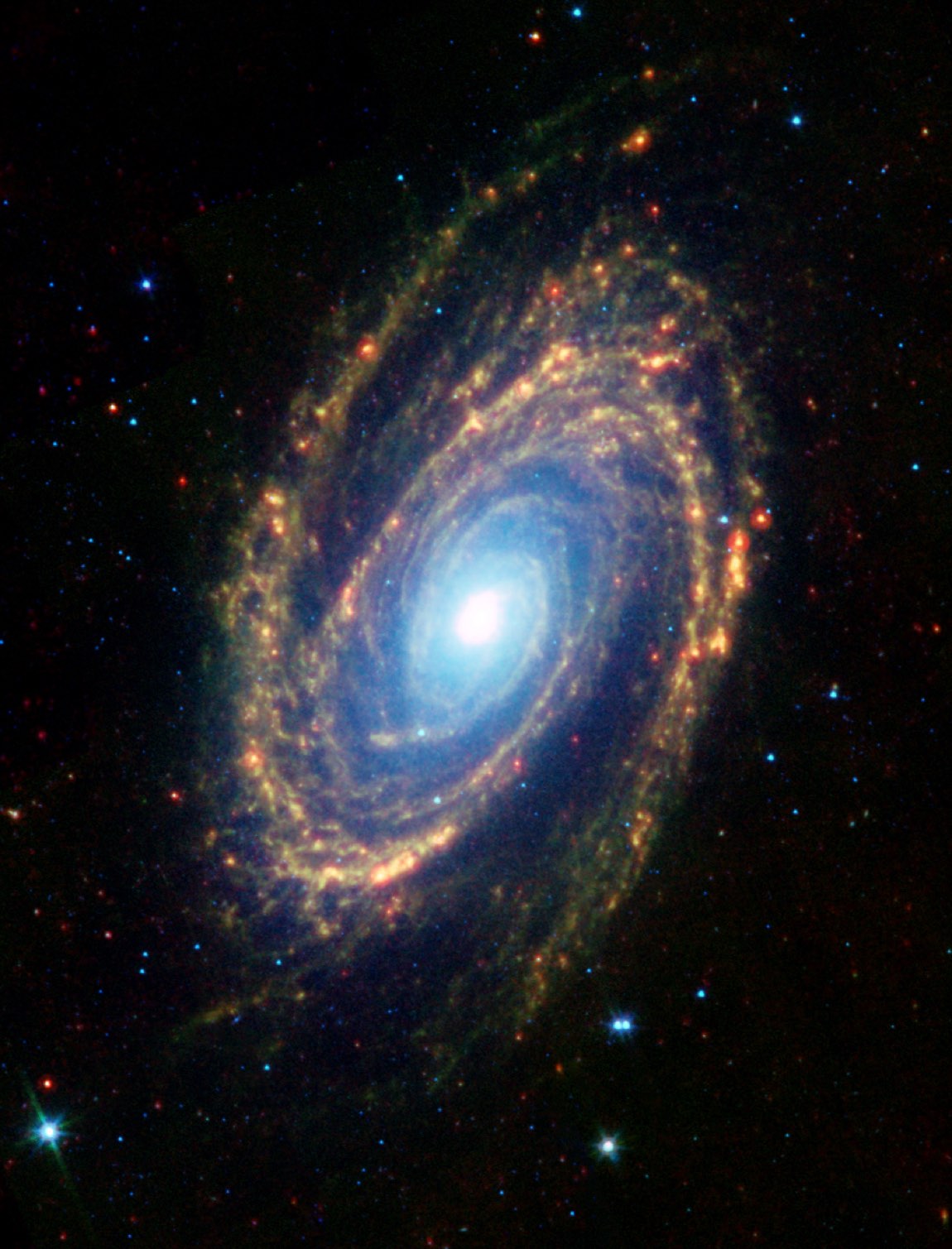
 Photograph · NASA/JPL/Caltech/University of Arizona
Galaxy · Deep guide
Bode's Galaxy
Also called: M81
A textbook spiral locked in a gravitational duel with its cigar-shaped neighbor.
What is it?
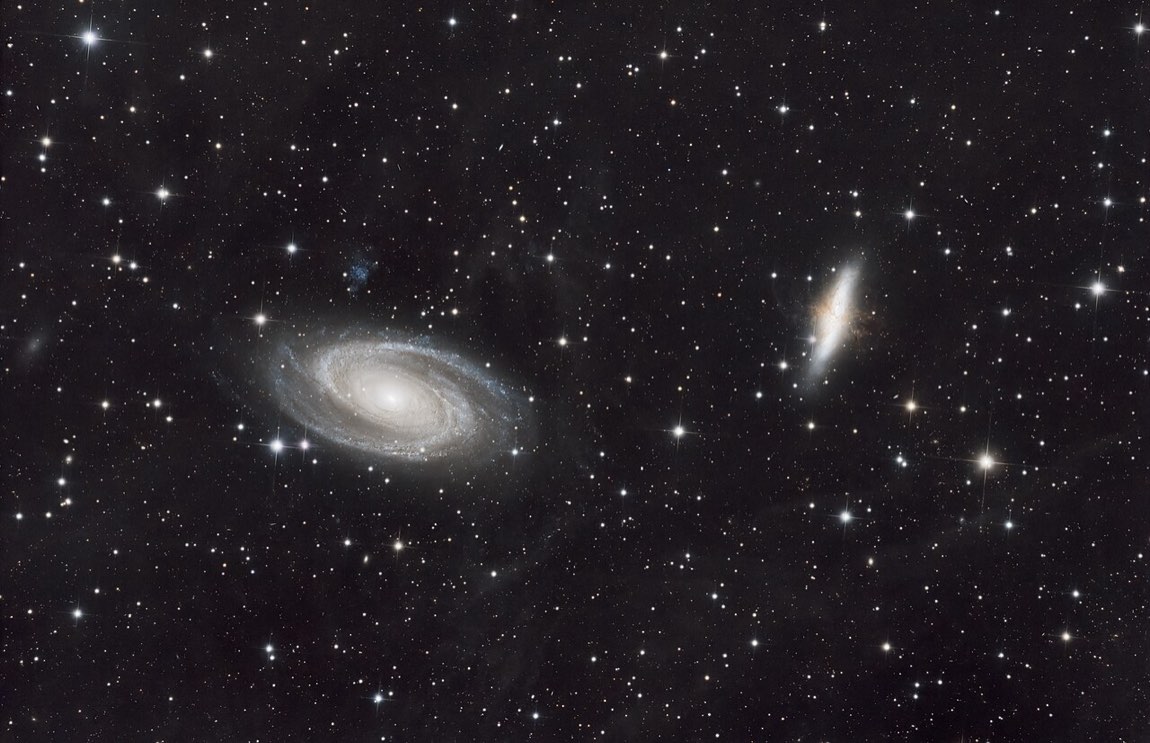
Bode's Galaxy (M81), 12 million light-years away in Ursa Major, is among the most photographed spirals in the sky — bright, symmetric, and paired with the Cigar Galaxy (M82), whose furious starburst was ignited by M81's gravitational passes. The two make a single binocular field: order and chaos side by side.
The deep dive
Researched for the Atlas from Wikipedia — Messier 81 (5,162 characters read) · updated Sep 20, 2026
01 Discovered on New Year's Eve, 1774
Johann Elert Bode spotted what would later bear his name on 31 December 1774, making it one of the earlier deep-sky objects logged by a professional observer. His find attracted little wider attention until 1779, when Pierre Méchain and Charles Messier independently re-identified the same fuzzy patch of light and added it to Messier's famous catalogue as entry 81. That dual-discovery history is why the galaxy carries two common names — Bode's Galaxy in honour of its finder, and Messier 81 in honour of the catalogue that brought it to a broader astronomical audience. The designation NGC 3031 came still later, when John Louis Emil Dreyer compiled the New General Catalogue in the 1880s. So a single galaxy accumulated three separate identities across roughly a century of sky-watching, each name reflecting a different chapter in the organised study of the cosmos.
02 A grand design spiral, perfectly formed
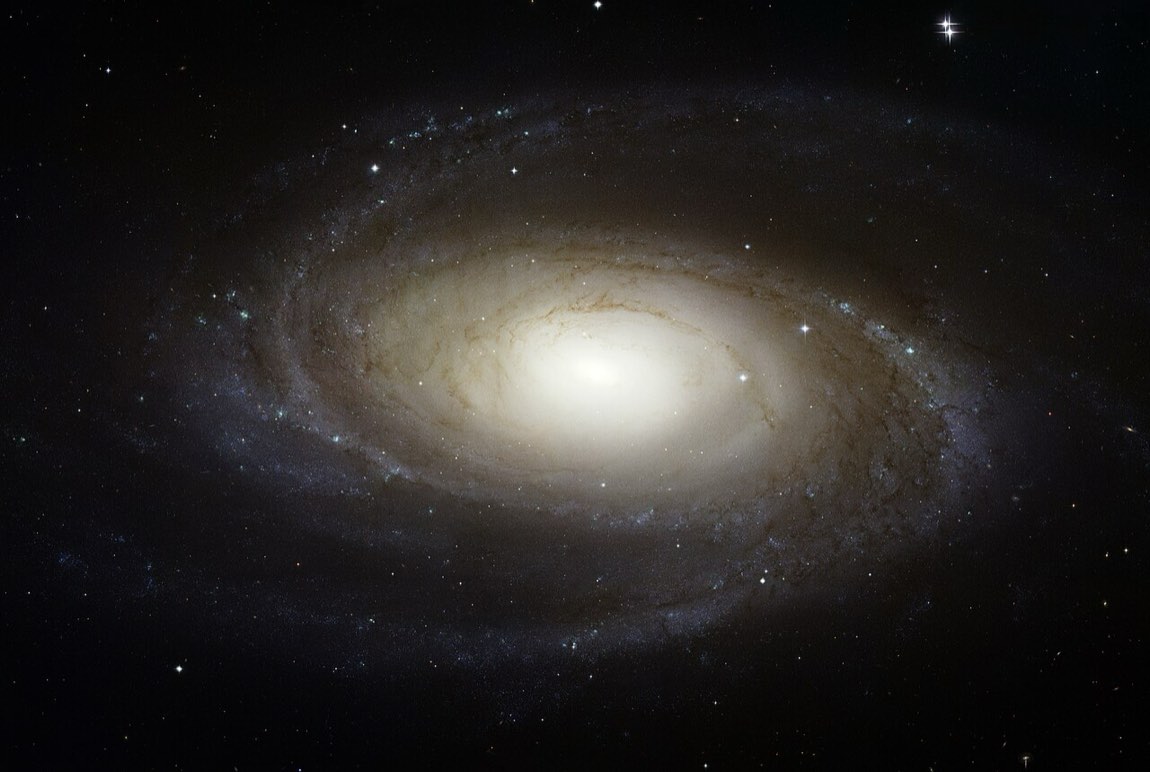
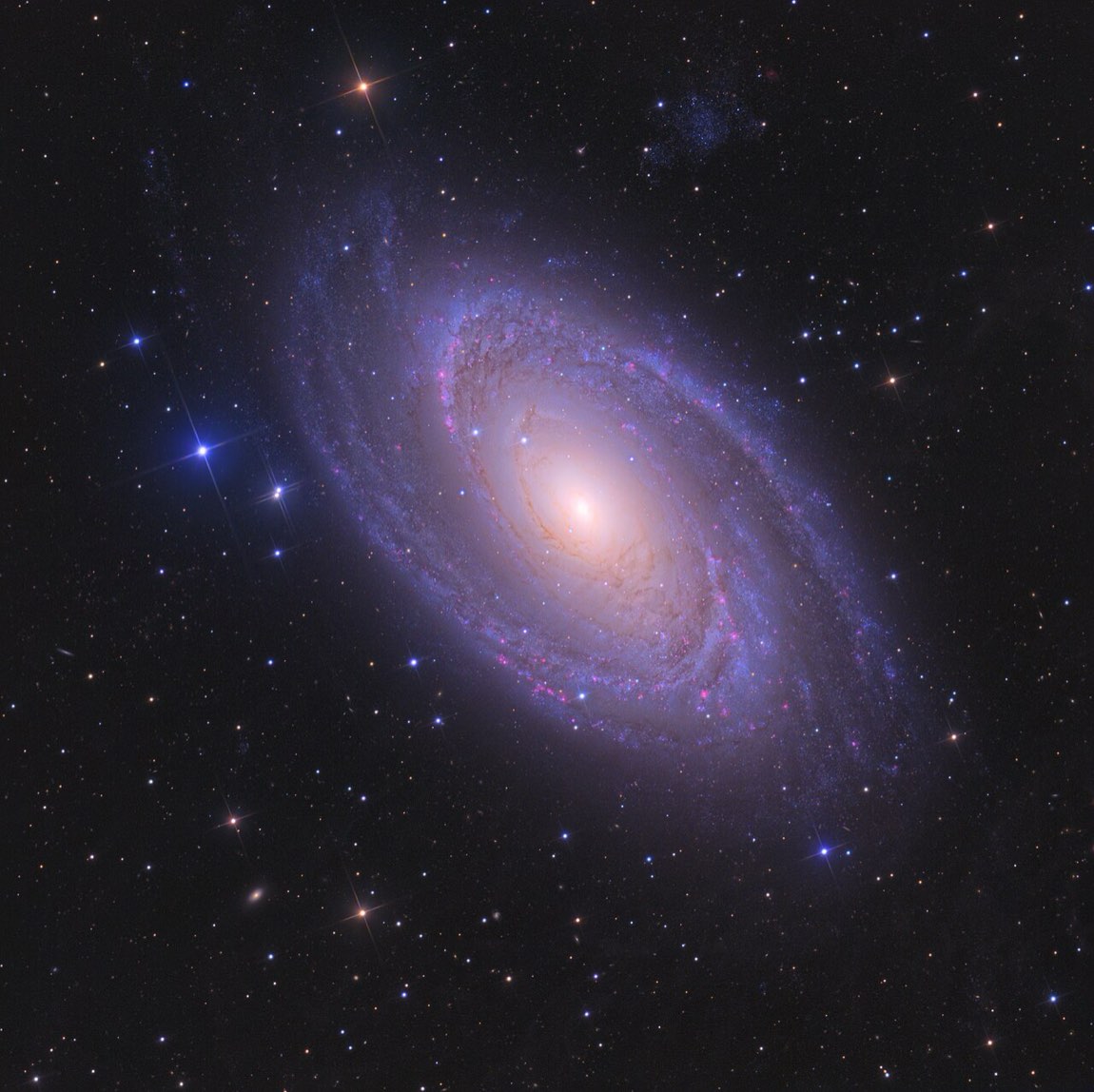
Messier 81 belongs to a category called grand design spirals — galaxies whose arms are sweeping, continuous, and symmetrically arranged rather than patchy or fragmentary. Its isophotal diameter, measured at the D25 surface-brightness level, reaches 29.44 kiloparsecs, which works out to 96,000 light-years. That is nearly the same width as the Milky Way, making M81 a true peer rather than a dwarf satellite. The galaxy's overall brightness and size, combined with a distance of roughly 12 million light-years, place it among the most prominent spiral galaxies visible from Earth. It is prominent enough that highly experienced amateur astronomers can occasionally glimpse it without optical aid under an exceptional dark sky, though most observers need at least binoculars. Telescopes with apertures of 8 inches (20 cm) or larger are required before individual structural features — spiral arms, the bright nucleus — begin to resolve.
03 How to find and observe M81 yourself
Messier 81 lives in the constellation Ursa Major, sitting approximately 10 degrees northwest of Alpha Ursae Majoris, the star also known as Dubhe. Several other galaxies in the M81 Group share that patch of sky, making it a rich field to sweep. April is the best month for observation from mid-northern latitudes, when the galaxy rides high enough for steady, dark-sky viewing. Observers south of roughly the 20th parallel south find the galaxy rises only very briefly and extremely low on the horizon, making a good view difficult. Binoculars and small telescopes show M81 and its famous neighbour Messier 82 as a matched pair in the same field of view — one of the most celebrated binocular double-galaxy sights in the sky. Apertures of 8 inches (20 cm) or more begin to reveal the spiral structure, while larger instruments can trace the brighter spiral arms against the galaxy's glowing core.
 ⤢
⤢
04 A supermassive black hole with a companion Deeper
The core of M81 hosts a supermassive black hole with a mass of about 7 × 10⁷ solar masses — roughly 70 million times the mass of our Sun. Unlike many galactic centres, this one is genuinely active: it possesses an accretion disk of infalling material and a one-sided relativistic jet, meaning matter is being ejected at velocities approaching the speed of light. What makes the M81 nucleus particularly intriguing is evidence that a second supermassive black hole may be orbiting the primary one with a period of around 30 years. If confirmed, this secondary object would have a mass estimated at roughly one-tenth that of the primary — still approximately 7 million solar masses. Binary supermassive black hole systems are thought to arise from galaxy mergers, and confirming one here would offer a rare nearby laboratory for studying how the most massive objects in the universe pair up and eventually merge.
05 Dust, infrared light, and star factories Deeper
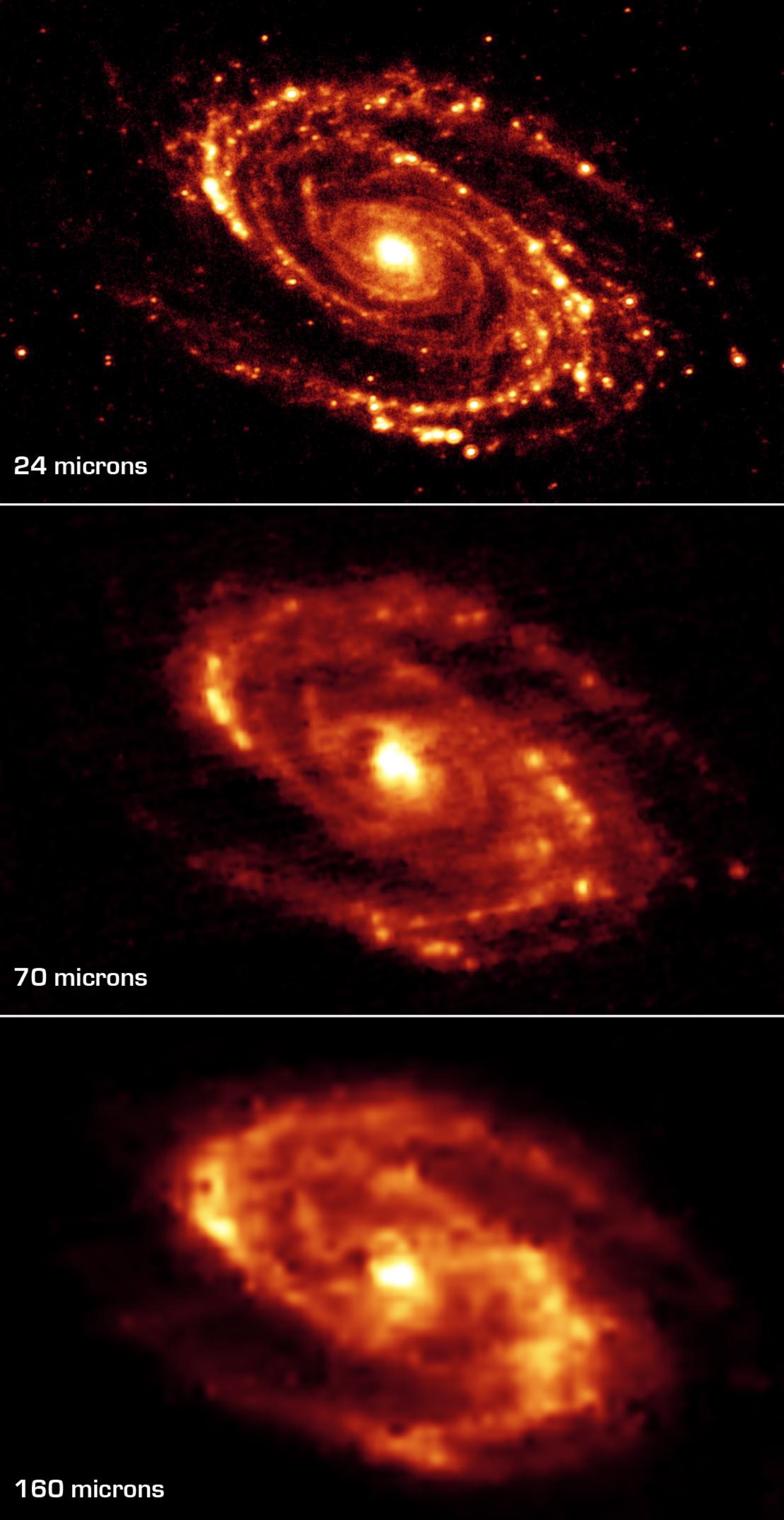
Most of the infrared light radiated by Messier 81 comes not from stars directly but from interstellar dust — microscopic solid particles scattered through the galaxy. This dust is concentrated within the spiral arms rather than distributed uniformly across the disk, and its location has been found to correspond closely with star-forming regions. The connection makes physical sense: newly formed massive blue stars are extremely hot and short-lived, and they pump out intense ultraviolet and visible radiation that heats surrounding dust grains to temperatures at which the grains re-radiate energy in the infrared. In this way, the spiral arms of M81 glow warmly at infrared wavelengths, tracing out the galaxy's active stellar nurseries. Infrared observations therefore give astronomers a way to map ongoing star formation even through clouds of gas and dust that block ordinary visible light.
06 SN 1993J: a supernova that changed categories Deeper
On 28 March 1993, an amateur astronomer named F. García, observing from Spain, discovered a supernova in Messier 81. Named SN 1993J, it peaked at an apparent magnitude of 10.7 — bright enough to be seen in modest backyard telescopes — and was the second brightest Type II supernova observed during the entire 20th century. What made it scientifically extraordinary was that it refused to stay in its category. Early spectra showed strong hydrogen emission lines, hallmark of a Type II supernova caused by an exploding supergiant. But over time those hydrogen lines faded and were replaced by strong helium lines, typical of Type Ib supernovae. The way its luminosity varied over time also matched Type Ib behaviour rather than Type II. Scientists ultimately classified SN 1993J as Type IIb, a transitional class that helped demonstrate that Type Ib and Ic supernovae likely arise from giant stars losing their outer layers through processes related to those in ordinary Type II events. The supernova also yielded a rough distance estimate to M81 of 8.5 ± 1.3 million light-years, though with considerable uncertainty.
 ⤢
⤢
07 Measuring distance with Cepheid stars Deeper
The most precise distance measurement to Messier 81 came from a study by Freedman and colleagues using the Hubble Space Telescope. They identified classical Cepheid variable stars inside M81 and tracked how each star's brightness pulsed over time. Cepheids follow a well-established relationship between their pulsation period and their intrinsic luminosity — a relationship first discovered by Henrietta Swan Leavitt in the early 20th century. By comparing how bright each Cepheid appeared from Earth against how bright its period said it truly was, the team calculated a distance of 3.63 ± 0.34 megaparsecs, equivalent to 11.8 ± 1.1 million light-years. That uncertainty of roughly one megaparsec reflects both the measurement precision and the spread among individual Cepheids. Leavitt's period-luminosity relation, derived a century ago from observations of the Small Magellanic Cloud, thus reaches across 12 million light-years to anchor M81 firmly on the cosmic distance ladder.
08 Gravitational wrestling with neighbours
Messier 81 is not alone; it is the largest member of the M81 Group, a collection of 34 galaxies in Ursa Major sitting about 11.7 million light-years from Earth. Its two most significant neighbours are Messier 82 and NGC 3077, and the gravitational tug-of-war among all three has left visible scars. Hydrogen gas has been stripped from all three galaxies, forming extended filamentary structures threading through the group — streamers of raw material pulled loose by mutual attraction. The interaction has also funnelled interstellar gas inward toward the centres of M82 and NGC 3077, fuelling explosively rapid star formation known as starburst activity in both of those galaxies. M81 itself appears to have escaped with its elegant spiral structure largely intact, acting somewhat like the gravitational anchor of the group while its neighbours undergo more violent transformations.
09 A globular cluster population and a mystery signal
Messier 81 is estimated to harbour 210 ± 30 globular clusters — dense, ancient balls of hundreds of thousands of stars that orbit the galaxy like satellites orbit a planet. That count places M81 in a mid-range category among large spirals. Far more unusual is a signal that may originate from within this globular cluster population. In late February 2022, astronomers reported that M81 may be the source of FRB 20200120E, a repeating fast radio burst. Fast radio bursts are intense millisecond-duration pulses of radio energy whose origins are still actively debated, and a repeating one apparently associated with a globular cluster in a galaxy 12 million light-years away would be remarkable. The association remains tentative, but if confirmed it would make M81 the host of one of the closest known fast radio burst sources ever identified, offering an unprecedented opportunity to study these enigmatic events at relatively short cosmic range.
 ⤢
⤢
10 Why proximity makes M81 so scientifically valuable
Of all the reasons professional astronomers study Messier 81 so intensively, proximity is the most fundamental. At roughly 12 million light-years, the galaxy is close enough that individual stellar populations, Cepheid variables, globular clusters, and even supernovae can be resolved and studied with existing telescopes. Its active galactic nucleus — powered by that 70-million-solar-mass black hole — can be examined in detail across radio, infrared, optical, and X-ray wavelengths simultaneously. The galaxy's large angular size on the sky, a consequence of its relative nearness, means that structures spread across tens of thousands of light-years in physical extent are spread across enough arc-minutes to be spatially mapped. Taken together, M81's combination of proximity, size, brightness, an active nucleus, ongoing star formation, a dramatic supernova on record, and a candidate fast radio burst make it one of the most information-rich individual galaxies accessible to astronomers working today.
11 Open questions still surrounding this galaxy Deeper
Despite decades of study, Messier 81 still holds unresolved puzzles. Whether the candidate second supermassive black hole truly orbits the primary with a 30-year period remains to be confirmed; detecting a companion black hole through its gravitational influence on the jet and accretion disk is technically demanding and the evidence is described as suggestive rather than definitive. The association between M81 and the repeating fast radio burst FRB 20200120E was described by its discoverers as a possibility — astronomers reported M81 may be the source, leaving room for alternative explanations. Even the galaxy's distance carries an uncertainty bar of ±1.1 million light-years, meaning a volume of cosmic space roughly two million light-years deep still brackets the true value. These open edges are a reminder that even the most-studied nearby galaxies can still yield surprises, and M81 continues to be a target for new surveys and instruments.
 ⤢
⤢