 Photograph · NASA Hubble Space Telescope · CC BY 2.0
Galaxy · Deep guide
NGC 185
Also called: Caldwell 18 · C18 · UGC 396 · PGC 2329
A dwarf satellite of Andromeda that may hold the closest Seyfert-type active nucleus to Earth.
What is it?
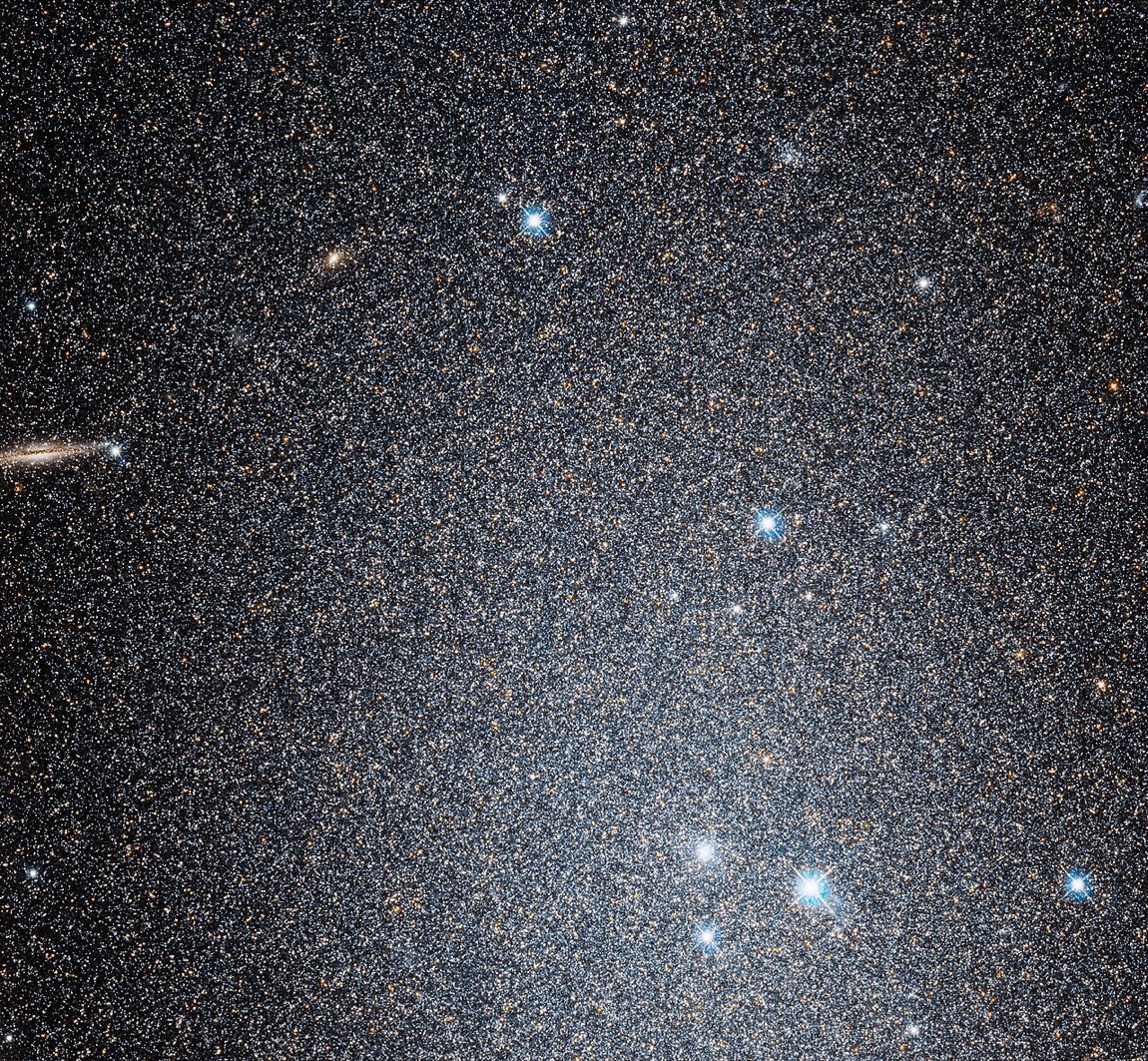
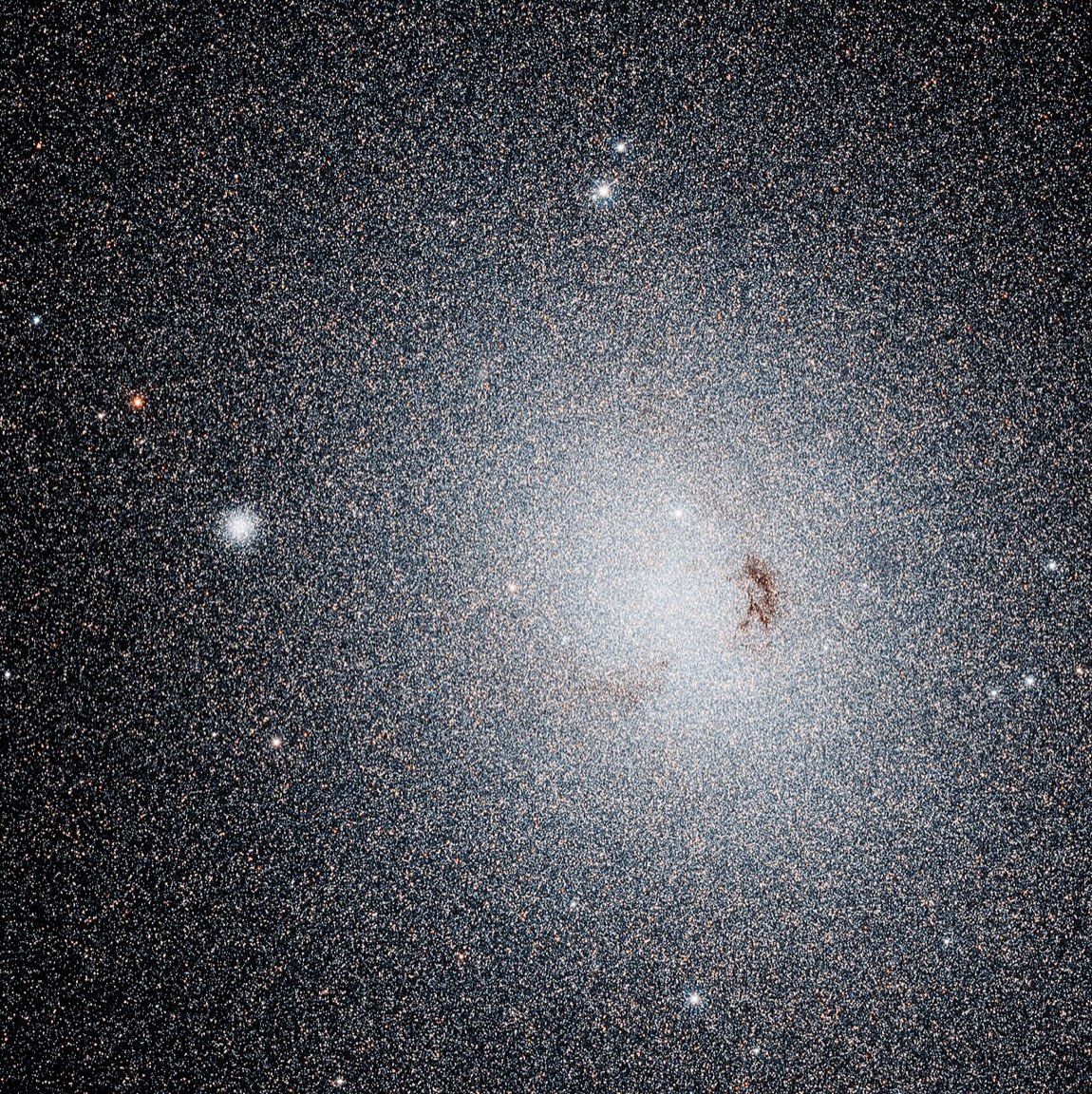
NGC 185 is a dwarf spheroidal galaxy in Cassiopeia and a satellite of the Andromeda Galaxy. Unlike most small elliptical galaxies it contains young star clusters, showing that it kept forming stars slowly until fairly recently. It also has an active nucleus usually classed as a Type II Seyfert, which would make it the only known Seyfert galaxy in the Local Group and possibly the closest to Earth, though that status is debated. William Herschel discovered it on 30 November 1787.
The deep dive
Researched for the Atlas from Wikipedia — NGC 185 (2,085 characters read) · updated Nov 15, 2026
01 A Satellite Chained to Andromeda
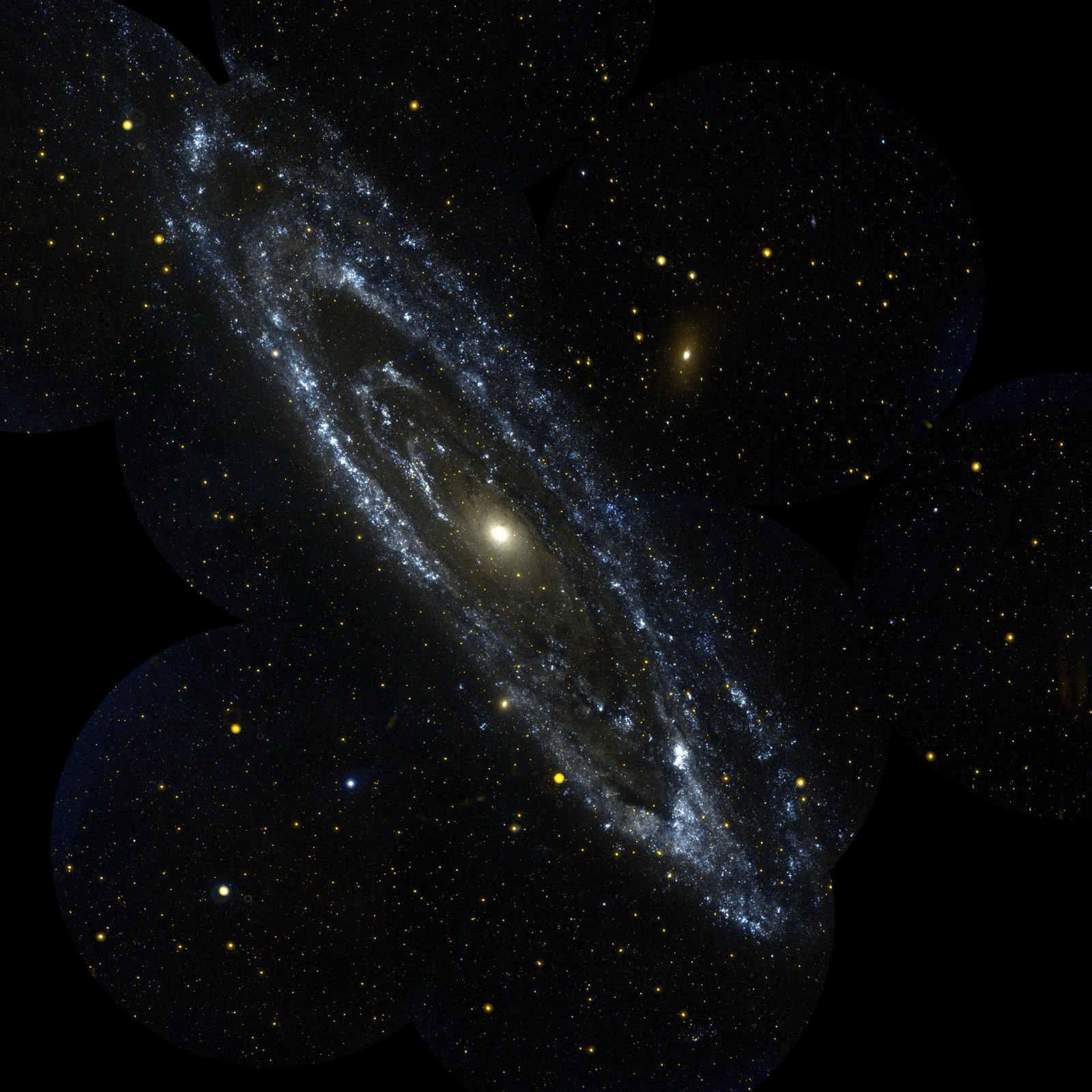
NGC 185 is not a free-roaming galaxy but a satellite of the Andromeda Galaxy (M31), gravitationally bound to its massive neighbor much as the Moon is bound to Earth. This makes it a member of the Local Group, the loose family of galaxies that includes the Milky Way. Its distance of 2.08 million light-years places it slightly farther than Andromeda itself, yet it remains in Andromeda's gravitational embrace. This satellite relationship matters enormously for understanding how NGC 185 evolved: a dwarf galaxy in orbit around a giant is subject to tidal forces and interactions that can strip gas, suppress or trigger star formation, and reshape the dwarf's structure over billions of years. Studying NGC 185 therefore gives astronomers a close-up window into the way large galaxies like Andromeda accumulate and influence their smaller companions — a process that likely shaped our own Milky Way's retinue of satellites as well.
02 Two Ways to Measure a Galaxy's Distance Deeper
Pinning down exactly how far away NGC 185 is requires clever techniques, since no ruler stretches 2 million light-years. Astronomers have applied two independent methods and compared the answers. The first, surface brightness fluctuations, works by measuring how "grainy" a galaxy looks: a more distant galaxy appears smoother because individual stars blur together. This technique yields a distance of 2.08 ± 0.15 million light-years (640 ± 50 kiloparsecs). The second method, the tip of the red giant branch (TRGB), exploits the fact that the brightest red giant stars reach a predictable maximum luminosity before shedding their outer layers — a natural cosmic milepost. Applying this method to NGC 185 gives 2.02 ± 0.2 million light-years (620 ± 60 kiloparsecs). The two answers agree within their uncertainties, which gives astronomers confidence in the measurement, though the overlapping error bars mean the true distance remains pinned only to roughly a 5–10 percent margin.
03 Star Formation: A Long Fade, Not a Sudden Stop
Most dwarf spheroidal galaxies appear to be stellar fossils — their gas used up long ago, their star-forming days firmly behind them. NGC 185 tells a more nuanced story. Research by Martínez-Delgado, Aparicio, and Gallart in 1999 established that the overwhelming majority of star formation in NGC 185 happened early in its history, as expected for this class of galaxy. Yet star formation did not simply switch off. Over the last roughly 1 billion years, new stars have continued to form, but only within the central region of the galaxy. This slow, centrally concentrated trickle of star birth distinguishes NGC 185 from most of its dwarf spheroidal cousins, which tend to show no such recent activity. The result is a galaxy that is old at heart but quietly, stubbornly still building new stars in its innermost zone — a relic that has not entirely given up on reinventing itself.
04 Walter Baade's Surprising Blue Objects
In 1951, the renowned astronomer Walter Baade turned his attention to NGC 185 and spotted something unexpected: young, blue objects scattered within the galaxy. At the time, finding blue objects in a dwarf spheroidal was startling, because such galaxies were assumed to be entirely old and red. Blue color in a stellar population typically signals youth and high mass — stars that formed recently and burn hot. However, follow-up observations eventually revealed that Baade's blue objects were not individual stars as he had initially thought, but rather compact young stellar clusters — groups of stars rather than single suns. This distinction is important: a cluster of young stars in one small region is a very different kind of star formation event than a galaxy-wide burst of activity. The identification of these clusters helped cement NGC 185's reputation as genuinely unusual among dwarf spheroidals, with pockets of recent stellar activity embedded in an otherwise ancient stellar population.
05 A Supernova's Ghost Near the Core Deeper
Among the discoveries made by Martínez-Delgado and colleagues was a supernova remnant located near the center of NGC 185. A supernova remnant is the expanding shell of gas and dust ejected when a massive star ends its life in a catastrophic explosion. The presence of such a remnant close to the galaxy's nucleus is a direct piece of evidence that massive, short-lived stars — the kind that only form in recent star-forming episodes — have indeed been born and died in NGC 185 within the relatively recent astronomical past. Massive stars live only a few million years before exploding, so a supernova remnant is effectively a timestamp: star formation happened here, recently enough that its most extreme products have already lived and died. This discovery reinforces the picture that NGC 185's central region has been an ongoing, if subdued, site of stellar activity even as the outer parts of the galaxy have long since grown quiet.
06 An Active Nucleus in a Quiet Dwarf Deeper
Perhaps the most remarkable feature of NGC 185 is what lurks at its center. The galaxy hosts an active galactic nucleus, or AGN — a compact, energetic core powered by processes involving a central massive object. NGC 185 is usually classified as a Type II Seyfert galaxy, a category defined by the presence of narrow emission lines in the galaxy's spectrum that betray gas being excited to extreme energies near the nucleus. What makes this extraordinary is context: Seyfert galaxies are typically large, luminous spiral galaxies, not tiny dwarf spheroidals. NGC 185 is believed to be possibly the closest Seyfert galaxy to Earth, and it holds the remarkable distinction of being the only known Seyfert galaxy within the entire Local Group. However, the article is honest about uncertainty here — NGC 185's classification as a Seyfert is questioned by some researchers, meaning the nature of its nucleus remains an open scientific debate rather than a settled fact.
07 Why "Possibly the Closest Seyfert" Matters
If NGC 185's Seyfert status is confirmed, its proximity to Earth — just 2.08 million light-years away — would make it an invaluable laboratory. Most Seyfert galaxies and other AGN-hosting galaxies lie hundreds of millions or even billions of light-years from us, so they appear tiny and unresolved even in powerful telescopes. At NGC 185's distance, astronomers can resolve individual star clusters and study the galaxy's structure in far finer detail than is possible for more distant Seyfert hosts. This proximity could allow researchers to investigate exactly what powers an AGN in a dwarf galaxy, whether the same physical mechanisms operate as in much larger Seyfert galaxies, and how such an active nucleus coexists with — and perhaps drives — the low-level star formation still occurring in the central region. The uncertainty about its true Seyfert classification makes answering these questions even more pressing.
08 Three Centuries of Observations and Catalogues
NGC 185 has accumulated a long paper trail of observations across more than two centuries. William Herschel discovered it on November 30, 1787, entering it into his records as "H II.707." His son John Herschel returned to it in 1833, labeling it "h 35," and then again in 1864 when he included it as "GC 90" in his General Catalogue of Nebulae and Clusters — one of the foundational reference works of nineteenth-century astronomy. By the late 1890s, technology had advanced enough to capture light mechanically rather than just by eye: between 1898 and 1900, James Edward Keeler photographed NGC 185 for the first time using the Crossley Reflector at Lick Observatory. It is also catalogued as Caldwell 18, part of a modern list compiled to help amateur astronomers find notable objects missed by Charles Messier's famous catalogue. This layered history of observation reflects how the galaxy has remained scientifically interesting across generations of astronomers.
09 The Crossley Reflector and Early Astrophotography
When James Edward Keeler photographed NGC 185 between 1898 and 1900, he was using an instrument that had recently transformed astronomy: the Crossley Reflector at Lick Observatory. Capturing an image of a faint, diffuse dwarf galaxy like NGC 185 on photographic plates required a telescope capable of collecting light over long exposures, and the Crossley, a 36-inch reflecting telescope, was well suited to the task. Keeler's photographs of NGC 185 were part of a broader program demonstrating the power of astrophotography to reveal objects and structures that the human eye at the eyepiece could not detect. At the time, it was not yet understood that NGC 185 was an external galaxy — that understanding would come decades later as the scale of the universe was established. What Keeler captured was a faint smudge of light, later understood to be an entirely separate stellar system containing billions of stars.
10 How to Find NGC 185 in the Night Sky
NGC 185 appears in the constellation Cassiopeia, the distinctive W-shaped grouping of bright stars visible from the Northern Hemisphere for much of the year. Because Cassiopeia lies near the northern celestial pole, it is circumpolar for many mid-to-high latitude observers, meaning it never sets below the horizon and can be viewed on any clear night. The galaxy carries an apparent magnitude that places it within reach of amateur telescopes, though its light is spread across an extended area rather than concentrated into a point, making it appear dim despite that rating. It sits relatively close in the sky to NGC 147, another dwarf spheroidal satellite of Andromeda, and the two are sometimes observed as a pair. Finding it typically requires a good star chart and a telescope with moderate aperture, combined with dark skies away from city light pollution to reveal its faint, diffuse glow.
11 Open Questions About a Peculiar Little Galaxy Deeper
NGC 185 leaves astronomers with several genuinely unresolved questions. The most pressing is the true nature of its nucleus: is it a bona fide Seyfert AGN, or does something else explain its emission-line spectrum? If it is a Seyfert, what powers it in such a small galaxy, and does it host a supermassive black hole comparable in scale to those found in the cores of giant Seyfert spirals? A second open area concerns the interplay between the central AGN, the supernova remnant found nearby, and the ongoing low-level star formation: are these phenomena connected, with the AGN perhaps supplying energy that sustains or quenches star birth? Finally, the two distance measurements — 2.08 ± 0.15 million light-years from surface brightness fluctuations and 2.02 ± 0.2 million light-years from the TRGB method — agree well but still carry meaningful uncertainties. Refining the distance would sharpen every derived physical quantity, from the galaxy's true luminosity to the absolute energetics of its nucleus.