 Photograph · NASA Hubble Space Telescope · CC BY 2.0
Galaxy · Deep guide
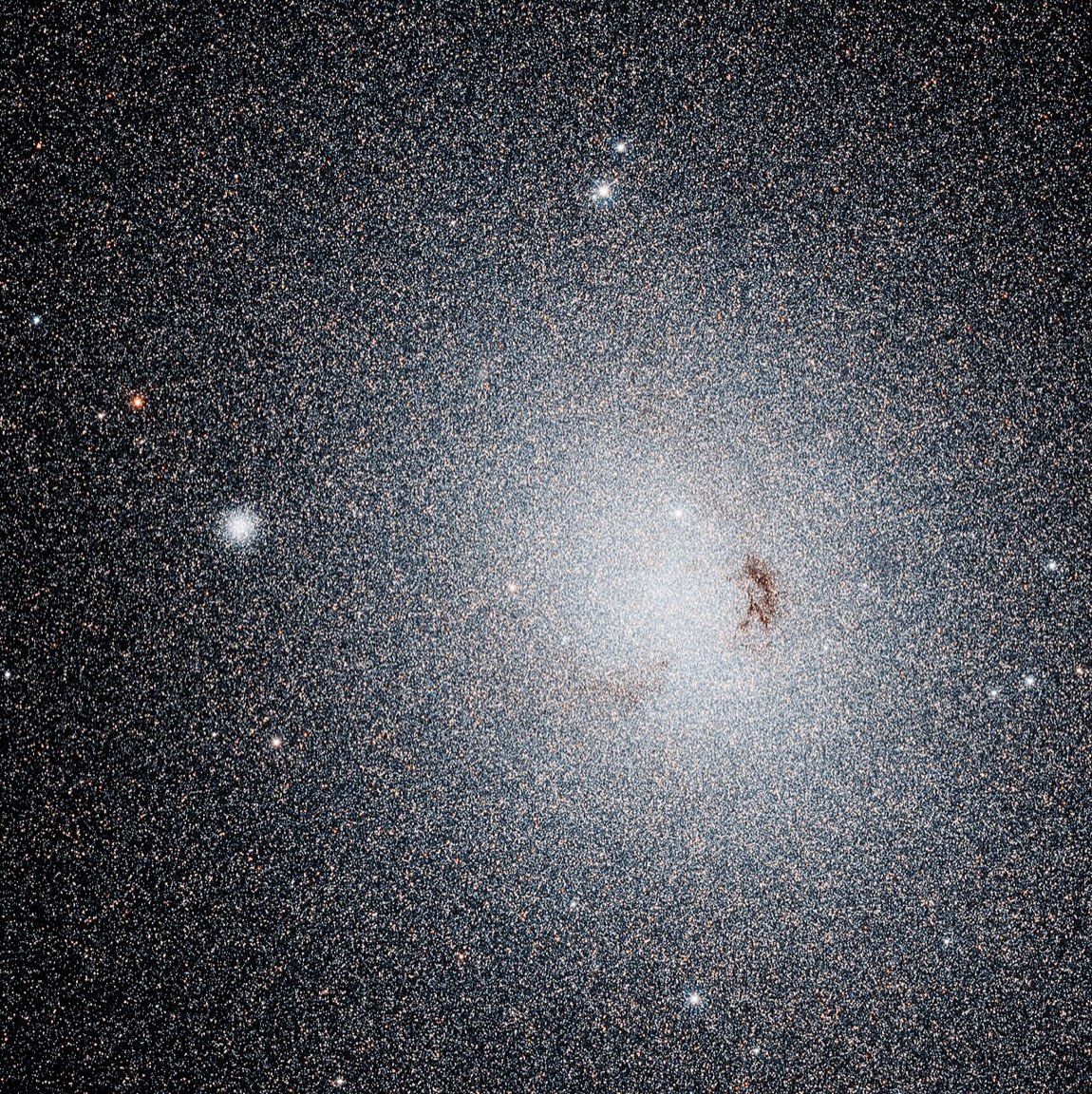
NGC 147
Also called: Caldwell 17 · C17 · DDO 3 · PGC 2004 · UGC 326
A faint dwarf companion of the Andromeda Galaxy that stopped making stars billions of years ago.
What is it?
NGC 147 is a dwarf spheroidal galaxy in Cassiopeia and a satellite of the Andromeda Galaxy, part of our Local Group. It forms a physical pair with another Andromeda satellite, NGC 185, and is the harder of the two to see because its light is spread more thinly. Its last significant burst of star formation ended about 3 billion years ago, and it contains almost no gas today. John Herschel discovered it in 1829; Walter Baade confirmed in 1944 that it belongs to the Local Group by resolving it into individual stars.
The deep dive
Researched for the Atlas from Wikipedia — NGC 147 (2,326 characters read) · updated Nov 15, 2026
01 A Galaxy Frozen in Time
NGC 147 stopped making stars roughly 3 billion years ago, and in cosmic terms that makes it something like a city that simply closed its factories and never reopened them. A survey of the brightest asymptotic giant branch stars within a radius of 2 arcminutes from the galaxy's center pinpoints that cutoff: the last significant star-forming activity occurred around 3 Gyr ago. What remains is a large population of older stars — veterans of an earlier, more active era. The galaxy shows a spread in both metallicity and age among those stars, which tells astronomers that NGC 147 did not form all at once from a single cloud of primordial gas. Instead, it built itself up over time through several rounds of star formation, each generation of stars enriching the gas with heavier elements before the whole process ground to a halt.
02 Why the Star Factories Shut Down Deeper
When stars age and shed their outer layers, they return gas and dust to the interstellar medium — in principle replenishing the raw material for future star formation. In NGC 147, that replenishment never happened, or at least it did not stay. Astronomers have searched for neutral hydrogen gas (H I) and found none; the upper limit on the interstellar medium mass is far lower than you would expect if the galaxy had simply held onto the material shed by its evolving stars over billions of years. This strongly implies that the ISM has been depleted — stripped away, consumed, or expelled. The metallicity spread among the surviving stars confirms that chemical enrichment did occur over time, so the gas was present once and did cycle through stellar generations. Something ultimately removed what was left, cutting off the supply and freezing NGC 147 in its current, quietly aging state.
03 Two Techniques, Two Answers Deeper
Measuring the distance to a galaxy is rarely a single clean calculation, and NGC 147 illustrates why astronomers triangulate using multiple independent methods. The surface brightness fluctuations technique works by analyzing how grainy a galaxy's bulge looks — a more distant galaxy appears smoother because its stars blur together. Applied to NGC 147, this method yields a distance of 2.67 ± 0.18 Mly (870 ± 60 kpc). The tip of the red giant branch method is more direct: it exploits the fact that the brightest red giant stars reach a predictable maximum luminosity, acting as a standard candle. That technique places NGC 147 at 2.21 ± 0.09 Mly (680 ± 30 kpc). The two results disagree by more than their individual error bars suggest they should, and averaging them produces a combined estimate of 2.53 ± 0.4 Mly (780 ± 120 kpc). The tension between the methods is a genuine open question, not simply rounding.
04 A Paired Companion Across the Void
NGC 147 is not wandering the Local Group alone. It forms a physical pair with NGC 185, another dwarf galaxy and remote satellite of the Andromeda Galaxy. The two are close enough in space to be gravitationally associated — genuine companions rather than a chance alignment on the sky. Both are satellites of M31, orbiting the great spiral far from its core, but their relationship with each other adds an extra layer of structure. Interestingly, the two galaxies differ in character despite their partnership: NGC 185 is visible in small telescopes, while NGC 147 is fainter and slightly larger, giving it a considerably lower surface brightness that makes it the harder target of the pair. Same neighborhood, same parent galaxy, yet noticeably different personalities.
05 Baade's Moment: Resolving Individual Stars
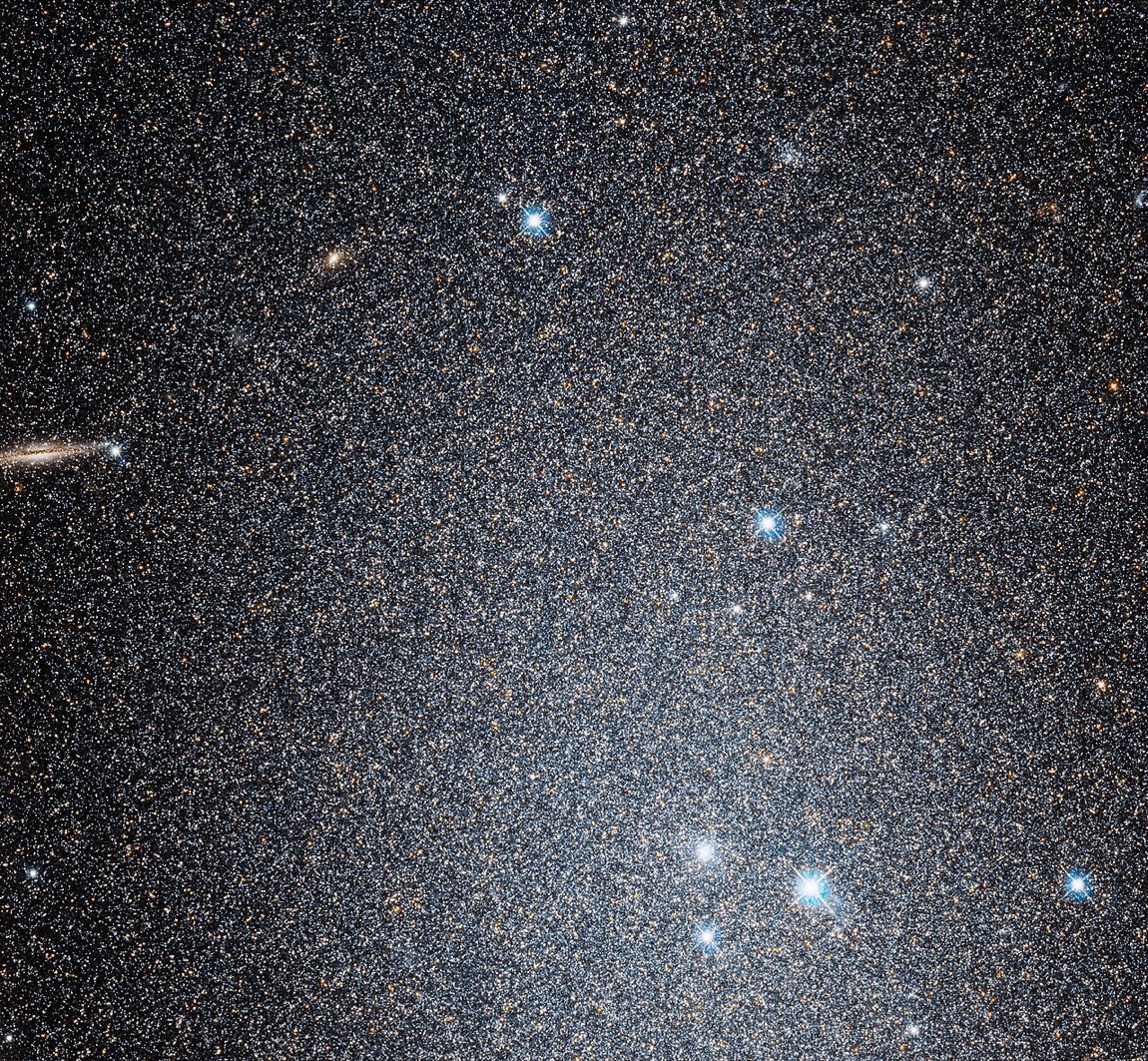
For years after NGC 147 was discovered, its membership in the Local Group remained unconfirmed — it could have been a background object at a far greater distance. That question was settled definitively in 1944 by Walter Baade, working with the 100-inch (2.5 m) telescope at Mount Wilson Observatory near Los Angeles. Baade was able to resolve NGC 147 into individual stars, a feat that confirmed the galaxy was close enough to belong to our own cosmic neighborhood. Resolving a galaxy into stars — seeing discrete points of light rather than a smooth glow — requires both a large telescope and a genuinely nearby target. The 100-inch was then among the most powerful instruments in the world, and Baade's success placed NGC 147 firmly on the map of the Local Group.
06 Surface Brightness: The Observer's Challenge
Surface brightness is a measure of how much light a galaxy spreads across a given area of sky, and it determines how easy or hard a target is to see far more than raw apparent magnitude alone. NGC 147 is visually fainter than NGC 185 and slightly larger in angular size, which together produce a considerably lower surface brightness — meaning its light is diluted across more sky. The Webb Society Deep-Sky Observer's Handbook describes it as large, quite faint, and irregularly round, brightening in the middle toward a stellar nucleus. That central brightening provides the only real anchor for the eye at the eyepiece. By contrast, NGC 185's higher surface brightness makes it accessible in small telescopes. NGC 147 demands darker skies, more aperture, or both — a humbling reminder that bigger is not always easier.
07 John Herschel and the Discovery Night
NGC 147 entered the astronomical record in September 1829, when John Herschel swept it up during his systematic surveys of the northern sky. Herschel was the son of William Herschel, discoverer of Uranus, and carried on his father's tradition of meticulous sky cataloging with large reflecting telescopes. The galaxy sits in the constellation Cassiopeia, the W-shaped northern circumpolar figure, which kept it accessible from Herschel's observing sites in England. The object later received multiple catalog identities: NGC 147 from the New General Catalogue, DDO 3 from the David Dunlap Observatory catalog of dwarf galaxies, and Caldwell 17 from Patrick Moore's Caldwell Catalogue, which was specifically designed to highlight showpiece objects missed by the famous Messier list.
08 A Dwarf Spheroidal in the Local Group
Dwarf spheroidal galaxies are among the smallest and faintest galaxies known, and NGC 147 sits comfortably in that category. Unlike spiral galaxies with their rotating disks of gas and young stars, or elliptical galaxies with their massive star counts, dwarf spheroidals are modest, roundish systems dominated by old stellar populations and largely devoid of ongoing star formation. NGC 147 is one of several such satellites orbiting the Andromeda Galaxy, contributing to the extended family of M31 much as smaller moons contribute to a planetary system. The Local Group itself — the collection of galaxies gravitationally bound to one another including the Milky Way and Andromeda — counts NGC 147 among its confirmed members, a status secured by Baade's 1944 resolution of the galaxy into stars.
09 Chemical Enrichment Without a Future Deeper
The spread in stellar metallicity inside NGC 147 tells a story of chemical evolution that played out over multiple generations. When the first stars formed, they did so from relatively pristine, hydrogen-and-helium-dominated gas. As those stars lived and died, they seeded the surrounding medium with heavier elements — oxygen, carbon, iron — raising the metallicity of subsequent stellar generations. The spread astronomers observe today means that stars in NGC 147 formed across a range of epochs, each batch slightly more metal-rich than the last. This is evidence of genuine chemical enrichment, the same process that operates in much larger galaxies. Yet the story has an abrupt ending: roughly 3 billion years ago the cycle stopped, the gas disappeared, and NGC 147 has been coasting on its existing stellar population ever since, slowly aging without renewal.
10 How to Find NGC 147 in the Sky
NGC 147 lies in Cassiopeia, a constellation well-placed for observers throughout the northern hemisphere and visible year-round from mid-northern latitudes as it circles the north celestial pole. Its proximity on the sky to NGC 185 makes the two galaxies a natural double target for a single observing session. Because NGC 147's surface brightness is considerably lower than that of its companion, finding it rewards patience and dark skies rather than raw aperture alone. The galaxy is described in observing literature as large and irregularly round, with a central brightening toward a stellar nucleus — a subtle gradient rather than a dramatic core. Experienced visual observers recommend higher magnification to darken the sky background and improve contrast, coaxing the faint glow into view against the star fields of Cassiopeia.
11 Open Questions That Remain Unanswered Deeper
NGC 147 leaves several puzzles on the table. The discrepancy between its two best distance measurements — 2.67 ± 0.18 Mly from surface brightness fluctuations versus 2.21 ± 0.09 Mly from the tip of the red giant branch — is larger than the stated uncertainties comfortably explain, suggesting that at least one method is encountering systematic errors not fully accounted for. The mechanism that depleted the interstellar medium is also unresolved: was gas stripped by the gravitational influence of Andromeda during a past close approach, expelled by stellar winds and supernovae in the final burst of star formation 3 billion years ago, or lost through some combination of processes? And the physical pairing with NGC 185 raises questions about whether the two galaxies have interacted directly, potentially influencing each other's evolution — a relationship that future observations may eventually clarify.