 Photograph · ESO · CC BY 4.0
Galaxy · Deep guide
NGC 1097
Also called: Caldwell 67 · NGC 1097 · Arp 77
A barred spiral with a glowing ring of star birth around a 140-million-Sun black hole.
What is it?
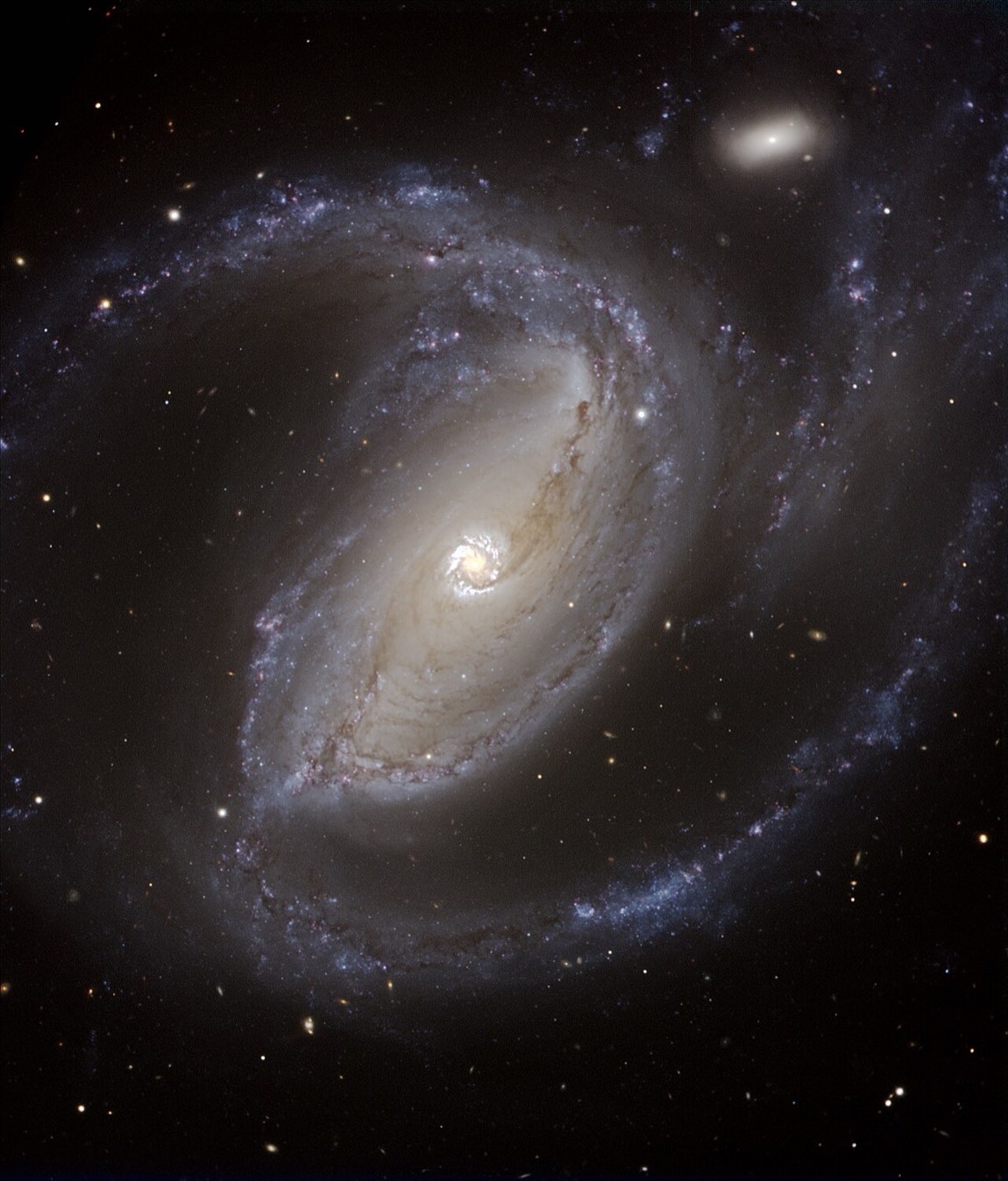
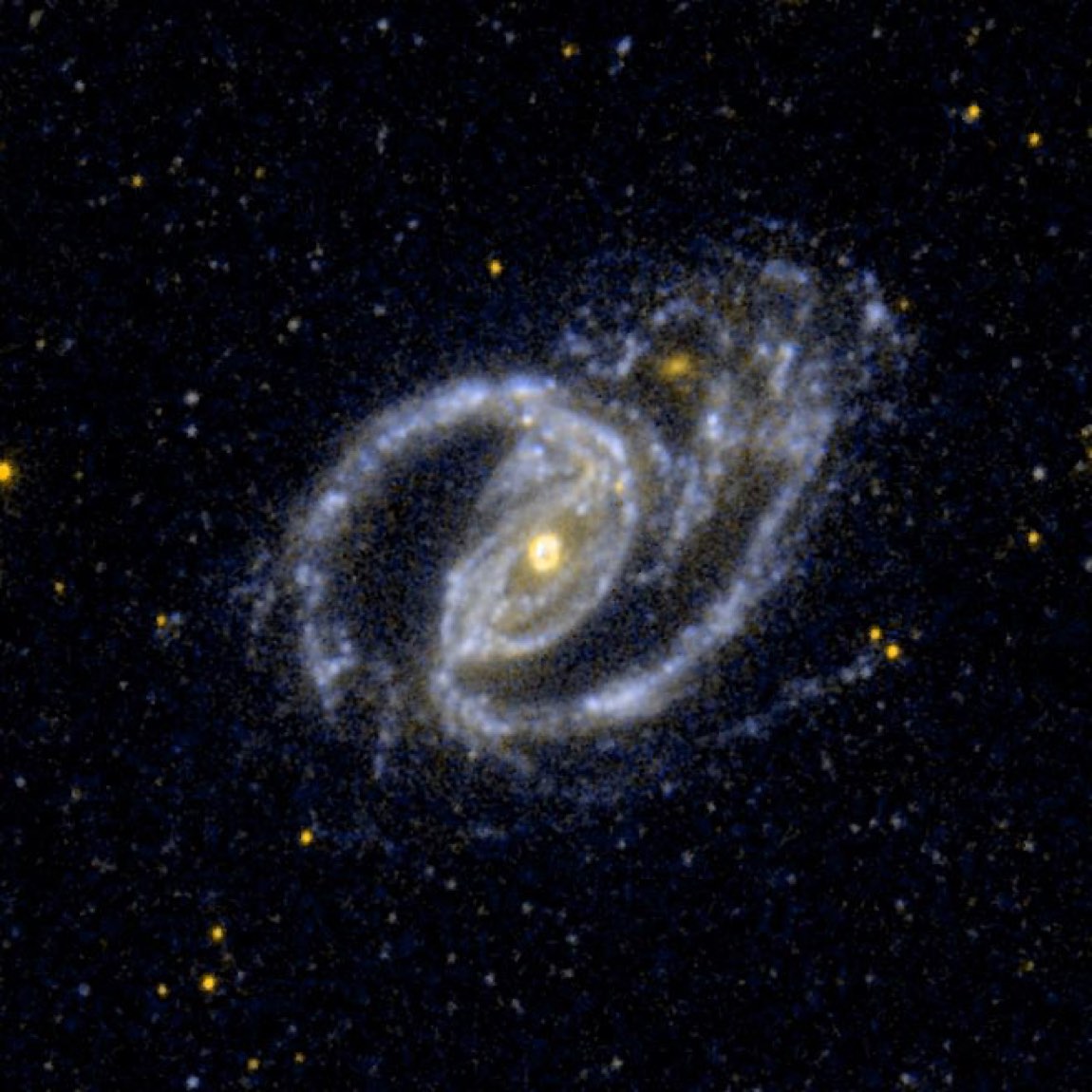
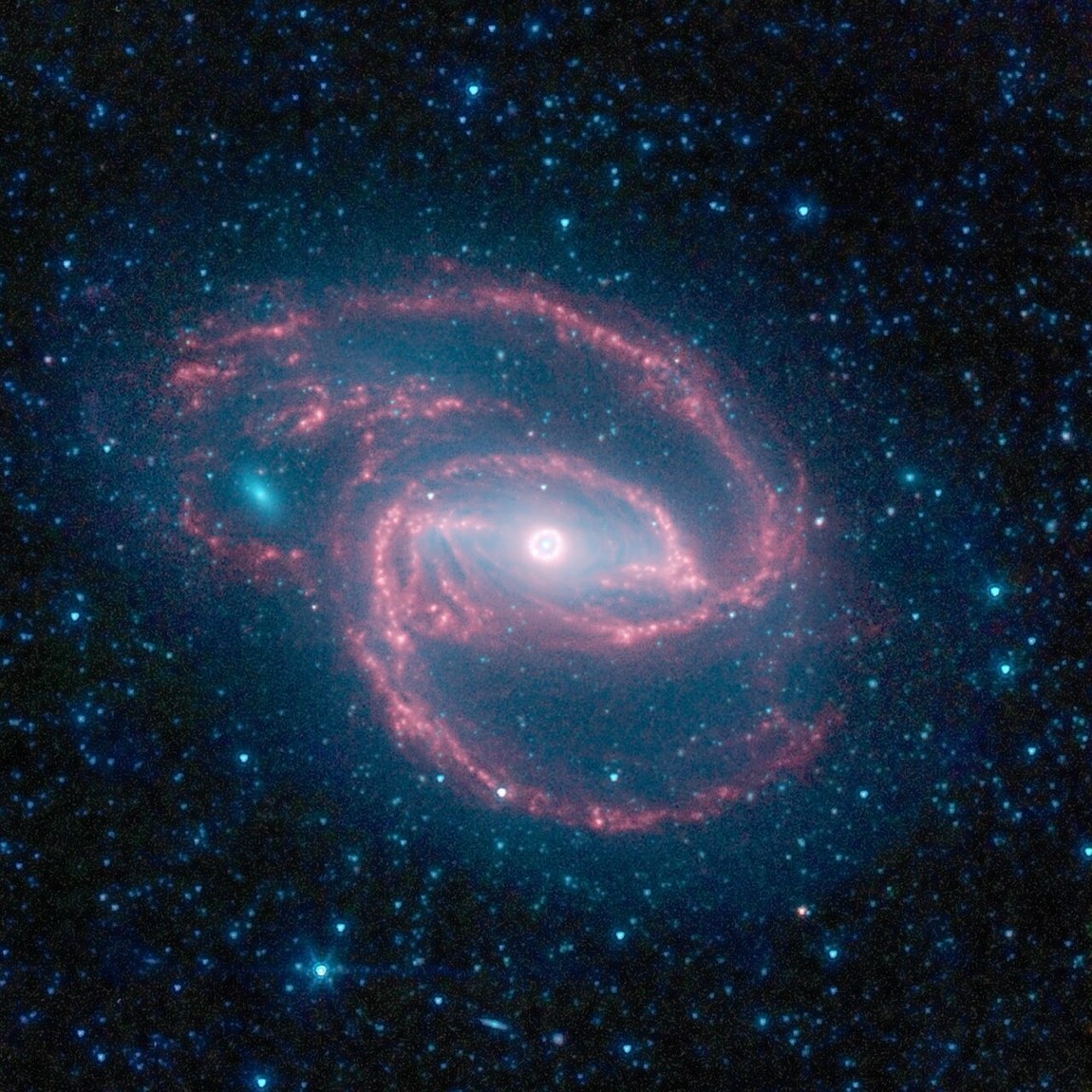
NGC 1097 is a barred spiral galaxy in Fornax, discovered by William Herschel in 1790. It is interacting with a small companion, NGC 1097A, and shows tidal debris from that encounter. At its centre sits a supermassive black hole estimated at 140 million solar masses, wrapped in a bright ring of star-forming regions about 5,000 light-years wide. Gas flowing inward along the galaxy's bar feeds that ring. Four supernovae have been seen in it.
The deep dive
Researched for the Atlas from Wikipedia — NGC 1097 (2,418 characters read) · updated Nov 15, 2026
01 A Galaxy Eating Another Galaxy
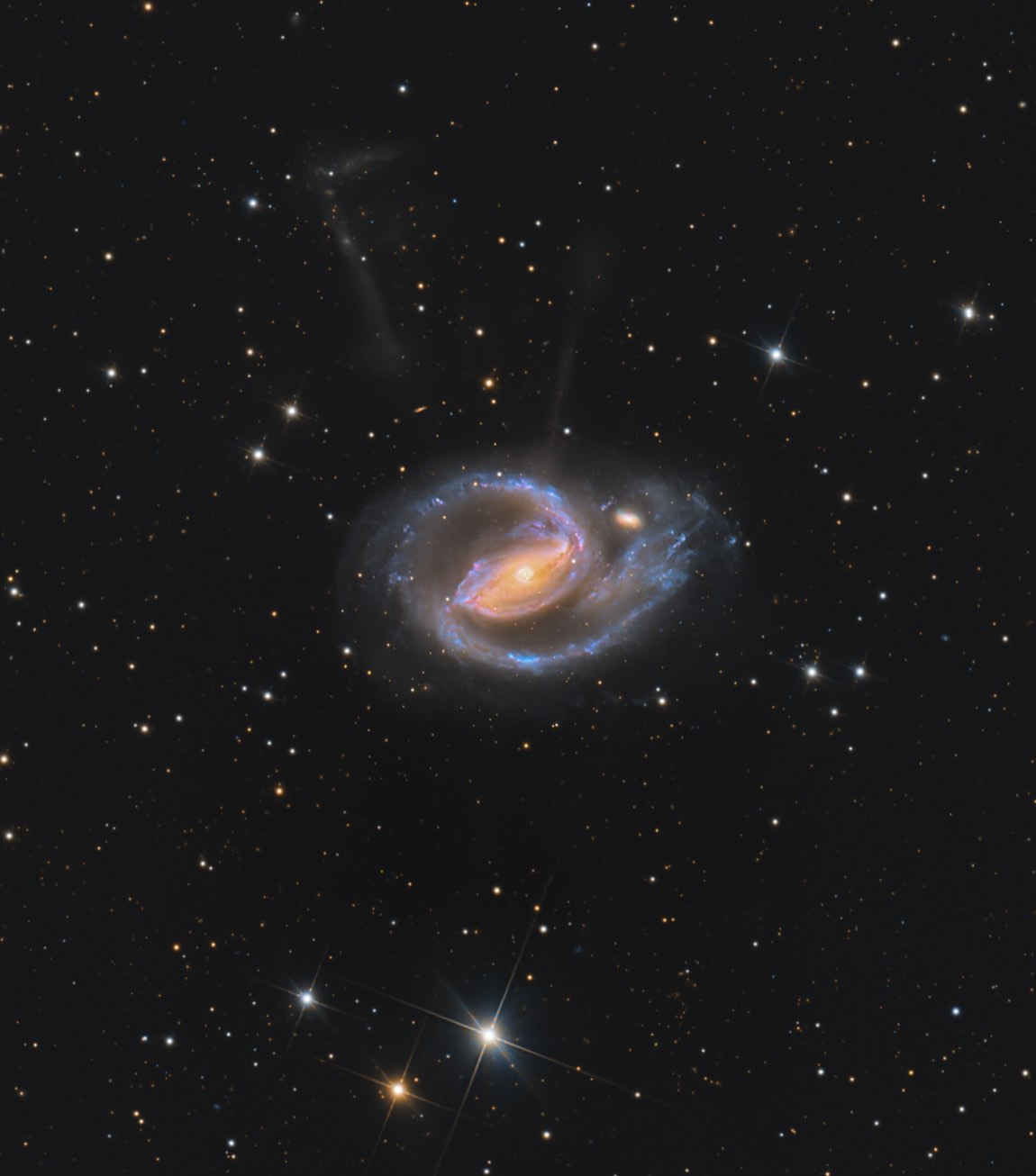
One of the strangest features of NGC 1097 is a set of four narrow optical jets that appear to shoot outward from its nucleus. For a time, astronomers suspected these were tidal tails — long streamers of hydrogen gas dragged out when two galaxies gravitationally tangle. But deep imaging with the Very Large Array radio telescope using 21 cm HI wavelengths failed to detect any atomic hydrogen gas in the jets, which should have been present if they were ordinary tidal debris. Numerical simulations supported the same conclusion. The current interpretation is striking: the jets are the shattered, smeared-out remains of a dwarf galaxy that NGC 1097 cannibalized at some point in its past. The unfortunate victim was pulled apart, and its stellar material now forms these ghostly linear streaks visible in deep photographs. It is a vivid demonstration that large galaxies grow, at least partly, by consuming smaller neighbors — a process that has shaped NGC 1097's unusual appearance across millions of years.
02 The Glowing Ring Around the Black Hole
Surrounding NGC 1097's supermassive central black hole is a spectacular ring of intensely active star-forming regions. This ring is approximately 5,000 light-years in diameter — roughly the same as the distance from Earth to the center of the Milky Way. It glows because material is constantly being funneled toward it: gas and dust spiral inward from the ring toward the black hole along a network of filaments, while fresh material flowing toward the central bar of the galaxy feeds the ring from outside. This continuous inflow of raw material triggers bursts of new star formation around the ring's circumference, lighting it up. Beyond the ring, NGC 1097's spiral arms extend tens of thousands of light-years further outward, making the ring look like a bright, tight core set inside a much grander structure. The combination of an active nucleus, a feeding black hole, and a star-birth ring makes NGC 1097 one of the more dynamic large galaxies known in the nearby universe.
03 The Supermassive Black Hole's True Scale Deeper
The black hole at the heart of NGC 1097 has a mass 140 million times that of the Sun. For context, the well-studied black hole at the center of the Milky Way, Sagittarius A*, is roughly 4 million solar masses — meaning NGC 1097's central black hole is about 35 times more massive. Despite this enormous mass, the nucleus is currently described as only weakly active. NGC 1097 is classified as a Seyfert galaxy, a category defined by a relatively low-luminosity active galactic nucleus compared to the most powerful quasars. Deep photographs were the first to reveal the four narrow optical jets apparently emanating from this nucleus, and those jets were initially interpreted as signs of a vigorous active core. Subsequent spectral analysis of the brightest jet across the full radio-to-X-ray energy range ruled out both synchrotron radiation and thermal free-free emission as their source, eventually pointing instead to a stellar origin. The nucleus is active, but quietly so — a giant engine idling rather than roaring.
 ⤢
04 What the Jets Are Really Made Of Deeper
When the four optical jets of NGC 1097 were first photographed, they seemed like a textbook example of jets powered by an active galactic nucleus — beams of energetic particles fired outward from regions near a black hole. This interpretation was tested by analyzing the spectral energy distribution of the brightest jet from radio wavelengths all the way through to X-rays. Both synchrotron emission, produced by fast electrons spiraling through magnetic fields, and thermal free-free emission, produced by hot ionized gas, were ruled out as the dominant source. The jets are instead composed of stars. This is consistent with the later conclusion that the jets represent the disrupted body of a cannibalized dwarf galaxy — the stars that once made up that smaller system are now distributed along these narrow linear structures. The fact that something which looks so much like an active-nucleus jet turned out to be a trail of stars underscores how deceptive galaxy morphology can be when studied only in optical images without complementary spectral and radio data.
05 Two Very Different Satellite Galaxies
NGC 1097 has two confirmed satellite galaxies orbiting it, and they could hardly be more different from each other. The larger is NGC 1097A, a dwarf elliptical galaxy with a peculiar character that sets it apart from typical smooth, featureless ellipticals. It orbits at a distance of 42,000 light-years from the center of NGC 1097. The gravitational interaction between NGC 1097A and its host has contributed to the tidal debris and distortions visible throughout the larger galaxy. The second satellite, NGC 1097B, is a much smaller dwarf irregular galaxy with a mass of only 5 million solar masses — roughly one ten-thousandth the mass of the Milky Way. It is the outermost of the two companions and was not discovered visually at all; it revealed itself through its HI emission, the radio signal emitted by neutral hydrogen gas. Beyond its mass, type, and discovery method, very little else is currently known about NGC 1097B, making it one of the system's remaining open puzzles.
06 Four Supernovae and What They Tell Us
NGC 1097 has hosted four observed supernovae, all of them Type II — the explosive deaths of massive stars that have exhausted their nuclear fuel. The first, SN 1992bd, was discovered on 12 October 1992 by Chris Smith and Lisa Wells and reached an apparent magnitude of 15, bright enough for moderate-aperture telescopes to detect. SN 1999eu, found by Masakatsu Aoki on 5 November 1999 at magnitude 17.3, was classified as Type II-pec, meaning it showed peculiarities that set it apart from a standard Type II event. SN 2003B, discovered by the prolific supernova hunter Robert Evans on 5 January 2003, also reached magnitude 15. The most recent, SN 2023rve, was found by Mohammad Odeh on 8 August 2023 and was the brightest of the four at magnitude 14. The steady occurrence of core-collapse supernovae in NGC 1097 is consistent with its active star-forming ring producing a continuous supply of short-lived massive stars that end their lives explosively within a few million years of formation.
 ⤢
07 William Herschel's Discovery in 1790
NGC 1097 was discovered by the astronomer William Herschel on 9 October 1790. Herschel was then in the midst of his systematic sweeps of the sky, cataloguing nebulae and star clusters with his large reflecting telescopes from England. At 45 million light-years away, NGC 1097 appears in the southern constellation Fornax, which sits relatively low in the sky as seen from British latitudes, making it a less convenient target than many of Herschel's other discoveries. Through the telescopes of his era, NGC 1097 would have appeared as little more than a faint, fuzzy smear — none of its extraordinary internal structure, its star-forming ring, its stellar jets, or its satellite galaxies would have been separable. The galaxy is also catalogued as Caldwell 67, part of Patrick Caldwell-Moore's later list of deep-sky objects worth observing. Everything known about NGC 1097's true complexity has come from photographic, radio, and space-based observations developed over the two centuries since Herschel first noted its existence.
08 A Severely Interacting System Deeper
NGC 1097 is described in the literature as a severely interacting galaxy, and the visual evidence confirms this characterization. Obvious tidal debris and large-scale distortions in the galaxy's structure have been produced by ongoing gravitational interaction with its companion NGC 1097A. When two galaxies pass close to each other or orbit in proximity, their mutual gravity stretches and distorts each body, pulling out streams of stars and gas and warping the overall shape. In NGC 1097's case, the interaction has been severe enough to produce the kind of dramatic morphological changes — tidal debris, structural distortions, and likely the eventual cannibalization events that left behind the stellar jets — that make it a particularly rich subject for studying how galaxies influence and reshape one another. The system is therefore not just interesting for its central black hole or its star-forming ring; it is a snapshot of the messy, violent process by which galaxies co-evolve when they share the same gravitational neighborhood over billions of years.
09 Observing NGC 1097 from Earth
NGC 1097 lies in the constellation Fornax, a southern constellation named after a chemical furnace, positioned in the sky south of the celestial equator. At a distance of 45 million light-years it is one of the larger and closer barred spiral galaxies available to observers in the southern hemisphere, and its apparent magnitude makes it accessible to amateur telescopes under good dark-sky conditions. The four stellar jets and the star-forming ring are not visible to amateur instruments and require deep long-exposure imaging or large professional telescopes to resolve. The companion galaxy NGC 1097A can be identified in photographs near the main galaxy's disk. The supernovae discovered in NGC 1097 — particularly those reaching magnitude 14 and 15 — would have been detectable with backyard telescopes around the time of their discovery, and the 2023 event, SN 2023rve, reached magnitude 14, the brightest of the four recorded so far. For observers in the northern hemisphere, Fornax's low declination makes NGC 1097 a challenging target, best seen from tropical or southern latitudes.
 ⤢