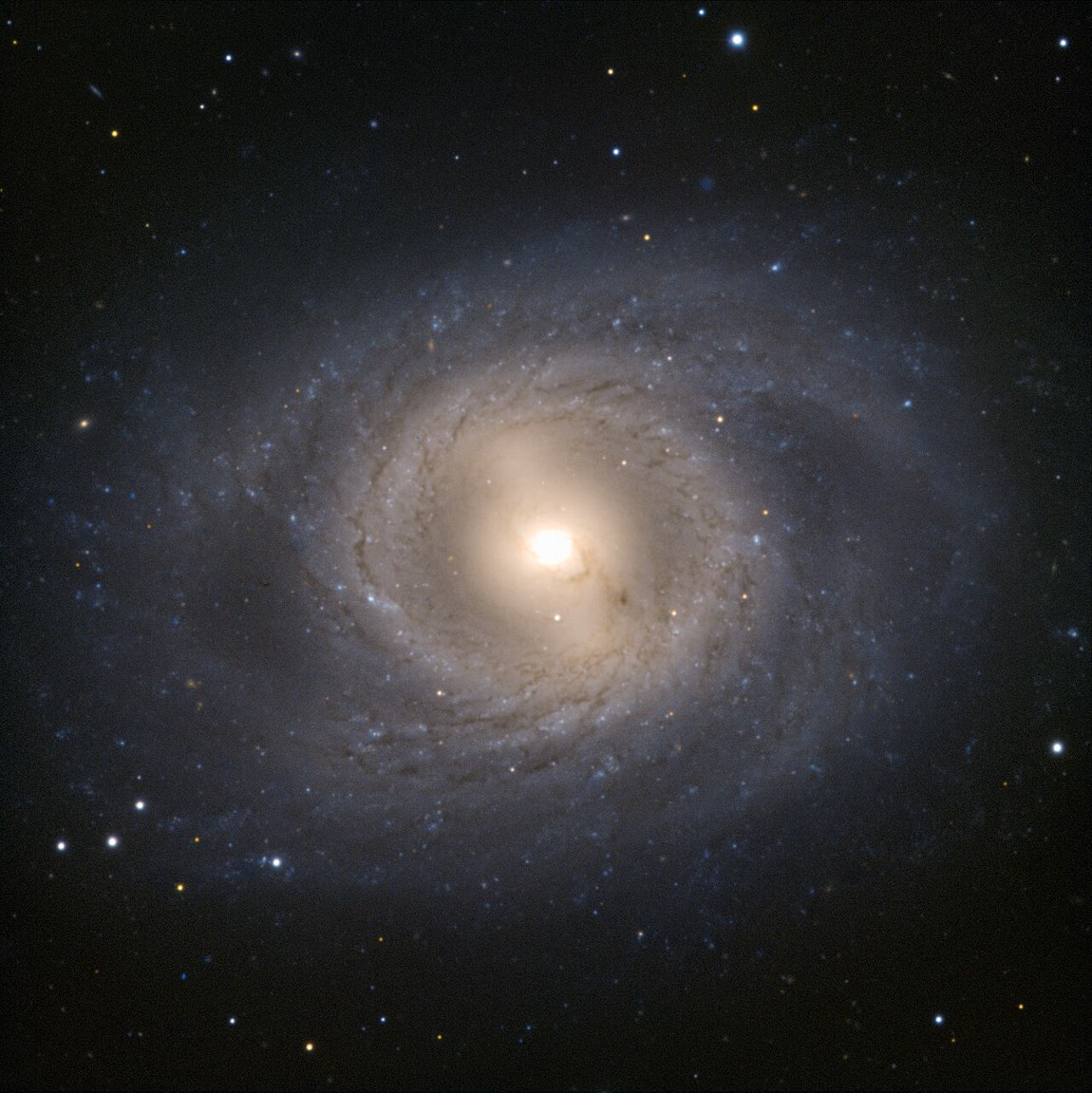
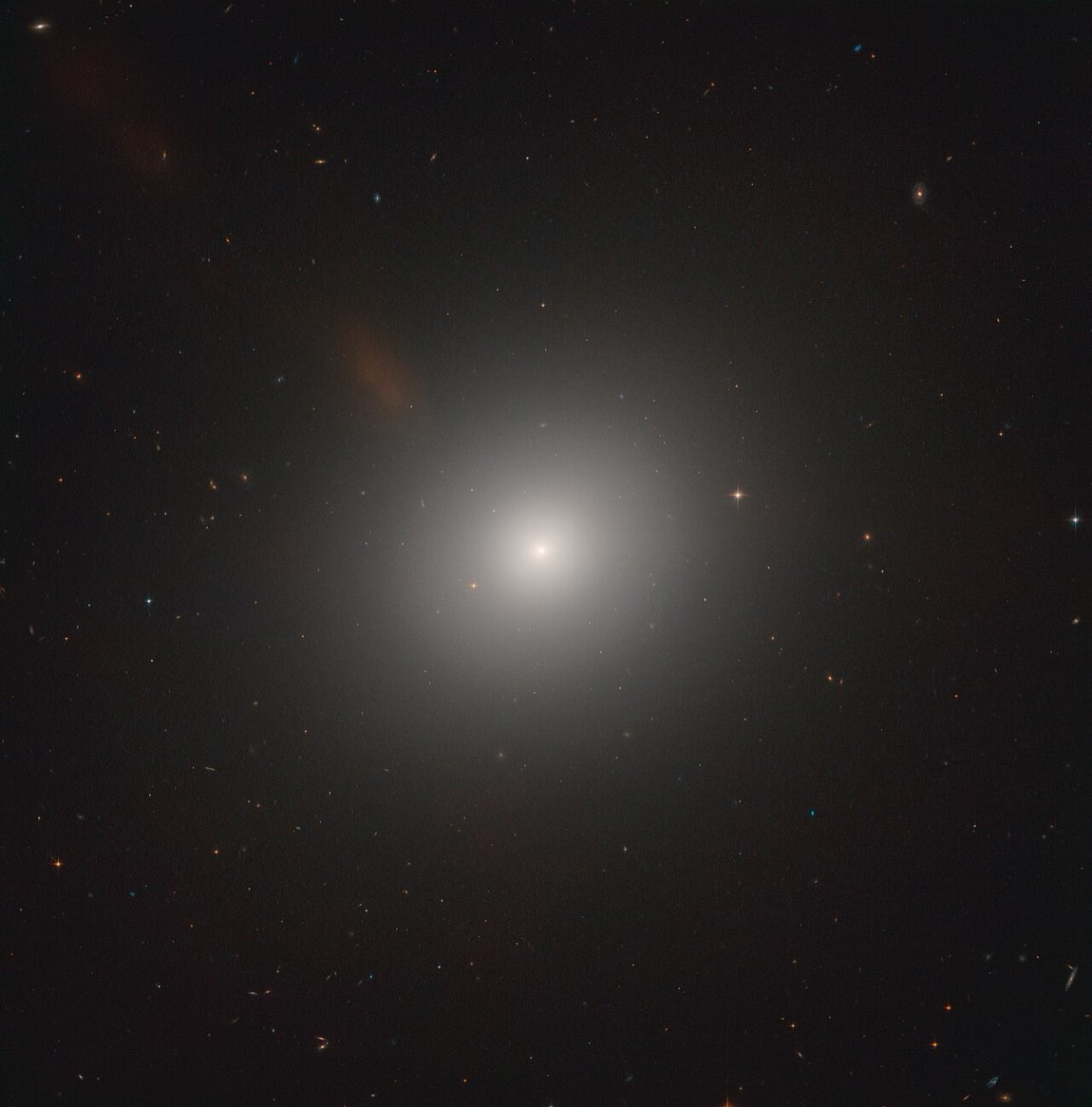
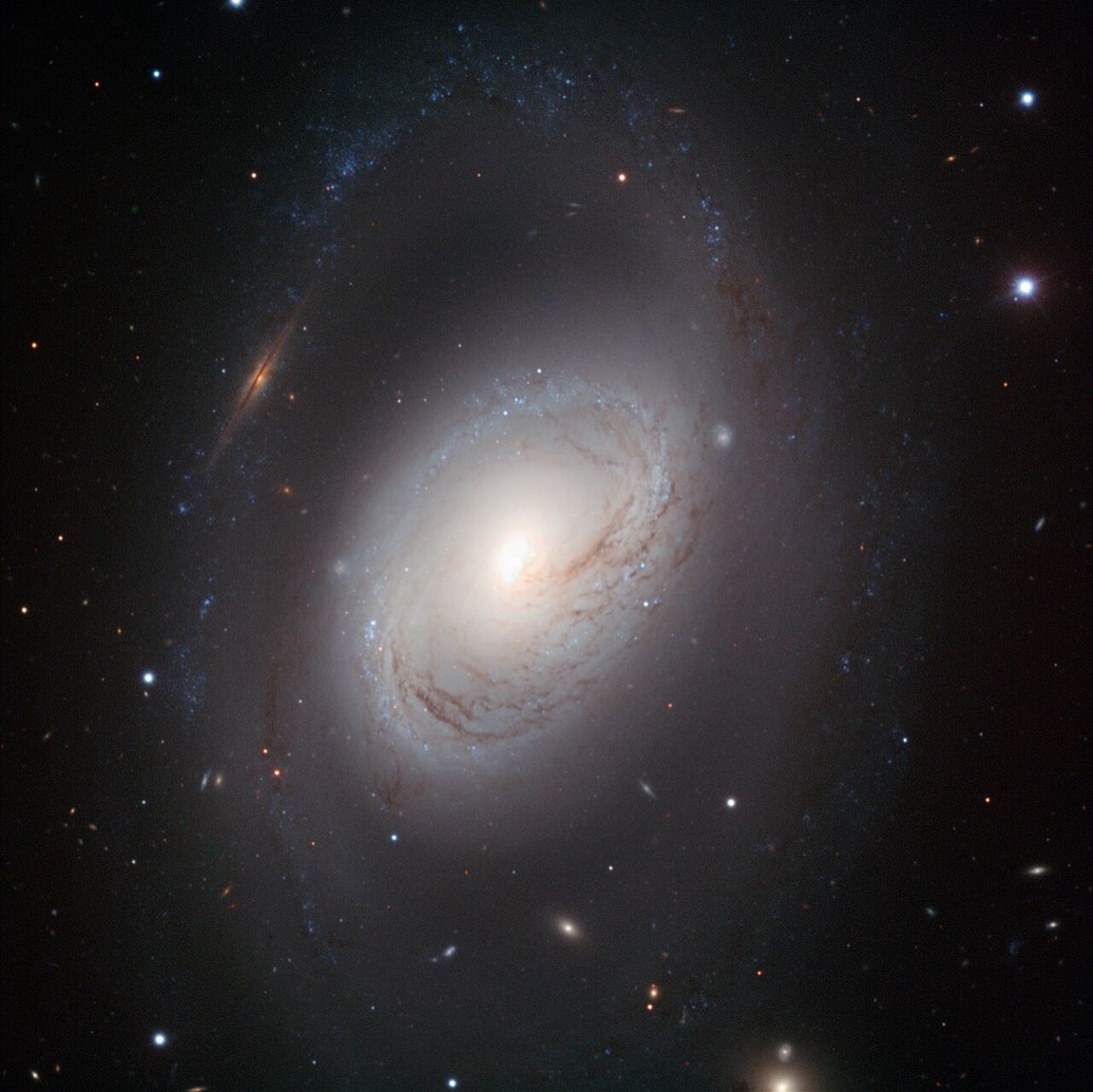
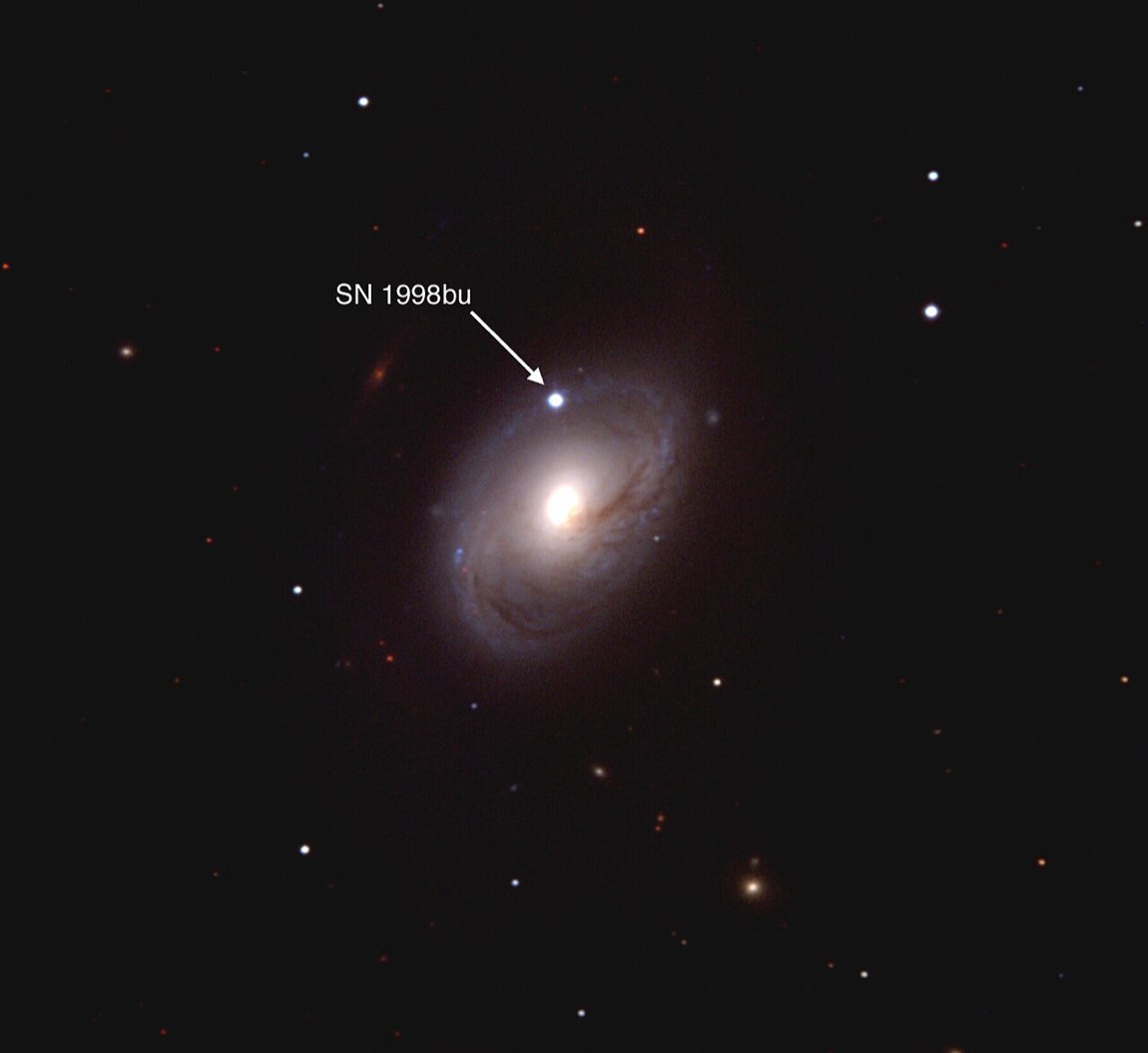
 Photograph · ESO/Oleg Maliy · CC BY 3.0
Galaxy · Deep guide
Messier 96
Also called: M96 · NGC 3368 · UGC 5882 · PGC 32192
A lopsided spiral in Leo whose core sits off-centre, the brightest galaxy in its group.
What is it?
Messier 96 is a spiral galaxy in Leo, about 31 million light-years away. Pierre Méchain discovered it on 20 March 1781, and Messier confirmed it four days later. It has a double bar and a small inner bulge, and its nucleus shows weak activity. Telescope images reveal that its gas and dust are spread unevenly, its arms are poorly defined and its core is shifted from the centre. It is the brightest galaxy in the M96 Group, which also includes M95 and M105.
The deep dive
Researched for the Atlas from Wikipedia — Messier 96 (2,479 characters read) · updated Nov 15, 2026
01 Discovered in a single busy week in 1781
M96 owes its place in astronomical history to two French astronomers working in close collaboration. Pierre Méchain spotted the faint smudge on March 20, 1781 — during one of the most productive weeks in observational astronomy, when Méchain was sweeping the sky and turning up multiple objects that would fill Messier's growing catalogue. He passed word to Charles Messier, who trained his own telescope on the spot just four days later, confirmed the sighting, and recorded it officially. That four-day turnaround reflects how rapidly the two men communicated and cross-checked each other's work. Messier's catalogue was originally designed as a practical tool for comet hunters — a list of things that looked like comets but weren't — so M96 earned its entry simply by being a convincing impostor. Neither man could have known they were cataloguing an intermediate spiral galaxy tilted about 53° toward us, sitting some 31 million light-years away. The whole exchange happened nearly two and a half centuries ago, yet that original confirmation date remains the anchor for every subsequent study of this galaxy.
02 A double bar hiding inside a spiral Deeper
M96 is classified as a double-barred spiral galaxy, a structure more intricate than a simple barred spiral. It possesses a small inner bulge running through the core as well as a distinct outer bulge — two separate bar-like features nested inside each other. This kind of architecture is thought to influence how gas funnels toward the galactic center, potentially feeding both star formation and nuclear activity. The nucleus itself is not quiet: it shows a weak LINER2 type of activity, a low-ionization nuclear emission-line region that sits at the gentler end of the active galactic nucleus spectrum. What drives even that modest glow is almost certainly a supermassive black hole lurking at the center, suggested by variations detected in the galaxy's ultraviolet emission from the core. Estimates for the black hole's mass span a wide range — from 1.5 million to 48 million solar masses — reflecting genuine uncertainty in the measurements rather than a settled answer. That spread of nearly a factor of thirty shows how difficult it remains to pin down central black hole masses even in relatively nearby galaxies.
03 Why M96 looks lopsided
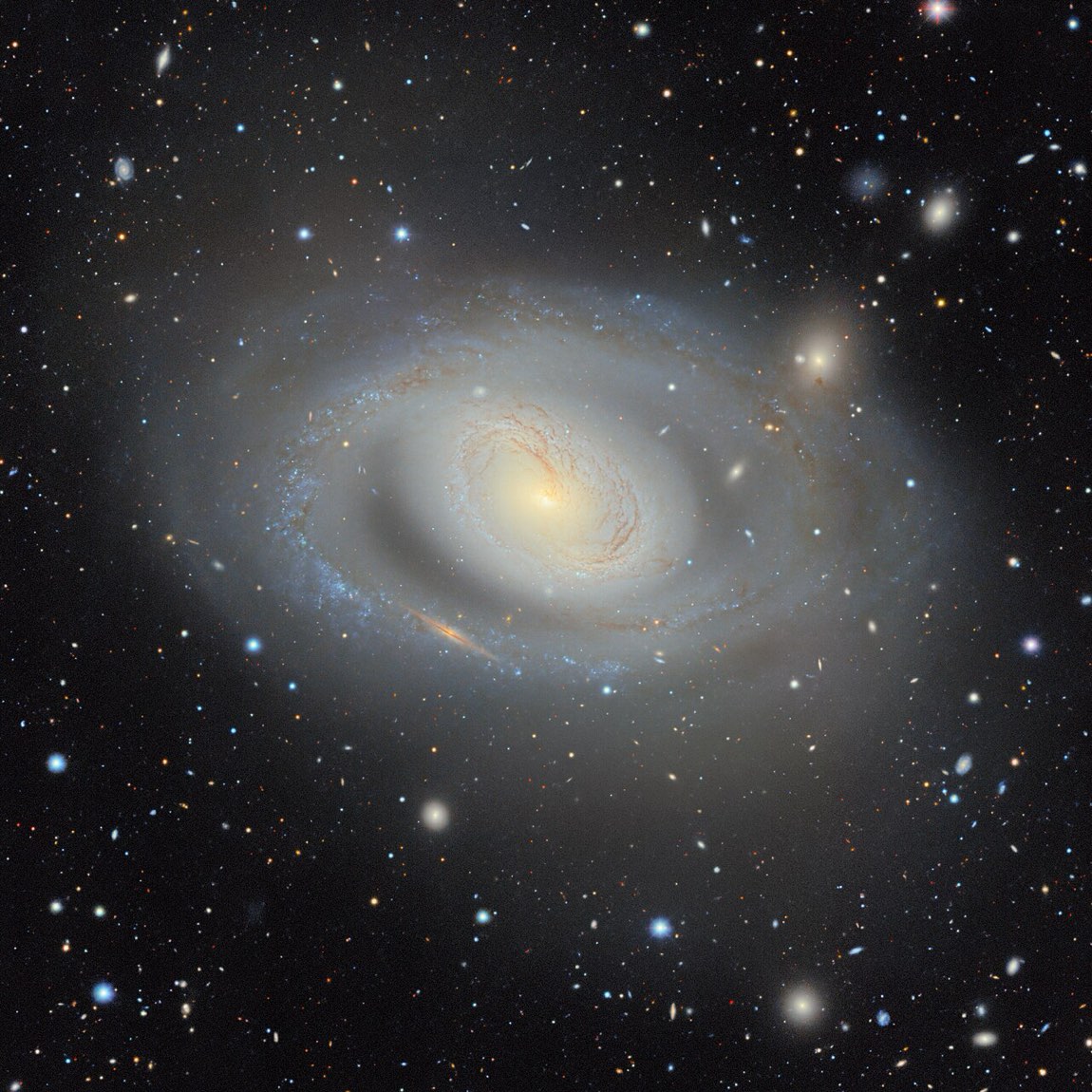
Even a modest telescope reveals something unusual about M96: it is strikingly asymmetric. Its dust and gas are spread unevenly across its weak spiral arms, and perhaps most tellingly, the galaxy's core is not centered within its own boundaries — it sits offset from the midpoint of the galaxy's full extent. The arms themselves are asymmetrical, an irregularity astronomers attribute to gravitational tugging by neighboring galaxies within the M96 Group. This kind of tidal distortion is common in galaxy groups, where members pass close enough to one another over billions of years to warp each other's shapes without necessarily merging. M96 is roughly the same mass and size as the Milky Way, so imagining our own galaxy similarly stretched and off-kilter gives an intuitive sense of the forces involved. The asymmetry is not a minor cosmetic detail — it redistributes the raw material for star formation, concentrating gas in some regions while leaving others relatively starved, which shapes where new stars are being born across the disk right now.
04 Seeing M96 with your own eyes
Finding M96 is described as burdensome even with large binoculars, which is a candid warning that casual stargazers may come away frustrated. The article sets a practical threshold: a telescope of at least 25.4 cm (10.0 inches) of aperture under a genuinely good sky. At that size you can begin to make out a halo spanning roughly three by five arcminutes — about one-tenth the apparent width of the full Moon — with a brighter core region standing out from the surrounding glow. The galaxy is inclined about 53° to our line of sight, oriented at a position angle of 172°, which means it appears neither perfectly face-on nor perfectly edge-on but tilted at an intermediate angle that lets observers see some of the disk structure without the full spiral pattern being laid out flat. That tilt is actually useful: it hints at depth and three-dimensionality in a way a purely face-on galaxy cannot. For observers willing to invest in aperture and dark skies, M96 rewards patience in the constellation Leo, where it anchors a small but rich region of sky.
05 The supernova that lit up 1998
On May 9, 1998, an amateur astronomer named Mirko Villi discovered a new point of light in M96 — a Type Ia supernova catalogued as SN 1998bu. Within less than two weeks it blazed to its maximum brightness, reaching about magnitude 11.6 on May 21, which made it bright enough to be a compelling target for modest backyard telescopes and earned it the distinction of being the brightest supernova of 1998. Type Ia supernovae are the thermonuclear destruction of a white dwarf star that has accumulated too much mass, and they are prized by cosmologists as distance indicators because their peak brightness is remarkably consistent. After maximum light, SN 1998bu faded steadily in the months that followed. Observations of the expanding debris cloud a full year after the explosion revealed a striking detail: the explosion had forged approximately 0.4 solar masses of iron from nuclear reactions during the blast. Spectroscopic analysis of the remnant confirmed the presence of radioactive cobalt-56, which decays into iron-56, providing a direct chemical fingerprint of the nucleosynthesis process that supernovae perform across the universe.
 ⤢
06 Iron forged in a single stellar death Deeper
The chemical legacy of SN 1998bu is worth pausing on. The detection of 0.4 solar masses of iron in the ejecta one year after the explosion is not just an impressive number — it is a direct measurement of nucleosynthesis in action. For scale, our entire Sun contains roughly one solar mass of material, so this single supernova produced iron equivalent to nearly half a Sun's worth of mass in a matter of seconds during the explosion. The spectral confirmation of radioactive cobalt-56 decaying into iron-56 is significant because it traces the specific nuclear chain reactions that power a Type Ia supernova's prolonged light curve. The energy released by that radioactive decay is what keeps a supernova shining for weeks and months after the initial blast rather than fading instantly. Each atom of iron now drifting through the M96 disk from this event will eventually mix into future star-forming gas clouds, potentially becoming part of rocky planets billions of years from now — the same process by which Earth accumulated its own iron core and the iron in human blood.
07 M96's place in a galaxy neighborhood
M96 is not an isolated system — it is the brightest member of the M96 Group, a gravitationally bound collection of galaxies in Leo. The group's other Messier-catalogue members are M95, another spiral, and M105, a bright elliptical galaxy, with at least nine additional galaxies rounding out the ensemble. What makes this group particularly notable in the broader context of large-scale structure is its distinction as the nearest group to our own Local Group that contains both bright spiral galaxies and a bright elliptical galaxy together. Most nearby groups tend to be dominated by one type or the other, so the M96 Group offers a relatively close-up laboratory for studying how spirals and ellipticals coexist and interact. The gravitational interactions among group members are almost certainly responsible for the asymmetries visible in M96 itself, as tidal forces from neighbors tug at its arms and redistribute its gas over cosmic timescales. At roughly 31 million light-years away, the group is close enough that individual supernovae — like SN 1998bu — are detectable from Earth.
08 Mapping star birth across 50 galaxies Deeper
M96 has been selected as one of 50 nearby galaxies targeted by the Legacy ExtraGalactic UV Survey, known as LEGUS. The program's explicit goal is to provide an unprecedented view of star formation within the local universe, using ultraviolet observations to cut through older stellar populations and pick out the youngest, hottest stars — the ones born most recently. Ultraviolet light is a powerful tracer of star formation because massive young stars radiate intensely in that part of the spectrum before they burn out quickly on astronomical timescales. By including M96 in this survey alongside 49 other galaxies of varying types and environments, researchers can compare how star formation proceeds differently across different galactic architectures and group environments. For M96 specifically, the survey is especially relevant given the galaxy's known asymmetry — the uneven distribution of dust and gas across its arms means star formation is not happening uniformly, and mapping it in UV detail can show exactly where the process is concentrated and why. LEGUS data from M96 thus connects the galaxy's peculiar structure to the ongoing story of stellar birth happening within it right now.
09 Open questions that remain unsettled Deeper
Despite decades of study, M96 leaves several questions genuinely open. The mass of the central supermassive black hole is the most striking example: estimates range from 1.5 million to 48 million solar masses, a spread so wide it reflects the difficulty of the measurement rather than a converging answer. Nailing down that mass requires either resolving the motions of stars very close to the nucleus or modeling the ultraviolet variability with high precision — neither is straightforward at 31 million light-years. The exact mechanism driving the LINER2 activity in the nucleus is also debated more broadly in the field; it may be powered by the central black hole accreting at a low rate, or by other processes such as shocks or evolved stellar populations. The root cause of M96's striking asymmetry — specifically which neighboring galaxies have contributed most gravitational influence and over what timescale — has not been definitively resolved. And the LEGUS survey data, while providing an unprecedented UV view of star formation, is still being analyzed and compared across the full sample of 50 galaxies, meaning the full scientific return for M96 in that context is still accumulating.
 ⤢