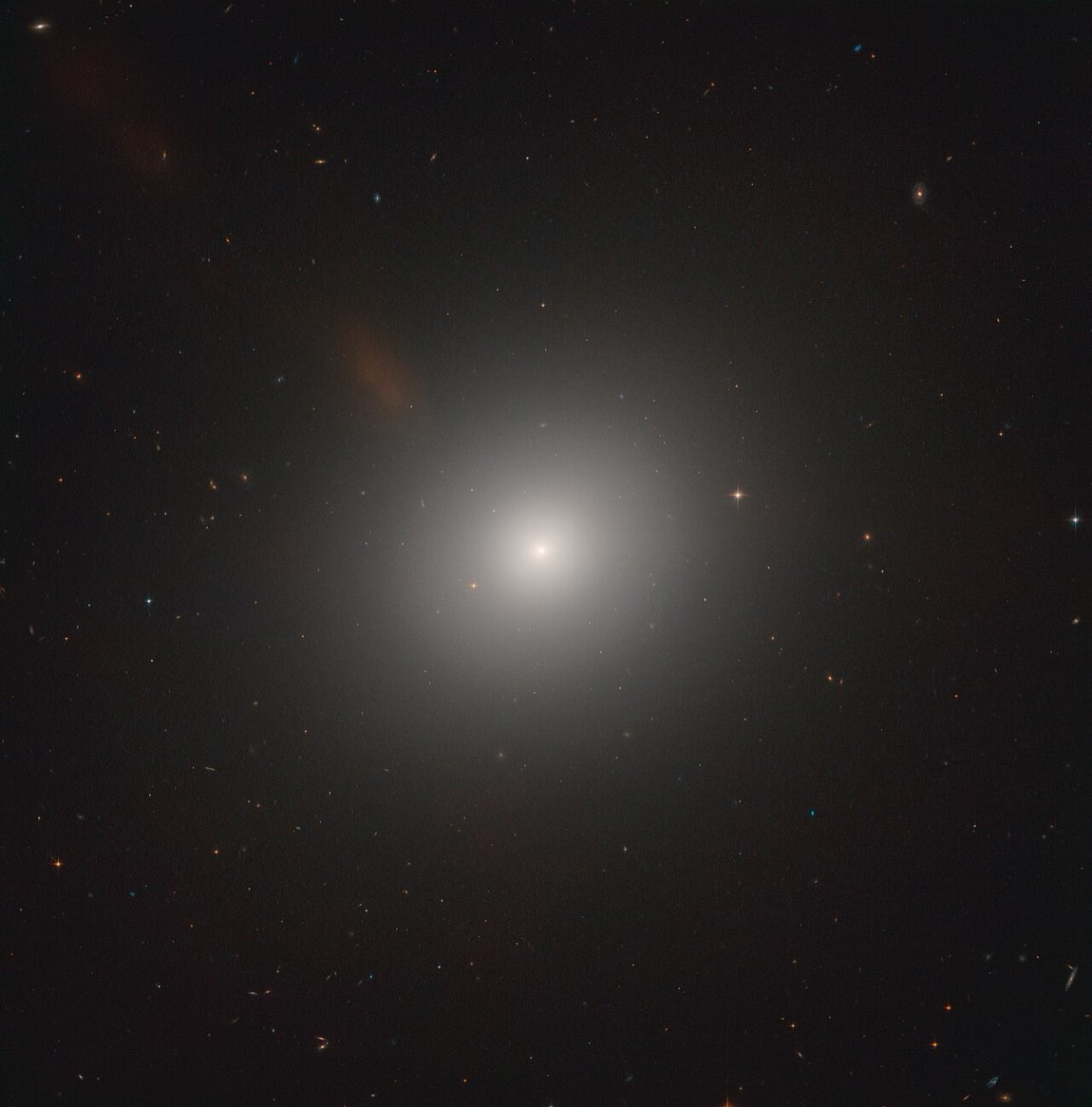
 Photograph · Credit: ESA/Hubble & NASA, C. Sarazin et al. · CC BY 4.0
Galaxy · Deep guide
Messier 105
Also called: M105 · NGC 3379 · UGC 5902 · PGC 32256
A smooth, nearly round elliptical in Leo, added to Messier's list long after it was published.
What is it?
Messier 105 is an elliptical galaxy in Leo, about 36.6 million light-years away. Pierre Méchain found it in 1781, days after spotting M95 and M96, but it never made Messier's published lists. It was added much later after Helen Sawyer Hogg found a letter in which Méchain described it. It is the largest elliptical in the Messier catalogue outside the Virgo Cluster. Its shape is remarkably smooth, with no ripples or shells, and its core holds a supermassive black hole.
The deep dive
Researched for the Atlas from Wikipedia — Messier 105 (2,231 characters read) · updated Nov 15, 2026
01 Rediscovered by a Letter in a Drawer
Pierre Méchain spotted M105 in 1781, just days after finding the nearby galaxies Messier 95 and Messier 96 — a remarkable run of discoveries in a single corner of Leo. Yet the galaxy never made it into the editions of Messier's catalogue published during his lifetime, because Messier himself never independently confirmed the object. For well over a century it remained in a kind of bureaucratic limbo, catalogued under its NGC number, 3379, but carrying no Messier designation. The situation changed thanks to historian of astronomy Helen S. Hogg, who unearthed a letter written by Méchain that precisely located and described the object. That description matched NGC 3379 closely enough to settle the question, and the galaxy was formally appended to the Messier list. It stands as a reminder that even the most famous catalogues in science are living documents, quietly corrected by archival detective work generations after the original observations were made.
02 The Shape of Near-Perfect Symmetry
M105 carries the morphological classification E1, meaning it is a standard elliptical galaxy flattened by just 10 percent — barely squashed at all compared to more elongated ellipticals. Its major axis points along a position angle of 71 degrees. What makes the galaxy's shape particularly striking to researchers is the almost eerie regularity of its isophotes, the contour lines of equal brightness mapped across its face. Those isophotes are near-perfect ellipses, twisting no more than 5 degrees out of alignment with one another across the entire body of the galaxy. The ellipticity itself changes by no more than 0.06 from one isophote to the next. And there is no fine structure — no ripples, shells, or asymmetric warps — visible anywhere in those brightness contours. Many elliptical galaxies bear faint ripple patterns that betray past collisions or mergers, so the smooth, featureless isophotes of M105 suggest either a remarkably undisturbed history or mergers ancient enough that all such scars have long since been erased.
03 A Black Hole in a Quiet Engine Room Deeper
At the center of M105 sits a supermassive black hole whose mass is estimated at between 1.4×10⁸ and 2×10⁸ solar masses — that upper bound is roughly 200 million times the mass of our Sun, or about 40 times more massive than the black hole at the center of the Milky Way. The black hole feeds an active galactic nucleus, but only just barely. The nucleus is classified as a LINER, which stands for Low-Ionization Nuclear Emission-line Region, with a spectral subclass of L2/T2. That designation means the nucleus produces no broad hydrogen-alpha emission line, which would be the signature of a vigorously accreting black hole, and that its emission line ratios fall in an intermediate zone between a classic LINER and a star-forming H II region. In practical terms, M105's central engine is running at a whisper rather than a roar — a distinction that makes galaxies like this valuable test cases for understanding how supermassive black holes behave when starved of fuel over cosmic timescales.
04 Ellipticals That Still Make Stars
The conventional picture of an elliptical galaxy is a "red and dead" system — one whose star formation ended billions of years ago, leaving behind nothing but aging, cool, reddish stars drifting in slow orbits. M105 complicates that picture in a small but meaningful way. The galaxy contains a detectable population of young stars and stellar clusters, suggesting that some star formation is still occurring, albeit at an extraordinarily slow rate. This matters because it blurs the boundary between truly quiescent ellipticals and galaxies that remain ever so slightly alive to new stellar birth. Researchers studying M105 have also identified two distinct stellar populations in the galaxy's halo when observing its giant stars: a dominant metal-rich subpopulation and a weaker metal-poor group. The presence of both groups hints at a layered chemical history, with different epochs or modes of star formation contributing stars of very different metallicities to what appears on the outside to be one seamless, uniform system.
05 An Invisible Ring the Size of a Small Galaxy Group
Perhaps the most dramatic feature associated with M105 is not part of the galaxy itself at all. M105 and its nearby companion NGC 3384, a barred lenticular galaxy, are together wrapped inside an enormous ring of neutral hydrogen gas with a radius of 200 kiloparsecs — equal to 650,000 light-years. To put that scale into perspective, the entire Milky Way disk is only about 100,000 light-years across, so this ring is roughly six and a half Milky Ways placed end to end. The ring has a measured mass of 1.8×10⁹ solar masses, nearly two billion times the mass of our Sun packed into a structure of raw, cold hydrogen. What makes the ring scientifically exciting is that star formation has been detected within it. This is neutral gas that has not yet collapsed into stars in the main bodies of either galaxy, yet it is actively producing new stellar nurseries at the ring's periphery, raising questions about how such an outlying structure formed and what governs star formation so far from any galactic center.
06 The Leo I Group: A Rich Galactic Neighborhood
M105 belongs to the M96 Group, also called the Leo I Group, a collection of galaxies gathered in the constellation Leo. Its fellow Messier objects in the group are M95 and M96, and all three were discovered by Méchain within days of each other in 1781. The Leo I Group is described as one of the richest groups of galaxies in the Local Volume — the sphere of space close enough to study in reasonable detail. Unlike our own Local Group, which is gravitationally dominated by just two large galaxies, the Milky Way and Andromeda, the Leo I Group is dominated by not one but several galaxies simultaneously. That structural difference makes it a useful comparison case for cosmologists trying to understand how galaxy groups evolve, how their member galaxies interact, and how the balance of power within a group shapes the histories of individual galaxies over billions of years. M105 sits at a distance of 36.6 million light-years, placing the whole group well beyond our Local Group but still within reach of detailed observational study.
07 Biggest Elliptical in the Messier Catalogue Outside Virgo
M105 holds a specific record within the Messier catalogue: it is the largest elliptical galaxy listed by Messier that is not a member of the Virgo Cluster. The Virgo Cluster dominates the catalogue's elliptical galaxy population because it is the nearest major galaxy cluster and contains some of the most massive galaxies in the nearby universe. M105, sitting in the Leo I Group rather than Virgo, thus stands apart as the premier non-Virgo elliptical in Messier's collection. This distinction is partly a matter of celestial geography — the Leo I Group happens to lie at 36.6 million light-years, farther from us than the Virgo Cluster's core — and partly a reflection of how skewed toward Virgo the census of large ellipticals naturally becomes when surveying bright, nearby galaxies. For observers scanning through Messier objects, M105 offers a chance to study a substantial elliptical in a very different environmental setting from the crowded Virgo Cluster surroundings.
08 How to Find M105 in the Night Sky
M105 sits in Leo, one of the most recognizable zodiac constellations, which makes it accessible to observers in both hemispheres for a good portion of the year. With an apparent magnitude quoted in the article-consistent context of a galaxy requiring a small to moderate telescope to resolve, it lies close on the sky to its companions M95 and M96, the trio that Méchain swept up in quick succession in 1781. Because the three galaxies sit near one another, a wide-field eyepiece can capture M105 and NGC 3384 together in the same view — an unusually rewarding pairing given that those two galaxies are physically bound to each other and share the enormous neutral hydrogen ring surrounding them. The galaxy's equatorial position in Leo means it passes nearly overhead for mid-latitude observers, minimizing the blurring effects of Earth's atmosphere and giving the best chance of detecting its smooth, condensed glow. Its E1 classification and featureless isophotes mean even large telescopes reveal no dramatic internal structure — but its brightness and companionable sky position make it a satisfying target.
09 Open Questions Swirling Around a Quiet Galaxy Deeper
Despite looking like one of the most settled, uneventful galaxies in the nearby universe, M105 carries several unresolved puzzles. The range of black hole mass estimates — spanning from 1.4×10⁸ to 2×10⁸ solar masses — reflects genuine uncertainty in the dynamical modeling needed to weigh a black hole using stellar or gas motions. The origin of the enormous neutral hydrogen ring surrounding M105 and NGC 3384 is not fully explained; such a structure at a radius of 200 kiloparsecs is unusual, and understanding whether it formed from stripped gas, primordial material, or some earlier interaction between the two galaxies remains an active area of inquiry. The detection of star formation within that ring adds another layer of complexity, since the conditions that trigger star formation so far from any galactic nucleus are not well understood. And the presence of both metal-rich and metal-poor stellar populations in the halo invites questions about how many distinct episodes of star formation or accretion shaped M105 across cosmic history — history that its deceptively smooth isophotes have so far declined to reveal.