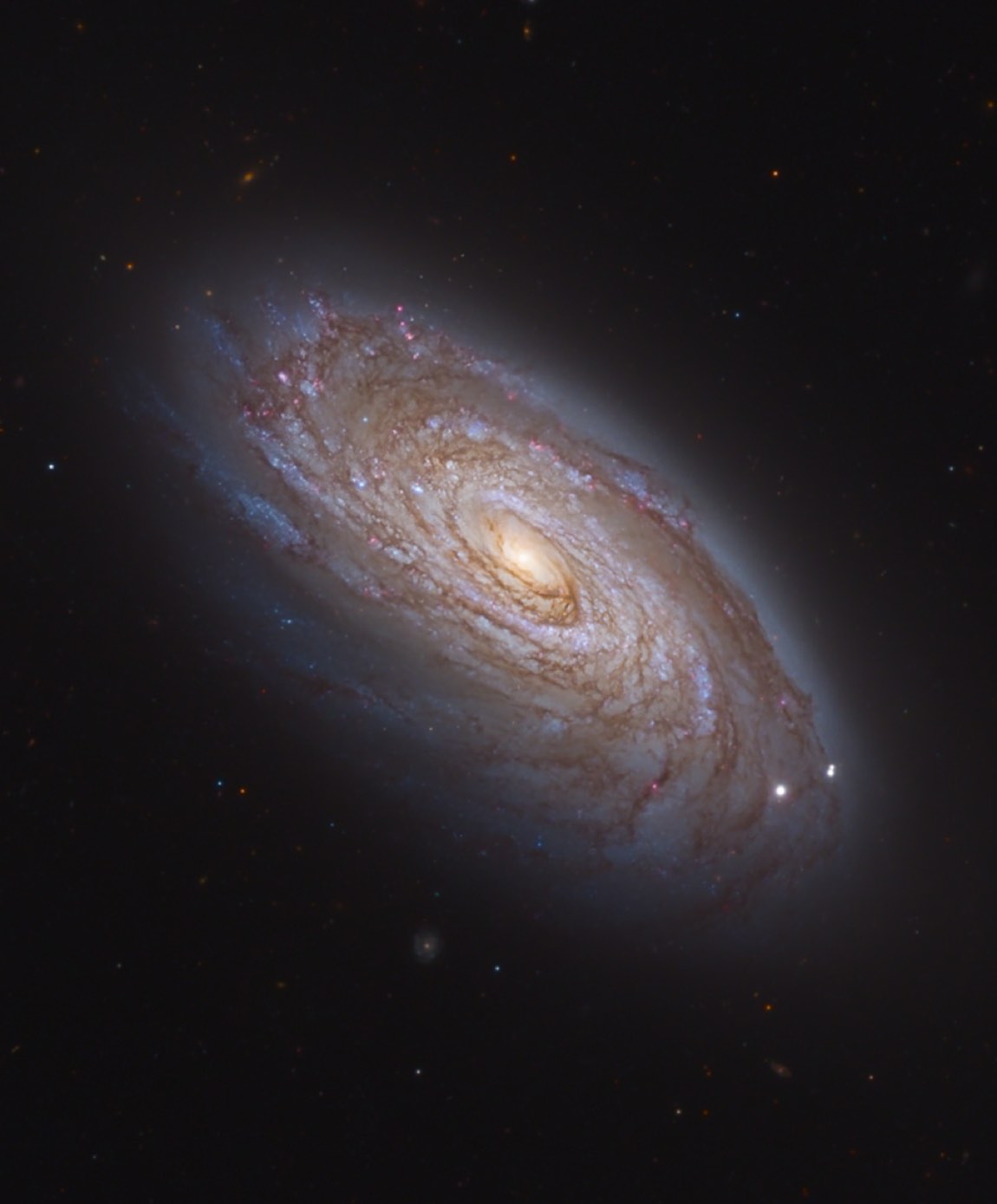
 Photograph · NASA, ESA, and J. Lee (California Institute of Technology) · CC BY-SA 4.0
Galaxy · Deep guide
Messier 91
Also called: M91 · NGC 4548 · UGC 7753 · PGC 41934
The 'missing' Messier object, lost for nearly two centuries because of a bookkeeping slip.
What is it?
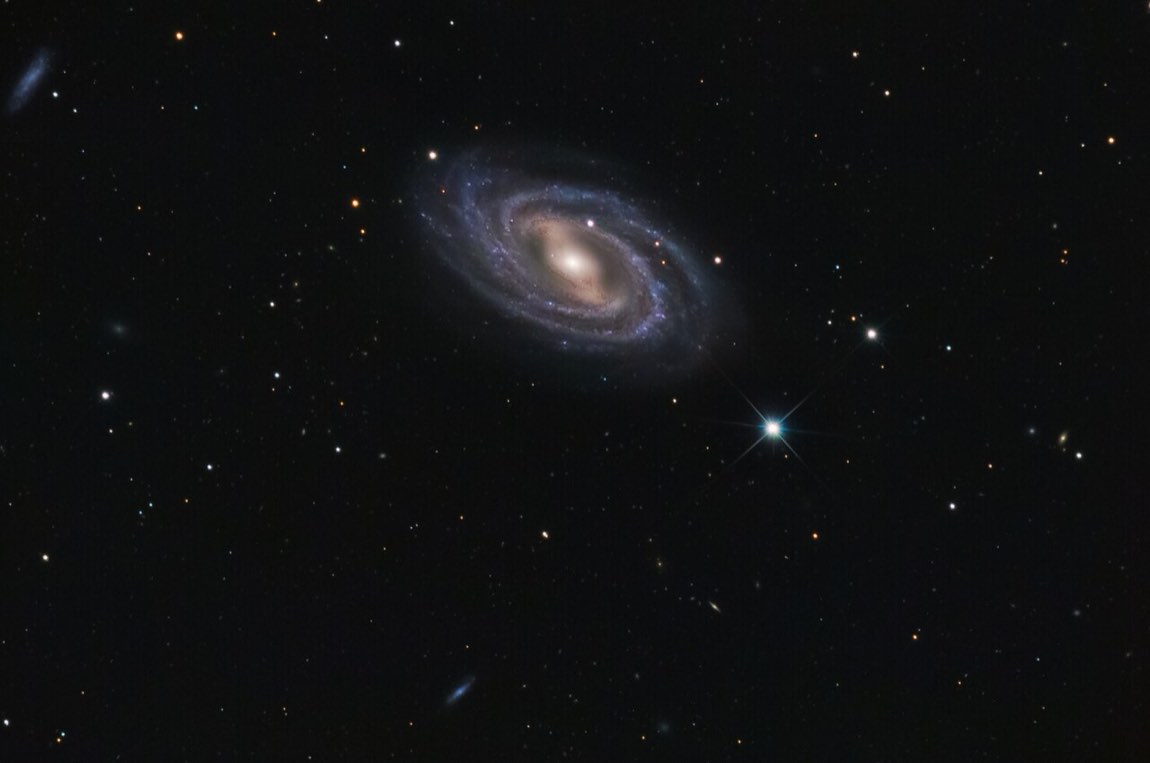
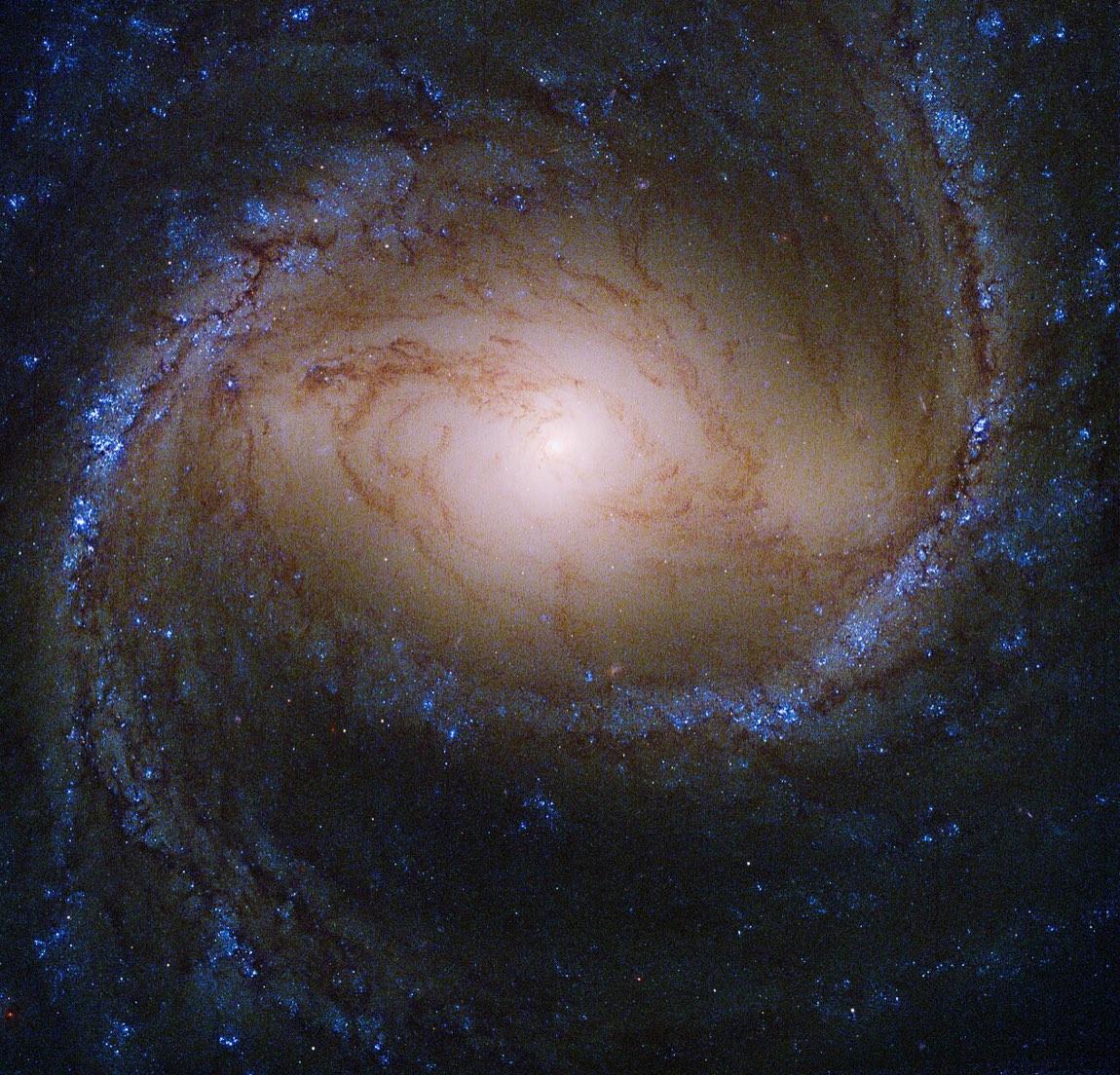
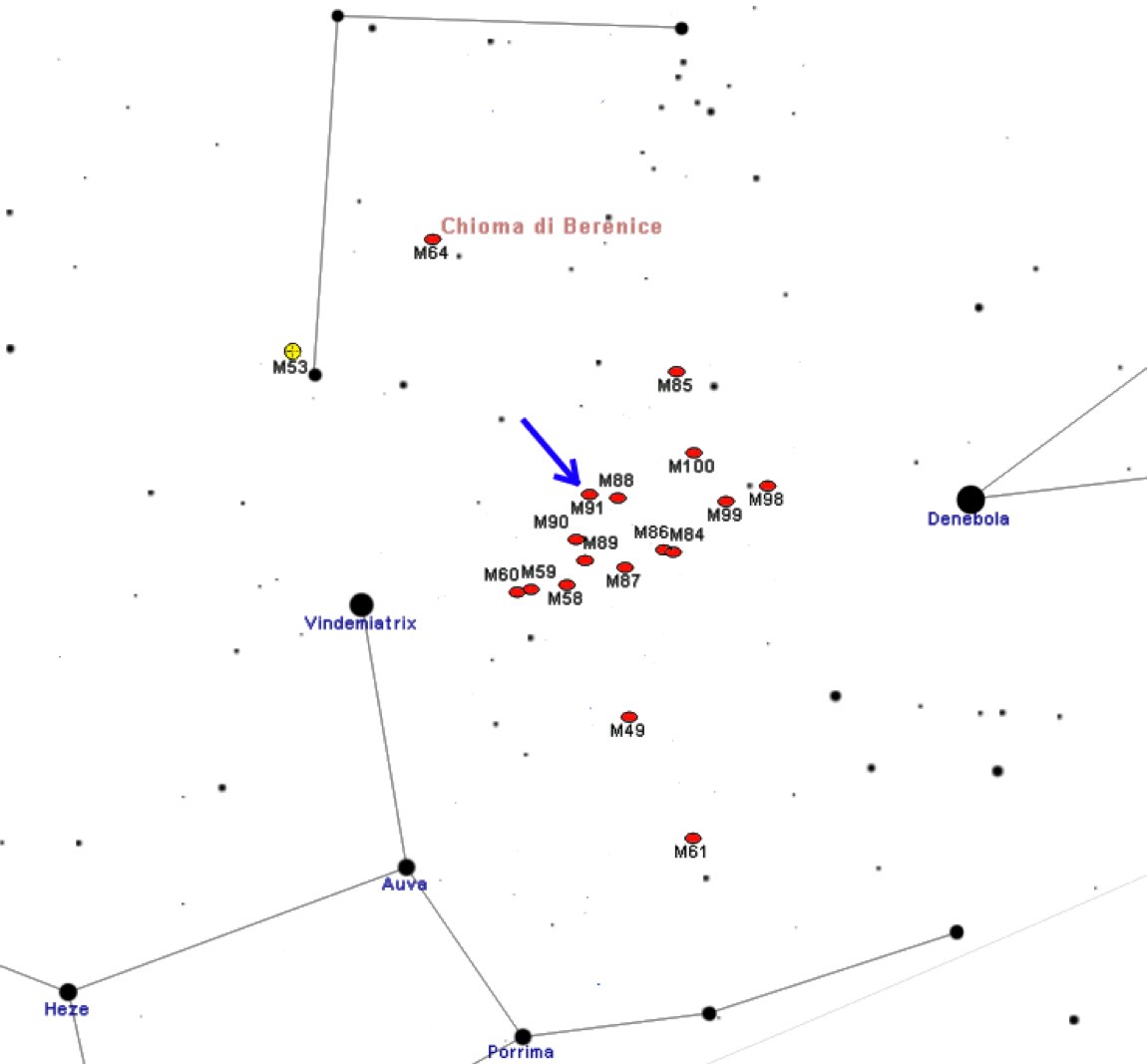
Messier 91 is a barred spiral galaxy in Coma Berenices, part of the Virgo Cluster, about 63 million light-years away. Messier recorded it in 1781 but measured its position from the wrong reference galaxy, so for a long time no object matched his entry. In 1969 amateur astronomer William C. Williams worked out that M91 is the galaxy NGC 4548, which William Herschel had catalogued in 1784. At magnitude 10.2 it is the faintest object in the Messier catalogue.
The deep dive
Researched for the Atlas from Wikipedia — Messier 91 (2,869 characters read) · updated Nov 15, 2026
01 The long mystery of a missing Messier object
For nearly two centuries, M91 was one of astronomy's small but nagging embarrassments — an entry in Charles Messier's famous catalog that simply could not be matched to any real object in the sky. The problem traced back to a bookkeeping error Messier made in 1781: he recorded the galaxy's position relative to Messier 58, when he should have used Messier 89 as his reference point. That single slip was enough to send subsequent observers searching the wrong patch of sky entirely. The puzzle sat unresolved until 1969, when amateur astronomer William C. Williams worked the problem backwards, computing right ascension and declination relative to M89 instead of M58. His corrected coordinates matched Messier's original figures to within 0.1 arcminutes in right ascension and just 1 arcminute — a sixtieth of a degree — in declination. That precision was enough to close the case. The object Messier had seen was NGC 4548, a galaxy already catalogued by William Herschel in 1784. Williams's solution is a reminder that careful positional detective work, not new telescopes, was all it took to recover a lost piece of astronomical history.
02 Messier's original description and what he saw
When Charles Messier swept his telescope across the southern reaches of Coma Berenices in 1781, he described what he found as a nebula without stars, and noted it appeared fainter than M90. He had no way of knowing he was looking at an entire galaxy roughly 63 million light-years away — the word galaxy in its modern extragalactic sense would not come into use for objects like this until the 20th century. To Messier, it was simply one of eight nebulae he discovered in that same 1781 session, the last of that group and, as it turned out, the faintest object he would ever add to his catalog. With an apparent magnitude of 10.2, it sits at the very dim end of the Messier list, requiring dark skies and patience to pick out. That faintness, combined with the positional error he recorded, meant this particular entry would cause astronomers more trouble than any other in his famous catalogue.
03 Pinning down the distance with Cepheid variables Deeper
Establishing that M91 truly belongs to the Virgo Cluster, rather than merely sitting in the same direction by chance, required solid distance measurements. Those came in 1997, when astronomers observed Cepheid variable stars within the galaxy. Cepheids are prized as distance markers because there is a well-understood relationship between how rapidly they pulse in brightness and how luminous they actually are — measure the period, and you know the true brightness; compare that to how bright the star appears, and distance follows directly. The 1997 Cepheid study placed M91 at 52 ± 6 million light-years from Earth. That figure sits somewhat closer than the often-quoted round figure of about 63 million light-years, and the uncertainty of 6 million light-years either way reflects the real difficulty of such measurements across intergalactic distances. Either way, the result was definitive enough to confirm M91's membership in the Virgo Cluster, anchoring it within the same vast gravitational assembly of thousands of galaxies that dominates our corner of the universe.
04 A galaxy moving against the cosmic flow Deeper
One of M91's more counterintuitive properties involves its motion through space. Most galaxies are carried away from us by the expansion of the universe, and the Virgo Cluster as a whole recedes at roughly 1,100 km/s. Yet M91 displays an observed recessional velocity of only about 400 km/s — far less than the cluster average. The explanation is a substantial peculiar velocity of around 700 km/s directed back toward us, partially cancelling the cluster's outward recession. This peculiar velocity is not M91 defying cosmic expansion; rather, it reflects the galaxy's local orbital motion within the gravitational well of the Virgo Cluster, much like a ball thrown upward inside a moving train. The cluster's enormous collective mass pulls member galaxies into complex orbits, so individual members can appear to move toward us even while the cluster itself drifts away. M91's velocity figures make it a useful case study in separating true cosmological recession from the gravitational dynamics that churn galaxies around inside their home clusters.
05 What makes a galaxy anemic
M91 carries the classification of an anemic galaxy, a term that paints a vivid picture of what is missing. Normal spiral galaxies of comparable size tend to be active places, threading their arms with cold hydrogen gas that collapses into stellar nurseries and lights up with new star formation. An anemic galaxy has conspicuously less of this raw material — reduced gas content and, as a consequence, a much quieter rate of star birth compared with other galaxies of its type. The term itself is deliberately medical in its imagery: the galaxy is not dead, but it is pale and depleted. For M91, this classification sits alongside its barred spiral structure, meaning it still has the characteristic central bar and winding arms, yet those arms are not the bustling star-forming regions one might expect. Understanding why cluster galaxies like M91 become anemic is an active area of research; leading ideas involve processes that strip or consume a galaxy's gas supply as it moves through the hot, tenuous medium that fills the space between cluster members.
06 The prominent bar and how to measure it
The most visually striking structural feature of M91 is its central bar — a straight, elongated concentration of stars cutting across the galaxy's core, from which the spiral arms then trail outward. In M91 this bar is described as conspicuous, meaning it stands out clearly when the galaxy is observed under good conditions. Astronomers characterize the bar's orientation using a position angle measured from north toward east, and for M91 that angle runs from 65 degrees through to 245 degrees — essentially the same line extended in both directions, as expected for a bar passing through the galactic center. Position angles are a standard way of describing the tilt of elongated features on the sky without ambiguity, and knowing M91's bar angle helps observers orient their expectations before looking. Bars like this are thought to funnel gas toward a galaxy's center and can influence the broader dynamics of spiral arm structure, though in an anemic galaxy like M91, whatever gas the bar moves has already been substantially depleted compared to more gas-rich spirals.
07 Why M91 is so hard to find and observe
Despite being a large galaxy — large enough to show extent even in modest amateur telescopes — M91 is widely regarded as one of the most challenging objects in the entire Messier catalog to actually detect. The difficulty is a direct consequence of its low surface brightness: the galaxy's total light is spread across a large area of sky, diluting it to the point where any background glow from light pollution easily overwhelms it. Observers rank it alongside M33, M74, and M101 as a candidate for the most difficult Messier object under suburban skies. Under dark skies the situation improves considerably, since the same large angular size that makes it hard to spot in a city becomes an advantage — the galaxy looks prominent once the sky background is truly dark. The lesson M91 teaches amateur astronomers is that apparent magnitude alone does not predict how easy a target will be; surface brightness, the brightness per unit area of sky, matters just as much or more. Its apparent magnitude is 10.2, technically within reach of small telescopes, but the experience at the eyepiece depends heavily on where you observe from.
08 M91's place in the local supercluster
M91 is not an isolated galaxy wandering through empty space. It sits within the Virgo Cluster, a sprawling gravitational gathering of galaxies that itself forms the core of the larger Local Supercluster — the vast web of galaxy groups and clusters of which the Milky Way's own Local Group is a small outlying member. Being part of the Virgo Cluster means M91 exists in a relatively dense galactic environment, surrounded by thousands of other galaxies bound together over hundreds of millions of years. That environment is likely directly connected to M91's anemic character: cluster galaxies are subject to forces that gas-rich field galaxies in emptier regions of space are not. The Local Supercluster context also means that when cosmologists map the large-scale structure of the nearby universe, M91 and its Virgo Cluster neighbors represent one of the dominant concentrations of mass in our cosmic neighborhood, within roughly 100 million light-years of home.
09 NGC 4571 and the question of a rival candidate Deeper
The identification of M91 as NGC 4548 is now the accepted solution, but the story has a footnote worth knowing. Some sources note that the nearby spiral galaxy NGC 4571 was considered as a candidate for Messier's missing object during the period when the identification was still unsettled. NGC 4571 lies in the same general region of Coma Berenices, which made it a plausible option before Williams's precise positional analysis clarified matters. The article does not specify exactly who advanced NGC 4571 as a candidate or on what grounds, but its consideration reflects how genuinely ambiguous the puzzle was before 1969. With positional records from 18th-century observations, angular separations between nearby galaxies can fall within the uncertainties of older measurements, creating genuine room for competing interpretations. Williams's method of carefully recomputing coordinates relative to the correct reference galaxy — M89 rather than M58 — provided the precision needed to resolve the ambiguity and confirm NGC 4548 as the true identity of the object Messier logged that night in 1781.
10 The faintest entry in a famous catalog
Of the 110 objects in the Messier catalog — compiled by Charles Messier and his colleague Pierre Méchain over several decades of comet-hunting in 18th-century Paris — M91 holds the distinction of being the faintest, with an apparent magnitude of 10.2. The catalog spans an extraordinary range of object types: open star clusters, globular clusters, supernova remnants, nebulae, and galaxies. That M91, a barred spiral galaxy containing hundreds of billions of stars, ranks as the dimmest entry is a reflection of its distance and low surface brightness rather than any intrinsic feebleness. The catalog was never intended as a systematic survey of faint objects; Messier compiled it specifically to flag things that might fool observers into thinking they had found a new comet. A dim smudge at magnitude 10.2 would have been exactly the kind of persistent fuzzy patch that could mislead an eager comet hunter. So M91's faintness, the very property that makes it hard to observe today, is precisely why it earned its place on that famous list.
 ⤢