 Photograph · Ngc1535 · CC BY-SA 4.0
Galaxy · Deep guide
Messier 88
Also called: M88 · NGC 4501 · UGC 7675 · PGC 41517
A neat, many-armed spiral diving toward the centre of the Virgo Cluster.
What is it?
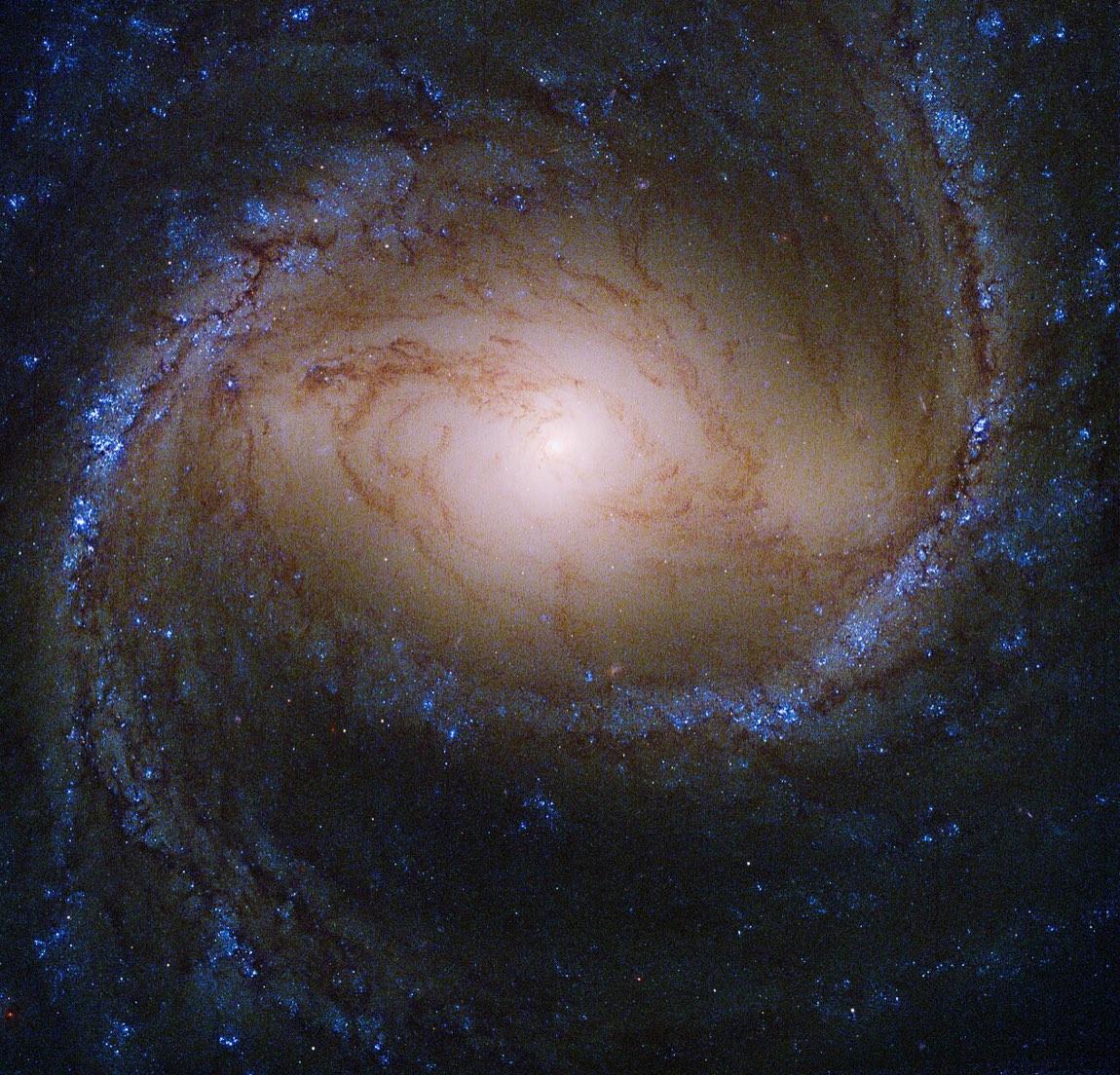
Messier 88 is a spiral galaxy in Coma Berenices, discovered by Messier in 1781. It is one of fifteen Messier objects in the Virgo Cluster and is on a long, stretched orbit heading roughly toward the cluster's core, home of the giant galaxy M87. It should make its closest approach in about 200 to 300 million years. As it moves through the cluster's thin hot gas, the pressure is sweeping hydrogen off its leading edge. Its very regular arms can be traced all the way into the core.
The deep dive
Researched for the Atlas from Wikipedia — Messier 88 (1,905 characters read) · updated Nov 15, 2026
01 A Galaxy Falling Toward a Giant
M88 is not simply drifting through space — it appears to be on a highly elliptical orbit that is carrying it on an approximate collision course with the center of the Virgo Cluster. That center is dominated by M87, one of the largest and most massive elliptical galaxies known. Right now M88 sits between 0.3 and 0.48 million parsecs from that core — roughly one to one and a half million light-years away — and astronomers estimate it will reach its closest approach somewhere between 200 and 300 million years from now. That is a vast span of time, yet in cosmic terms it is a near-future appointment. The uncertainty in both the current distance and the arrival time reflects how difficult it is to measure the full three-dimensional motion of a galaxy tens of millions of light-years away. What is clear is that M88 is not a passive bystander in the Virgo Cluster; it is an active participant in the cluster's gravitational drama, and that infall is already reshaping the galaxy in measurable ways.
02 Ram Pressure and the Stripping of Hydrogen
As M88 plunges inward through the Virgo Cluster, it is pushing through the diffuse intergalactic medium — a thin but real gas that fills the space between galaxies. The resulting ram pressure acts much like wind stripping leaves from a moving car, peeling away the galaxy's outermost reservoir of neutral hydrogen gas. This process, called ram pressure stripping, has already been detected along the western, leading edge of M88, the side that faces the direction of travel. Neutral hydrogen is the raw fuel from which new stars eventually form, so losing it has long-term consequences for how many future generations of stars M88 can produce. The stripping is confined to the outer regions for now, but as the galaxy continues its infall and the ram pressure intensifies, the effect could reach progressively deeper into the disk. M88 therefore offers astronomers a real-time laboratory for studying how cluster environments suppress star formation — a process thought to have transformed countless spiral galaxies into gas-poor, star-formation-dead systems over cosmic history.
03 The Architecture of Its Spiral Arms
M88 is classified as an Sbc spiral galaxy, a designation that places it between the moderately wound Sb class and the loosely wound Sc class. This middle-ground winding gives the arms a graceful, open sweep without being so loose that they dissolve into patchy, ill-defined structures. One of the most striking features noted by astronomers is how remarkably regular the spiral arms are — they can be traced continuously all the way down into the galactic core rather than fragmenting or blurring as they approach the center. The galaxy is also unbarred, meaning there is no elongated linear structure of stars cutting across the nucleus the way there is in galaxies like the Milky Way. Instead, the arms wind smoothly outward from the central bulge. M88 is tilted 64 degrees relative to our line of sight, so we see it at a significant angle — not quite edge-on, not quite face-on — an orientation that makes the spiral structure visible while also allowing astronomers to measure how fast gas is rotating within it.
04 How Fast Is the Gas Spinning? Deeper
One of the key measurements astronomers make of a spiral galaxy is its rotation velocity, because that number encodes the total mass distribution — including dark matter — holding the system together. For M88, the maximum rotation velocity of the gas has been measured at 241.6 ± 4.5 kilometers per second. To put that in perspective, the Milky Way's gas rotates at roughly a similar order of magnitude, though direct comparison is complicated by differences in how such measurements are made. The quoted uncertainty of ± 4.5 km/s reflects genuine precision: spectroscopic observations can pin down Doppler shifts in emission lines to remarkable accuracy. This rotation velocity is linked to the galaxy's mass profile and helps constrain how much dark matter is present in the outer disk. It also feeds into our understanding of how ram pressure stripping interacts with the galaxy's gravitational self-binding — the stronger the rotation, the better the galaxy can hold onto its inner gas even as the cluster environment works to strip the outer layers away.
05 A Seyfert Nucleus Hiding in Plain Sight Deeper
M88 carries a secret in its core: it is classified as a Type 2 Seyfert galaxy, meaning its nucleus is producing narrow emission lines from highly ionized gas. In a Type 2 Seyfert, the energetic central engine — driven by material accreting onto a supermassive black hole — is believed to be obscured from direct view by a torus of dust and gas, so we see only the narrow-line emission region rather than the broad emission lines that characterize a Type 1 Seyfert. The core region of M88 contains a central condensation 230 parsecs in diameter — roughly 750 light-years across, a substantial but not enormous nuclear zone. Within that condensation, there are two distinct concentration peaks rather than a single smooth center, hinting at complex structure possibly related to gas dynamics or past merging activity. This condensation is not static; it is actively being fed by material flowing inward along the spiral arms, funneling fresh gas toward the nucleus and potentially sustaining the low-level activity of the central engine.
06 The Supermassive Black Hole at Its Center
At the very heart of M88 sits a supermassive black hole with a mass of about 80 million times that of the Sun — expressed more precisely in the technical literature as 10 to the power of 7.9 solar masses. That figure places it comfortably within the range of supermassive black holes found in moderately active galactic nuclei. For comparison, the Milky Way's central black hole, Sagittarius A*, has a mass of about 4 million solar masses, so M88's black hole is roughly 20 times more massive. It is this black hole whose gravitational influence drives the accretion of infalling gas from the spiral arms, powers the Seyfert emission, and heats the surrounding gas to produce the highly ionized conditions that generate the narrow spectral lines we detect from Earth. The black hole itself is invisible, as all black holes are, but its influence on the surrounding gas and its emission signatures make it one of the defining characteristics of M88 as an astronomical object.
07 A Supernova Caught in 1999
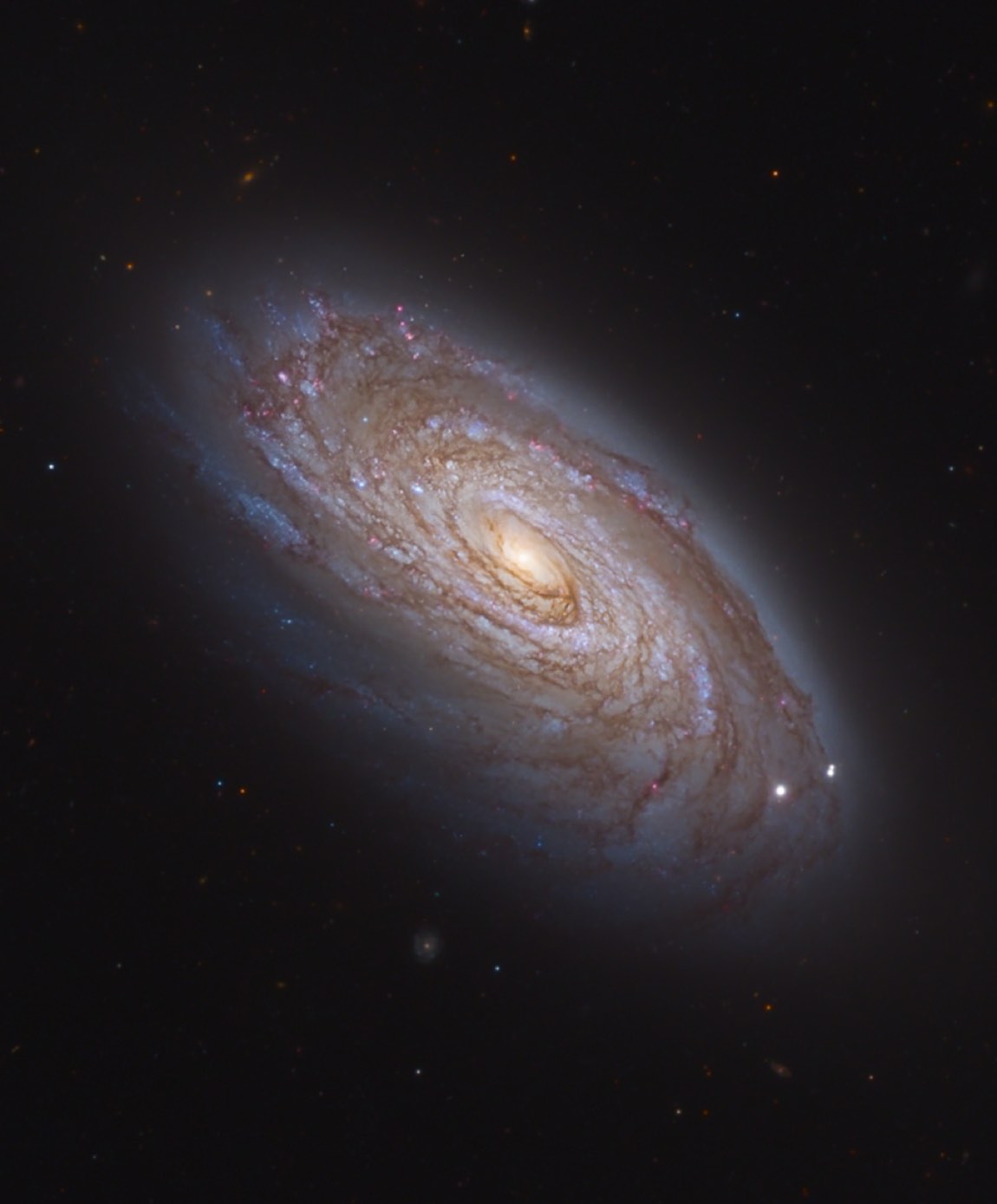
On 29 May 1999, astronomers working the Lick Observatory Supernova Search — a systematic sky patrol program known by the acronym LOSS — discovered a supernova in M88. Designated SN 1999cl, it was classified as a Type Ia supernova and reached an observed magnitude of 16.4. Type Ia supernovae are especially important to astronomers because they arise from a well-understood physical mechanism: a white dwarf in a binary system accretes enough mass to exceed a critical threshold and detonates in a runaway nuclear explosion. Because their peak brightness is highly predictable, they serve as standard candles for measuring cosmic distances. At magnitude 16.4, SN 1999cl was far too faint to see with the naked eye — the faintest stars visible under perfect dark skies are around magnitude 6 — but it was well within reach of modest telescopes. Discovering a supernova in a known Messier object is scientifically valuable because the host galaxy's distance and properties are already reasonably well characterized, giving context to the explosion.
08 Its Place in the Virgo Cluster Census Deeper
M88 is one of fifteen Messier objects confirmed as members of the Virgo Cluster, the closest large galaxy cluster to our own Local Group of galaxies. Its formal catalog identifier within the cluster is VCC 1401, assigned in the Virgo Cluster Catalogue, which lists 2,096 candidate member galaxies. Being number 1401 out of 2,096 gives a sense of just how richly populated this cluster is — the Virgo Cluster contains not just famous showpieces like M87 and M88 but thousands of smaller and less celebrated galaxies spanning a wide range of types and evolutionary states. The Virgo Cluster Catalogue itself is a foundational reference document for extragalactic astronomy, providing a systematic framework for studying how environment shapes galaxy evolution. M88's membership in this cluster is not merely a cataloguing footnote; it is the reason the galaxy is experiencing ram pressure stripping and is falling toward the cluster center, making the cluster context inseparable from understanding M88's current state and future evolution.
09 Messier's Discovery in 1781
Charles Messier logged M88 in 1781 as part of his now-famous catalog of nebulae and star clusters — objects that could be mistaken for comets by the comet hunters of the era. Messier was himself primarily a comet hunter, and his catalog was essentially a practical reference list of things that were not comets. At the time, the true nature of these fuzzy patches was completely unknown; the idea that they might be entire galaxies comparable to the Milky Way lay more than a century in the future. M88 appears in the constellation Coma Berenices, a region of sky that sits far from the dense star fields of the Milky Way's disk and therefore offers relatively unobstructed views into the deep extragalactic universe. This part of the sky is in fact home to the Virgo Cluster itself, which spreads across Coma Berenices and neighboring Virgo. Messier cataloged it without any knowledge that he was documenting a member of a vast gravitationally bound system of thousands of galaxies.
10 How to Find and Observe M88
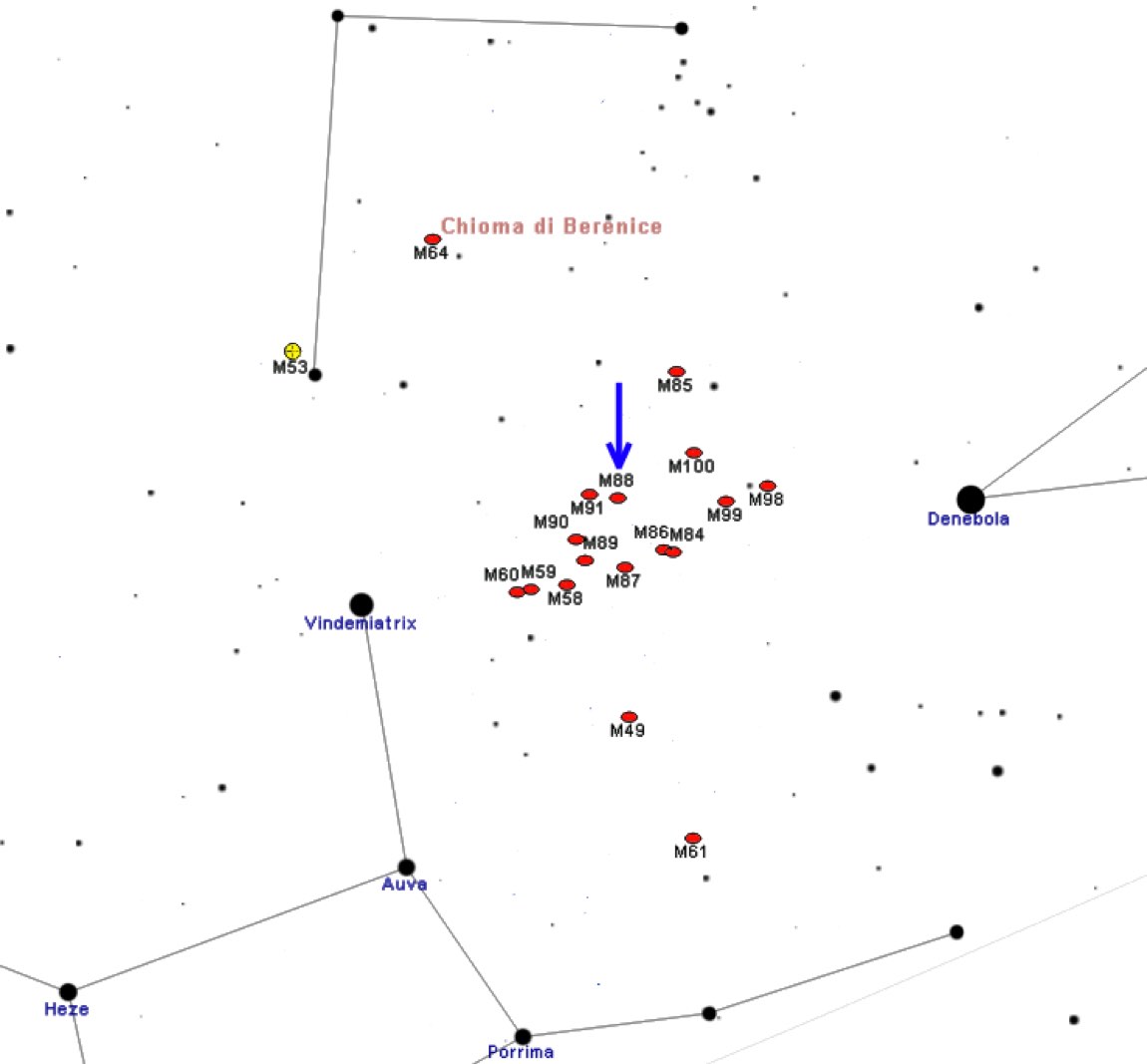
M88 lies in the constellation Coma Berenices, which sits in the northern sky and is best placed for observation during spring evenings from the Northern Hemisphere. Its apparent magnitude makes it accessible to amateur astronomers using modest telescopes, particularly under dark skies away from city light pollution. The galaxy's 64-degree inclination to the line of sight means it presents an elongated, somewhat oval appearance rather than a circular face-on disk or a thin edge-on sliver — an angle that lets observers appreciate the extent of the galaxy without losing structural detail to foreshortening. With a larger telescope under good conditions, the brighter central condensation can be distinguished from the more diffuse outer disk. M88 sits in a rich field of galaxies — the Virgo Cluster spills across this region of sky — so observers scanning the area will often encounter other Messier and NGC objects within the same wide field, making M88 a natural starting point or waypoint for extended galaxy-hopping sessions in one of the sky's most rewarding regions.
11 Open Questions About Its Future Deeper
Despite everything astronomers know about M88, significant uncertainties remain. The range given for its distance — 50 to 60 million light-years — is not a minor rounding ambiguity but reflects genuine difficulty in pinning down distances at this scale, even with modern methods. Similarly, the estimate that M88 will make its closest approach to the center of the Virgo Cluster in 200 to 300 million years carries a 100-million-year spread, which reflects uncertainty in both the galaxy's current velocity and the mass distribution of the cluster itself. What happens during and after that closest approach is not fully predictable: the ram pressure the galaxy experiences will intensify dramatically as it passes near M87, potentially stripping far more of its neutral hydrogen than has been removed so far. Whether enough gas remains in the inner disk to sustain star formation through that encounter is an open question. The dual concentration peaks inside the 230-parsec central condensation also invite further study — their origin and their relationship to the galaxy's Seyfert activity are not yet fully understood.
 ⤢