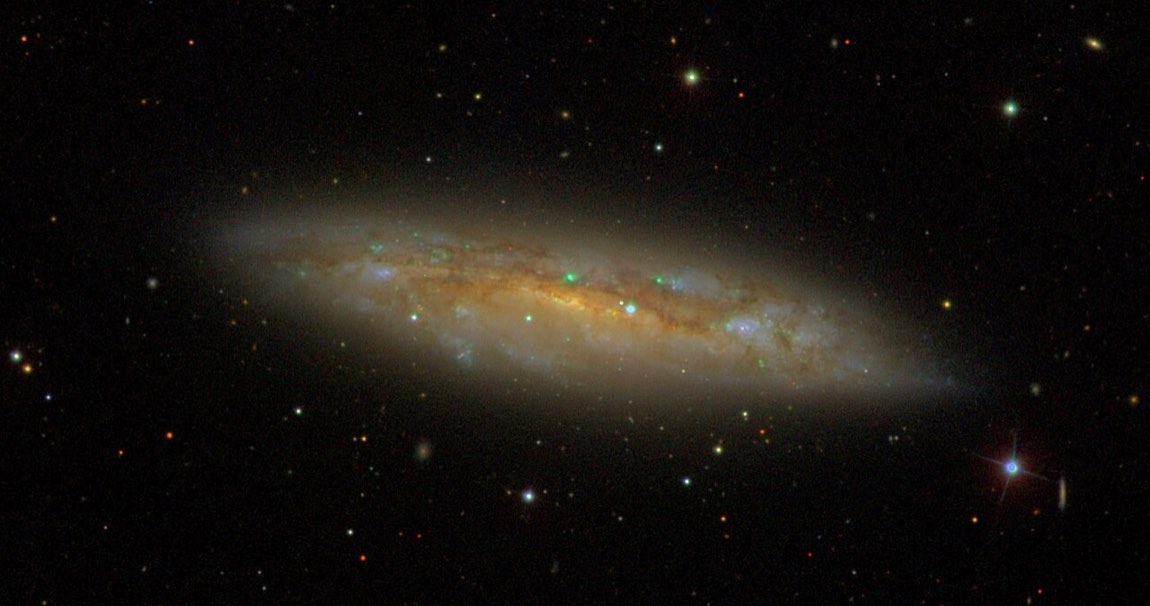
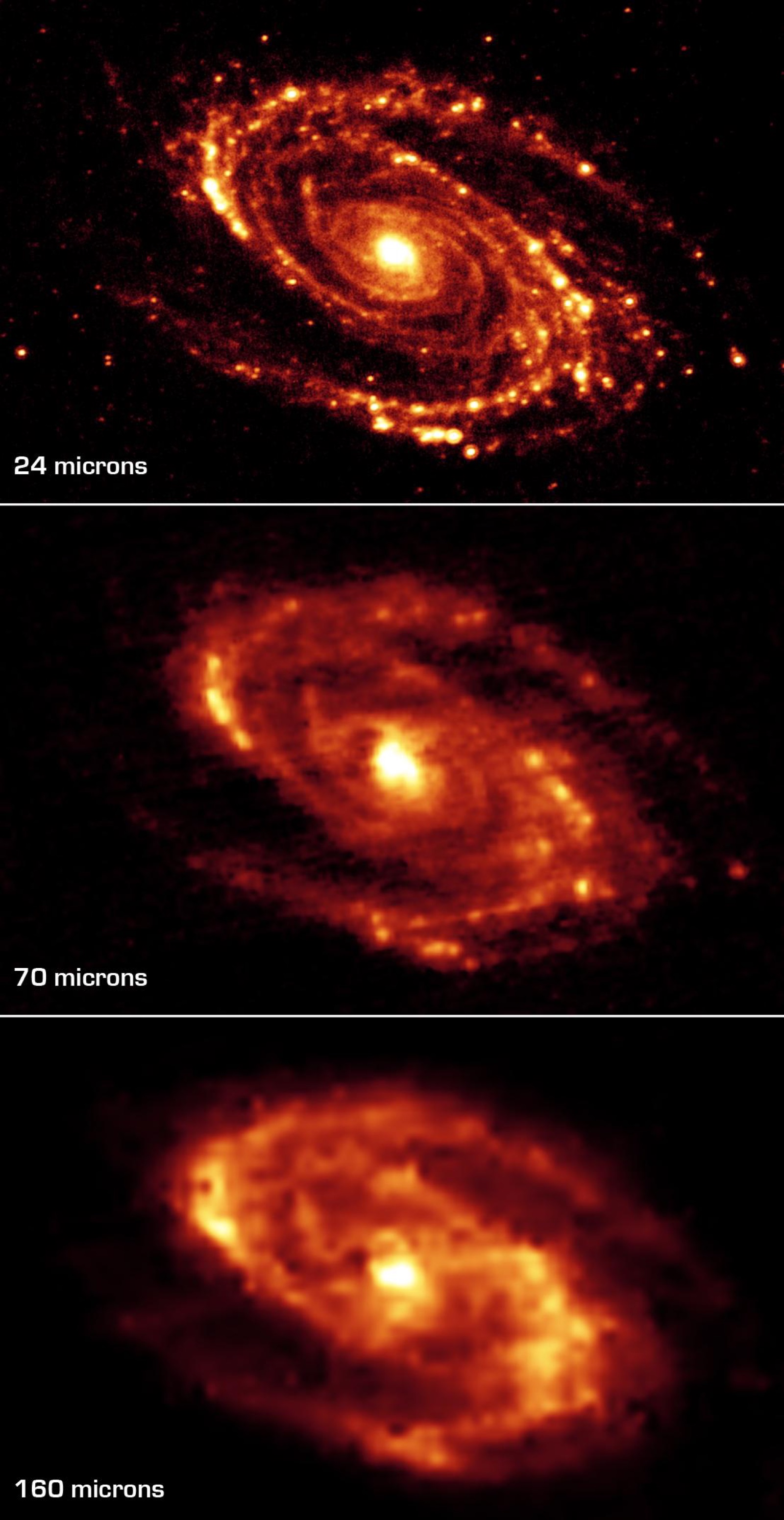
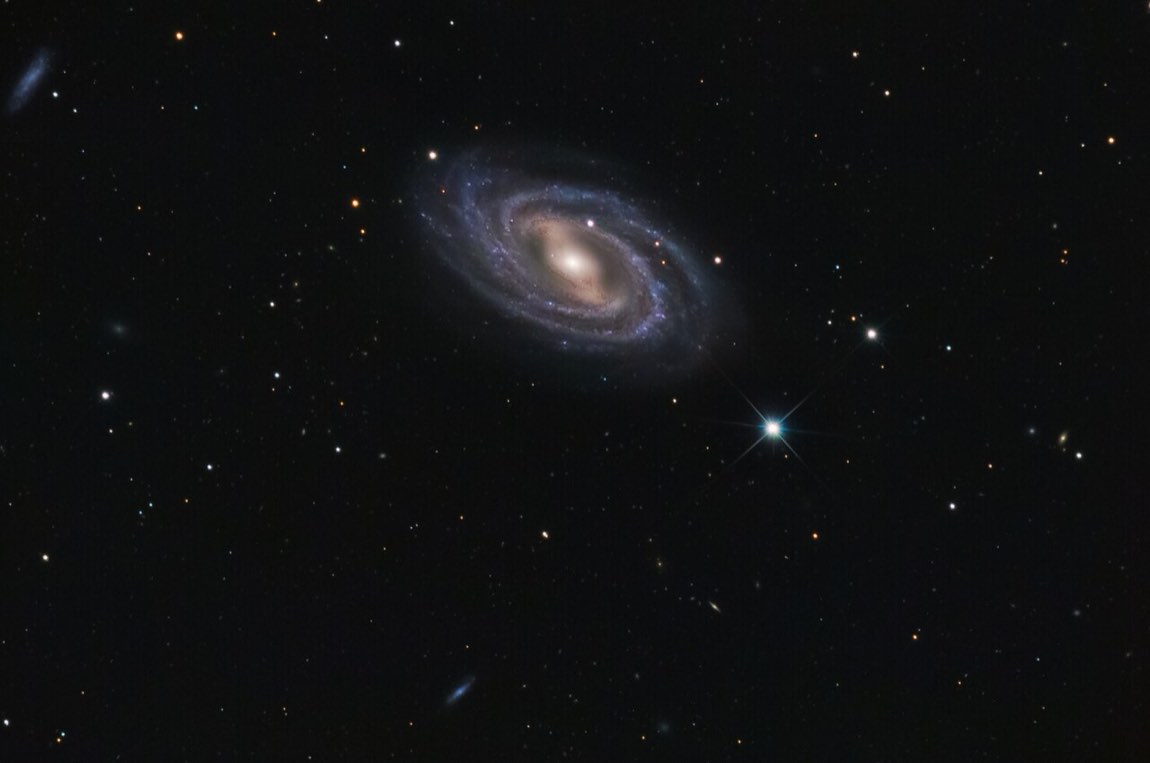
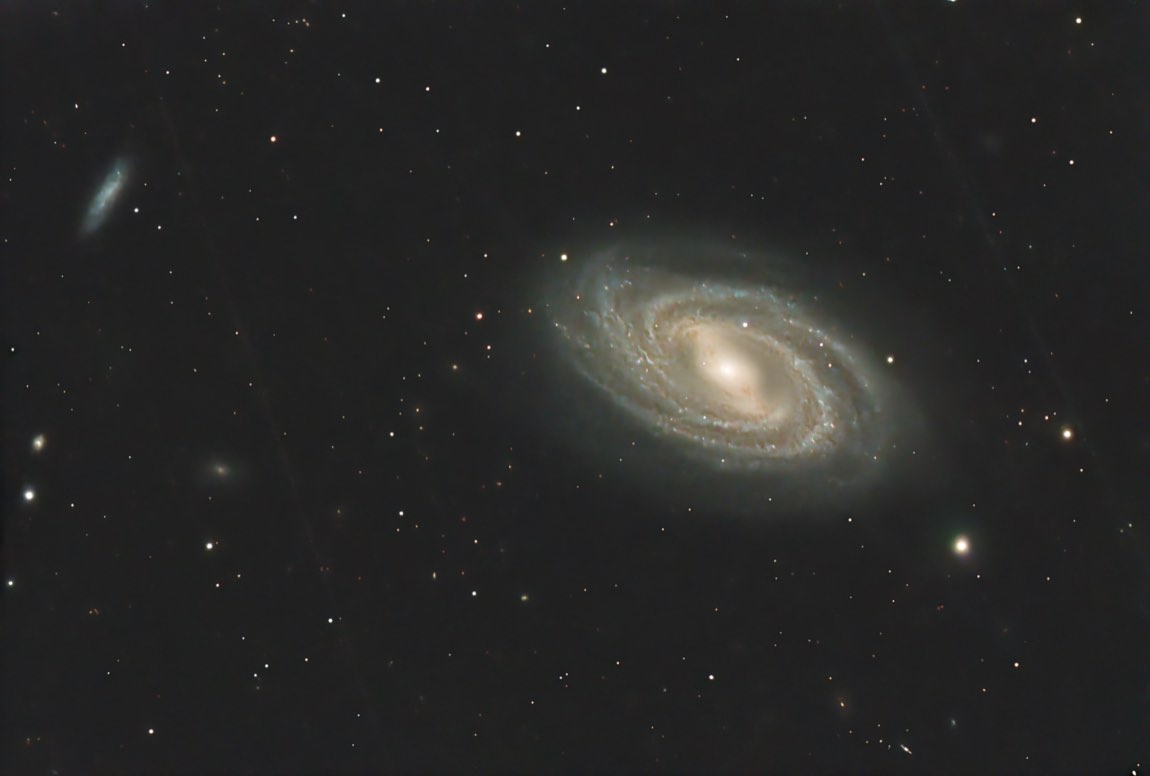
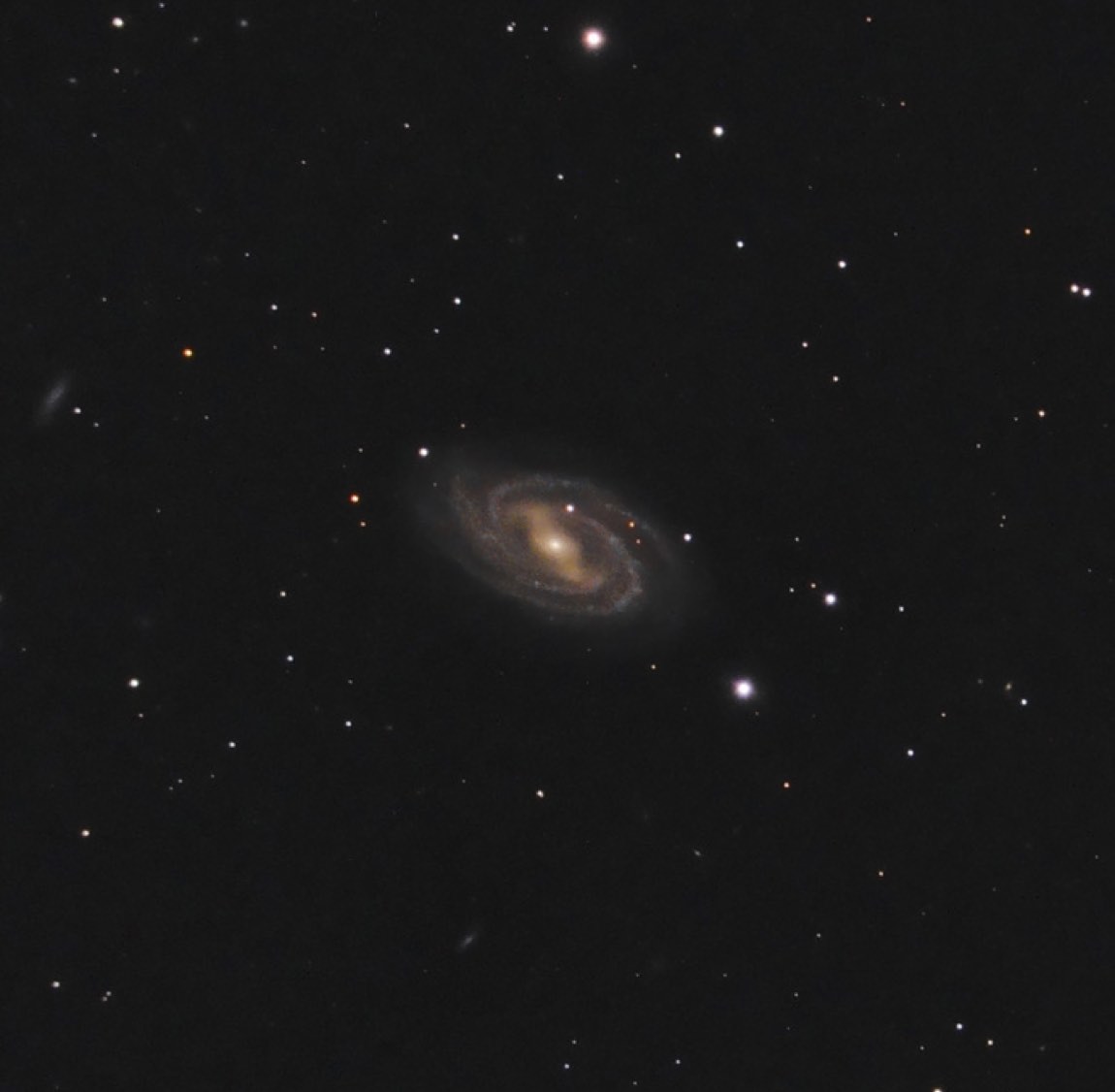
 Photograph · KPNO/NOIRLab/NSF/AURA/George Hatfield and Flynn Haase · CC BY 4.0
Galaxy · Deep guide
Messier 109
Also called: M109 · NGC 3992 · Vacuum Cleaner Galaxy · UGC 6937 · PGC 37617
The most distant object in the Messier catalogue, a barred spiral in Ursa Major.
What is it?
Messier 109 is a barred spiral galaxy in Ursa Major, just southeast of the star Phecda (Gamma Ursae Majoris). Pierre Méchain discovered it in 1781, and Messier added it to his catalogue two years later as an appendix. For decades, objects numbered above 103 were not considered official, but by the late 1970s all 110 were in common use. At about 67 million light-years, M109 is the most distant object in the Messier catalogue. It has at least three satellite galaxies.
The deep dive
Researched for the Atlas from Wikipedia — Messier 109 (1,904 characters read) · updated Nov 15, 2026
01 Discovery and a Catalog Controversy
Pierre Méchain spotted M109 in 1781, but it took two more years before Charles Messier formally catalogued it — and even then, only as an appended object rather than a numbered entry in the main body of his famous list. That subordinate status haunted the galaxy for decades. From the 1920s through the 1950s, astronomers widely regarded any Messier object numbered above 103 as unofficial, a kind of celestial footnote. The debate had real stakes: respected figures disagreed openly. Sir Patrick Moore drew the line at 104 objects, though he did list M105 through M109 as addenda. David H. Levy, by contrast, referenced the full modern catalog of 110 objects. It was not until the late 1970s that all 110 entries came into common use among astronomers — a resolution that rescued M109 from its long bureaucratic limbo and finally gave Méchain's discovery its proper place in one of astronomy's most beloved inventories.
02 The Farthest Object Messier Ever Listed
Among everything Messier and his collaborators recorded — cometary pretenders, nebulae, star clusters — M109 holds a singular distinction: it is the most distant object in the entire Messier Catalog, with M91 coming in second. The measured distance is 67.2 ± 23 million light-years, and that uncertainty of 23 million light-years is itself larger than the distance from Earth to many nearby galaxies, reminding us how difficult extragalactic distance measurement remains. To put 67.2 million light-years in human terms: light leaving M109 when non-avian dinosaurs still walked Earth has only just arrived at our telescopes. The fact that such a remote object is visible at all with modest equipment speaks to the galaxy's genuine luminosity, and it means that every photon we collect from M109 carries news that is tens of millions of years old by the time it reaches us.
03 A Galaxy That Leads a Crowd of Fifty
M109 is not an isolated spiral drifting through empty space. It is the brightest and most dominant member of the M109 Group, a large gathering of galaxies concentrated in the constellation Ursa Major that may number over 50 individual members. Being the gravitational anchor of such a populous group places M109 in a category of cosmically influential objects — a local heavyweight whose gravity shapes the orbits and evolution of dozens of smaller companions. Three of those companions have been individually catalogued: UGC 6923, UGC 6940, and UGC 6969 are confirmed satellite galaxies, with the article noting that possibly more remain to be identified. Detailed hydrogen line observations have been obtained for M109 and all three known satellites, giving astronomers a multi-object dataset to study how gas behaves across an entire galaxy system rather than in isolation.
 ⤢
04 What the Hydrogen Map Reveals Inside Deeper
Radio observations tracing neutral hydrogen — designated H I, or "H one" — have produced a revealing portrait of M109's gas distribution. Across most of the galaxy, the H I layout is described as regular, with a low-level radial extension of gas stretching outside the stellar disc. That outskirts extension is subtle, suggesting a galaxy that has not recently been dramatically disturbed. Far more striking is what happens at the center: within the bar itself, there is a pronounced hole in the gas distribution, a region conspicuously depleted of neutral hydrogen. Astronomers interpret this central H I hole as evidence that the bar has been funneling gas inward over time, relocating it from the bar region toward the nucleus. Crucially, the very emptiness of this hole implies that no large accretion events — no major mergers or significant infall of fresh gas — can have occurred in M109's recent past, painting a picture of a galaxy whose inner regions have been quietly sculpted by its own structure rather than disrupted by outside collisions.
05 The Role of the Bar in Shaping M109 Deeper
M109 is classified as a barred spiral, meaning its core is bisected by an elongated, roughly straight structure of stars and gas rather than simply tapering to a round nucleus. Bars are not passive features; they act as dynamical engines, generating gravitational torques that drive gas from the bar region toward the galactic center. The H I observations of M109 offer a textbook illustration of this process: gas is apparently being transported inward by the bar, depleting the bar region itself and creating the observed central hole. This matters for understanding star formation and the feeding of any central black hole, because bar-driven inflow is one of the principal ways that disk galaxies can concentrate fuel at their cores without requiring a merger. M109 therefore provides a relatively clean, recently undisturbed case study of secular evolution — the slow, internally driven transformation of a galaxy's structure over billions of years.
06 A Supernova Caught in 1956
On 8 March 1956, astronomer Howard S. Gates was working with the 18-inch Schmidt telescope at Palomar Observatory when he detected a stellar interloper in M109. The object, designated SN 1956A, was a Type Ia supernova — the thermonuclear detonation of a white dwarf star that had accumulated too much mass. At the time of discovery it shone at magnitude 12.3, bright enough to be a noteworthy catch even against the backdrop of a galaxy 67 million light-years away. Its precise position was recorded as 67 arcseconds east and 9 arcseconds south of the galaxy's center, placing it well within the disk rather than at the nucleus. Type Ia supernovae are especially important to astronomers because their peak luminosities are remarkably consistent, making them standard candles for measuring cosmic distances. SN 1956A thus represents not just a dramatic stellar death but a potential calibration tool embedded in the same galaxy whose distance we still measure with significant uncertainty.
 ⤢
07 Finding M109 in the Night Sky
Locating M109 is straightforward for anyone familiar with the Big Dipper, because the galaxy sits in the northern constellation Ursa Major and can be found south-east of the star Phecda — formally designated Gamma Ursa Majoris, or γ UMa. Phecda marks the bottom-left corner of the Dipper's bowl, making it one of the more recognizable guide stars in the sky. Because M109 lies so close to such a prominent star, star-hoppers can find it with relatively modest optical aid once they know where to look. The galaxy's apparent magnitude reflects its intrinsic brightness, which is impressive given that it is the most distant object in the Messier Catalog. Northern hemisphere observers have a particular advantage: Ursa Major is circumpolar from most mid-latitude locations, meaning M109 is accessible on any clear night of the year rather than being confined to a narrow seasonal window.
08 The Nickname: Vacuum Cleaner Galaxy
Beyond its catalog designations of Messier 109 and NGC 3992, the galaxy carries the informal nickname "the Vacuum Cleaner Galaxy." The article does not explain the precise origin of this name, but nicknames for galaxies typically arise from their visual appearance in images or the impression their structure creates. For a barred spiral that observational evidence suggests is actively sweeping gas inward via its bar — depleting the bar region of neutral hydrogen and concentrating material toward the nucleus — the vacuum cleaner metaphor has an appealing scientific resonance, even if the name may have been coined for purely visual reasons. Informal nicknames like this one serve a real function in science communication, giving a memorable handle to objects that otherwise exist only as catalog numbers, and they often reflect the community's intuition about a galaxy's personality long before detailed observations confirm what is actually happening inside.
09 Three Named Satellites and Open Questions Deeper
M109's three confirmed satellite galaxies — UGC 6923, UGC 6940, and UGC 6969 — are more than decorative companions. The fact that detailed hydrogen line observations have been obtained for all three, alongside M109 itself, means astronomers can compare the gas properties of the central dominant galaxy with its dwarf neighbors. Such comparisons probe questions about how satellite galaxies lose or retain their gas over time in the presence of a large host. The article notes that M109 may have additional satellites beyond the three catalogued ones, leaving open the question of whether the full satellite population has been mapped. This uncertainty is common in galaxy group studies: faint dwarf galaxies are hard to detect and confirm as group members rather than background objects. Within the broader M109 Group, which may exceed 50 members, the dynamics of satellite accretion, gas stripping, and eventual merging remain active areas of investigation that M109's proximity and brightness make tractable.
 ⤢