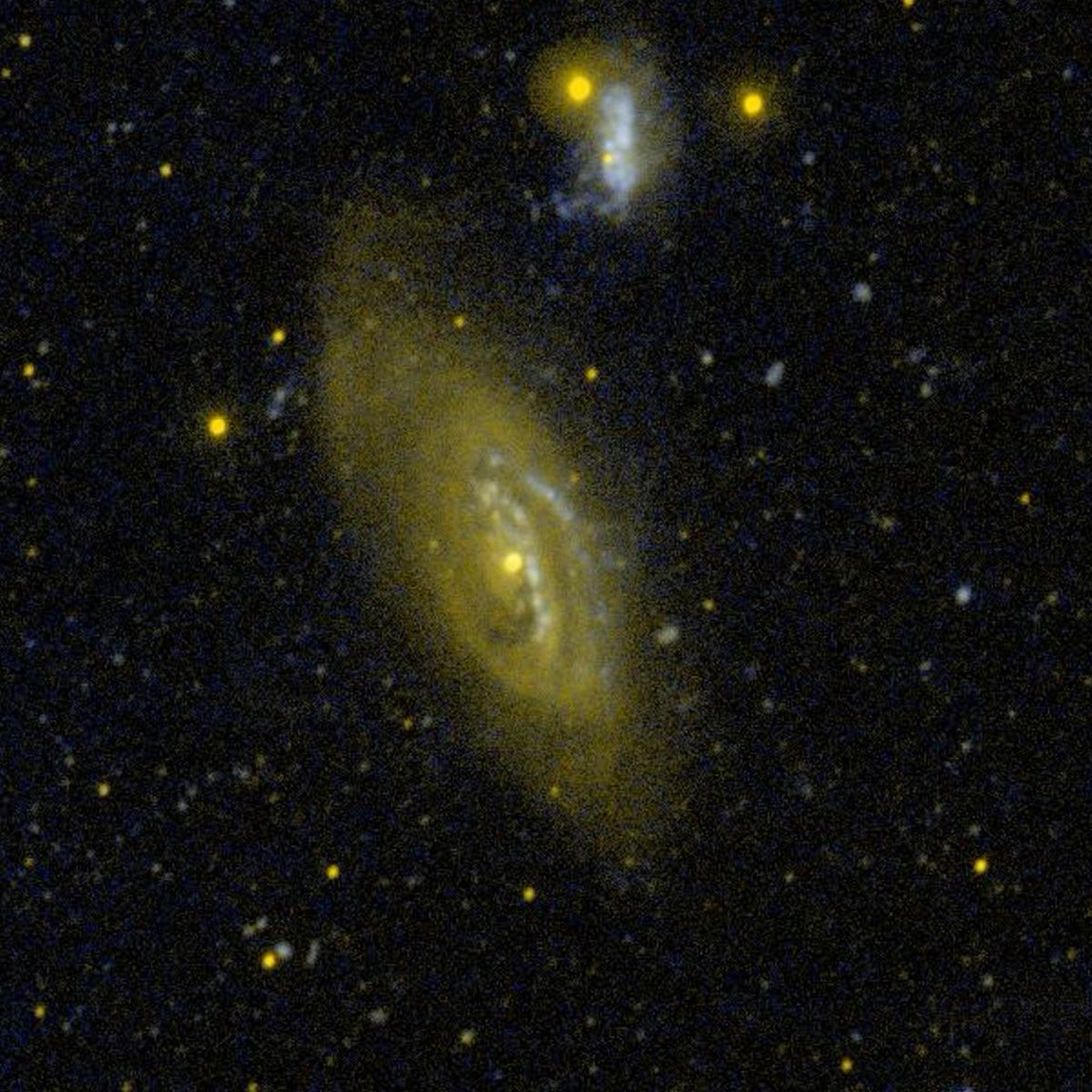
 Photograph · Judy Schmidt from USA · CC BY 2.0
Galaxy · Deep guide
Messier 90
Also called: M90 · NGC 4569 · Arp 76 · Carabin Galaxy
A big Virgo spiral being stripped of its gas, leaving smooth, quiet arms.
What is it?
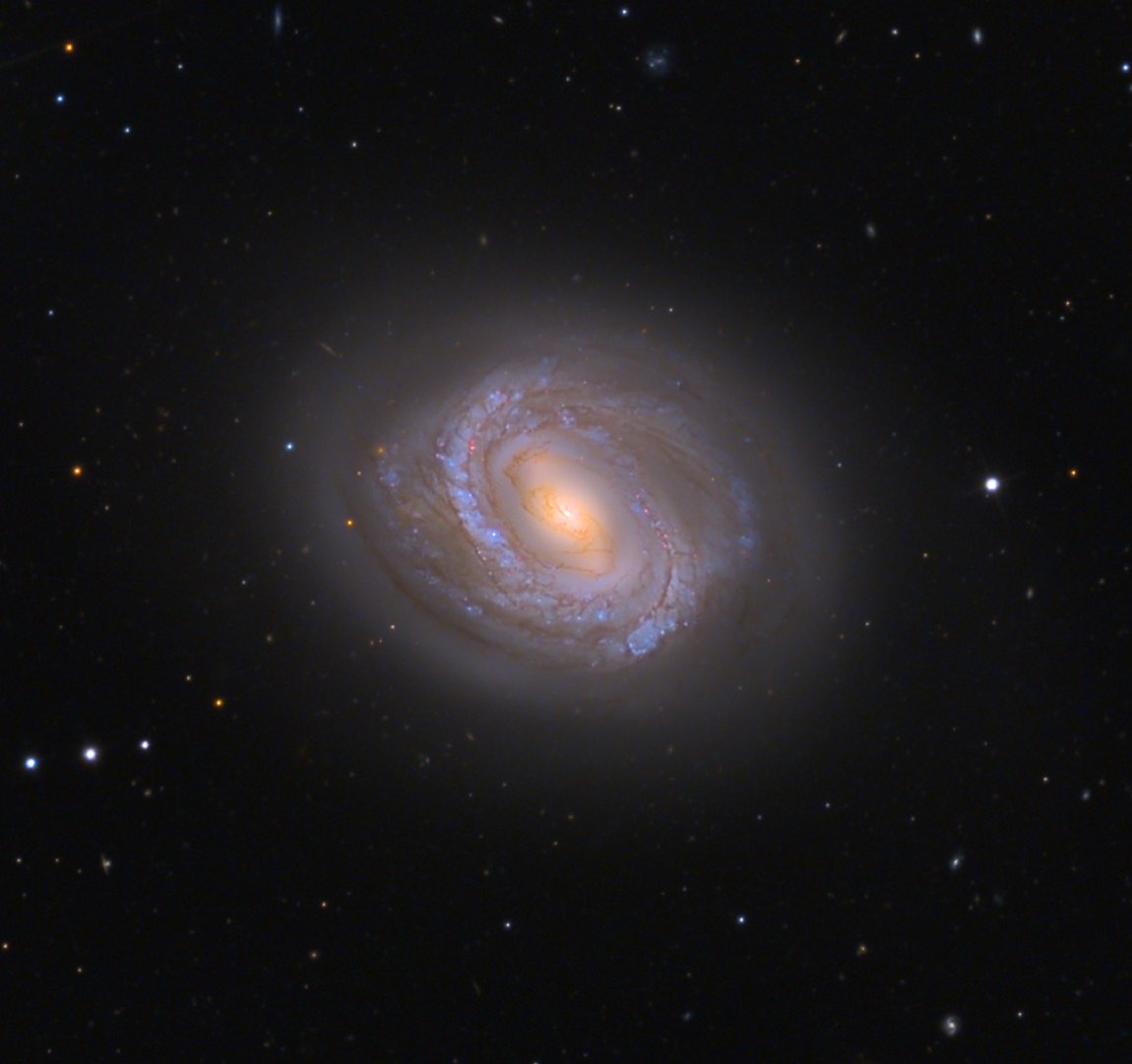
Messier 90 is a spiral galaxy about 60 million light-years away in Virgo, discovered by Messier in 1781. It is one of the largest and brightest spirals in the Virgo Cluster, brighter in absolute terms than the Andromeda Galaxy. As it travels through the cluster's hot gas, most of its own gas is being pushed out, a process called ram-pressure stripping. With little fuel left, its star formation has dwindled, so its arms look smooth rather than knotted with bright young star clusters. Tails of stripped gas stretch up to 260,000 light-years.
The deep dive
Researched for the Atlas from Wikipedia — Messier 90 (3,143 characters read) · updated Nov 15, 2026
01 A galaxy falling toward us
Almost every galaxy we observe has a redshifted spectrum, meaning its light is stretched toward longer wavelengths as the universe expands and carries galaxies away from us. Messier 90 is a striking exception: its spectrum is blueshifted, telling us that the net distance between it and the Milky Way is actually shrinking. This made early astronomers suspect it might be a foreground object sitting in front of the Virgo Cluster rather than inside it. That interpretation turned out to be wrong. The blueshift phenomenon is concentrated among galaxies in the same patch of sky as the Virgo Cluster, which reveals something important about the cluster itself: its member galaxies have an enormous spread of individual velocities. Messier 90 happens to be moving through the cluster in a direction that, when combined with the cluster's own motion, produces a net approach toward the Milky Way. It is a reminder that cluster membership is a chaotic, high-speed affair, not a serene gravitational parking lot.
02 Ram-pressure stripping in action Deeper
As Messier 90 plunges through the Virgo Cluster, it pushes against the hot, diffuse gas that fills the space between galaxies — the intracluster medium. This encounter acts like a cosmic headwind, a process called ram-pressure stripping, which has robbed the galaxy of much of its own interstellar medium. The consequences are dramatic and visible. Star formation regions appear severely truncated compared to similar spiral galaxies that live in quieter surroundings outside the cluster. Even more striking, some HII regions — clouds of ionized hydrogen that normally signal active star birth — have been displaced entirely outside the galactic plane. Trailing behind the galaxy are long tails of ionized gas that have been physically torn away, stretching up to 80,000 parsecs, or 260,000 light-years. That distance is roughly 2.5 times the diameter of the Milky Way. These tails are a direct record of the violence of cluster life, written in glowing gas across intergalactic space.
03 The anemic galaxy prototype
Because ram-pressure stripping has suppressed star formation so thoroughly across most of its disk, Messier 90 belongs to a rare and important category: the anemic galaxy. Its spiral arms, rather than being knotted and clumpy with the bright star-forming regions seen in healthy spirals, appear smooth and featureless. Astronomers have designated Messier 90 as one of only two prototypes of this class, the other being NGC 4921 in the Coma Cluster. Some researchers take the classification even further, arguing that Messier 90 qualifies as a passive spiral galaxy — a type more commonly found in distant, high-redshift galaxy clusters, where the universe was younger and cluster environments were even more extreme. Finding such an object relatively nearby, at around 60 million light-years, gives astronomers a close-up laboratory for studying how cluster forces can effectively switch off a spiral galaxy's star-forming engine while leaving its overall spiral structure largely intact.
04 A hidden burst of star birth at the core Deeper
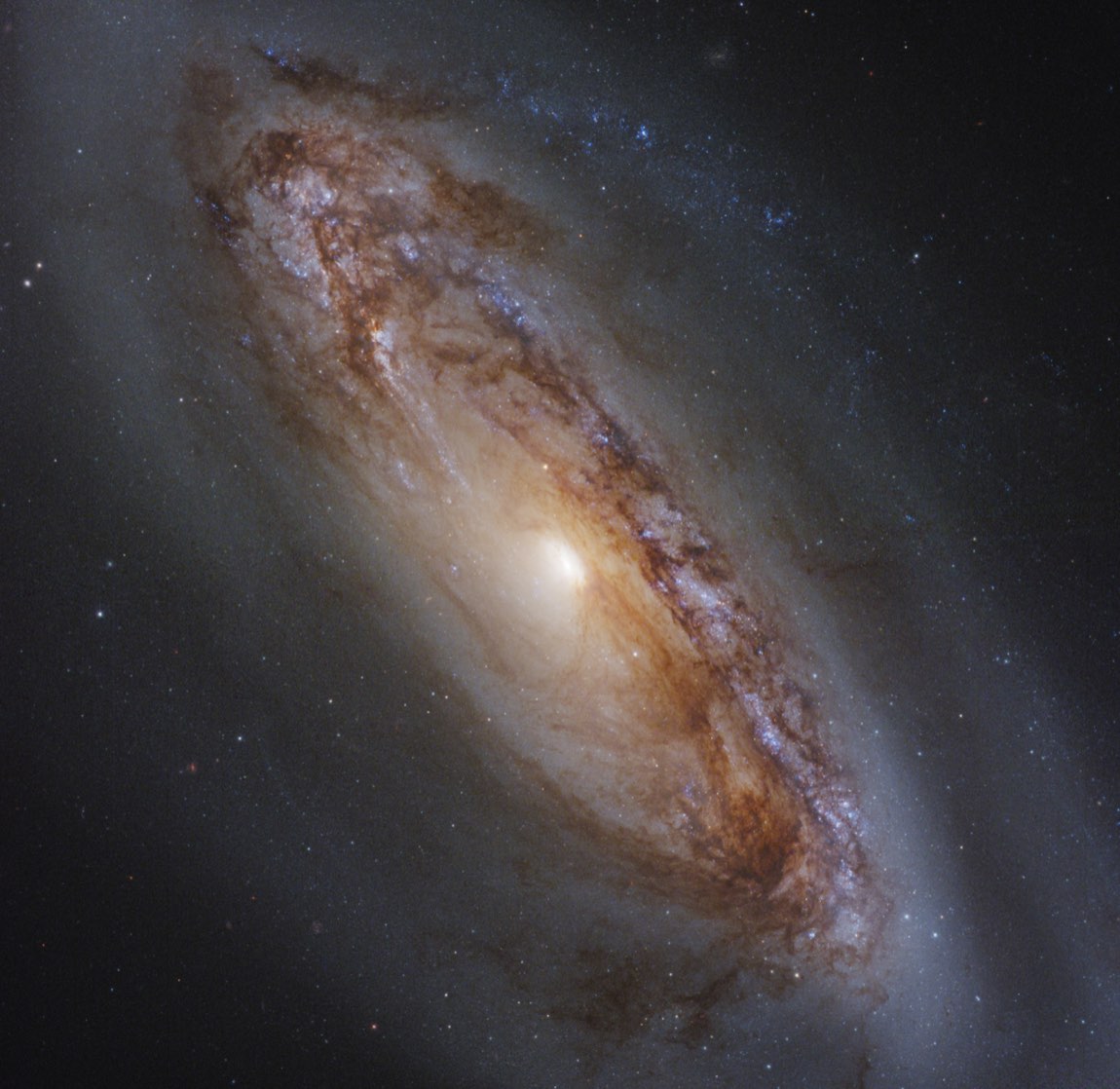
Despite its quiescent outer disk, the center of Messier 90 tells a surprisingly active story. Nestled in its nucleus is a population of roughly 50,000 stars of spectral types O and B — the hottest, most massive, and shortest-lived stars known — that formed approximately 5 to 6 million years ago. By cosmic standards, that is essentially yesterday. Surrounding them are A-type supergiants produced in earlier starbursts that ignited between 15 and 30 million years ago. The nucleus therefore preserves a layered archive of multiple episodes of intense star formation. These successive bursts have had violent consequences: up to 100,000 supernovae exploding in the nucleus have collectively generated powerful outflows called superwinds, which are driving the galaxy's interstellar medium outward into the surrounding intracluster medium. These outflows are collimated into two jets, and one of those jets is being visibly disturbed as the galaxy moves through Virgo's intracluster gas — an interaction between the galaxy's own expelled material and the larger cluster environment.
05 Brightness that rivals Andromeda
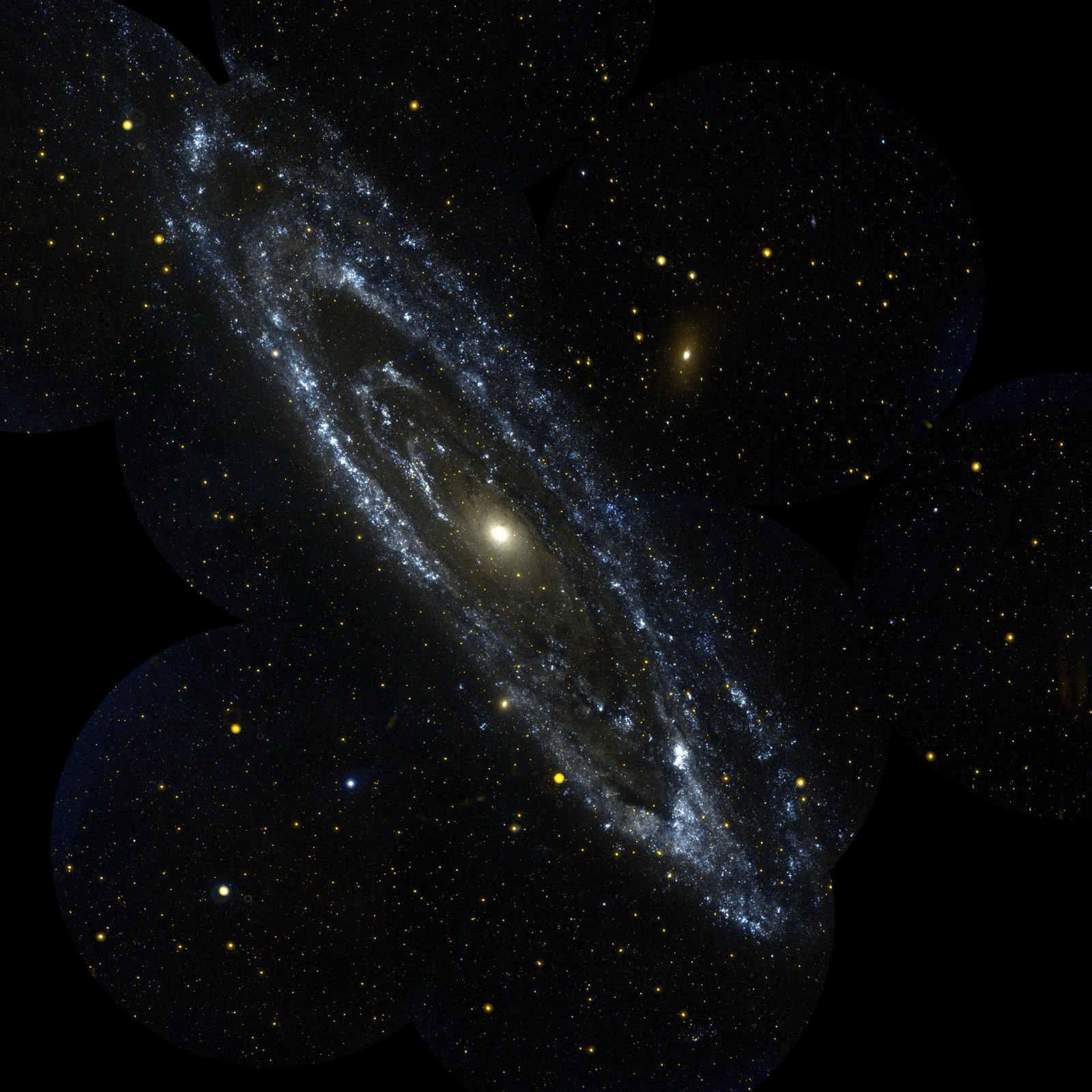
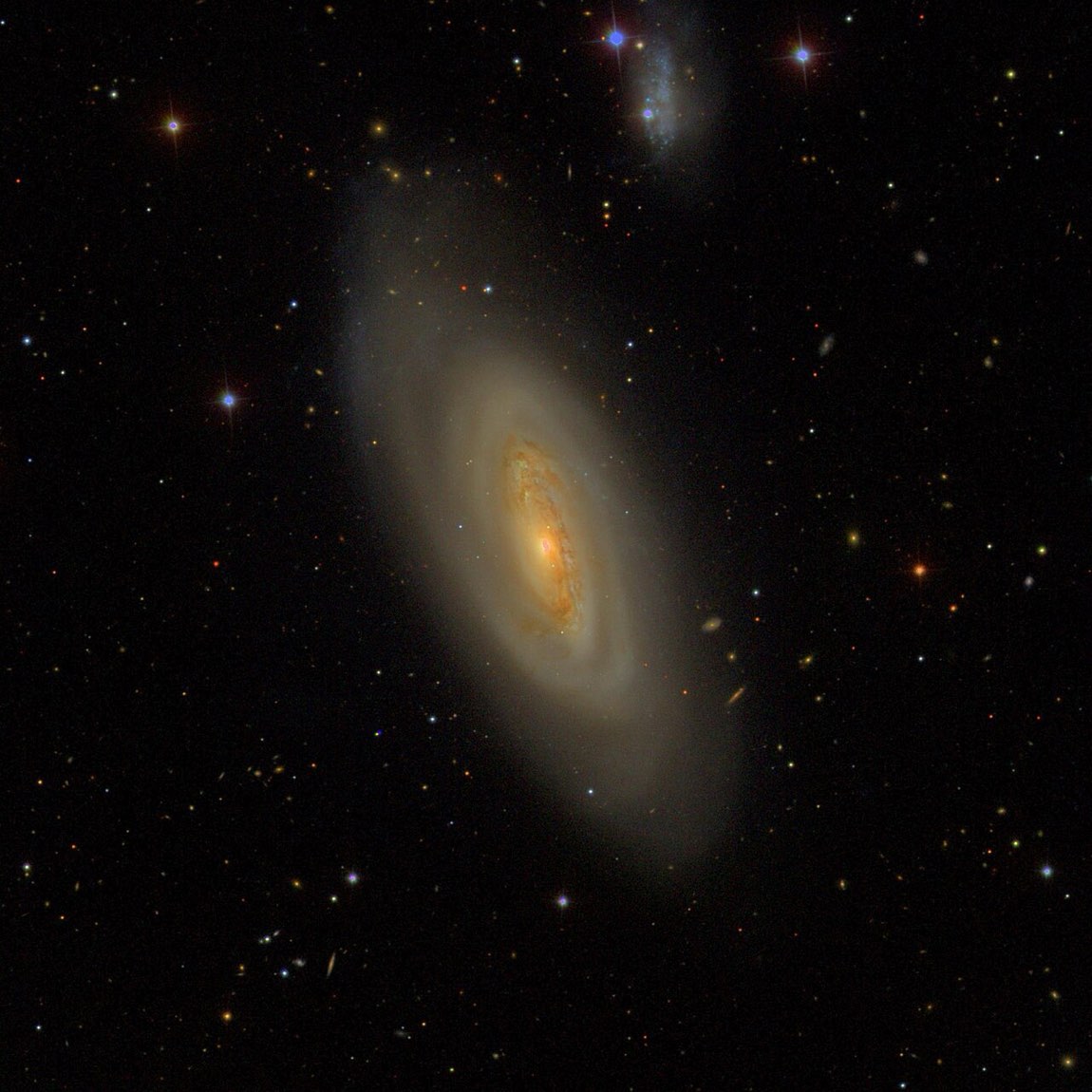
Messier 90 is not merely a large spiral — it is one of the largest and brightest spiral galaxies in the entire Virgo Cluster. Its absolute magnitude sits at around −22, a figure that places it intrinsically brighter than the Andromeda Galaxy, our nearest large galactic neighbor and the dominant spiral of our own Local Group. That is a remarkable distinction for a galaxy that has been battered by its cluster environment and had its star formation largely suppressed. The sheer stellar mass already accumulated over its lifetime more than compensates for the slowdown in new star production. Messier 90 sits about 1.5 degrees on the sky from the central subgroup dominated by the giant elliptical galaxy Messier 87, placing it within the denser, more dynamically active core region of the Virgo Cluster where environmental effects like ram-pressure stripping are strongest.
 ⤢
06 A thousand globular clusters
One of the more quietly impressive facts about Messier 90 is its globular cluster system. The galaxy hosts around 1,000 globular clusters — dense, ancient balls of hundreds of thousands to millions of stars that orbit a galaxy's halo like a swarm of satellites. Rich globular cluster systems tend to accompany massive, luminous galaxies, and Messier 90's collection is consistent with its status as one of the Virgo Cluster's heavyweight spirals. These clusters formed early in the universe's history and have survived the ram-pressure stripping that swept away the galaxy's diffuse gas, because their own gravity is strong enough to hold them together. They are therefore fossil records of the galaxy's earliest epochs, predating the truncation of star formation that defines Messier 90's present-day appearance. Studying their ages, metallicities, and spatial distribution can reveal how and when the bulk of Messier 90's stellar mass was assembled.
07 Why measuring its distance is tricky Deeper
Pinning down the precise distance to a galaxy usually involves a technique called the Tully-Fisher relation, which links a spiral galaxy's rotation speed to its intrinsic luminosity. The faster a spiral spins, the more massive and luminous it is — a reliable enough correlation to serve as a cosmic distance ladder rung. For Messier 90, however, this method is effectively off the table. Ram-pressure stripping has depleted the galaxy's neutral hydrogen gas, known as HI, to low levels, and neutral hydrogen is exactly what astronomers measure to map a spiral galaxy's rotation and apply the Tully-Fisher relation. Without sufficient HI, the technique cannot be used reliably. This practical obstacle illustrates how the same cluster process that physically transforms the galaxy also complicates the tools astronomers use to study it, forcing researchers to rely on alternative distance indicators.
08 Messier's discovery and the Virgo puzzle
Charles Messier catalogued Messier 90 in 1781, adding it to his famous list of objects that could be confused with comets. At that time, the nature of these smudgy nebulae was entirely unknown — the debate over whether they were nearby gas clouds or vast island universes of stars lay more than a century in the future. Messier simply wanted a practical reference list to avoid false comet alarms. It was only in the twentieth century, after Edwin Hubble established the extragalactic nature of spiral nebulae, that objects like M90 were understood to be galaxies at enormous distances. The subsequent discovery of its blueshift, and the long interpretive struggle over whether that meant foreground placement or cluster membership, unfolded across decades of spectroscopic observation. That debate ultimately helped astronomers understand that galaxy clusters are not static structures but dynamic, velocity-rich environments where individual members can appear to approach us even as the universe expands.
09 The uncertain friendship with IC 3583
For a time, the small galaxy IC 3583 was considered a satellite of Messier 90, an idea that would have made the pair an interacting system worth studying in detail. The updated picture is more sobering: astronomers now think the two galaxies are too far apart from each other to be gravitationally interacting at all. This kind of revision is common in observational astronomy, where proximity on the sky can mislead — two objects can appear close together as seen from Earth while being separated by enormous distances in three-dimensional space. The reclassification of IC 3583 from likely satellite to unrelated neighbor removes one potential source of dynamical disturbance from Messier 90's story, leaving ram-pressure stripping and the galaxy's own internal starburst history as the dominant forces shaping its current appearance.
 ⤢