 Photograph · ESA/Hubble and NASA · CC BY 4.0
Galaxy · Deep guide
Messier 89
Also called: M89 · NGC 4552 · UGC 7760 · PGC 41968
An almost perfectly round galaxy in Virgo with traces of a violent past.
What is it?
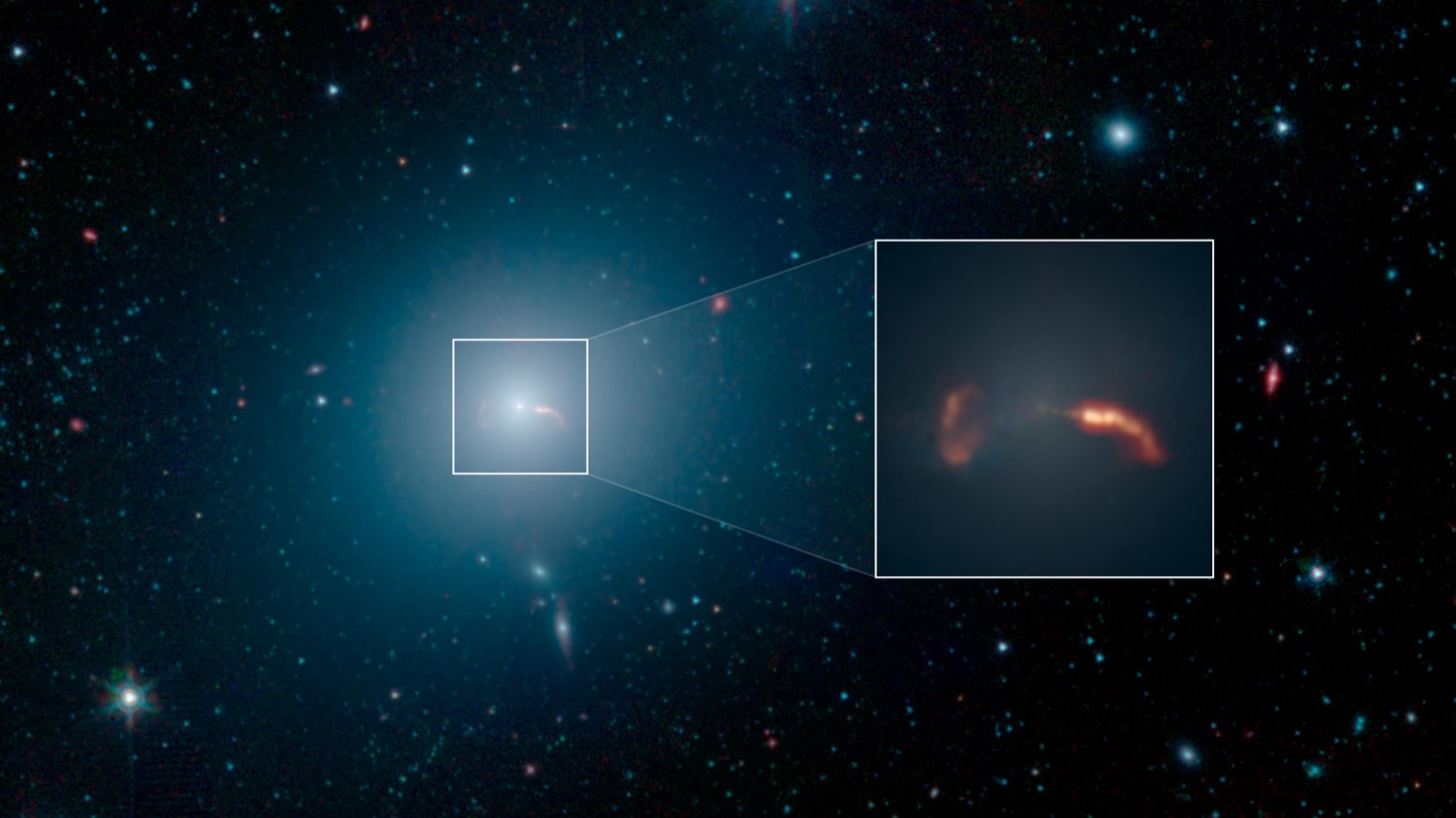
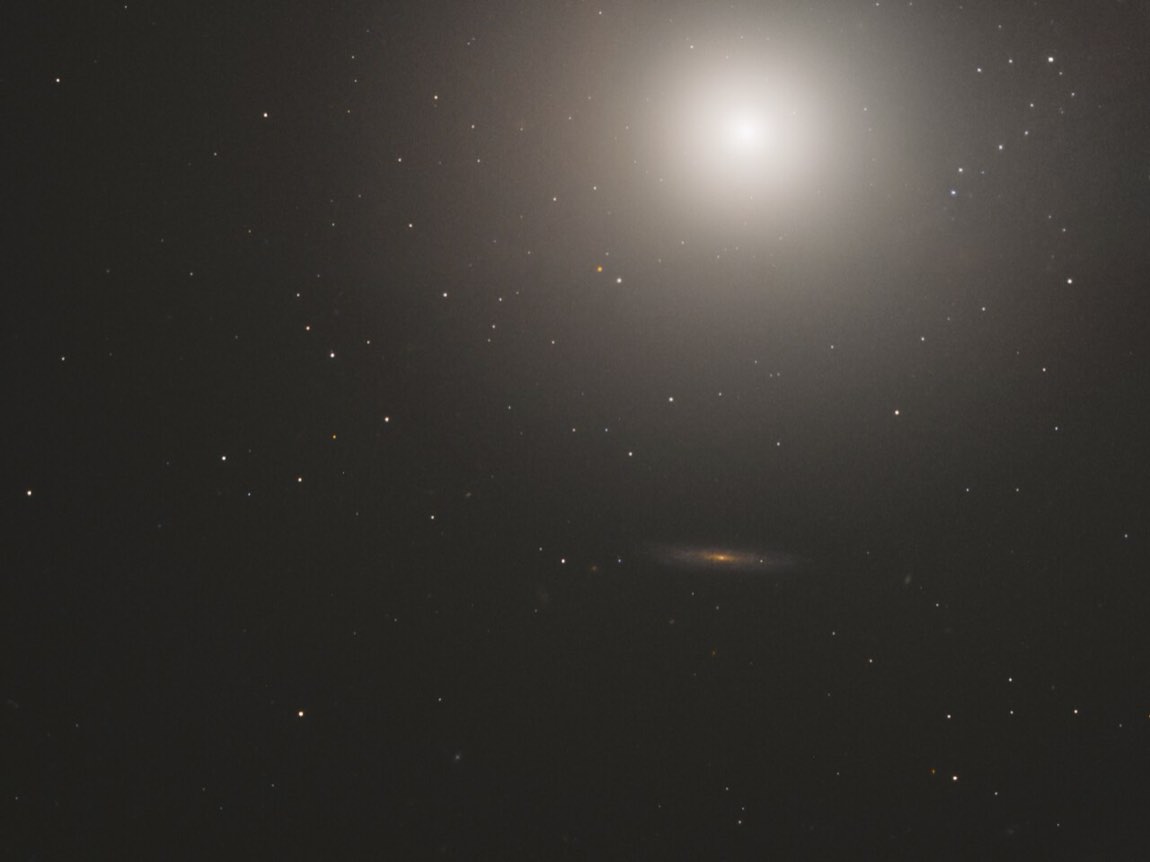
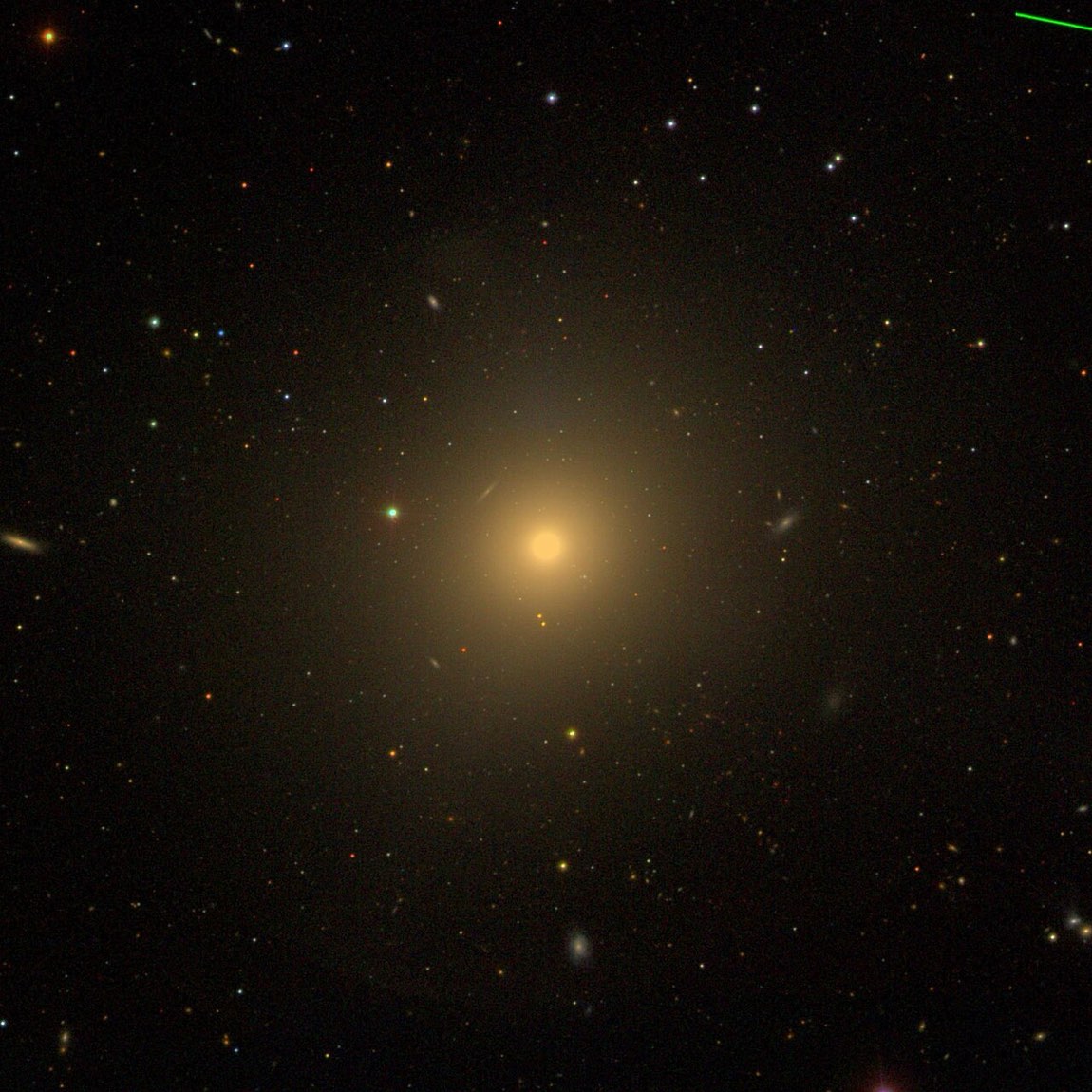
Messier 89 is an elliptical galaxy in the Virgo Cluster, discovered by Messier on 18 March 1781. It looks nearly perfectly round, either because it really is spherical or because we view a stretched galaxy end-on. It is surrounded by gas and dust reaching up to 150,000 light-years, with jets of hot particles, hinting that it was once an active quasar or radio galaxy. Shells and plumes around it suggest past mergers. X-ray images show rings of hot gas from an outburst at its core roughly 1 to 2 million years ago.
The deep dive
Researched for the Atlas from Wikipedia — Messier 89 (1,482 characters read) · updated Nov 15, 2026
01 A galaxy that looks perfectly round
Most elliptical galaxies are visibly squashed or stretched into an egg-like shape, but M89 is a striking exception. Current observations leave open the genuine possibility that it is nearly perfectly spherical — an almost unique quality among easily measurable galaxies of its type. Astronomers have checked all comparable ellipticals out to several times M89's distance and found distinct flattening in every one of them. M89 alone resists that pattern. There is, however, a competing explanation: the galaxy could simply be a conventional ellipsoid that happens to be pointed directly at Earth, so we look straight down its long axis and perceive a circle. Distinguishing between a true sphere and a well-aimed ellipsoid is genuinely difficult with current data, and the debate remains open. Either outcome is scientifically interesting — a true sphere would be extraordinarily rare, while a perfectly aimed ellipsoid would be a remarkable coincidence of viewing geometry.
02 Shells and plumes: a violent merger past
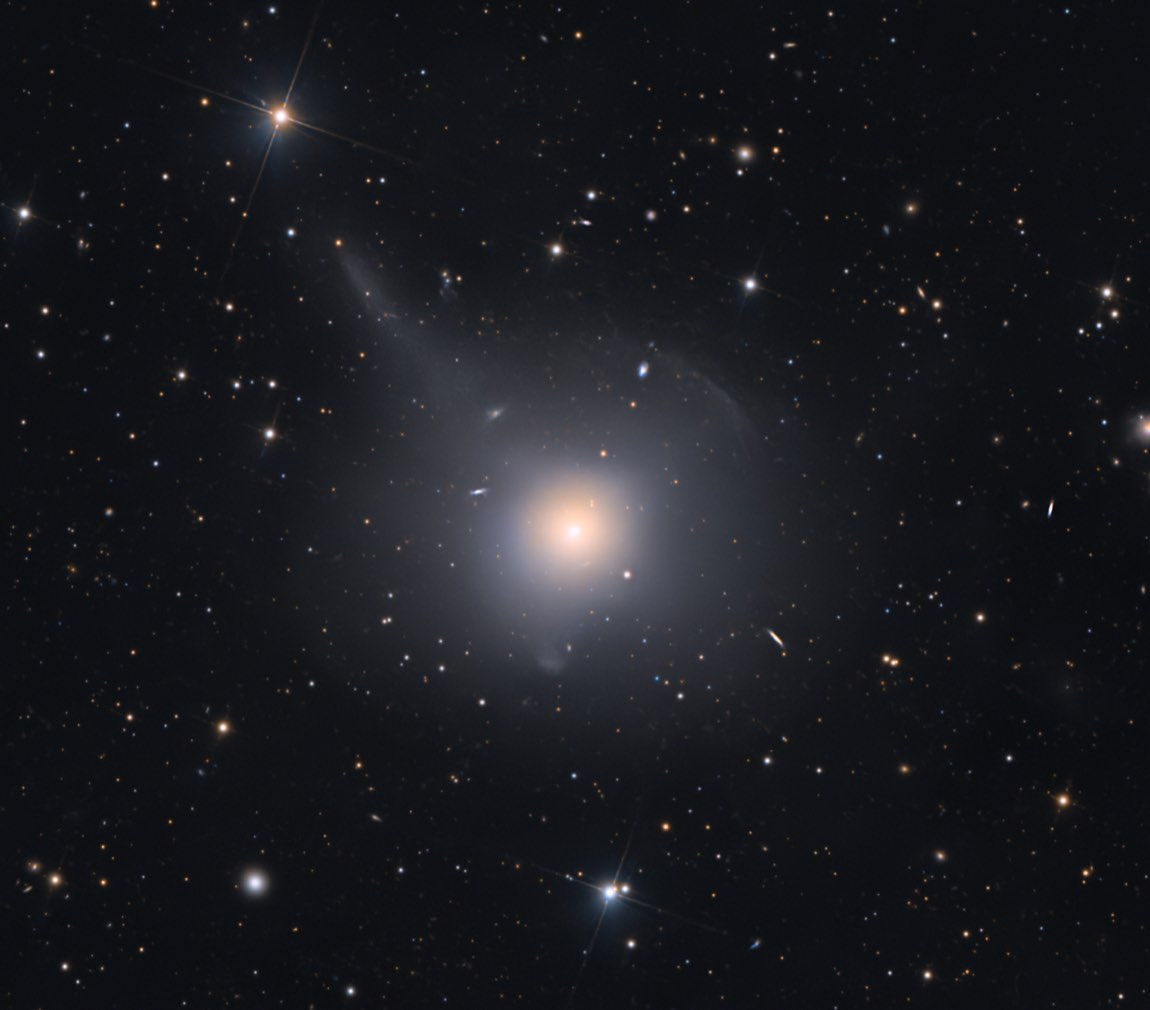
Surrounding M89 is an extensive and complex system of shells and plumes — faint, arc-like wrappings of stars that betray a dramatic history. These structures are the gravitational echoes of one or more significant galaxy mergers. When a smaller galaxy falls into a larger one, its stars do not simply blend smoothly; they slosh back and forth under gravity and settle into concentric shell-like features that can persist for billions of years. The presence of multiple distinct shells and plumes around M89 suggests it has experienced not just one collision but possibly several over its lifetime. These features are most visible in deep imaging and require careful processing to reveal against the galaxy's diffuse outer glow. They serve as a fossil record of M89's growth, showing that the seemingly serene, featureless ball of stars visible in a small telescope is actually the product of a long and turbulent assembly process.
03 Gas jets and a hidden quasar past Deeper
Beyond its stellar shells, M89 is wrapped in a broader structure of gas and dust that extends up to 150,000 light-years from its center — a span wider than the entire Milky Way. Stretching outward from the nucleus, jets of heated particles reach up to two-thirds of that distance, roughly 100,000 light-years. Jets like these are the hallmark of an active galactic nucleus, where a supermassive black hole is vigorously feeding and blasting plasma outward along its rotation axis. Today M89's core is relatively quiet, but the scale of these jets and the surrounding gas envelope are powerful evidence that the galaxy was once an active quasar or radio galaxy — a blazingly luminous object that would have outshone its entire stellar population. The activity has since subsided, leaving behind these extended relics as the only visible testimony to what was once an extraordinarily energetic phase.
 ⤢
04 The supermassive black hole at the core Deeper
At the heart of M89 sits a supermassive black hole with a measured mass of (4.8 ± 0.8) × 10⁸ solar masses — roughly 480 million times the mass of the Sun. To put that in perspective, the black hole at the center of the Milky Way, Sagittarius A*, weighs about 4 million solar masses, making M89's central engine more than a hundred times heavier. Despite this enormous mass, the black hole is currently in a dormant or low-activity state compared to the vigorous past implied by the galaxy's jets and gas envelope. The uncertainty in the mass measurement, plus or minus 0.8 × 10⁸ solar masses, reflects the genuine difficulty of pinning down black hole masses in distant galaxies, where indirect dynamical methods must be applied. Understanding this black hole's current feeding rate and its relationship to the galaxy's past quasar activity is an ongoing area of research.
05 X-ray rings and a recent outburst Deeper
NASA's Chandra X-ray Observatory has revealed two ring-like structures of hot gas glowing in X-rays within M89's nucleus. These rings are interpreted as the expanding shock fronts left behind by an energetic outburst from the galaxy's central region that occurred roughly 1 to 2 million years ago. In cosmic terms that is remarkably recent — early members of the genus Homo were walking the Earth at the time this energy pulse was released. Such outbursts are thought to occur when a black hole briefly resumes accretion, releasing a burst of energy that pushes surrounding gas outward in a bubble or ring. Chandra observations also detected evidence of ram-pressure stripping acting on M89 as it moves through the hot intracluster medium of the Virgo Cluster. This process, where the cluster's diffuse gas sweeps away the galaxy's own gas like wind stripping leaves from a moving car, is gradually altering M89's fuel supply and long-term star-forming potential.
06 Ram-pressure stripping in the Virgo Cluster
M89 is not drifting through empty space — it is plowing through the hot, diffuse gas that fills the Virgo Cluster, the massive group of galaxies of which M89 is a member. As M89 moves through this intracluster medium, the pressure of the surrounding gas acts like a headwind, gradually pushing the galaxy's own gas outward and away from it. This phenomenon, called ram-pressure stripping, has been detected in M89 through Chandra X-ray observations. Over time, stripping can deplete a galaxy of the raw material it needs to form new stars, effectively quenching star formation. For M89, which is already an elliptical galaxy with relatively little ongoing star formation, the stripping reinforces its gas-poor character. The interaction also leaves observable signatures in the distribution of hot gas around the galaxy, providing astronomers with a real-time snapshot of how cluster environments shape and transform their member galaxies.
 ⤢
07 An extraordinary globular cluster system
M89 is surrounded by a remarkable swarm of globular clusters — ancient, densely packed balls of hundreds of thousands of stars that orbit a galaxy like satellites. A survey conducted in 2006 estimated approximately 2,000 ± 700 globular clusters within 25 arcminutes of M89's center. For comparison, the Milky Way is thought to host somewhere between 150 and 200 globular clusters in total, many of which have been individually confirmed. M89's tally is therefore roughly ten times larger than our own galaxy's entire retinue. Rich globular cluster systems are common in large elliptical galaxies, and their numbers often correlate with the total mass of the host galaxy and its merger history. The wide uncertainty range — 700 clusters either way — reflects the genuine challenge of distinguishing faint, distant globular clusters from background galaxies and foreground stars in a deep survey image.
08 Discovery on a single night in 1781
Charles Messier discovered M89 on March 18, 1781, the same remarkably productive observing session during which he also cataloged several other Virgo Cluster members. Messier was primarily a comet hunter, and his famous catalog was originally a practical tool — a list of fuzzy, comet-like objects that could confuse observers and lead them astray. M89, appearing as a small, faint, round smudge in his modest telescope, was exactly the kind of object his catalog was designed to flag and dismiss. It was assigned the number 89 in his catalog, and later independently cataloged as NGC 4552 in John Louis Emil Dreyer's New General Catalogue. The fact that what looked like an unremarkable blur to Messier is now known to harbor a 480-million-solar-mass black hole, ancient merger shells, X-ray rings, and thousands of globular clusters is a testament to how dramatically astronomical technology has transformed our understanding of even the most cataloged objects in the sky.
09 How to find and observe M89
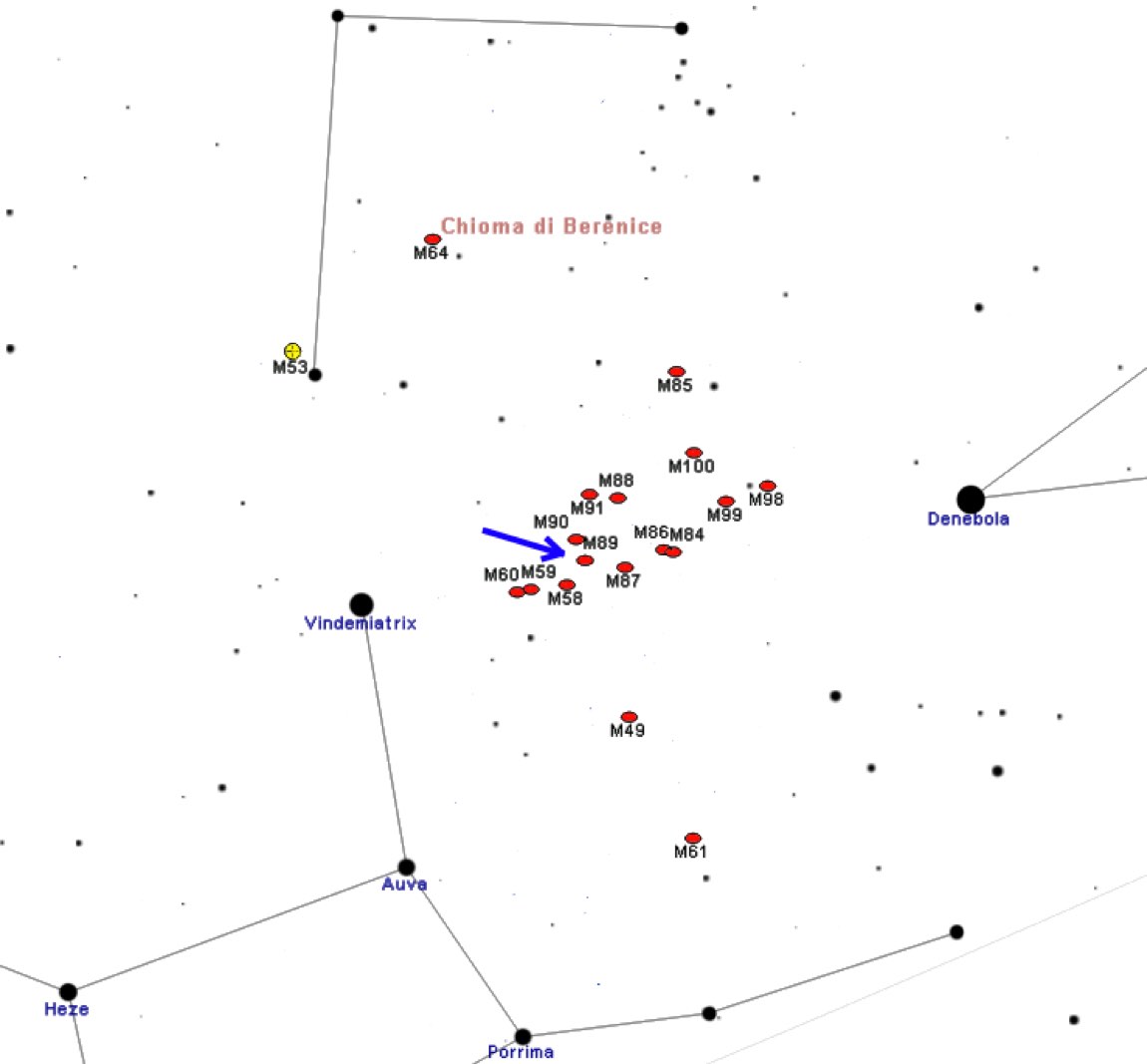
M89 is located in the constellation Virgo and carries an apparent magnitude that places it within reach of amateur telescopes under reasonably dark skies. It sits within the dense heart of the Virgo Cluster, a region packed with galaxies that makes it both rewarding and sometimes confusing to navigate. Because M89 appears nearly circular, it lacks the visual drama of edge-on spiral galaxies or visibly elongated ellipticals, but that very roundness makes it a curiosity worth seeking out. In a small telescope it appears as a compact, slightly concentrated glow. Larger apertures begin to hint at the brighter central region. The surrounding shells, plumes, and gas structures described by research are far too faint for visual observation and require long-exposure astrophotography or professional facilities. M89's membership in the Virgo Cluster means that a single wide field of view can capture it alongside several other Messier objects, making it a natural stop on any tour of that region of sky.
 ⤢
10 What M89 tells us about galaxy evolution Deeper
M89 is a compact case study in almost every major process thought to shape elliptical galaxies over cosmic time. Its shells and plumes document a merger history; its jets and gas envelope record a past quasar phase; its X-ray rings capture an outburst from just 1 to 2 million years ago; its ram-pressure stripping shows real-time interaction with the cluster environment; and its enormous globular cluster population reflects the accumulated mass of its long life. Few single galaxies offer such a layered archive of evolutionary processes simultaneously visible. The open question of whether M89 is truly spherical or merely oriented to appear so also matters theoretically, because the internal dynamics and formation pathways of a genuine sphere differ meaningfully from those of a standard ellipsoid. Taken together, M89 rewards study not because it is extreme in any single property, but because it encodes so many different chapters of galactic history in one object.