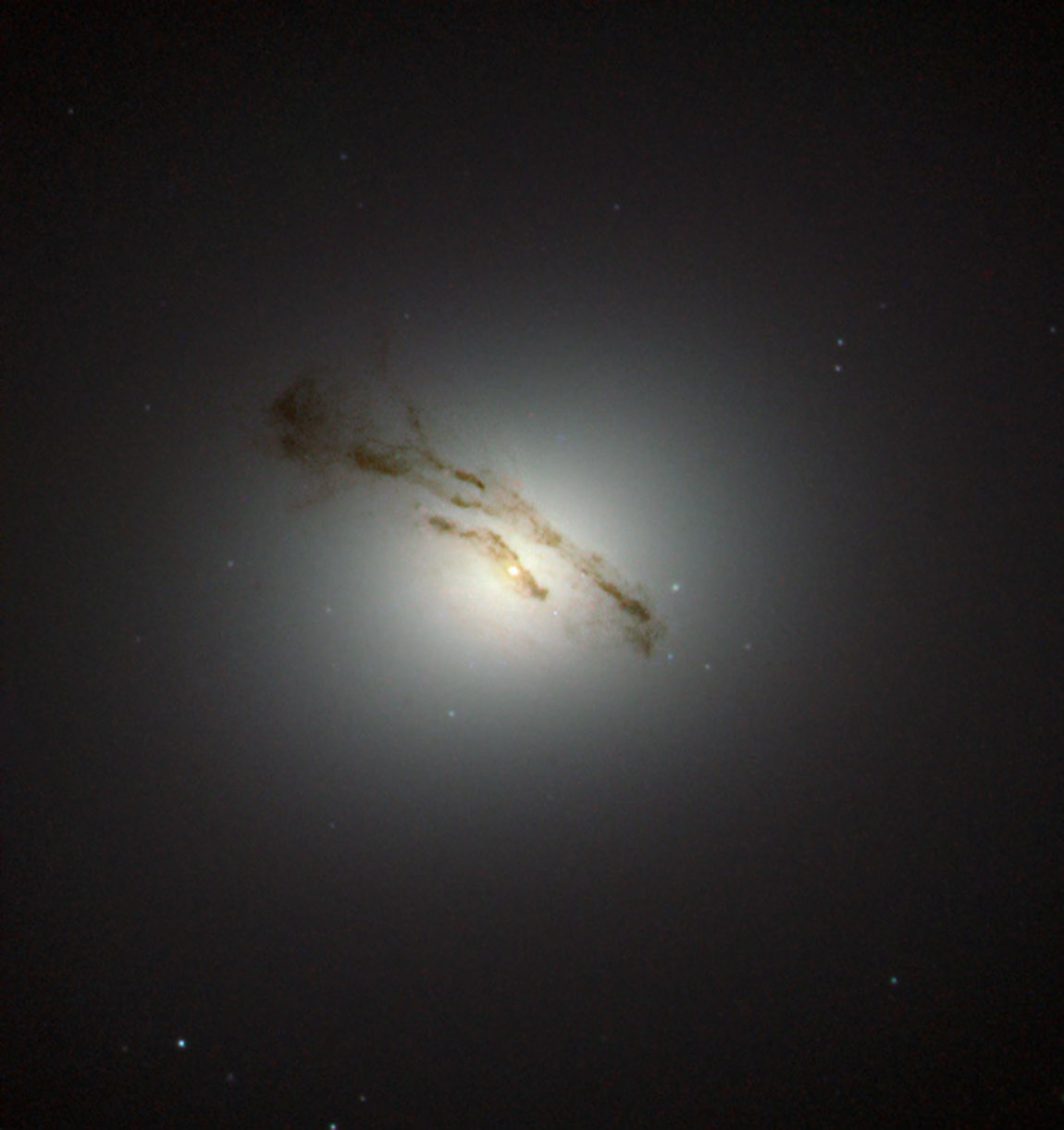
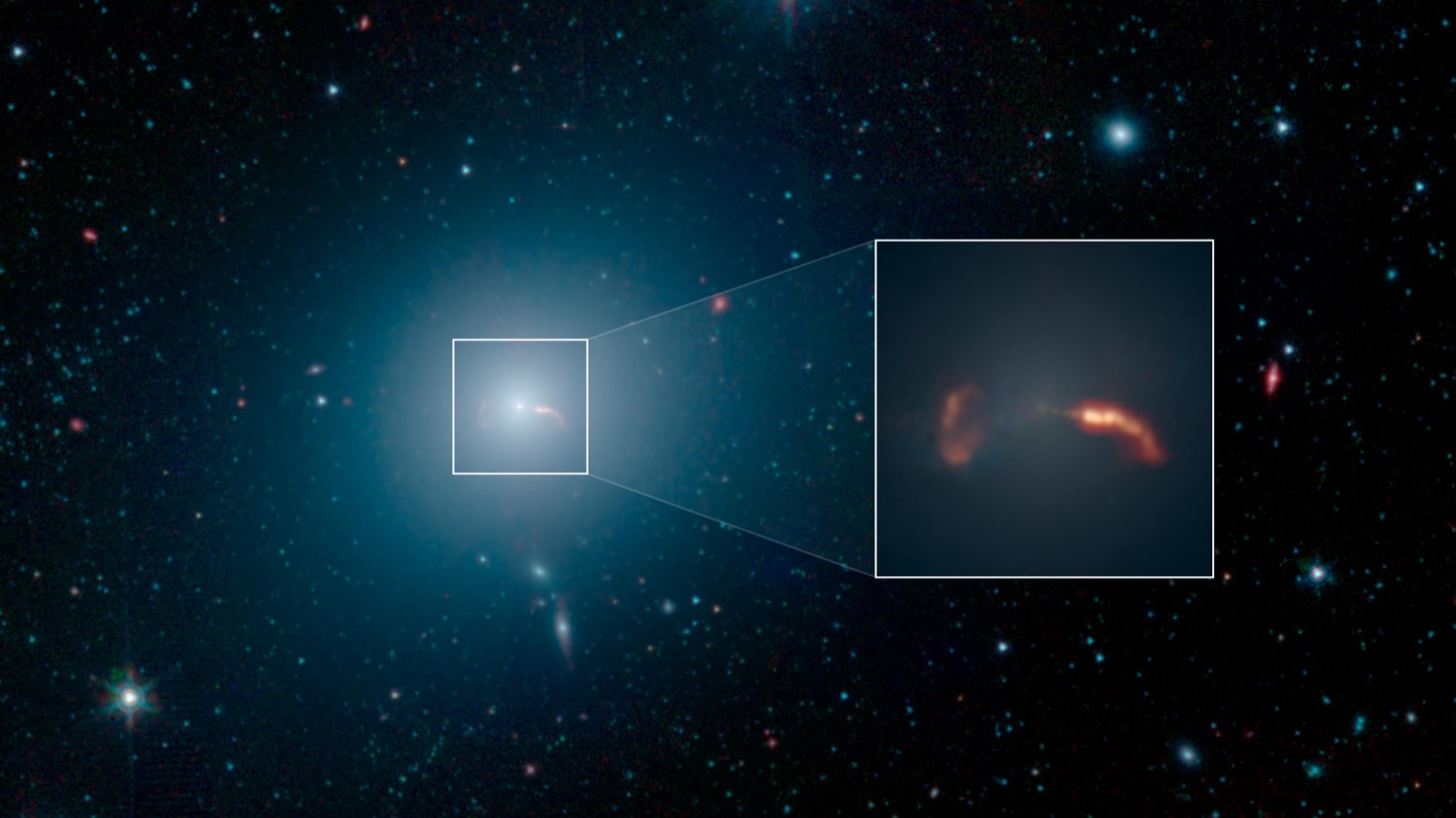
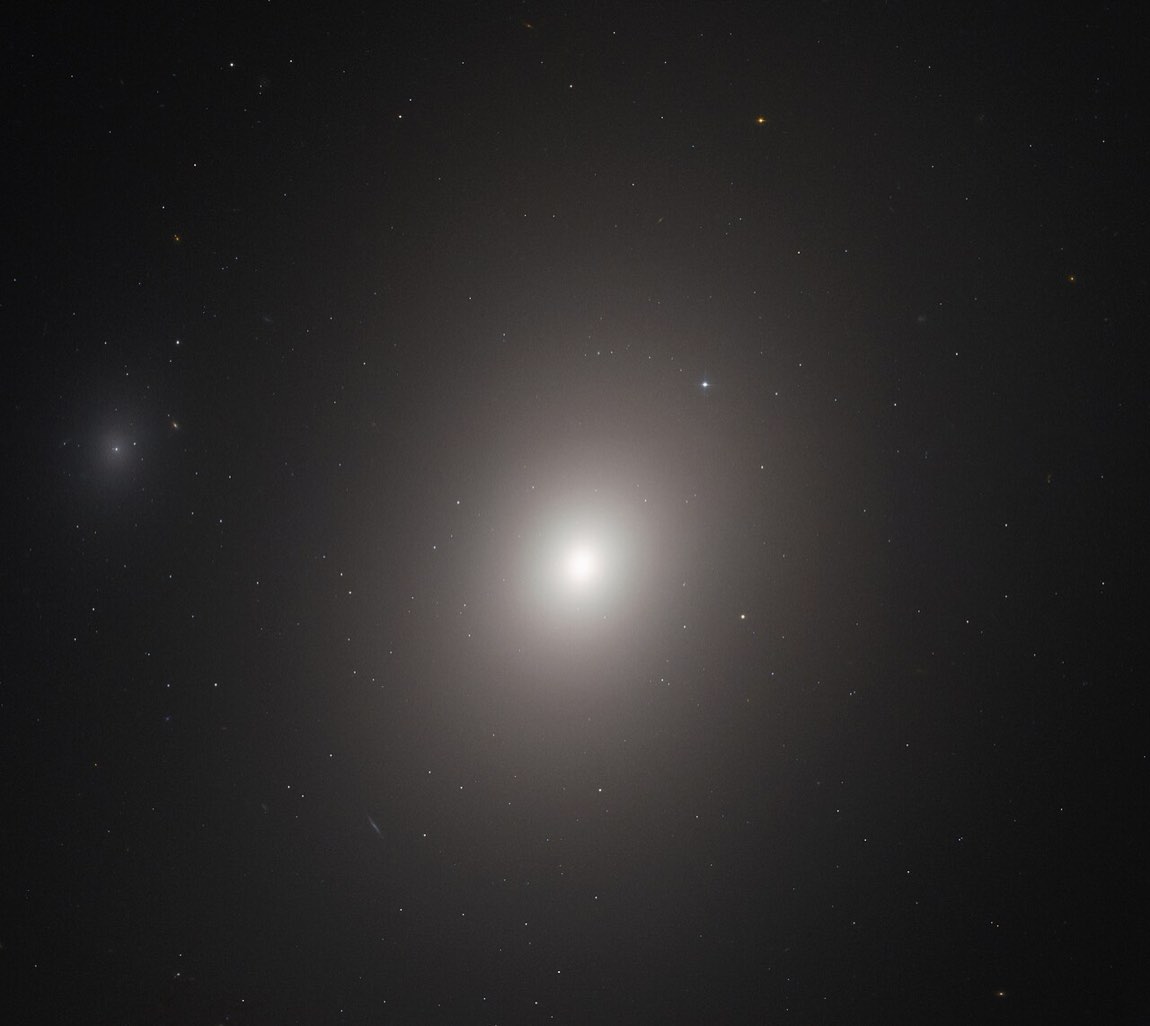
 Photograph · ESA/Hubble & NASA, P. Cote et al. · CC BY 4.0
Galaxy · Deep guide
Messier 86
Also called: M86 · NGC 4406 · UGC 7532 · PGC 40653
A Virgo Cluster galaxy rushing toward us, the biggest blueshift in the Messier catalogue.
What is it?
Messier 86 is an elliptical or lenticular galaxy in the heart of the Virgo Cluster, discovered by Messier in 1781. While the universe's expansion carries most galaxies away from us, M86 is approaching the Milky Way at about 244 km/s, the largest blueshift of any Messier object. That happens because it is falling toward the cluster's centre from the far side. As it plows through the cluster's hot gas, it is being stripped of its own gas, leaving a long X-ray-bright trail. It hosts about 3,800 globular clusters.
The deep dive
Researched for the Atlas from Wikipedia — Messier 86 (1,497 characters read) · updated Nov 15, 2026
01 The highest blueshift in Messier's catalog
Most galaxies appear redshifted — their light stretched toward longer wavelengths as they race away from us in an expanding universe. Messier 86 is a dramatic exception. It displays the highest blueshift of any object in the entire Messier catalog, meaning its light is compressed toward shorter, bluer wavelengths because the galaxy is, net of its other motions, charging toward the Milky Way at 244 km/s — roughly 880,000 kilometers per hour. This does not mean a collision is imminent. The explanation lies in the geometry of the Virgo Cluster: both the Milky Way and M86 are falling toward the dense gravitational heart of that enormous cluster from roughly opposite directions. M86 is simply falling inward from the far side, closing the gap between it and us. Once it swings past the cluster center, it will likely recede again. This peculiar approach velocity makes M86 one of the most memorable objects for anyone learning about galactic dynamics and cosmic motion.
02 A galaxy caught in a cosmic headwind
As M86 plunges through the Virgo Cluster at high speed, it is not moving through empty space — it is pushing through a diffuse hot plasma called the intracluster medium that fills the space between galaxies. The pressure of this medium acting on a moving galaxy is called ram-pressure stripping, and M86 is experiencing it dramatically. Like a hand dragged through water, the galaxy is steadily losing its own interstellar medium — the gas and dust that would otherwise fuel future star formation. The stripped material does not simply vanish. It trails behind M86 as a long plume of extremely hot, X-ray-emitting gas that has been detected by the Chandra space telescope. This glowing tail is direct observational evidence of a galaxy being gradually depleted of its raw materials by the environment it moves through, illustrating how cluster membership can fundamentally alter a galaxy's fate.
03 Filaments of stolen gas from a neighbor Deeper
Ram-pressure stripping from the intracluster medium is not the only way M86 is gaining or redistributing material. The galaxy is linked by several distinct filaments of ionized gas to NGC 4438, a spiral galaxy that has been severely disrupted — most likely through a past gravitational encounter. These filaments suggest that M86 may have actively stripped gas and interstellar dust from NGC 4438, essentially pulling material out of a neighbor during a close passage. NGC 4438's distorted, ravaged appearance is interpreted as evidence of just how violent that interaction was. The ionized gas threading between the two galaxies is a rare visible record of a galactic-scale robbery still written across tens of thousands of light-years of space. Together, the ram-pressure plume and the NGC 4438 filaments paint M86 as a galaxy simultaneously losing its own material while potentially incorporating material torn from another.
04 Stellar streams: the ghosts of swallowed dwarfs
Surrounding the bright core of M86 is an extended halo, and within that halo astronomers have identified a number of stellar streams — thin, arc-like ribbons of stars. These streams are interpreted as the remnants of dwarf galaxies that strayed too close to M86 and were tidally disrupted, their stars stretched out into long trails by gravitational forces before being gradually absorbed. The process is sometimes called galactic cannibalism, and it appears to have been a recurring feature of M86's history. Each stream is effectively a fossil record of a smaller galaxy that no longer exists as a coherent object. Identifying and mapping these streams helps astronomers reconstruct the merger history of large elliptical galaxies, testing theories about how the biggest galaxies in the universe assembled their mass piece by piece over cosmic time.
05 A chemical mismatch inside the galaxy Deeper
One of the more surprising findings about M86 concerns its metal composition. When astronomers examined the abundances of magnesium, silicon, and sulfur within the galaxy, they found that these elements match the broader cosmic average more closely than they match the composition of M86's own stellar population. This is a chemically unexpected result. In a galaxy that has evolved in relative isolation, the interstellar medium and the stars that formed from it should share a broadly similar chemical fingerprint. The discrepancy in M86 implies that even the ongoing ram-pressure stripping is not powerful enough to remove gas from the innermost regions of the galaxy — the core retains material with its own distinct history. The mismatch therefore tells astronomers something important: stripping processes work from the outside in, and the deep interior of a massive elliptical like M86 can preserve a chemical identity that diverges from the surrounding environment.
06 M86 and M84: a conspicuous pairing
In the sky, M86 forms what observers and astronomers describe as a most conspicuous group with Messier 84, another large galaxy. The two are physically located near the dense core of the Virgo Cluster, and in a small telescope or binoculars they appear as a matched pair of glowing ellipses sitting close together on the sky. This region of Virgo is sometimes called Markarian's Chain when the broader string of galaxies extending from M84 and M86 is included. For visual observers, the pairing is one of the most striking examples of a galaxy duo accessible with modest equipment. For researchers, the proximity of two massive ellipticals in the cluster core makes this region an important laboratory for studying how the cluster environment shapes galaxy evolution, gas stripping, and interactions among its most massive members.
07 Discovery and place in Messier's catalog
Charles Messier discovered M86 in 1781 and cataloged it alongside dozens of other nebulous objects he wished to distinguish from comets — the objects he was actually hunting. At the time, the true nature of these smudges of light was entirely unknown; the idea that they might be vast stellar systems comparable to or larger than the Milky Way lay more than a century in the future. M86 is also identified as NGC 4406 in the New General Catalogue, a designation that came later. Its location deep in the Virgo Cluster means it sits in one of the richest regions of the sky for galaxy observing, and its exceptional blueshift — the highest among all Messier objects — gives it a distinctive physical identity within that famous list. Messier likely saw it as an unremarkable oval glow, entirely unaware of the violent dynamics that modern telescopes would eventually reveal.
08 The Chandra telescope's X-ray revelation Deeper
Visible-light images of M86 show a smooth, serene elliptical galaxy with little hint of internal drama. The drama becomes apparent only when the galaxy is observed in X-ray wavelengths. The Chandra space telescope has detected a very long trail of hot, X-ray-emitting gas stretching behind M86 — the direct signature of ram-pressure stripping in action. X-ray astronomy is essential for observing this phenomenon because the stripped intracluster and interstellar gas is heated to temperatures of millions of degrees, far too hot to radiate in visible light but bright at X-ray energies. The Chandra observations effectively made the galaxy's motion through the intracluster medium visible for the first time, turning an abstract physical process into something that could be mapped and measured. Without space-based X-ray observatories capable of the resolution Chandra provides, this tail and the physics it encodes would remain completely hidden.
09 An elliptical with 3,800 globular clusters
M86 hosts a remarkably rich population of globular clusters — dense, ancient balls of stars that orbit a galaxy's halo — with a total estimated number of around 3,800. For comparison, the Milky Way harbors roughly 150 to 160 known globular clusters, making M86's retinue more than twenty times larger. This abundance is consistent with M86's status as a massive elliptical galaxy sitting at the heart of a large cluster: massive ellipticals in dense environments tend to accumulate large globular cluster systems, partly through mergers with smaller galaxies that bring their own clusters along. These ancient stellar systems can be billions of years old and serve as fossil records of early galaxy formation. Studying the ages, metallicities, and spatial distribution of M86's globular clusters helps astronomers trace the assembly history of this galaxy across cosmic time.
10 How to observe M86 from Earth
M86 lies in the constellation Virgo and sits at the heart of the Virgo Cluster, placing it in one of the most galaxy-dense patches of sky accessible to amateur observers in the northern spring. It is classified as a bright elliptical or lenticular galaxy, and its apparent magnitude makes it visible through modest telescopes under reasonably dark skies. The best strategy for finding it is to star-hop toward the cluster core where M86 and its neighbor M84 appear as a close pair. Under good conditions, observers using larger amateur instruments can begin to appreciate the broader chain of Virgo galaxies surrounding them. What binoculars and small telescopes show as a soft oval glow conceals, as this article reveals, a galaxy with an extraordinary blueshift, a Chandra-detected X-ray tail, ionized gas filaments connecting it to NGC 4438, and thousands of orbiting globular clusters — none of which are visible to the eye.