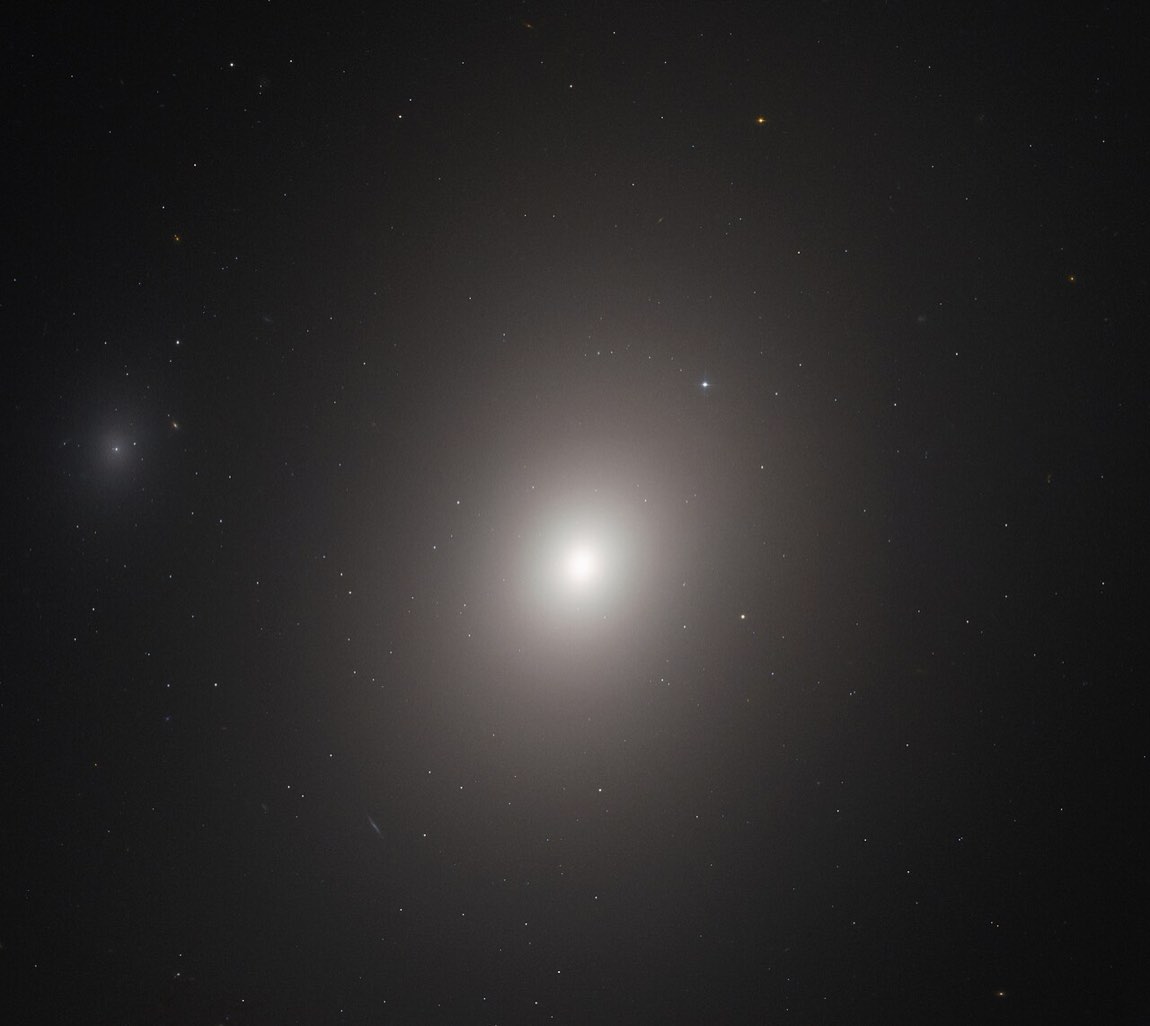
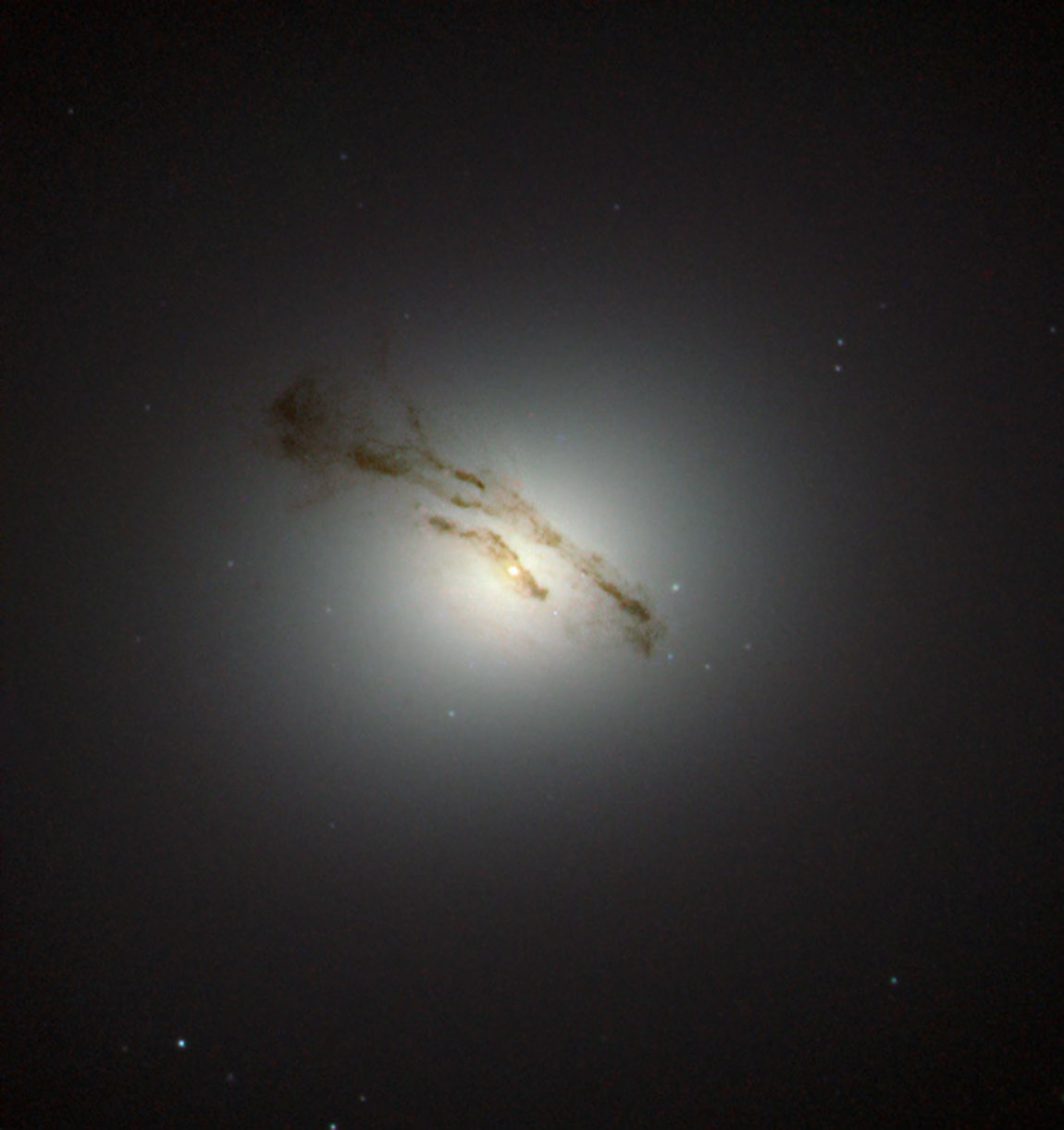
 Photograph · ESA/Hubble & NASA · CC BY 4.0
Galaxy · Deep guide
Messier 84
Also called: M84 · NGC 4374 · UGC 7494 · PGC 40455
A giant galaxy in the crowded core of the Virgo Cluster, firing twin jets from its centre.
What is it?
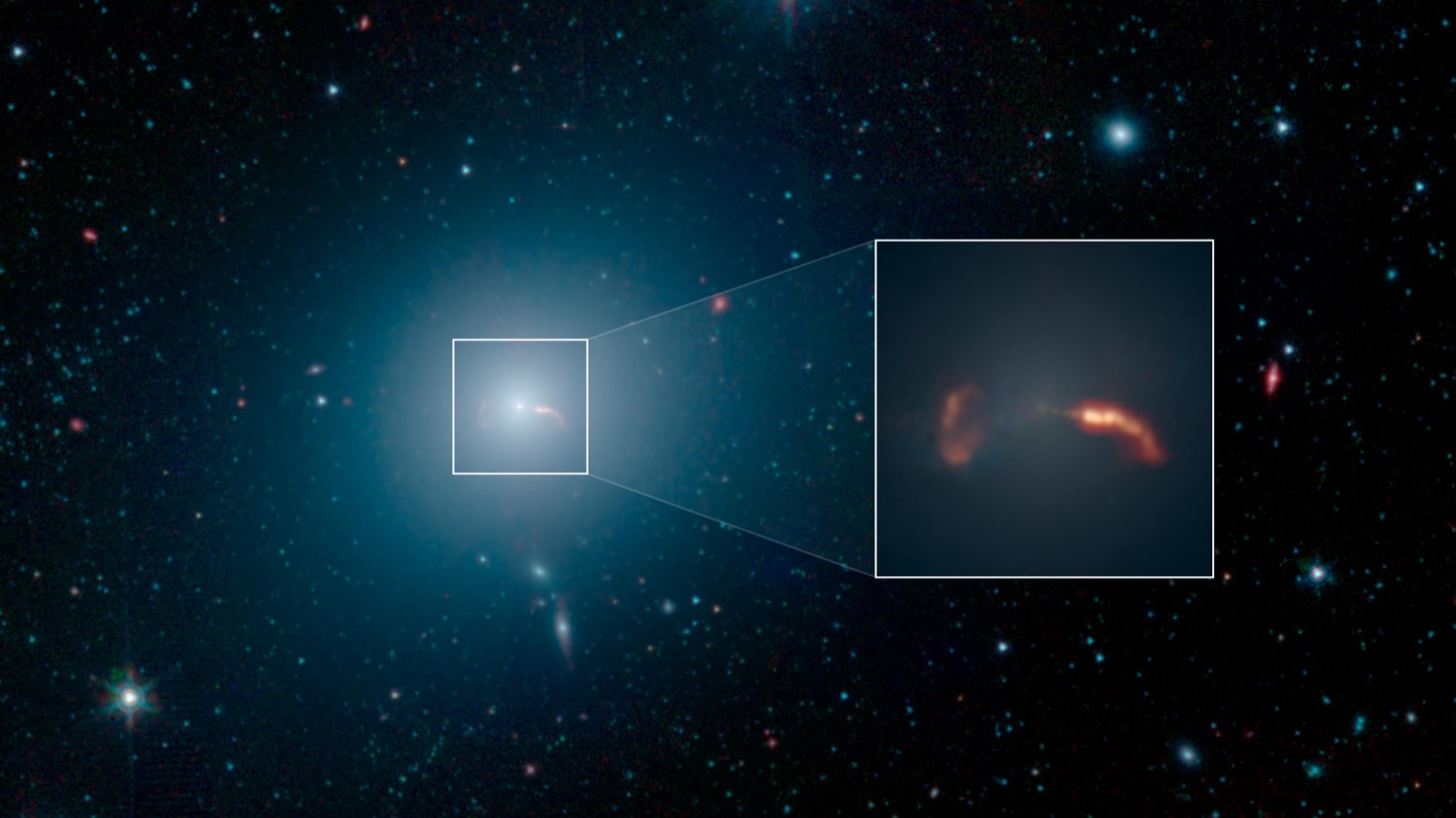
Messier 84 is a giant elliptical or lenticular galaxy deep in the core of the Virgo Cluster, discovered by Messier in 1781. It is almost round, flattened by only about 10 percent. Radio telescopes and Hubble have found two jets shooting out of its centre and a fast-spinning disk of gas, signs of a supermassive black hole. It forms very few new stars. It has around 1,800 globular clusters, fewer than expected for a galaxy of its kind, and sits close on the sky to M86.
The deep dive
Researched for the Atlas from Wikipedia — Messier 84 (2,204 characters read) · updated Nov 15, 2026
01 A Galaxy Caught Between Two Types
M84 sits in an intriguing taxonomic grey zone. Its morphological classification is E1, which formally marks it as an elliptical galaxy with a flattening of about 10% — meaning it is very nearly spherical but not quite perfectly round. Yet astronomers also consider it a possible lenticular galaxy, a category that sits midway between a true elliptical and a spiral, retaining a disk-like structure without prominent spiral arms. This ambiguity matters because the two types have different formation histories and different relationships to the star-forming gas that fills their environments. What is clear is that M84 is genuinely giant: its extinction-corrected total luminosity in the visual band reaches about 7.64×10¹⁰ solar luminosities — roughly seventy-six billion times the light output of our Sun. Its visible stellar body is then wrapped inside a massive dark matter halo that extends well beyond what any optical telescope can directly image, adding enormous unseen mass to the system.
02 The Supermassive Black Hole Inside
At the heart of M84 lurks one of the more precisely measured supermassive black holes known. Radio observations combined with Hubble Space Telescope imaging revealed two jets of matter shooting outward from the galactic center, a classic sign of an active nucleus. More telling still, Hubble detected a disk of gas and stars in rapid rotation right at the core. The speed of that rotation allowed astronomers to calculate the mass of whatever is anchoring it: 1.5×10⁹ solar masses, or one and a half billion times the mass of our Sun. For perspective, the black hole at the center of our own Milky Way, Sagittarius A*, is roughly four million solar masses — meaning M84's central black hole outweighs it by a factor of nearly four hundred. The jets extending from this object are direct evidence that at least some material falling toward the black hole is being redirected and hurled back out into the surrounding galaxy and beyond.
03 How Mass and Light Relate in the Core Deeper
One of the physically informative numbers astronomers use to probe a galaxy's interior is its mass-to-light ratio — essentially how many solar masses of material exist for every unit of solar luminosity emitted. For M84, the central mass-to-light ratio has been measured at 6.5. This figure is higher than you would expect if the core contained only the kinds of stars that dominate the outer parts of the galaxy, suggesting that something dense and dark — most likely the supermassive black hole and its immediate gravitational influence — is contributing mass without contributing proportional light. Crucially, the ratio does not stay constant. It steadily increases with distance from the center, up to a point, meaning the mix of luminous matter and dark or non-luminous matter shifts as you move outward through the galaxy. This kind of gradient is an important clue to how material was assembled during the galaxy's formation and how the dark matter halo connects to the visible stellar body.
04 Three Supernovae in One Galaxy
M84 has hosted three observed supernovae, an unusually high tally for an elliptical galaxy. The first, SN 1957B, was a Type Ia event reaching a peak magnitude of 12.5 — bright enough to be spotted independently by Howard S. Gates on 28 April 1957 and then again by Dr. Giuliano Romano on 18 May 1957. The second, SN 1980I, reached magnitude 14 and was discovered by M. Rosker on 13 June 1980, though its precise host remains uncertain: it may have occurred in neighboring galaxy NGC 4387 or in M86 rather than in M84 itself. The third and scientifically most influential was SN 1991bg, found visually by Reiki Kushida on 9 December 1991 at magnitude 14, with a precovery image showing it had already reached magnitude 14.9 by 3 December. SN 1991bg turned out to be peculiar and unusually faint for its class, and it is now used as a defining template: similar events worldwide are classified as Type Ia-91bg-like supernovae in its honor.
05 Why SN 1991bg Changed Supernova Science Deeper
Type Ia supernovae are prized in cosmology because they were long assumed to be reliable standard candles — explosions of such consistent brightness that their apparent faintness directly reveals their distance. SN 1991bg complicated that picture. It was a Type Ia in classification but was noticeably underluminous compared to the typical member of that category, earning the designation Type Ia-pec, for peculiar. Its discovery in M84 and the extensive study that followed showed that not all Type Ia supernovae are identical, and that a subluminous population exists which could mislead distance measurements if not identified and treated separately. The event was studied so thoroughly that it became the defining example of its own subclass. Today, when observers anywhere in the world find a similarly dim and fast-evolving Type Ia, they classify it as 91bg-like, with the galaxy M84 therefore leaving a permanent mark on the vocabulary and methodology of observational cosmology.
06 What Three Supernovae Tell Us About the Stars
Elliptical galaxies are generally considered stellar graveyards — systems where the gas for making new stars ran out long ago, leaving behind a population of old, red stars. Old stellar populations produce very few Type Ia supernovae because those explosions require a specific evolutionary pathway that takes time to run its course, but not so much time that the progenitor stars have all died. The fact that M84 has produced three observed supernovae, at a rate considered high for its galaxy type, is therefore scientifically puzzling and informative. Astronomers suggest this elevated rate may indicate that M84 contains a population of intermediate-age stars — not ancient by galactic standards, but not freshly formed either. This matches other evidence in the galaxy: M84 also hosts a few young stars and star clusters, confirming that star formation has not entirely ceased, even if it proceeds at a very low rate today.
07 A Surprising Deficit of Globular Clusters Deeper
Globular clusters — ancient, densely packed balls of hundreds of thousands of stars — are found in abundance around large elliptical galaxies. The number associated with a galaxy tends to scale with the galaxy's total mass and luminosity, and for a giant like M84 the expectation would be a correspondingly large system of these clusters. The measured count, however, comes in at only 1,775±150 globular clusters, a figure described in the literature as much lower than expected for an elliptical galaxy of M84's size. This deficit is an open question. It may reflect something unusual about how M84 formed — perhaps it grew through a different balance of mergers and accretion than typical ellipticals of similar mass — or it may point to processes that have stripped or destroyed clusters over cosmic time. The uncertainty in the count, ±150, reflects the genuine challenge of separating M84's clusters from background objects in a region of sky as crowded as the Virgo Cluster core.
08 M84's Place in the Virgo Cluster
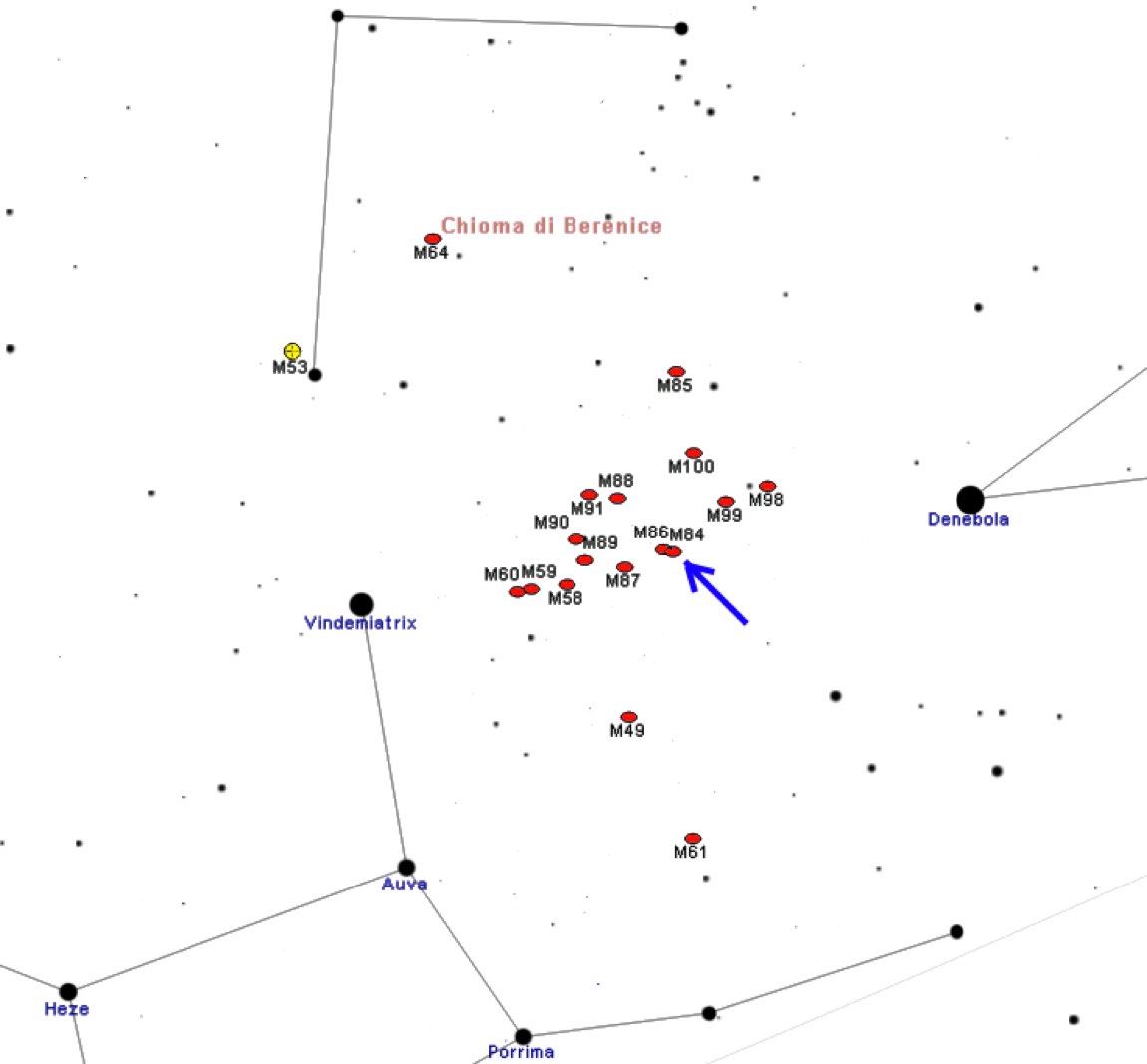
M84 does not drift through empty space. It sits inside the heavily populated core of the Virgo Cluster, one of the nearest large galaxy clusters to the Milky Way and the gravitational anchor of the broader local supercluster. The Virgo Cluster core is an exceptionally crowded region of the universe, packed with hundreds of galaxies in close gravitational proximity, which is why the ownership of SN 1980I is disputed — in that environment, supernovae in neighboring galaxies like NGC 4387 and M86 can appear projected very close to M84 in the sky. Being embedded in such a rich cluster environment also influences M84's evolution directly: cluster membership exposes a galaxy to ram-pressure stripping of gas, tidal interactions with neighbors, and a constant supply of potential merger partners, all of which shape the star formation history and structure that observers measure today.
09 Discovering M84: Messier's 1781 Survey
Charles Messier catalogued M84 in 1781 during a systematic search for objects that might be mistaken for comets — the great practical hazard for comet hunters of his era. Fuzzy, non-moving smudges of light could fool an observer into thinking they had found a new comet, so Messier compiled a reference list of known nebulous objects to avoid false alarms. M84 became the 84th entry in that catalogue. In Messier's time there was no way to know whether such objects were clouds of gas within the Milky Way or entire separate stellar systems at unimaginable distances. The true nature of galaxies like M84 — island universes of hundreds of billions of stars — would not be established until the twentieth century. What began as a practical tool for comet hunters thus became one of the most enduring and widely used catalogues in amateur and professional astronomy alike.
10 How to Find and Observe M84
M84 resides in the constellation Virgo, which gives northern hemisphere observers their best viewing window in spring evenings. Its apparent magnitude makes it accessible through a modest amateur telescope, and its half-light radius — the angular size enclosing half its total light — is 72.5 arcseconds, just over one arcminute. That angular size means it appears as a small but noticeably extended glow rather than a point of light, distinguishable from stars even at moderate magnification. What makes the viewing particularly rewarding is M84's location deep in the Virgo Cluster core, a region so dense with galaxies that experienced observers can sweep through dozens of them in a single evening. M84 itself appears close in the sky to M86, another giant galaxy, and the two are often framed together in the same wide-field view, offering a striking visual demonstration of how packed the cluster's heart truly is.
11 Jets, Disks, and the Active Nucleus Deeper
The twin jets emanating from M84's center are among the clearest evidence that its supermassive black hole is not entirely dormant. In active galactic nuclei, jets form when magnetic fields thread infalling material and redirect a fraction of it outward at high velocity, perpendicular to the accretion disk. Radio observations were the first to reveal M84's jets because such structures radiate strongly at radio wavelengths as charged particles spiral through magnetic fields. The Hubble Space Telescope added the complementary view: a disk of gas and stars in rapid rotation at the very center, the kinematic signature that allowed the black hole mass of 1.5×10⁹ solar masses to be pinned down. Together, the jets and the rotating disk paint a consistent picture of a galaxy that experienced a more energetically active past and retains a central engine capable of renewed activity, should fresh material fall within the black hole's gravitational reach.
 ⤢